
Frame and Plume
STRUCTURE-PURPOSE PAIR — *Frame names the shape. Plume names the voice. A reader who has both can see the passage whole.*
Press play to listen along. The line being read lights up as you go.
Show full transcript
Loading transcript…
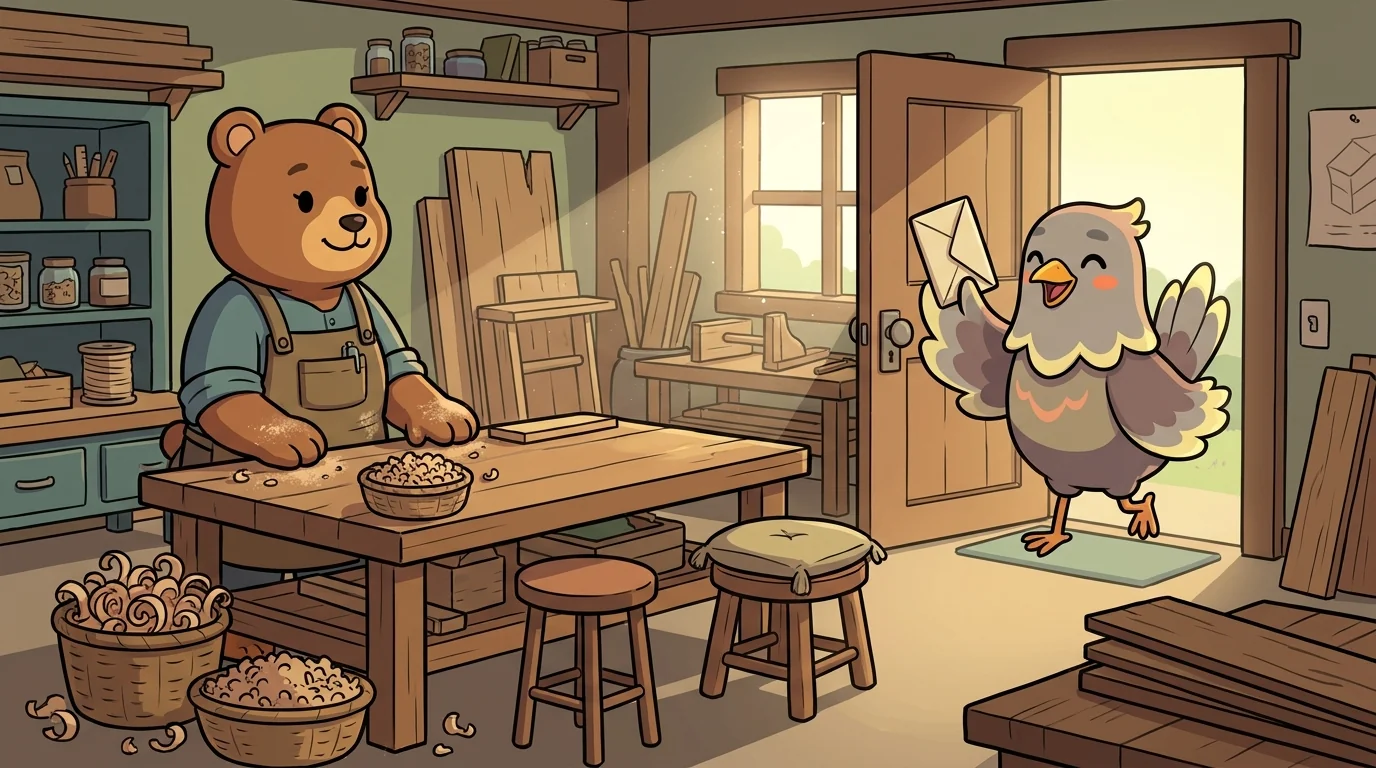
A soft, persistent quiet settled over Frame’s workshop that morning, broken only by the rustle of her paws sifting through wood shavings. She meticulously separated the delicate, feathery curls of pine from the coarser, shorter fragments of oak, each type destined for its own woven basket. Frame found a profound satisfaction in this pre-construction ritual. It was a way to clear her mind, preparing the space for the precise work ahead.
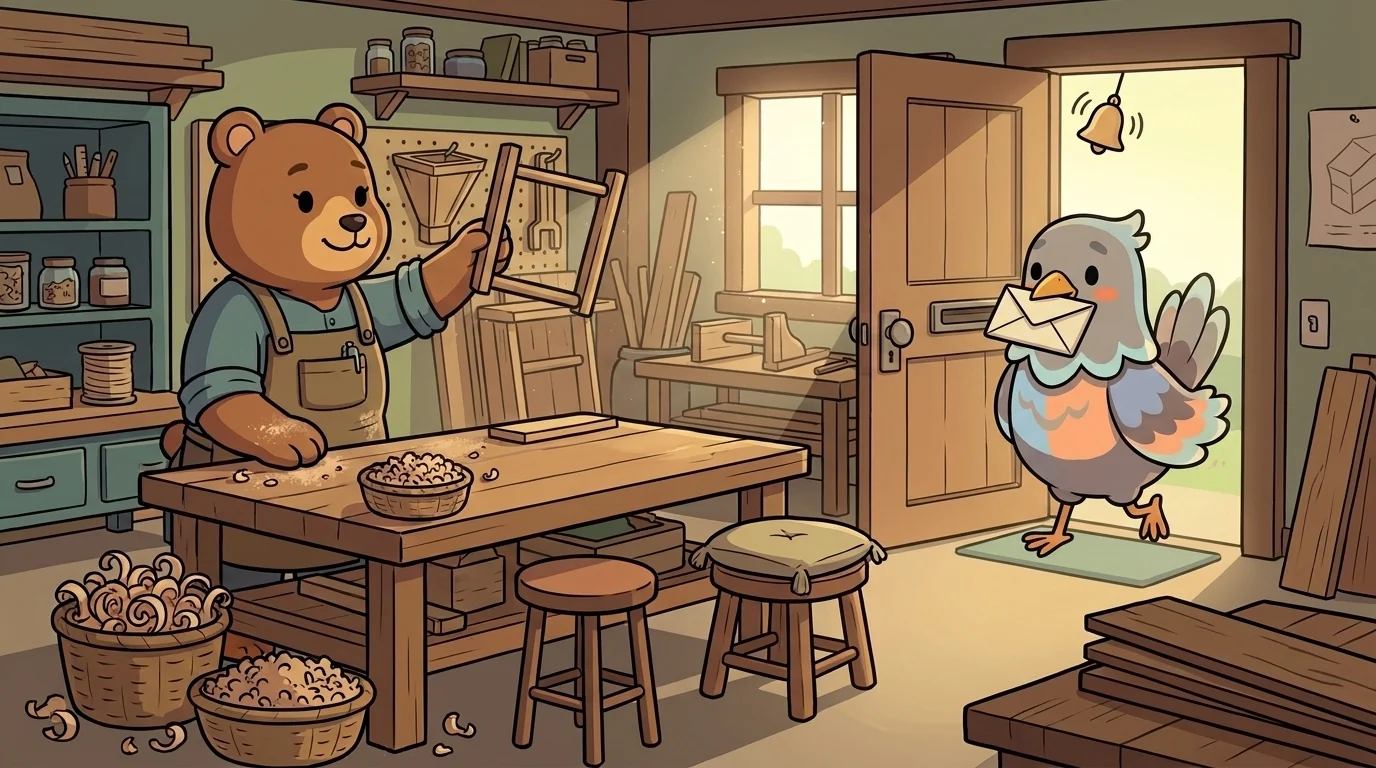
Three gentle, rhythmic knocks sounded at the workshop door, pulling Frame’s attention from her task. She glanced toward the window, catching a fleeting, vibrant shimmer of color. An iridescent green dissolved into sapphire, then softened to a pale, luminous gold.
“Plume,” Frame murmured, a small smile touching her lips.
The door swung inward, revealing Plume. Her plumage that day displayed a subtle, muted gray, edged with faint saffron highlights. This particular shade, Frame knew, was Plume’s listening color, a neutral canvas she wore before immersing herself in a text. It signified an open, receptive state, awaiting the passage’s true voice.
“I brought something,” Plume announced, holding aloft a thick, cream-colored envelope. Its heft suggested more than a casual note. “A passage arrived in the mail, from one of our students. They specifically asked for us to read it together.”
Frame brushed the fine layer of sawdust from her paws. She then pulled a tall, sturdy stool to her workbench, its surface scarred with the history of countless projects. Plume, with a graceful hop, settled onto a wider stool nearby, designed to accommodate the elegant sweep of her tail feathers. She carefully slid the single sheet of paper from the envelope, placing the passage between them on the smooth, worn wood.
The passage was concise, barely a paragraph in length.
> Last summer, the neighborhood pond turned green and stinky. Kids couldn't swim. Frogs left. The cause was something called algae bloom. It happens when fertilizer from lawns washes into water. The fix is simple. Plant a strip of tall grass between lawns and the pond. The grass catches the fertilizer before it reaches the water. By the end of summer, the pond was clear again.
Frame read the words silently, her eyes tracing each line. Then, without a word, she read it a second time, letting the details sink in. She tapped the workbench once, a soft, deliberate sound. It signaled her mind was beginning to grasp the underlying structure, to sense the particular architecture of the text.
“This one presents an interesting challenge,” she observed, her gaze still fixed on the paper.
Plume tilted her head, a thoughtful gesture. Her subtle gray plumage began to shift, slowly deepening into a curious, vibrant green, a hue that reflected her burgeoning interest.
“Let’s read it aloud together,” Frame suggested. “Afterward, we can identify its two distinct halves.”
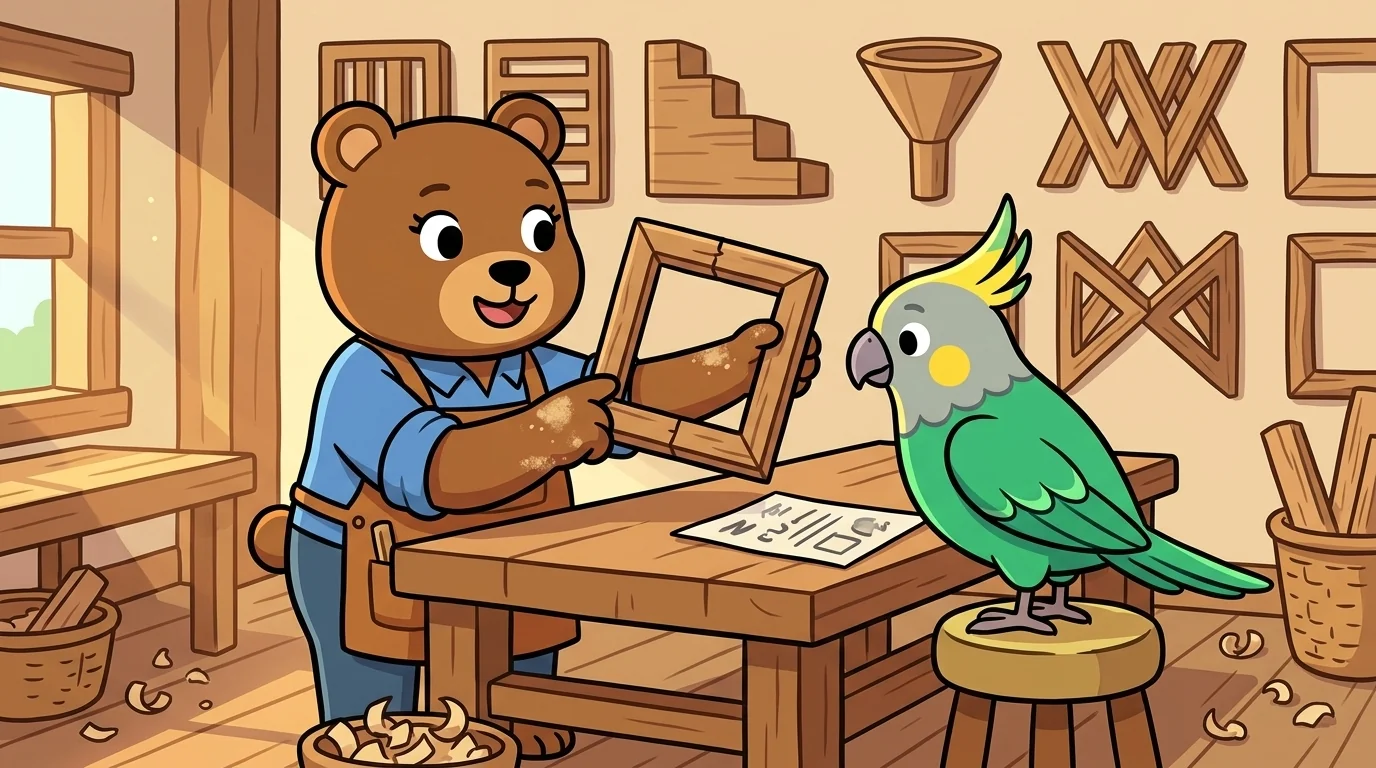
Frame gracefully slid off her stool, her movements fluid and purposeful. She crossed the workshop to a towering wall, meticulously organized with an array of wooden frames. Her paw glided along the smooth surfaces, brushing past the distinct forms. There were the rigid Parallel-bars, the ascending Staircase, the tapering Funnel, the mended Broken-fixed, and the ever-expanding Expanding. Each shape represented a fundamental way a story or idea could be structured.
“This passage clearly presents a challenge,” Frame explained, her voice steady. “And then it offers a resolution. The pond deteriorated, then someone devised a solution. So the inherent *shape* of this passage is —” She carefully lifted down the Broken-fixed frame, holding it aloft. “— this one.”
The Broken-fixed frame was crafted from two pieces of wood, unmistakably snapped apart at some point. Frame had meticulously glued the break back together, but the faint, silvery seam remained visible, a testament to its past fracture. The wood was whole once more, yet its history of breakage was permanently etched into its surface.
“Broken-fixed,” she reiterated, her paw tracing the visible mend. “We also call this structure *problem-solution*. The first half delineates the trouble, the obstacle encountered. The second half articulates the remedy, the effective answer.” She held the wooden frame beside the student’s paper. The fractured side of the frame perfectly aligned with the passage’s initial description. This included the green, stagnant pond, the absent swimmers, and the departed frogs. The mended side, in turn, mirrored the solution: planting grass, the pond’s eventual clarity.
Plume observed intently, her plumage shifting from its soft green to a brighter, more focused emerald, reflecting her deep concentration. “That’s remarkably clear,” she stated. “Once you visualize the frame, the underlying structure becomes instantly apparent.”
Frame nodded, acknowledging Plume’s insight. “Without the frame, the passage might simply feel like a collection of words. But with the frame, you can truly discern the writer’s deliberate construction. They composed this passage using a recognized pattern. They intended for you to recognize: here is something that went wrong, and here is precisely how it was made better.”
She carefully placed the Broken-fixed frame onto the workbench, directly over the passage. This ensured the two wooden halves precisely corresponded with the two textual sections. “The shape is named. That concludes my contribution.” She tapped the bench once, a quiet punctuation mark. “Now, it’s your turn.”
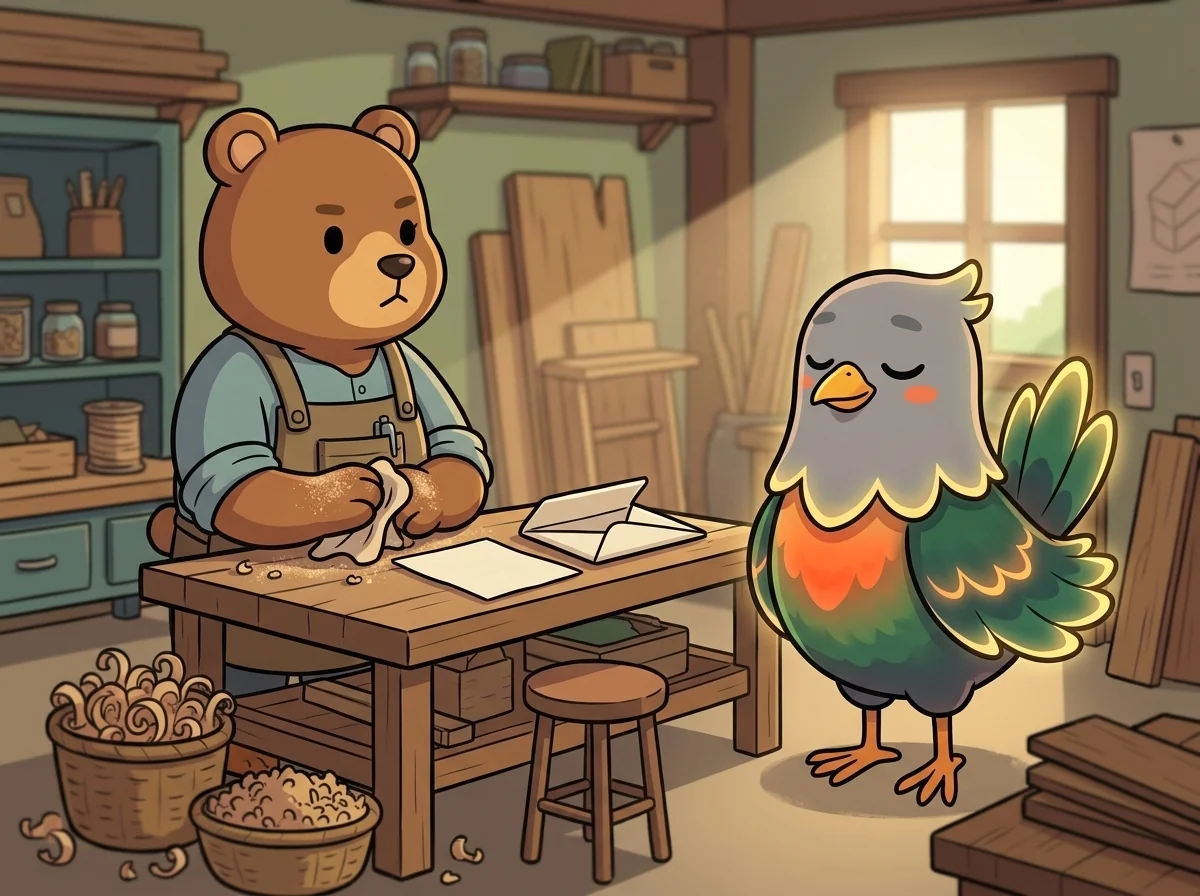
Plume gracefully descended from her stool, her plumage already beginning its subtle, anticipatory transformation.
Plume positioned herself beside the workbench, her posture poised and reflective. She closed her eyes for a brief moment, a small, private ritual she always observed before articulating a passage’s underlying purpose. It was her equivalent to Frame’s decisive bench-tap, a silent preparation for the intricate work of discernment.
“Purpose,” Plume stated softly, her voice barely a whisper.
As she spoke, her plumage began its intricate transformation, not a sudden burst, but a gradual, deliberate shift. The green deepened, growing richer, while delicate gold highlights emerged along the tips of her feathers. A faint, warm flush of orange diffused through her chest, like a sunrise spreading across a quiet sky.
“This isn’t informing,” Plume mused, her eyes still closed, her voice thoughtful. “Informing is typically dry, purely factual. It’s neutral, and it would call for my palest gray. This passage feels different.”
She began to pace slowly around the workbench, her steps measured. “Nor is it entertaining. Entertaining passages are bright, often playful. They demand my most vibrant yellow, perhaps with playful flicks of red. This isn’t that kind of energy either.”
Frame watched, a quiet appreciation in her gaze. She admired Plume’s unique methodology, her careful process of elimination. This often revealed the truth by first discarding what it was not.
“This passage desires a specific outcome,” Plume continued, her voice gaining a subtle conviction. “It wants the reader to act in some way, or at least to consider action. It aims for the reader to conclude: Oh, that approach worked. Perhaps we could implement something similar in our own community.” She tilted her head slightly. “This is a form of *persuasion*. Yet, it’s a gentle persuasion, not forceful or alarming. The author isn’t shouting demands or instilling fear. Instead, they present a concise success story, trusting the reader to discern the inherent lesson.”
Her plumage settled into its final, resonant hue: a deep, gold-edged green, radiating warmth, stability, and a quiet sense of hope. It was the color of conviction, of yes, this approach is effective.
“Purpose: to persuade. Tone: hopeful, calm, and grounded in fact,” Plume declared, finally opening her eyes. “That concludes my contribution.”
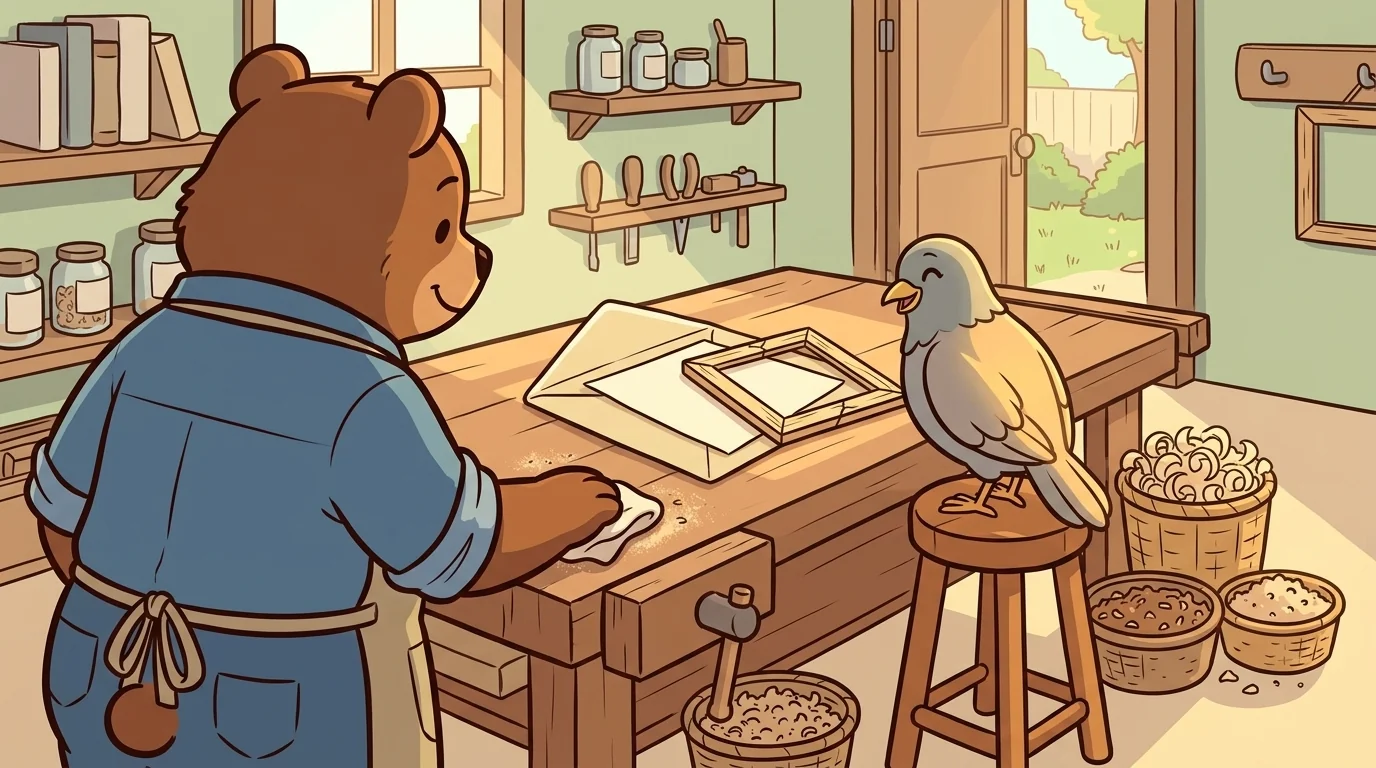
She offered a small nod to Frame. “But your initial identification of the shape was crucial. The shape provided the framework that allowed me to truly hear the voice.”
Frame nodded in return. “And your discerning voice, in turn, confirms the shape. A persuasive passage almost invariably adopts a problem-solution framework. The shape and the voice align perfectly, revealing the writer’s intentional design for both elements.”
A quiet understanding settled between them at the workbench. The mended Broken-fixed frame lay across the student’s passage, a tangible representation of its structure. Plume’s plumage, still glowing with its soft, warm gold, pulsed gently beside it. Morning sunlight streamed through the workshop window, painting shifting patterns on the wooden floor. A faint breeze stirred the neatly sorted wood-shaving baskets.
“This is precisely why our collaboration is so essential,” Frame observed, her gaze sweeping over their shared workspace.
Plume readily agreed. “A reader who perceives only the shape, without recognizing the voice, interprets a passage merely as a diagram. They might understand the type of passage, but they fail to grasp the writer’s true intention. Such a reader might scan this paragraph and simply shrug, thinking, Yes, a pond was fixed. They would entirely miss the subtle persuasion.”
Frame carefully picked up the Broken-fixed frame, turning it gently in her paws. “Conversely, a reader who hears only the voice, without discerning the underlying shape, experiences a passage primarily as a mood. They might feel hopeful, they might feel persuaded. But they wouldn’t consciously register the writer’s deliberate choice of a problem-solution structure. They could read this paragraph and feel good, yet struggle to articulate why it works to another person.”
“Shape and voice,” Plume affirmed, her gaze meeting Frame’s.
“Frame and Plume,” Frame responded, a quiet echo.
This exchange was their own small, cherished tradition. Whenever a passage had been fully analyzed and understood, they would speak these two pairs of words together, always in the same sequence. Shape first, then voice. Frame’s name first, then Plume’s. It was their unique way of sealing the work, a quiet acknowledgment of their complementary expertise.
Frame gently slid the passage back into its envelope, then returned the Broken-fixed frame to its designated hook on the wall. Plume’s vibrant plumage gradually softened, easing back toward a neutral, pale gray. The passage had been thoroughly read, its voice precisely named. Plume no longer needed to maintain that particular expressive color.
“What message should we send back to the student?” Plume inquired, her voice thoughtful.
Frame paused, considering her words carefully. “We should tell them this: you have encountered a *problem-solution passage. The writer intended to persuade* you, gently, by sharing a small, relatable success story. Now you possess the ability to perceive both its fundamental halves. These include the precise shape the writer meticulously constructed, and the distinct voice they deliberately employed. Both of these are conscious choices. The writer made them on purpose, and you, too, can master these choices when you craft your own compelling passages.”
Plume nodded, a genuine appreciation in her eyes. “Shape and voice.”
“Shape and voice,” Frame echoed, a sense of quiet accomplishment in her tone.
A clear, resonant chime from the front room’s workshop bell announced another arrival. Through the mail slot, a fresh envelope had been slipped. Two more passages awaited their attention. The morning, it seemed, was only just beginning its intricate unfolding.
Plume gracefully hopped down from the workbench, moving toward the front room to retrieve the new envelope. Her plumage flickered briefly through a rapid, almost iridescent cycle. It showed gray, then a flash of pale blue, a hint of soft orange, before settling back to gray. She instinctively sampled the potential tones the next passage might demand.
Frame remained at the workbench, rolling up her sleeves with a renewed sense of purpose. She reached for the wall, pulling down two more frames, holding them ready. The tapering Funnel, in case the new text explored cause-and-effect. The rigid Parallel-bars, prepared for a compare-and-contrast structure.
The two of them—the meticulous carpenter and the perceptive peacock-reader, the steadfast wood-and-glue and the ever-shifting feathers, the concrete shape and the resonant voice—prepared themselves for the day’s unfolding challenges.
Whoever had crafted that simple pond passage had, with intention, planned both its halves. Frame had discerned the shape. Plume had interpreted the voice. Together, they possessed the unique ability to illuminate for any student precisely how an entire passage cohered.
This was the essence of their work. Frame articulated what the writer had meticulously built. Plume revealed how the writer had chosen to sound. And the reader, guided by their insights, walked away with a profound understanding of both.
The ReadQuest ensemble
Frame and Plume is part of ReadQuest's distributed-narrative cast. Each character embodies a different curricular primitive; together they teach the full subject.
-

Crest
Main idea / central message (the *peak* of the passage)
-

Hunch
Inference (reading between the lines)
-

Anchor
Evidence / textual citation
-

Plume
Author's purpose / voice / tone
-

Frame
Text structure (compare-contrast, sequence, cause-effect, problem-solution, description)
-

Pith
Vocabulary in context (deriving word meaning from surrounding text)
-

Yonder
Predicting — alert young-hare creature who reads the trail's clues to guess what's around the bend; a wrong guess just means the story surprised you
-

Vista
Visualizing — dreamy young-deer creature who turns words into a movie in the mind; the writer gives the words, the reader gives the pictures
-

Nettle
Questioning the text — question-quilled hedgehog who pokes a passage with why/how/what-if; asking questions means you're awake, not that you don't understand
-

Sheaf
Summarizing — warm-handed harvester who gathers a whole passage into one tidy armful, keeping the important middle and letting loose details fall