
Zeph
ZERO PLACEHOLDER — zero's load-bearing role in positional notation. The difference between 7, 70, 700, 7000 is the zero holding the lower positions empty.
Press play to listen along. The line being read lights up as you go.
Show full transcript
Loading transcript…

Zeph grew up next door to Tenfold. Their houses stood side-by-side on the western edge of Decimal, separated by a narrow, sun-drenched garden path. This proximity, in retrospect, shaped much of Zeph’s early life. The two girls, Tenfold (whose given name was Dec) and Zeph (whose given name was, simply, Zeph; her parents had liked the sound), were the same age. They walked to school together, sat through lessons side-by-side, and walked home again, often in comfortable silence. Each girl watched the other’s family through open windows at suppers and on holidays, observing the distinct rhythms of their lives.
The two families could not have been more different.
Tenfold’s family was a vibrant, sprawling entity, a constant hum of activity and sound. Her parents talked over each other at supper, their voices overlapping like a lively chorus. Her three older brothers wrestled in the parlor, their shouts echoing through the house. Her two younger sisters ran through the garden at all hours, their bare feet thudding on the grass. The house was always full of motion, a symphony of shouts and laughter, never truly quiet.
Zeph’s family, by contrast, was a study in quietude. There were six of them: Zeph, her two older brothers, her two older sisters, and her mother. Her father had been a sailor, lost in a storm when Zeph was three. The family did not, in Zeph’s lifetime, talk about him much. Her older brothers were busy with their studies and chores, moving with a focused intensity. Her older sisters were busier still, their days filled with lessons, needlework, and helping their mother. Zeph’s mother managed everything from a small, worn chair by the kitchen window, her movements precise and economical. Zeph was the youngest, the smallest, and the quietest of them all.
She was, even by her family’s hushed standards, exceptionally quiet.
She rarely spoke at supper, listening instead to the soft clinking of forks and the occasional murmured conversation. She rarely interrupted, waiting patiently for a pause that often never came. She rarely asked for things, preferring to fetch them herself or do without. When her older siblings argued about who had to clear the table, Zeph simply rose and cleared it. When they debated who had said what to whom on which day, Zeph slipped outside to the garden and pulled weeds, her hands moving with quiet purpose.

She was, her family eventually realized, the *placeholder*. She was the quiet space between the louder children, a silent anchor in their bustling lives. She held the family together by being where the noise was not, a still point around which their busy lives revolved.
When she was eight, a question began to bother her, a persistent itch in her mind. She decided to ask the family scholar, a friendly old man who visited the house once a week to tutor the older children. He always brought Zeph a small slate so she could practice writing while her siblings worked on harder things.
"How do you know seven is different from seventy?" she asked him one afternoon, her voice barely a whisper.
The scholar paused, his quill hovering over a scroll. He set down his book and turned to her, his eyes crinkling at the corners.
"What makes you ask such a question, little Zeph?" he inquired gently.
Zeph shifted on her stool, her small hands twisting in her lap. "My brother said today he bought seven apples at the market. My sister said yesterday she bought seventy apples for the family. They are both numbers with a seven in them. They look almost the same, but one is ten times the other. How does the seven know to be different?"
The scholar smiled, a slow, knowing smile. He had been a scholar for forty years, and he understood that when an eight-year-old asked a question like this, the eight-year-old was truly thinking. He took out a clean slate and a piece of chalk. He wrote a single numeral:
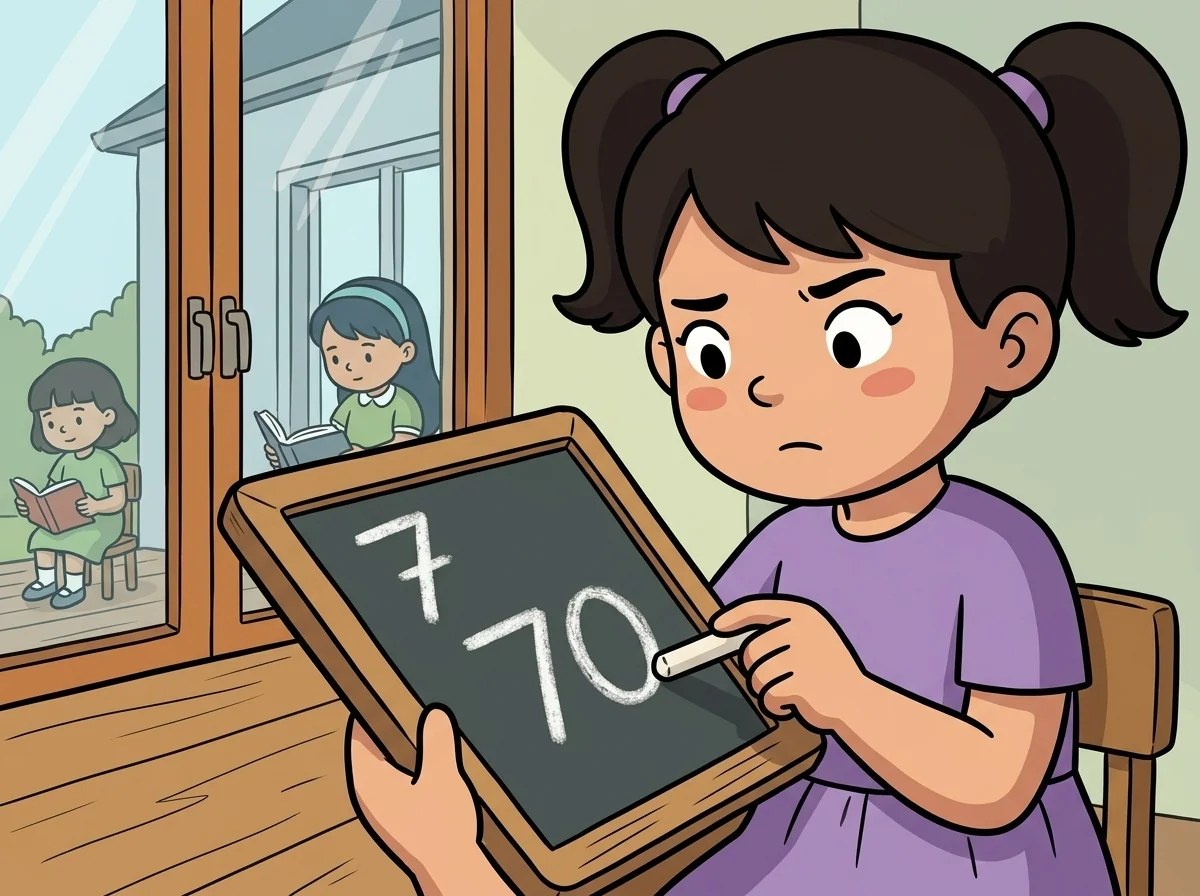
7
"This is seven," he said, his voice soft. "Read it aloud."
Zeph read it. "Seven."
Then, beneath it, he wrote another:
70
"And this is seventy," he continued. "Read it now. What is the difference you see?"
Zeph looked closely, her brow furrowed in concentration. She traced the shapes with her finger. "There is a seven and a zero."

"And what does the zero do?" the scholar asked, leaning forward slightly.
Zeph thought for a long moment, her gaze fixed on the slate. She chewed on her lip, trying to find the right words. "It makes the seven move," she finally said, slowly.
The scholar’s eyes widened slightly. "Move where?"
Zeph spoke even more slowly, working out the thought as she spoke. "To the left. The seven used to be in the ones place. The zero made it move to the tens place. The zero is holding the ones place empty. The seven went up. The seventy is ten times bigger because the seven is one position to the left."
The scholar set down his slate. He looked at Zeph for a long time, a quiet admiration in his gaze. Then he said, "Yes, Zeph. That is exactly right. You have just understood one of the most important inventions in the history of writing numbers. The *zero is not nothing. The zero is somewhere being empty*. It holds the lower positions open so the higher digits keep their meaning. Without the zero, you would have no way to tell seven from seventy from seven hundred. The zero is what makes positional notation work."
Zeph nodded, a small, satisfied gesture. She did not say anything for a while, letting the scholar’s words settle in her mind. The next morning, as she walked to school with Tenfold (who was still called Dec then), she explained what the scholar had said. Tenfold listened intently, her usual boisterous energy subdued by Zeph’s earnest explanation.
"That makes sense," Tenfold said, kicking a loose pebble. "The bead-frame works the same way. An empty wire is still a wire. It still counts as a position, even if there are no beads on it." They walked the rest of the way to school in quiet agreement, the morning sun warm on their faces.
That conversation, Zeph eventually said as an adult, was the moment she became who she was. She realized she was not simply a quiet child who was overlooked. She was the placeholder. The quiet held things together. Being empty in a position was not nothing. It was exactly the right thing to be.
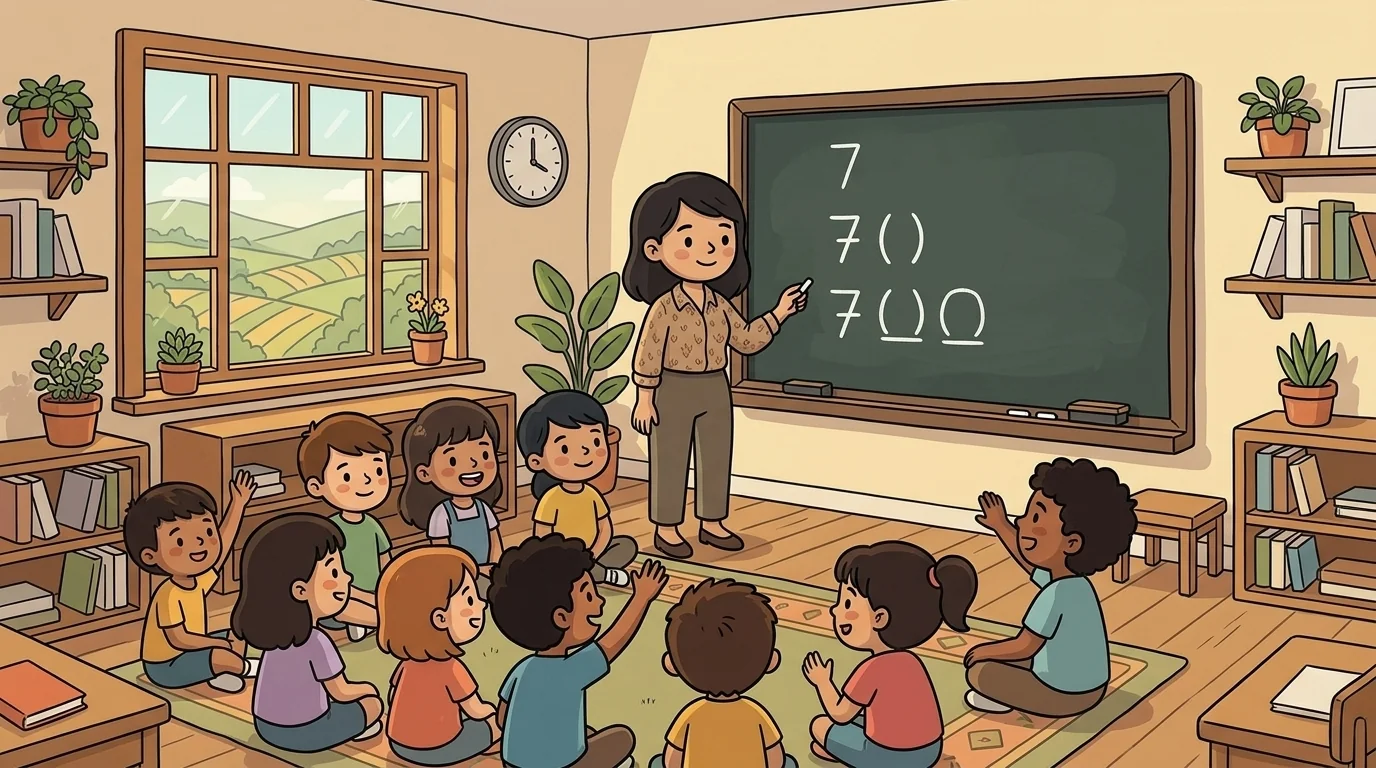
She studied numbers for the next twenty years, her quiet dedication leading her deeper into their mysteries. She joined the academy when she was twenty-eight, her understanding of the zero already profound. She has been teaching the zero ever since, guiding young minds to see its subtle power.
In her classroom, she begins every first-day lesson the same way. She writes on the board: 7. She writes below it: 70. She writes below that: 700. She turns to the class, her gaze sweeping over their eager faces. She says, "What is the same about these numbers? And what is different?"
The children, always, say the seven is the same. They point out the position is different. They notice the zeros at the end are different.
Zeph smiles, a small but warm expression that lights her eyes. She says, "Yes. The seven is the same. The zero is doing the work of holding the lower position empty so the seven can be in a higher position. Without the zero, you would have no way to tell these three numbers apart. The zero is doing more work than the seven."
When children ask her whether the zero is hard to understand, Zeph always gives the same answer:
"It is not hard. The zero is somewhere being empty. Once you truly see that, the rest of arithmetic makes perfect sense."
She still goes home to Decimal twice a year, walking the familiar road between her old house and Tenfold's old house. She still does not say much at supper, content to listen and observe.
She does, however, still hold the family together, a quiet, essential presence.
The Numberverse ensemble
Zeph is part of Numberverse's distributed-narrative cast. Each character embodies a different curricular primitive; together they teach the full subject.
-

Tenfold
Place value — powers of 10, positional notation
-

Mirror
Negative numbers — reflection across zero on the number line
-

Skip
Skip-counting and multiples — repeated addition as forward stepping
-

Tug
Inverse operations — addition ↔ subtraction (and the same idea for × ↔ ÷) as opposite pulls on the same line