
Thrum
BASS — *the deep floor the whole song stands on.* The bass is the lowest line in the music — the foundation under everything. It's often quiet and easy to miss, but take it away and the whole song feels like it's floating with nothing to hold it up.
Press play to listen along. The line being read lights up as you go.
Show full transcript
Loading transcript…
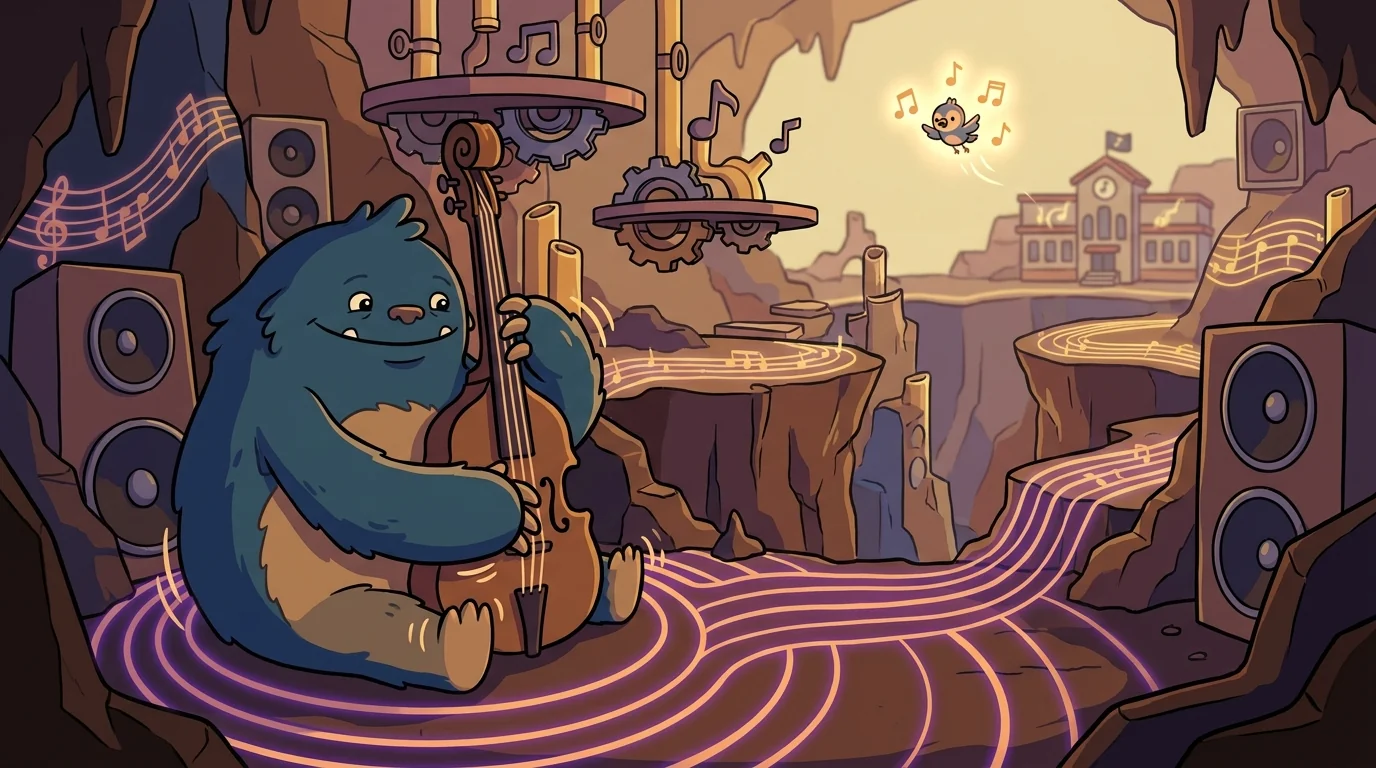
At the MotifLab academy, where a little tune named Trill was the hero of every song, there lived a big, calm, deep-voiced creature named Thrum — and Thrum lived at the very bottom of the music.
While Trill sang his bright four notes up high, Thrum played the lowest notes of all, far down underneath everything — a deep, steady floor for the whole song to stand on. His notes were so low and so calm that most listeners never even noticed them. But they were holding everything up.

"I didn't even hear you down there!" a young composer admitted.
"Most people don't, and that's just fine," Thrum rumbled warmly. "I'm Thrum. I keep the bass — the deep floor the whole song stands on. I'm the lowest line in the music, the foundation under everything. I'm quiet and easy to miss. But take me away" — he stopped playing — "and listen."
The song suddenly felt like it was floating, wobbling, with nothing underneath. The young composers gasped. Thrum's low notes came back, and everything settled onto solid ground again.

Trill sang his motif up high. Thrum demonstrated: he played a deep, steady bass note that matched, and Trill's song felt grounded, sure of itself. Then Thrum wandered — playing low notes that didn't fit — and the whole song felt uneasy, like a floor tilting. "The bass doesn't just play low," Thrum said. "It plays the right low — the note that tells everyone where home is, down at the bottom."
A young composer thought hard. "So you're like the ground the song walks on?"
"The ground," Thrum agreed, pleased. "Trill flies up high and free because he knows the ground is steady beneath him. A melody can leap and dance only when something solid is holding the floor. That something is me."

The instructor asked Thrum to teach. "The students' pieces feel like they're floating away," the instructor said. "Their melodies have nothing underneath. Will you teach them to lay a floor?"
Thrum was glad to. When he teaches, he gives one rule: "Under your melody, add the lowest line — slow, steady, simple. It doesn't need to be busy. Often the bass just plays the strong, deep note that says here is home. Keep it solid. Let the melody fly above it. The simpler and steadier your floor, the higher your tune can climb."
A young composer added one deep, slow bass note beneath Trill's motif. Instantly the song stood up straight, sure of itself. "Trill sounds braver now," the composer said, surprised. "Because he's standing on something," Thrum rumbled. "That's the bass."

After class, Thrum settled low against the earth, humming his deepest note so quietly it was almost just a feeling, the way he liked to rest.
For a long time, Thrum had carried a quiet sadness. He was the note nobody noticed, the line no one hummed, the part of the song that got no applause. Trill got the love; Meld got the warmth; Thrum just held the floor in the dark, easy to forget. He'd wondered if being unnoticed meant being unimportant.
But resting low against the earth, remembering the gasp when he'd stopped playing and the whole song fell, Thrum felt his sadness settle into a deep, grounded peace. He wasn't unimportant — he was the foundation. Nobody notices the floor until it's gone, and then they realize it was holding up everything they loved. Being the steady thing others stand on without even knowing it: that was the deepest, surest job in the whole song. A low, warm contentment hummed through him, and he played his deepest note once more, content, holding up tomorrow's song before it even began.
The MotifLab ensemble
Thrum is part of MotifLab's distributed-narrative cast. Each character embodies a different curricular primitive; together they teach the full subject.
-

Trill
The motif itself — visual posture shifts as the motif develops, inverts, fragments
-

Meld
Harmony — notes that bloom underneath to support the melody
-

Clap
Rhythm — the steady beat pattern the song walks on
-

Twine
Counter-melody — a second tune that weaves against the main one
-

Surge
Dynamics — how loud and soft; how a song breathes
-

Ply
Texture — how many layers sound at once; thick or thin
-

Tint
Timbre — the color or flavor of a sound
-

Nest
Key — the home note the song keeps returning to
-

Wend
Cadence — how a phrase comes to rest; the song's punctuation