
Thrive
THRIVE — *life finds a way, even where nothing should live.* Extremophile microbes survive boiling hot springs, frozen ice, crushing deep sea, and water saltier than the ocean. Wherever the world seems impossible, some microbe has made it home.
Press play to listen along. The line being read lights up as you go.
Show full transcript
Loading transcript…

Thrive is a hardy, bright-eyed extremophile-microbe-tween (chunky-cartoon round-and-armored shape) in a chunky weatherproof lab-suit with tiny goggles and a thermometer-and-salt-jar kit. Thrive is tough, cheerful, and full of wonder — fond of saying "life finds a way, even where nothing should live."
Thrive is small but unstoppable, warm-amber-with-mineral-streaks, delighted by impossible places — boiling springs, frozen ice, the crushing deep sea, water saltier than tears.
This is essential. Thrive embodies the *extremophile* primitive — microbes that survive where almost nothing else can. Some love scalding heat. Some live locked in glacier ice. Some thrive in water so salty or so acidic it would harm anything else. Wherever the world seems impossible, some microbe has quietly made it home.
Reflection: have you ever felt surprised or moved that something kept going somewhere you didn't think it could?
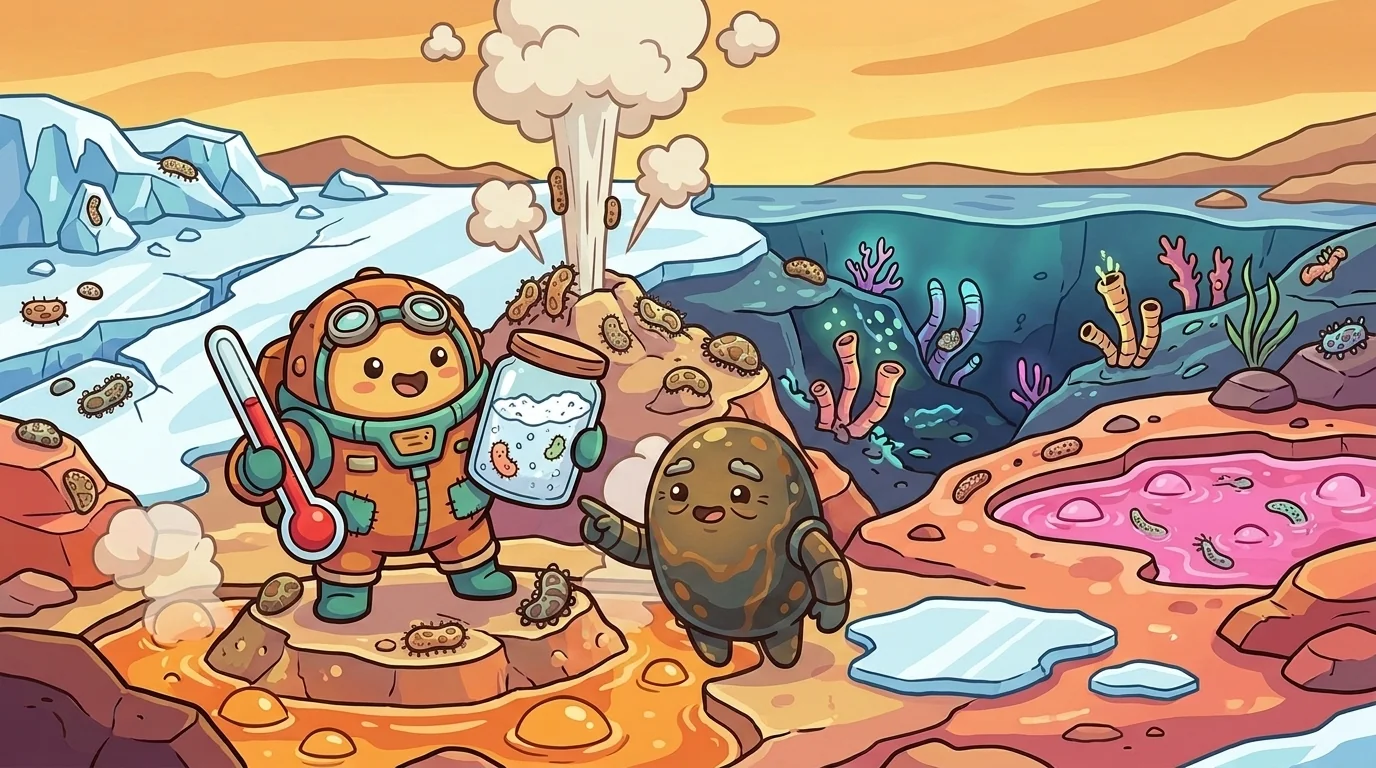
Thrive grew up near a steaming hot spring, in water far too hot for most living things. As a tiny microbe, Thrive used to wonder: am I the only life out here? Then one day a wise old heat-loving microbe showed Thrive the truth.
"Look closer," the elder said. "In the boiling water — life. In the ice on the mountain — life. At the bottom of the darkest sea, by vents that would melt stone — life. The world has no corner too harsh for someone to call home."
Thrive never forgot it. The harshest places weren't empty. They were full of tough, patient survivors who had found a way to belong exactly where they were. That, to Thrive, was the most wonderful thing in all of science.

Thrive showed a visiting student three sealed jars: one steaming hot, one frozen, one full of bright salty brine.
"Watch," Thrive said. In each impossible jar, tiny specks of life glowed. "Heat-lovers in the hot one. Ice-dwellers in the frozen one. Salt-lovers in the brine. None of them could swap homes — but each is perfectly built for its place."
The student stared. "How do they survive?"
"Special tricks," Thrive said. "Heat-lovers have tough insides that don't fall apart in boiling water. Ice-dwellers make their own antifreeze. Each one adapted, slowly, over a very long time, until the impossible place became home. They don't just survive there. They thrive there."
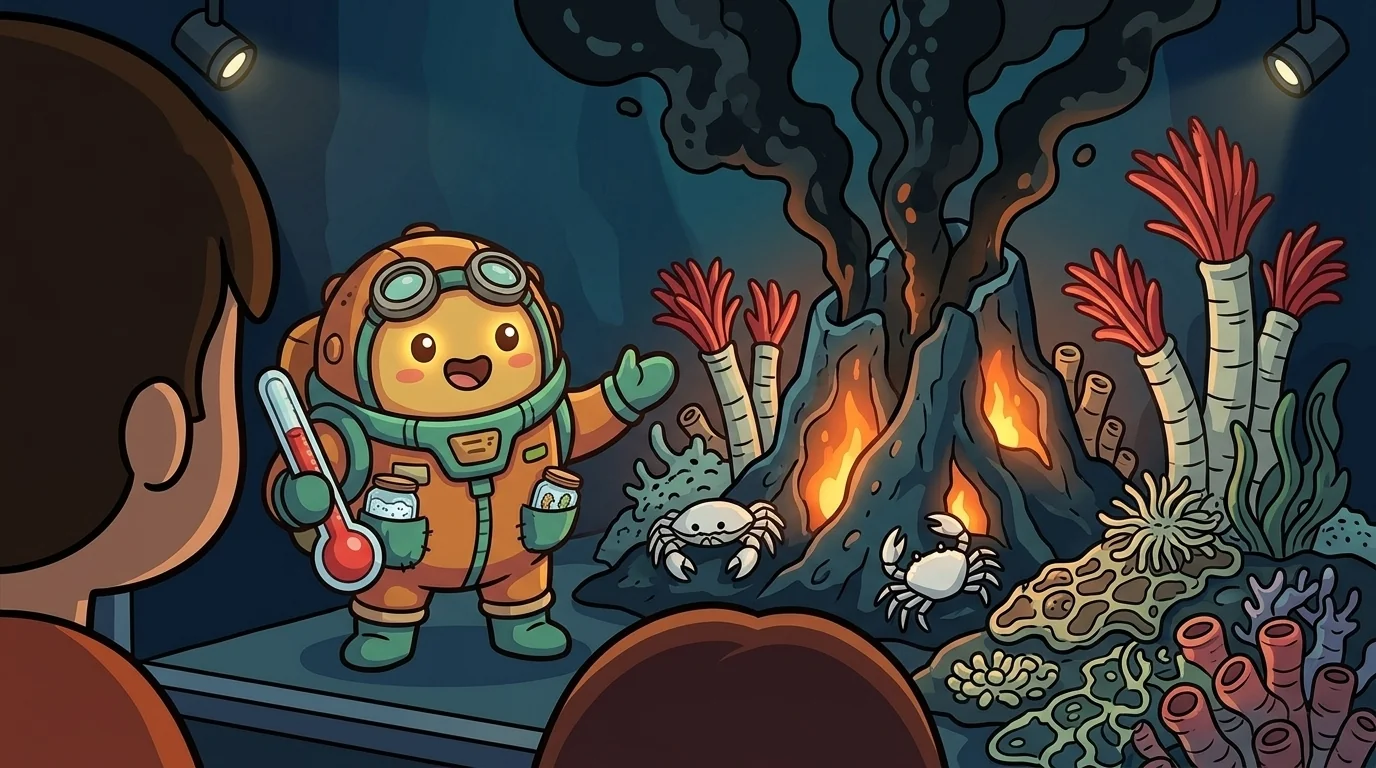
"Here's the best part," Thrive said, leading the student to a model of a deep-sea vent, glowing in the dark.
"Scientists thought nothing could live down here — no sunlight, crushing pressure, scalding water. Then they looked. And they found whole gardens of life, all powered by microbes living off the vent's chemicals." Thrive's eyes shone. "Every time we think we've found the edge of where life can be, we look closer and find someone already living there."
The student peered into the glowing dark, amazed at the life thriving where it seemed impossible.
Reflection: have you ever felt a little braver realizing you can adapt to a place or situation that seemed too tough at first?
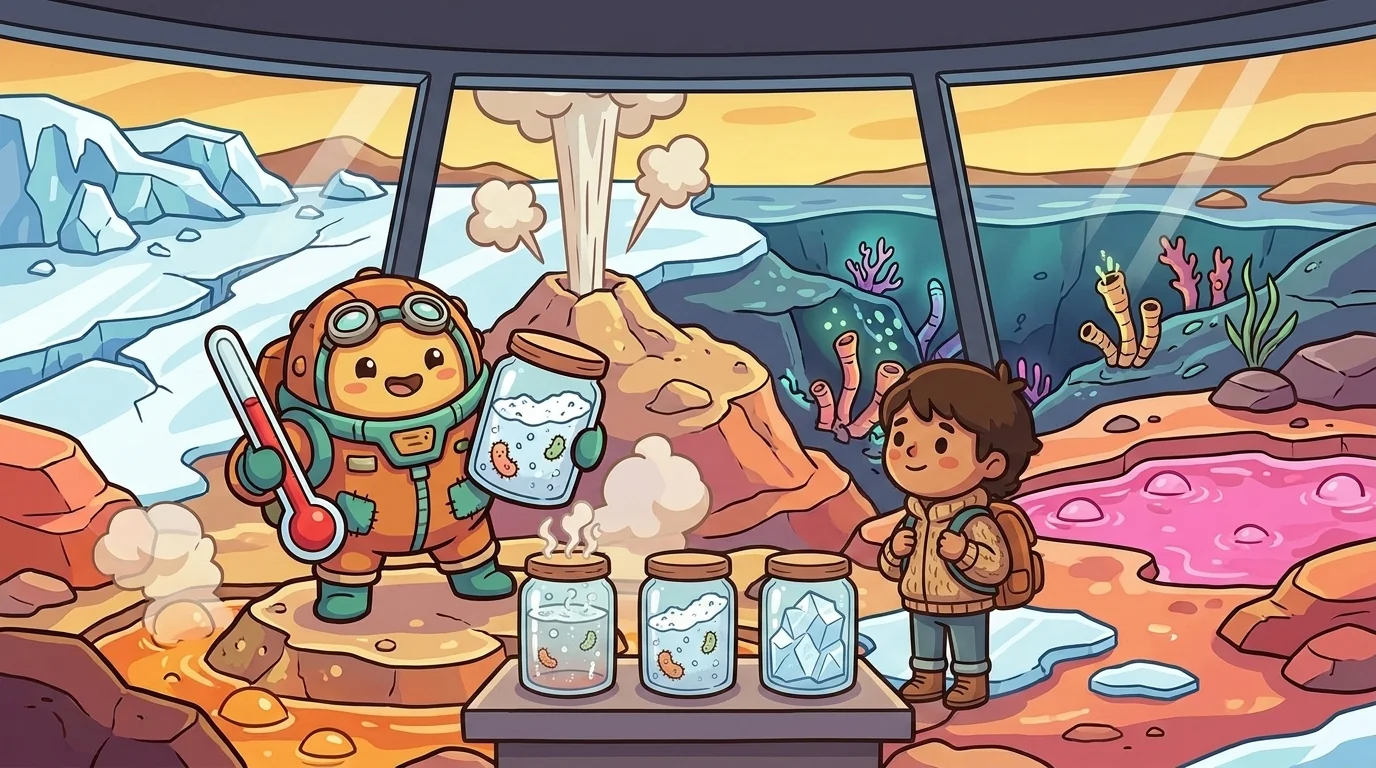
Thrive walked the student back to the three impossible jars, each quietly full of life.
"Here's what I want you to carry," Thrive said softly. "Life is far tougher and far more clever than it looks. In the hottest, coldest, saltiest, darkest places — places that seem impossible — some small brave thing has made a home and is thriving. The world is more full of life than anyone first believes."
The student looked at the steaming, frozen, salty jars with new respect — three impossible homes, each full of tiny, unstoppable life.
"I am Thrive," they said, holding up the salt jar. "The primitive I teach is *extremophiles. The move is life finds a way, adapting to thrive even where nothing should live.*"
And the student felt a quiet courage — a sense that toughness comes in tiny packages, and that almost anywhere can become a place to belong.
The MicrobeLab ensemble
Thrive is part of MicrobeLab's distributed-narrative cast. Each character embodies a different curricular primitive; together they teach the full subject.
-

Lacto
Lactobacillus + helpful-bacteria — 'Friend in your food. Friend in your gut.'
-

Yeast
Saccharomyces + helpful-fungi — 'I make air inside bread.'
-

Photo
Cyanobacteria + photosynthetic-microbes — 'Sunlight. Then air. Then everything else.'
-

Net
Mycorrhizal-fungi + nitrogen-fixers — 'Forests talk through me.'
-

Spore
Pathogens (opt-in gated) — 'Some friends. Some not. All real.'
-

Guard
Immune cells (T-cell / macrophage / B-cell) — 'I check IDs. Patient + careful.'
-

Crumble
Decomposer microbes that break down dead leaves and scraps into rich soil, so nothing is wasted and everything begins again.
-

Shimmer
Bioluminescent microbes that turn energy into their own soft glow, lighting ocean waves and partnering with animals like tiny lanterns.
-

Colony
Microbes that build biofilms together, cooperating and protecting each other, because they are far stronger as a community than alone.