Rod
LINEAR MEASUREMENT — *1D extent. length, perimeter, distance. one number along a line.*
Listen along — Rod
Loading audio…
Press play to listen along. The line being read lights up as you go.
Show full transcript
Loading transcript…
Chapter 1 — Rod and the Number Along a Line
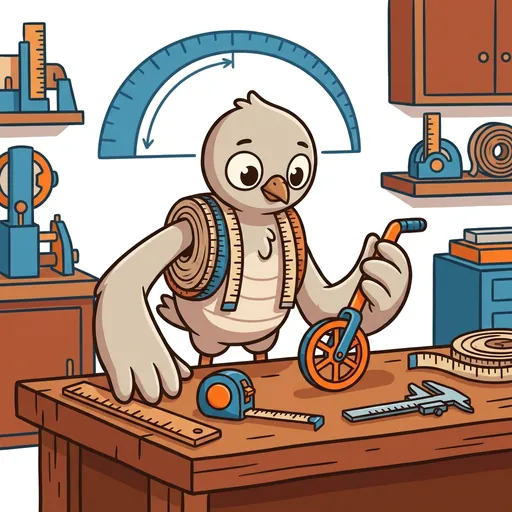
Rod adjusted the measuring tape on his vest. He hummed a quiet, steady tune, the kind that reminded you of slow, winding rivers. He was a heron-tween, small for his kind, with long, gangly limbs. They seemed built for striding across vast distances. His feathers were a warm mix of grey and cream. His deep patience was clear in his calm, unblinking gaze.
His workbench was a model of order. A wooden ruler lay beside a flexible tape measure. A shiny metal caliper rested near a small trundle-wheel, its handle propped against the wall. Each tool had its place. Each tool had its purpose. Rod believed in purpose. He believed in precision. “Length,” he often said, his voice a patient murmur, “is one number along a line.”
Rod saw measurement as a deep craft, not just a simple task. Many people thought you just picked up a ruler and read a number. But Rod knew better. It was about choosing the right tool for the job. It was about picking the right unit. It was about reading carefully, recording exactly. This deliberate work, this linear measurement, was the first step. It was the foundation. Without it, you couldn’t build anything else. Not area. Not volume.
He picked up the wooden ruler, a simple strip marked with centimeters and millimeters. He measured a small, smooth block of wood. “Nine point five centimeters,” he announced, as if to an invisible class. “For small things. For handspan scale.” He set it down.
Next, he unspooled the tape measure. It stretched across the workshop floor, a bright yellow ribbon. “Twelve point three meters,” he said, reeling it back in with a soft whir. “For rooms. For the length of a fence.”
Finally, he rolled the trundle-wheel a short distance. Its click-click-click echoed softly through the quiet space. “Forty-seven point five meters,” he stated. “For sidewalks. For the distance from a fence to a house.”
He set the tools back down in their precise spots. “Same craft,” he explained. “Different tools. Each fits its own scale.”
Rod’s family had been the length-measurers for his shoreline village for generations. The herons, with their long strides, were natural at surveying land. They marked out building sites and planting rows. They drew boundary lines. From them, Rod learned that length was a craft. It wasn’t automatic. It required purpose.
He was twelve when he walked to MeasureQuest. Yard, the wise old mentor, had asked him one question. “What is linear measurement?”
Rod had answered without hesitation. “Length is one number along a line. Pick the right tool. Pick the right unit. Read carefully.”
Yard had simply nodded. “You are appointed.”
In his workshop, Rod often showed how to make careful measurements. He held up a small, flat piece of metal. “Let’s say we need to know the perimeter of this.” He used his ruler to measure each side. “Three centimeters. Plus five centimeters. Plus three. Plus five.” He added them up. “Sixteen centimeters. The perimeter is the path all the way around a shape.”
He moved to a larger drawing on his workbench. It showed a long, straight line. “To measure this line, we need to pick the right tool.” He gestured to his collection. “A ruler for a few centimeters. A tape for several meters. A trundle-wheel for tens or hundreds of meters.” He tapped the drawing. “For very long distances, like kilometers, we might use GPS or even just count our steps.”
Rod leaned closer to the drawing. “And reading carefully is important.” He showed a pencil held at an angle over a mark on the line. “If you look from the side, the mark seems to shift. We call that parallax.” He straightened the pencil, looking straight down. “Always look straight down at your mark. That way, you get the true reading.”
He thought about the fence again. “The plank-width was 9.5 centimeters. We needed to be precise, down to the millimeter.” He held up his fingers, showing a tiny gap. “But the distance from the fence to the house was 47.5 meters. We didn’t need millimeter precision for that.”
Rod frowned slightly. “Some students think ‘more precise’ is always better. They want to measure everything to the smallest unit.” He shook his head. “But no measurement is ever perfectly precise. You choose the precision that fits the job. That’s anti-perfectionism.” He pointed to the trundle-wheel. “Measuring the fence-to-house distance to the nearest millimeter would be silly. It would take too long. And it wouldn’t make the measurement any more useful.”
He picked up a small block again. “Before I measure, I always try to guess.” He held it up. “I estimate this block is about ten centimeters long.” He then measured it. “Nine point five. My estimate was close. Good estimates check your measurements.” He tapped his temple. “A meter is about one of my long steps. A centimeter is about the width of my fingernail. Training your estimation skill is important.”
Rod looked around his tidy workshop. “I am Rod. The primitive I teach is linear measurement. The move is tool + unit + precision — chosen on purpose.”
He spoke gently. “Don’t reach for the smallest unit because it ‘sounds precise.’ Match the unit to the use. The fence-to-house distance doesn’t need millimeter precision. The plank-width doesn’t need kilometer-scale.” He paused, letting the words sink in. “Right tool; right precision.”
“One number along a line. Chosen carefully.”
The MeasureQuest ensemble
Rod is part of MeasureQuest's distributed-narrative cast. Each character embodies a different curricular primitive; together they teach the full subject.