Cup
VOLUME + CAPACITY — 3D space. how many cubes fit. cubic units, liquid measures.
Listen along — Cup
Loading audio…
Press play to listen along. The line being read lights up as you go.
Show full transcript
Loading transcript…
Chapter 3 — Cup and the Cubes That Fill
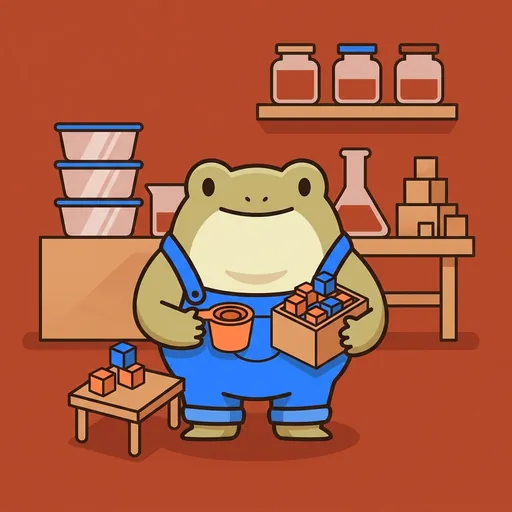
In the middle of the pond-village square, a small green frog-tween was stacking tiny wooden cubes into a shoebox, one careful layer at a time, and grinning like it was the best game in the world.
Cup laid down a row. Then another beside it, and another, until the bottom of the box was a neat little floor of cubes. She counted under her breath — five across, three deep — and pressed them flat with one webbed hand.
“That’s one layer,” she told the box, as if the box were listening. “Now we go up.”
A girl carrying a leaky bucket had stopped to watch. “You’re just… filling a box with blocks.”
“I’m finding out how much room is inside it,” Cup said, without looking up. She built a second layer on top of the first, then a third, then a fourth, humming the whole time. When she was done, the box was packed solid, corner to corner, lid to floor.
“Sixty,” she announced, patting it. “Sixty cubes fit. That’s how big the inside is.” She tipped the box gently so the girl could see the neat grid of them. “Not how tall, not how wide — how much space. Every cube is a little cup of room, and I counted every one.”
The girl set down her bucket and peered in. “Could you have just… measured it?”
Cup’s whole face lit up. “Oh, I love that question,” she said. “Come here. I’ll show you the two-face trick.”
Cup hadn’t always trusted the cubes. When she was small, the pond had felt like a bully.
Her family were water-pourers — the frogs who filled the village wells and measured out water for the fields. On her first real morning of work, her grandfather had handed her a fat clay jug and a slim tall bottle and asked her to say which one held more. Cup had stared. The bottle was taller. So she’d said the bottle, confident.
Her grandfather had poured the bottle into the jug. It filled it barely halfway.
Cup’s ears had gone hot. She felt small and wrong, the way you do when your eyes lie to you in front of someone you want to impress. “But it looked bigger,” she’d whispered.
“Tall isn’t the same as roomy, little pour,” her grandfather said. He wasn’t cross. He crouched down beside her. “Your eyes measured one thing — how high it stood. But water doesn’t care how tall. Water cares how much room. Wide room. Deep room. All of it, added up.” He tapped the jug. “Fill it with something you can count, and it stops fooling you.”
That afternoon Cup filled the jug with acorns, one by one, then the bottle, then counted both piles. The jug won by a landslide. And the hot, foolish feeling melted into something else entirely — a slow, steady certainty. The water hadn’t tricked her. She just hadn’t known how to ask it the right question yet. Now she did.
She walked to MeasureQuest at twelve, because a place that studied how big things were ought to care about the hardest kind of bigness — the kind that hides on the inside.
Yard, the old mentor who kept the workshops, met her at the gate. He didn’t ask her to lift anything or prove she was clever. He asked one thing. “What is volume?”
Cup didn’t answer straight away. She set down her satchel, took out a single small cube and a squat measuring-cup, and placed them side by side on the gatepost.
“This one,” she said, touching the cube, “is how much room a solid thing takes up. You count the little cubes that fit inside it.” Then she touched the cup. “This one is how much room a container can hold. Also little cubes — you just pour instead of stack.” She looked up at him. “People give them two names. Volume. Capacity. But they’re the same question wearing two coats. How much room is in there?”
Yard was quiet for a moment. Then he almost smiled. “You belong here,” he said.
Cup’s workshop was full of things that turned out to be roomier — or emptier — than they looked.
A boy came in one afternoon, chewing his lip over a homework page. “I have to find the volume of this box,” he said, “and I keep getting the formula wrong. Length times width times… something. I don’t even know what I’m doing.”
Cup didn’t reach for the formula. She reached for her box of cubes.
“Forget the formula for a second,” she said. “How long is the bottom of your box?”
“Five.”
“Lay me five cubes.” He did. “How deep?”
“Three.” He filled the row into a little floor — five across, three back. He counted without being asked. “Fifteen. That’s one layer.”
“Good. Now — how tall is the box?”
“Four.”
“So how many layers?”
The boy stopped. She watched him get it — watched his hand hover over the fifteen cubes and then lift, once, twice, four times, stacking the idea in the air. “Four layers of fifteen,” he said slowly. “That’s… sixty.”
“Sixty cubes. Sixty little rooms.” Cup grinned. “And that’s your formula. Five times three times four. It’s not a magic spell. It’s just counting the layers fast.” She slid a pitcher of water across the bench. “Same with liquid. This holds a thousand of those cubes’ worth of room — we call it a litre, but it’s the same cubes, just poured. The number was never the point. The room was.”
The boy looked at his page again, and this time he didn’t chew his lip.
Later, when the workshop had emptied out, the boy stuck his head back in. Quieter now.
“When I get an answer,” he said, “how do I know it’s right? The formula gives me a number, but the number doesn’t feel like anything.”
Cup thought about the clay jug. About the tall bottle that lied, and the hot-eared feeling, and the acorns she’d counted until the truth stopped hiding.
“You build it back,” she said gently. “In your head, or with real cubes if you can. If the number matches the room you can picture filling — layer on layer on layer — then it’s honest. The formula’s only a shortcut for counting. When you can still see the counting behind it, you’re not lost anymore. You’re just fast.”
The boy nodded, and she watched something loosen in his shoulders — the same easing she’d felt at the edge of the pond, years ago, when the water finally stopped fooling her.
She didn’t say the rest out loud, but she felt it, warm and round as a full jug: the most confusing things are usually just the ones you haven’t filled up yet. Pour them full, one cube at a time, and the fear runs right out the bottom.
The MeasureQuest ensemble
Cup is part of MeasureQuest's distributed-narrative cast. Each character embodies a different curricular primitive; together they teach the full subject.