Tick
TIME — *elapsed duration. intervals. the special-case unit-system (60 / 60 / 24 / 7 / 12).*
Listen along — Tick
Loading audio…
Press play to listen along. The line being read lights up as you go.
Show full transcript
Loading transcript…
Chapter 4 — Tick and the Odd-Number Family of Time
Pip was arguing with a clock, and losing.
“It makes no sense,” she said, jabbing the workshop’s big wall clock. “Everything else goes in tens. A meter is a hundred centimeters. A kilo is a thousand grams. But an hour is sixty minutes and a day is twenty-four hours and a week is seven days, and none of those are even friends with each other! Who did this?”
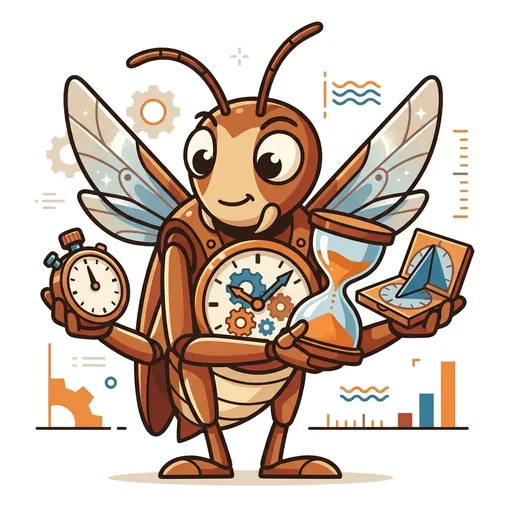
Tick looked up from his workbench. He was a cricket, tween-sized, part clockwork — his wings were shimmery little cartoon gears, and a clock face was stitched into his vest. He didn’t tell Pip she was wrong. He’d been exactly that angry, once, at exactly that clock.
“People did it,” he said. “Different people, in different centuries, who never met each other. That’s why the numbers don’t get along.” He clicked his stopwatch and it gave a tiny whirr. “Come here. I’ll introduce you to the whole odd family, one at a time. They’ve each got a story. None of them fell out of the sky.”
Tick’s own frustration had a village and a tower.
He’d grown up in the clock-tower village, where his family had always kept the time — crickets whose clockwork wings ticked a steady rhythm without anyone winding them. They’d built the village’s first sundial, then its first hourglass, then its first mechanical clock, each generation adding a machine.
As a small cricket, Tick had assumed time was just true — a fact, like water being wet. Then his grandfather showed him a cracked old tablet the family had kept for centuries, covered in wedge-shaped marks, and told him it was a merchant’s list from ancient Babylon, counted in sixties. “They chose sixty,” his grandfather said. “On purpose. Because sixty splits clean into halves and thirds and quarters and fifths and sixths — and they had no calculators, so easy splitting was worth more than easy counting.” Tick had felt the floor tilt a little. If the Babylonians chose sixty, then the minute wasn’t a fact. It was an inheritance. Somebody had handed it down, and now everyone carried it without remembering whose hands it came from.
He walked into MeasureQuest at thirteen, and Yard, the old mentor, was oiling the tower gears.
Yard didn’t ask him to list the units. He asked one thing: “Why isn’t a day ten hours long?”
Tick almost laughed with relief — it was the exact question he’d been chewing for years. “Because we didn’t invent the day,” he said. “We inherited it. Twenty-four came from the Egyptians and Greeks splitting daylight and dark into twelves. Seven days came from Babylonian and Hebrew calendars. Twelve months came from people trying to make the sun and the moon agree, which they never quite do.” He caught his breath. “Somebody did try ten. The French, during their revolution — ten-hour days, hundred-minute hours. It lasted about two years. People just… refused. The old numbers had too much of a grip.”
Yard set down his oilcan. “Most students want time to make sense,” he said. “You figured out it isn’t nonsense. It’s history wearing a clock’s face. Go on up — the tower’s yours to learn.”
When Pip demanded her introductions, Tick gave them one machine at a time.
He held up the stopwatch. “This one’s modern. It can catch a tenth of a second.” Whirr. Then the hourglass, tipping it so the sand began to trickle. “This one’s medieval. Same job — measuring how long — but it trusts falling sand instead of gears.” Last, a tiny sundial. “This one’s ancient. It reads the sun’s shadow. Three tools, three centuries, all telling you the same thing: how much time went past.”
Pip pointed accusingly at the clock again. “But the numbers—”
“I know. Sit.” Tick counted them off on his little fingers, and each one got a story instead of a rule. “Sixty seconds, sixty minutes — that’s Babylon, choosing a number that splits nicely. Twenty-four hours — Egypt and Greece, halving the light and the dark. Seven days — the old religious calendars. Twelve months — the endless argument between the sun and the moon.” He tapped his vest. “None of them are natural. They feel natural to you because you grew up inside them. That’s all.”
Then he did the thing that actually helped. “Here — a real one. A film starts at 2:50 and runs 25 minutes. When’s it over?” Pip started to write 2:75 and Tick caught her pencil, gently. “Ah — that’s the trap. Minutes don’t go past sixty. Ten of your minutes fill up the fifty, roll over into a new hour — three o’clock — and you’ve got fifteen left. Three-fifteen.” He let go of the pencil. “The odd numbers don’t just look weird. They bite, right at the sixty line, if you don’t respect the carry.”
Pip redid it and got 3:15. She stared at the clock, and some of the fury drained out of her shoulders. “It’s not stupid,” she said slowly. “It’s just… old.”
“It’s very old,” Tick agreed. “And it was passed down, not handed to us finished. Other people carry different ones — calendars that follow the moon, calendars that braid the sun and moon together, calendars I’ve never even seen. Ours isn’t the only one. It’s just the one in this tower.” He said it carefully, because his grandfather had taught him that too.
Pip clicked the stopwatch herself and timed how long the hourglass took to run out. She wrote the number down, respecting the carry this time, and didn’t complain once.
Tick watched her and felt his own little clockwork face relax into an easy smile. He remembered being furious at this exact clock — furious that time refused to be tidy. But somewhere in the years of learning why, the fury had quietly turned into something almost fond. He liked the odd old numbers now, the way you get fond of a grandparent’s stubborn habits once you know the story behind them.
“Sixty, sixty, twenty-four, seven, twelve,” he murmured, tapping the clock face on his chest. “Not natural. Not decimal. Just handed down, and worth carrying carefully.” And knowing the why had turned all that old frustration into a strange, warm peace.
The MeasureQuest ensemble
Tick is part of MeasureQuest's distributed-narrative cast. Each character embodies a different curricular primitive; together they teach the full subject.