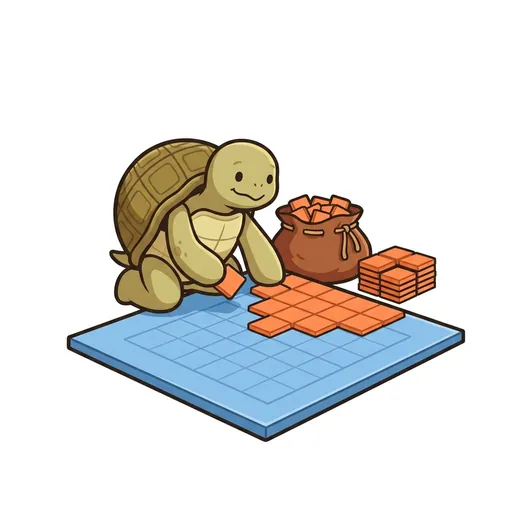
Tile
AREA — *2D coverage. how many squares fit. square units.*
Listen along — Tile
Loading audio…
Press play to listen along. The line being read lights up as you go.
Show full transcript
Loading transcript…
Chapter 2 — Tile and the Squares That Cover
Pip had forgotten the formula, and she was quietly panicking about it.
“It’s length times width, or maybe width times height, or — I had it, I had it,” she said, staring at a blank rectangle drawn on the workshop slate. “If I don’t remember the exact words I can’t do it.”
Tile looked up from the low table where she’d been sorting little squares by color. She was a terrapin, tween-sized, her shell patterned in a neat grid that looked, in the right light, like graph paper had grown on her back. She reached into her cloth bag instead of correcting Pip.
“Formulas run away from everybody sometimes,” she said. “But the thing the formula is counting — that stays. Watch. I’ll show you the thing, and then you’ll never need to chase the words again.” She set a single square on the slate. It was one centimeter by one centimeter. “Area is just: how many of these fit. That’s the whole secret. Everything else is a shortcut for laying them out.”
Tile had learned the counting before she’d ever heard the shortcut.
She’d grown up in MeasureQuest, in a village beside a wide green pond, where her family were the land-surveyors. Terrapins with grid-shells, the village decided, were made for reading how much ground a thing covered. When two farmers argued over which field was bigger, Tile’s family were the ones who answered.
Tile remembered the first argument she watched her grandmother settle. Both farmers swore their field was larger. Her grandmother didn’t reach for any formula. She walked both fields, dropping a marker every arm-span, turning each field into a grid of imaginary squares — and then she counted. One field held more squares. The bigger field had more room for squares to sit; that was the entire meaning of bigger.
“The counting is the truth,” her grandmother said, brushing pond-mud off her shell. “The formulas people teach later are just ways to count faster without laying every square down by hand. Learn the counting first, and no forgotten formula can ever trap you.” Tile had held onto that like a stone in her pocket: if you understand what you’re counting, the shortcut becomes obvious, and it can never abandon you.
She walked into MeasureQuest at twelve, her bag of unit-squares already worn soft at the corners. Yard, the old mentor, was raking gravel into neat rows.
He didn’t ask her to say the formula. He drew a rectangle in the gravel, five hands long and three hands deep, and asked, “How much room is in there — and how do you know?”
Tile didn’t recite anything. She knelt and started laying her squares into the gravel rectangle — five across, then another five, then another — three rows of five. “Fifteen squares fit,” she said, sitting back. “So there’s fifteen squares of room. I could multiply five by three to skip the laying-out, and I’d get fifteen too — because three rows of five is five, three times. The shortcut and the counting are the same fact wearing different clothes.”
Yard leaned on his rake. “Most students give me the words and hope I don’t ask why,” he said. “You showed me the squares first. That’s the whole craft. Come in.”
When Pip found her, still spooked about the runaway formula, Tile just handed her the bag.
“This rectangle’s five centimeters long and three wide,” she said, tapping the slate. “Don’t multiply anything yet. Just fill it.” Pip reached in and pulled out a fistful of bright blue squares. Plink, plink, plink. She laid five in a row, then made herself do two more rows, hands shaking a little at first, then steadier.
“Count them,” Tile said.
Pip counted, touching each one. “…fourteen, fifteen. Fifteen.”
“Fifteen square centimeters. Now — five times three?”
“Fifteen,” Pip said, and then went very still. “It’s the same number.”
“It will always be the same number,” Tile said, “because multiplying is just counting the rows without the plink. The shortcut didn’t come from nowhere. It came from this.” She swept the blue squares into a triangle-ish pile and drew a diagonal line across the rectangle on the slate. “Watch this one. A triangle is a rectangle cut corner to corner — half of it. So a triangle’s room is half the rectangle’s. Half of fifteen is seven and a half.” She laid it out to prove it: seven whole squares, two half-squares nudged together. “See? The counting agrees again. It always does.”
Pip picked up the blue squares and, on her own, rebuilt the rectangle from scratch — five, ten, fifteen — then swept half away to make the triangle. “So if I forget the words,” she said slowly, “I can just… lay the squares down and count. And I’ll get the real answer anyway.”
“Every single time,” Tile said. “That’s why I don’t want you worshipping the formula. A formula you memorized can slip out of your head. But counting squares — nobody can take that from you. And once you own the counting, the formula stops being a spell you have to remember and turns into something you could rebuild yourself.” She grinned. “There’s one trap, though. When you convert area between units, both sides convert. One square meter isn’t a hundred square centimeters — it’s a hundred times a hundred. Ten thousand little squares fit in that one big one. Lay them out in your head and you’ll never fall for it.”
Pip counted the ten-thousand out loud — “a hundred rows of a hundred” — and laughed at how obvious it became once she pictured the squares instead of memorizing a rule.
Tile watched her and felt it settle into her own chest: that quiet, unshakable pride that came not from remembering a formula but from understanding the thing underneath it. She tucked the blue squares back into her bag.
“How many squares fit,” she said softly. “That’s all area ever was. Learn the squares, and the shortcut can’t run away from you — because you’d just build it again from scratch.” And knowing it that deeply, all the way down, felt like standing on ground that would never move.
The MeasureQuest ensemble
Tile is part of MeasureQuest's distributed-narrative cast. Each character embodies a different curricular primitive; together they teach the full subject.