Cup
VOLUME + CAPACITY — *3D space. how many cubes fit. cubic units, liquid measures.*
Listen along — Cup
Loading audio…
Press play to listen along. The line being read lights up as you go.
Show full transcript
Loading transcript…
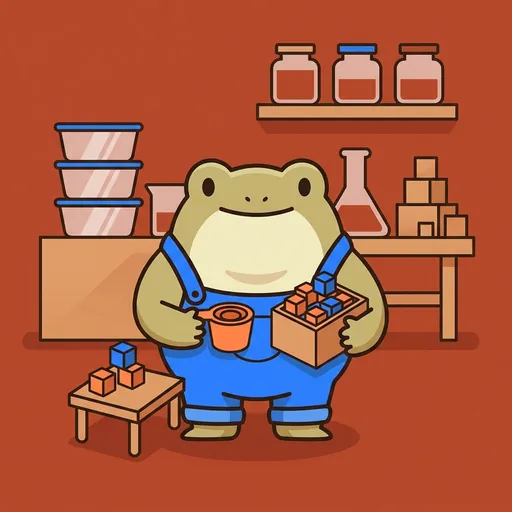
Cup was a small frog, round-bellied and green, the color of moss after a spring rain. She wore sturdy overalls, a little worn at the knees. Always, she carried her tools: a set of nesting measuring cups, shiny and precise, and a small wooden box filled with unit cubes. Her skin was a warm green, fading to cream on her belly. Cup moved with a quiet patience, especially when thinking about three-dimensional space. Her favorite saying, often delivered with a gentle nod, was: “Volume is how many cubes fit.”
The cups were for measuring liquids, like water or oil. The cubes, each exactly one centimeter on every side, were for solids. She used them to show how much space something took up. For Cup, these two tools showed the same big idea: how much three-dimensional space something occupied, or how much a container could hold.
Cup’s whole purpose was to teach about volume + capacity. She showed how measuring in three dimensions was just like extending the flat measurements of area, but with an extra layer. Many students got tangled up in the words. ‘Volume’ meant the space an object filled. ‘Capacity’ meant how much a container could hold. But Cup knew they were really the same thing, just looked at from different angles. Her work was all about helping people see things in three dimensions, building on the simple unit-counting that Tile taught for flat surfaces.
Cup’s message was always clear: “Volume is how many cubes fit. We’re talking about three-dimensional space here, measured in cubic units. Capacity is the same idea. It’s just how many cubes, or liquid units, a container can hold.”
She taught her students to think of volume as the full extent of a three-dimensional object. They learned about cubic units like cubic centimeters or cubic meters. Capacity, she explained, was simply that same physical idea applied to containers. A one-liter bottle, for example, had a capacity of one thousand milliliters, which was the same as one thousand cubic centimeters.
Cup always started with the basics. She showed how the volume of a rectangular prism worked. “It’s just layers,” she’d say, “like stacking flat tiles.” You found the area of the bottom layer (length times width), then stacked those layers up for the height. Later, she would introduce more complex shapes, like cylinders, explaining how their volume came from a circular area stacked tall. Spheres were for advanced students, a trickier puzzle. She also taught the displacement method for irregular objects: drop something in water and measure how much the water level rises. “The volume of the object,” she’d tell them, “is the amount of water it pushes aside.” Always, she emphasized understanding the counting first, not just memorizing a formula. A formula was just a shortcut, after all.
Cup’s family had lived for generations in the pond-village, where their special job was measuring water. They were the village’s water-pourers, carefully doling out water for the wells and the irrigation ditches. Through seasons of drought and flood, they learned a simple truth: “The water doesn’t care what unit you use. Just pick the right one for the job.” Cup carried that practical wisdom into her own work, applying it to every shape and every container.
When Cup was twelve, she made the long journey to MeasureQuest. Her mentor, Yard, met her at the gate. “What is volume?” Yard asked, his voice like rustling leaves. Cup didn’t hesitate. “It’s how many cubes fit. Three-dimensional space, measured in cubic units. Capacity is the same idea, just how many cubes or liquid units a container can hold.” Yard simply nodded. “You are appointed,” he said.
In her workshop, Cup often began with her unit cubes. She’d hold up a clear, empty box. “This box,” she’d say, “is five centimeters long, three centimeters wide, and four centimeters tall.” Then, with practiced movements, she’d fill the bottom. One layer of cubes, five by three, clicked into place. Fifteen cubes. “That’s one layer,” she’d explain. “Now, imagine stacking four of those layers, one on top of the other.” She’d quickly build the full box. “Sixty cubes total. So, the volume is sixty cubic centimeters. Or, if you use the formula: five times three times four equals sixty. Same answer, either way.”
Next, she’d pick up a clear glass pitcher and fill it with water. She’d pour it into a one-liter measuring cup. “This pitcher holds one liter,” she’d announce, pointing to the markings. “That’s a thousand milliliters, or a thousand cubic centimeters. It’s the same physical idea as the cubes, just with different words for the units.”
Cup would then look at her students, her green eyes serious. “I am Cup,” she’d say. “I teach volume + capacity. My job is to show you how to count in three dimensions, using cubic units. And to remember: volume and capacity are the same idea.”
She was always gentle with those who struggled. “Don’t get confused when people use ‘volume’ and ‘capacity’ for different things,” she’d advise. “They are the same physical idea. Capacity usually describes how much a container can hold. Volume describes how much space a substance takes up. But it’s the same units, the same counting, the same craft.”
Always, she returned to her simple truth: “How many cubes fit. It’s just the three-dimensional extension of the same craft.”
The MeasureQuest ensemble
Cup is part of MeasureQuest's distributed-narrative cast. Each character embodies a different curricular primitive; together they teach the full subject.