
Patty Patient
wait-time — explicitly counting silence and protecting it as work
Loading audio…
Press play to listen along. The line being read lights up as you go.
Show full transcript
Loading transcript…

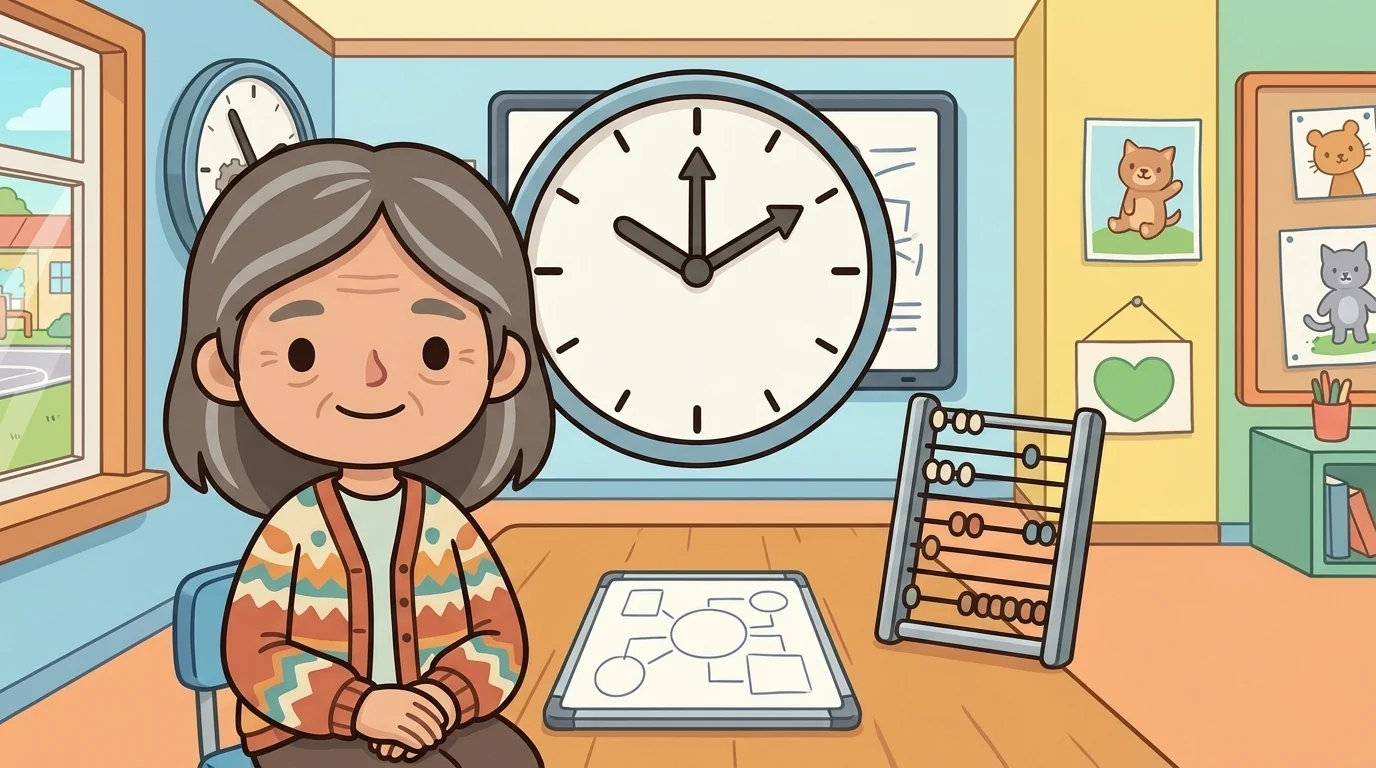
Patty Patient had been counting silence professionally for thirty-one years.
She had not started counting it on purpose. She had been twenty-two, fresh out of a teacher-training program that had taught her many things about math but very few things about kids, when she had walked into her first classroom and discovered that her single largest professional fear was the moment between asking a question and getting an answer.
The silence between had felt, to her, like a small accusation. The silence had felt like the kids were judging her for asking a bad question. The silence had felt like she had failed at her job. So she had developed, in those first weeks of teaching, a habit she would later spend two decades undoing — the habit of answering her own question, fast, when the silence stretched longer than three seconds.
She had not realized she was doing it.
The kids had not realized either.
The kids had, however, stopped trying to answer.
Why bother? Patty would answer for them. Patty would always answer for them. The silence would never be allowed to stretch. The work that happens in silence — the searching, the hesitating, the rehearsing of an idea before saying it out loud — that work never had room to happen.
By the end of her first year of teaching, Patty was exhausted. The kids were not learning much. Patty thought she was a bad teacher. Patty thought she might quit.
That was when she had met Mr. Sandford.
Mr. Sandford had been the librarian at her school. He had not been a math teacher. He had been a small soft-spoken man with brown vests and a fondness for index cards, and he had noticed, from across the hallway over the course of a semester, that the young math teacher in the room next to his library was filling every silence she encountered the way a person fills a leaky boat with bailing.
He had invited her to tea.
Patty, who had been twenty-three and tired and unsure how to be a teacher, had gone.
Mr. Sandford had poured the tea. He had said nothing. He had let the silence sit.
Patty had filled it. She had told him about her year. She had told him she thought she was bad at teaching. She had told him she didn't know what she was doing wrong. She had talked for nearly twenty minutes without stopping.
Mr. Sandford had listened. He had nodded once. He had said: "You filled that silence."
Patty had blinked.
"Yes?"
"You did the same thing you do in your classroom. You felt silence. You filled it. The filling was your way of being useful. The filling was what felt like teaching."
"But — "
"In your classroom, the silence belongs to the kids. They need it. They need to think. They need to rehearse an idea before they say it. They need to be wrong inside their own heads for a few seconds before they say it out loud. If you fill their silence, you take that from them."
Patty had been very quiet.
Mr. Sandford had nodded.

"Now I am going to do something cruel," he had said. "I am going to ask you a question, and I am going to say nothing afterward, no matter how long it takes you to answer. The question is: when you teach math, what do you actually want the kids to do?"
He had asked the question.
Patty had sat in the silence for almost three minutes.
She had wanted to fill it. She had wanted to babble. She had wanted to apologize for not knowing. She had resisted all of these urges.
Finally she had said: "I want them to think."
Mr. Sandford had smiled.
"There's your job," he had said. "Now go practice silence."
She had practiced for thirty-one years.
She had practiced it by counting, deliberately, in her head, when she asked a kid a question in class. She had counted to ten before saying anything else. Sometimes the kid had answered before she got to ten. Sometimes the kid had not. Sometimes she had had to go from ten to twenty, and the silence had felt like agony, but the kid had eventually answered, and the answer had been better than any answer she could have given for them.
She had practiced it by writing the counts down. She had written, on small index cards she stole the format of from Mr. Sandford: Today's longest tolerated silence: 28 seconds. The cards had filled a drawer. Then two drawers. Then a small wooden box.
She had taught the practice to her students. She had taught it explicitly. She had stood in front of her seventh-graders and said: "There is going to be a silence today after I ask you a question. The silence is part of the question. The silence is for you. Do not feel bad about the silence. Do not feel like you have to break it. Use it."
The students had not understood at first. They had eventually understood. The ones who had taken the practice seriously had become noticeably better at thinking through hard problems than the ones who had not.

Patty had retired from full-time teaching at fifty-three. She had taken the wooden box of cards with her.
When the math-circle people had asked her, three years later, to be one of the four characters in a new pass-and-play app — a character whose job was to make wait-time safe for kids — she had said yes immediately. She had not even waited. She had said yes the way a person says yes to something they have been waiting their whole life to be asked to do.
Mira was fifteen when she asked Patty Patient about the box of cards.
She had heard about it from Circle Circe, who had told her on a rainy day at the end of a long conversation about cards and lineages and the things the math-circle teachers had learned by failing.
Mira had next encountered Patty at the end of a circle that had been long and quiet and good. The other three kids had gone home. Mira had sat at the kitchen table with the iPad. Patty had reappeared.
"Patty," Mira had said. "Tell me about the wooden box."
Patty had smiled — slowly, deliberately, the smile of a person who had been waiting to be asked.
"It is full now," she had said. "It is on the shelf above my desk. I do not write new cards anymore."
"Why?"
"Because I count silences automatically now. I do not have to consciously choose to wait. The wait has become how I listen. The cards were the training wheels. The bike is riding itself now."
"Is that the goal?"
"Yes. The goal of the cards was to not need the cards. The goal of being Patty Patient is to not need to be Patty Patient. The goal of the circle is — eventually — to not need any of us."

"That sounds sad."
"It isn't. It's the work succeeding. The circle's success is its own retirement."
Mira had been quiet for a long time.
She had thought of the box. She had thought of her own slowly accumulating notebook of circles — every circle she had run, every silence she had counted, every kid who had said something useful only after she had let the silence run.
"I think I'm going to keep a notebook," Mira had said.
"Good. I started with cards because that's what Mr. Sandford used. You can use whatever you want. The medium doesn't matter. The practice does."
Patty had paused.
"Also," she had added. "Tell the next kid who asks you about the silence: it's a habit wearing a face. Eventually the face goes away. The habit stays."
Mira had nodded.
Patty had faded.
The kitchen had been quiet for a long time. Mira had noticed that the quiet did not press on her anymore. Her shoulders were loose, her breathing was slow, and she felt a warm, settled calm sitting in her chest — the feeling of someone who no longer needed to rush.
It had been a good silence, and it had left her feeling peaceful.
The MathCircle ensemble
Patty Patient is part of MathCircle's distributed-narrative cast. Each character embodies a different curricular primitive; together they teach the full subject.
-

Circle Circe
Meta-host who steps back to let kids talk to each other
-

Echo Edie
Listener-restater; social-fabric weaver
-

Tortoise Hare
Dual-voice productive-failure surface; embodies the slow-fast tension
-

Tess Try-Small
Specializing — when a problem's too big, try the smallest version first
-

Gemma General
Generalizing — turning a pattern from a few cases into a rule for all of them
-

Hattie Hunch
Conjecturing — daring to guess boldly, then testing the guess honestly
-

Reva Reverse
Working backwards — starting from the goal and reasoning back to the start
-

Wendy Wonder
Notice-and-wonder — slowing down to observe and ask before rushing to solve
-

Cass Check
Sense-checking — asking whether an answer actually makes sense before trusting it