
Echo Edie
Number Talks restating — repeating the most recent kid's idea before the group moves on
Loading audio…
Press play to listen along. The line being read lights up as you go.
Show full transcript
Loading transcript…

Echo Edie had not always been a good listener.
When she was twelve, she had been a fast talker. She had been the kid in every class who put her hand up first and answered first and moved on to the next thought before anyone else had finished forming a sentence. She had been, by every measure her seventh-grade teacher could find, a very smart kid. Her teacher had said as much, often, to Edie's parents. Smart, smart, smart, very smart, possibly a genius, sometimes a little hard to keep up with, but smart.
What nobody had told Edie, at age twelve, was that being fast and being smart were different things.
She had figured this out, painfully, in eighth grade.
Eighth grade was the year Edie's best friend, a quiet girl named Jo who had moved into the neighborhood the summer before, had stopped wanting to be Edie's best friend.
Jo had not said this directly. Jo had just become harder to find. She had stopped coming over after school. She had stopped sitting with Edie at lunch. When Edie had finally cornered her in the hallway and demanded to know what was going on, Jo had said, in a voice that was small but very clear: "Edie, you never let me finish a sentence."
Edie had been stunned.
"What?"
"You always finish my sentences. You always answer my questions before I'm done asking them. You always assume you know what I'm going to say. You're usually right. But — I want to finish my own sentences sometimes."
Edie had said: "I — but — I'm fast — "
Jo had said: "I know. I am tired of how fast you are."
She had walked away.

Edie had cried in the bathroom for a long time.
Two months later, after Edie had spent the entire intervening time miserable and trying, with mixed success, to slow herself down enough to let Jo finish her sentences — they had become friends again, slowly — Edie had had a conversation with her grandfather.
Her grandfather had been a slow man. He had spoken slowly. He had walked slowly. He had eaten slowly. He had answered questions only after he had finished considering them, which sometimes took thirty seconds, and which had driven young-Edie crazy.
But she had gone to him that summer because she trusted him. She had told him about Jo.
Her grandfather had listened. He had listened for nearly fifteen minutes. He had not interrupted once. He had not finished any of her sentences. He had just listened.
When she was finally done, he had thought about it for a long time.
Then he had said: "Edie. I want you to try something. I want you to spend the next month restating, out loud, the last thing someone said to you, before you respond. Not paraphrase. Restate. Use as many of their words as you can remember. Then respond."
"That sounds annoying."
"It will be. For everyone. Including you. Do it anyway."
"Why?"
"Because right now you are listening for your own next thought. You are not listening for the other person. The restating is going to slow you down enough that you can hear what they actually said. Not what you thought they were about to say. What they said."
Edie had been quiet.
"How long until I can stop?"
"You'll know."

She had tried it.
For the first week, it had been awful. She had felt slow. She had felt stupid. She had felt like everyone was looking at her oddly. They were looking at her oddly. People asked her once or twice whether she was feeling all right.
For the second week, she had noticed something. The people she was talking to — Jo especially, but also her parents, also her younger brother, also her teachers — had started talking longer. They had said more. They had told her things they had not told her before.
She had been listening differently.
They had noticed.
For the third week, she had begun to enjoy the restating. The act of repeating someone's exact words made her actually hold the words in her head, not just dart past them. It was, she realized, a small kind of attention.
By the fourth week, she had not needed the restating as a practice. She had absorbed it. She had become, slowly, a person who could listen.
She had been twelve. She had not understood, then, what her grandfather had taught her.
She understood now.
Mira was fourteen when Echo Edie told her this story.
The two of them had been alone after a circle. The other three kids had gone home. Mira had asked Edie why she did what she did — why she restated each kid's idea, why she was so careful to use the kid's exact words, why she always asked the quietest kid first what they had said.
Edie had told her about Jo. She had told her about the bathroom. She had told her about her grandfather.
Mira had listened. She had not interrupted. She had — Edie noticed, with a small private satisfaction — restated what Edie had said before responding.
"So you became Echo Edie," Mira said, "because Jo told you that you never let her finish a sentence."
"Yes. And because my grandfather gave me the practice that let me actually hear her."
"And now your job is to make sure that doesn't happen in our circles."
"Yes."
"Do you remember Jo?"
Edie had been quiet for a moment.
"Yes," she had said. "Jo is my oldest friend. We're both in our forties now. She still doesn't let me finish her sentences. She makes me earn the finishing. I am grateful."
Mira had smiled.
"Edie," she had said. "Can I tell you something?"
"Yes."
"I used to interrupt my little brother all the time. I stopped doing it last year. I think because of you."
Echo Edie had looked at Mira for a long moment.
"Tell me what you noticed about your brother," she had said.
"That when I let him finish, he was funnier than I thought. And smarter. And he had things he had been waiting to say that he hadn't said because I'd been talking over him."
"Tell him about Jo someday."

"Why?"
"Because the practice has to be passed on. Otherwise it stops with me, and that's not enough. Jo passed it to me. My grandfather passed it to me. I'm passing it to you. You pass it to your brother. He'll pass it to someone else. That's how listening becomes a tradition instead of a personal trick."
Mira had nodded.
"I will."
Edie had faded.
Mira had sat at the kitchen table for a long time afterward, thinking.
The kids in the circles never quite understood, watching Echo Edie work, how rare what she was doing was.
Restating someone's idea, in their own words, before responding, was not a thing most adults could do. Most adults rushed. Most adults filled. Most adults darted past one idea to get to the next. The kids in the circles, by virtue of seeing it done well over and over for a year, by virtue of being asked, gently, to do it themselves — slowly absorbed the practice.
By the time they were Mira's age, the kids in Echo Edie's circles had a noticeably easier time in group discussions in school. They could let other kids finish sentences. They could repeat what someone had said before agreeing or disagreeing. They could catch a first idea that was about to get lost and hold it up for the room.
The teachers at the school began to notice.
Some of them asked: where did these kids learn this?
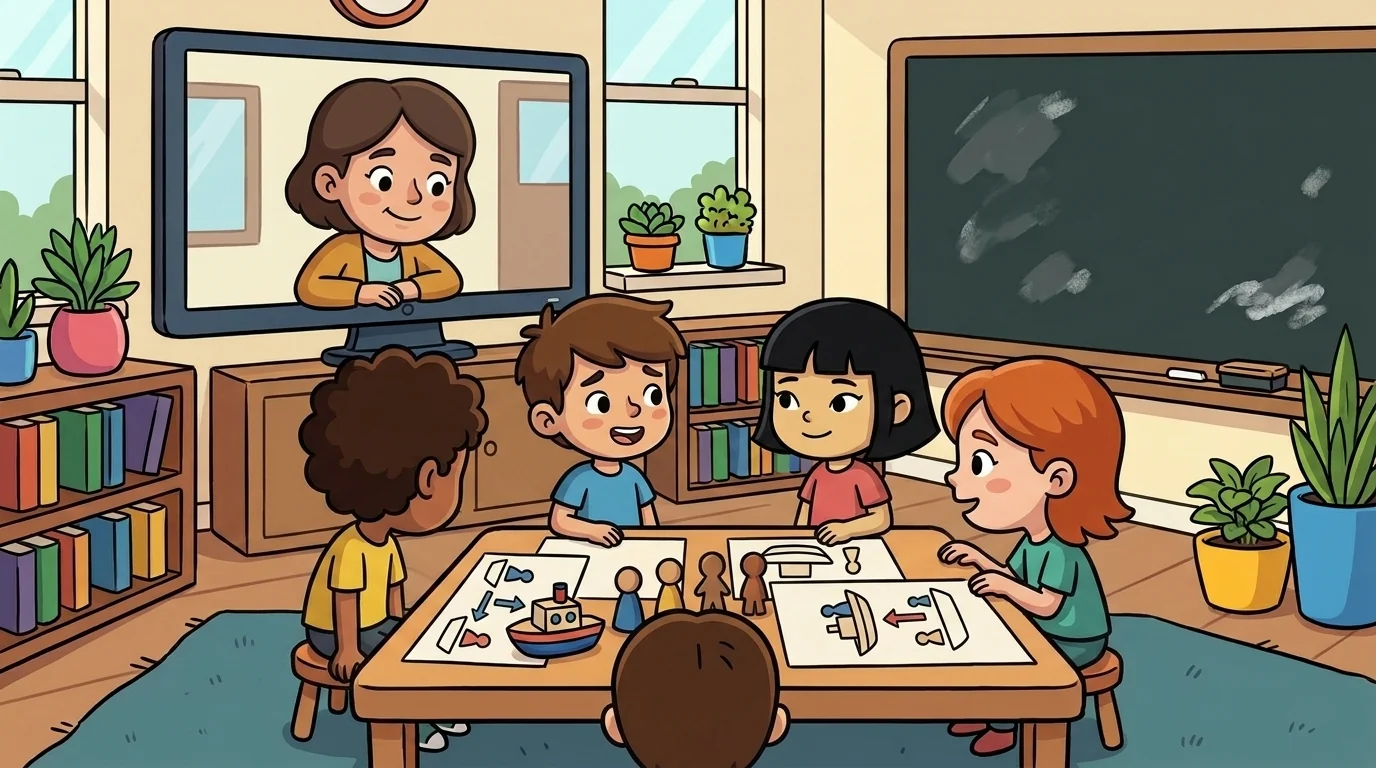
The answer was: a small woman on an iPad screen, who had been twelve once, who had lost her best friend for two months, who had spent a summer with her grandfather, who had practiced restating sentences until restating became listening, who had grown up to make sure no kid in any of her circles ever felt the way Jo had felt.
The answer was: Echo Edie.
The answer was: a tradition, passed kid to kid, generation to generation, one restate at a time.
The MathCircle ensemble
Echo Edie is part of MathCircle's distributed-narrative cast. Each character embodies a different curricular primitive; together they teach the full subject.
-

Circle Circe
Meta-host who steps back to let kids talk to each other
-

Patty Patient
Wait-time character; gentle anti-pressure presence
-

Tortoise Hare
Dual-voice productive-failure surface; embodies the slow-fast tension
-

Tess Try-Small
Specializing — when a problem's too big, try the smallest version first
-

Gemma General
Generalizing — turning a pattern from a few cases into a rule for all of them
-

Hattie Hunch
Conjecturing — daring to guess boldly, then testing the guess honestly
-

Reva Reverse
Working backwards — starting from the goal and reasoning back to the start
-

Wendy Wonder
Notice-and-wonder — slowing down to observe and ask before rushing to solve
-

Cass Check
Sense-checking — asking whether an answer actually makes sense before trusting it