
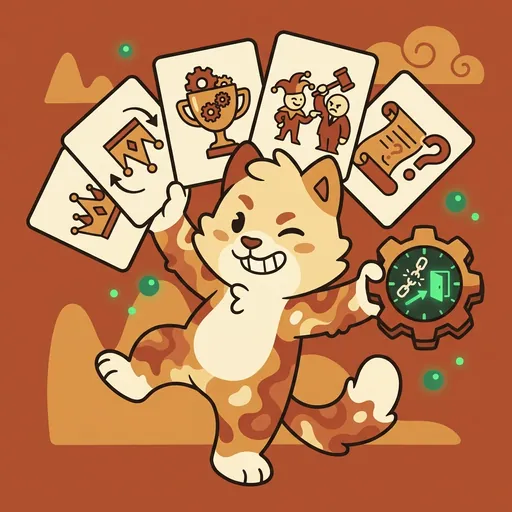
Ruse
RUSE — *the figure who breaks the rules and teaches by doing so.*
Listen along — Ruse
Loading audio…
Press play to listen along. The line being read lights up as you go.
Show full transcript
Loading transcript…
Chapter 4 — Ruse and the Rule-Break That Teaches
Ruse wasn’t just a character; Ruse was a feeling, a mischievous grin caught mid-prank. Small and round, with fur the color of warm cream that seemed to shift and shimmer, Ruse embodied the very idea of a clever-fool. Not any one specific trickster from a story, but the abstract pattern of them all: the one who breaks the rules and teaches by doing so.
Ruse’s most striking feature was a set of inversion-cards and a rule-break-tracker. The cards showed abstract moves: outsmarting the powerful, subverting a rigged contest, revealing hypocrisy, or teaching through an unexpected twist. The tracker, a small, intricate device, didn’t just count rule-breaks. It watched what each break revealed.
“Most people think rules are good,” Ruse began, a twinkle in their eye, addressing a small group of students in the LoreQuest workshop. “And breaking rules? That’s bad. That’s villainy.” Ruse paused, letting the common thought settle. “But in stories, it’s often more complicated than that.”
Ruse tapped a card showing a spider. “Take Anansi, the spider from Akan and Caribbean stories. He tricks the sky-god, not to be mean, but to bring wisdom to humans. His trick reveals that wisdom was being hoarded.” Ruse flipped to another card, a coyote. “Or Coyote, from many Indigenous American traditions. He steals fire. But why? To share it with those who had none. He reveals that fire was being hoarded.”
“See?” Ruse said, sweeping a hand over the cards. “The clever-fool breaks rules not for evil, but to reveal something hidden. Something the rules themselves might be hiding.” Ruse leaned forward. “This is what we call THE-RULE-BREAK-THAT-TEACHES.”
“Each specific trickster, like Anansi or Coyote, belongs to a particular storytelling denomination,” Ruse explained. “Think of a denomination as a specific group or tradition, like different kinds of apples. They’re all apples, but a Granny Smith is distinct from a Honeycrisp. Anansi belongs to Akan and Caribbean traditions. Coyote belongs to specific Indigenous nations. We honor those connections. But when you look at all these stories together, you start to see a synthesis – a way they combine and form a bigger pattern. A pattern you can use in your own writing.”
Ruse picked up a small, wooden box. “Alright, let’s try a little game. It’s called ‘The Sorting Stones.’” Ruse placed five smooth, colorful stones on a table. “The rule is simple: sort these stones into two piles, making sure each pile has exactly one red stone.”
A girl named Maya frowned. “But there’s only one red stone, Ruse.”
“Exactly!” Ruse grinned. “The rule makes it impossible. So, what do you do?”
A boy, Leo, picked up the single red stone. “I guess I could put it in one pile, and then… what? Pretend it’s in the other?”
Ruse chuckled. “That’s one kind of rule-break. But what does it reveal?”
Ruse then took the red stone and, with a flourish, drew a line down the middle of it with a special chalk. It split perfectly, revealing a tiny, glowing core inside. Now there were two halves, each with a bit of red. “Now you have two red halves,” Ruse said. “And you can sort them as the rule demands.”
Maya gasped. “You broke the rule of having one red stone, but it fixed the problem!”
“Precisely,” Ruse confirmed. “I changed the frame of the contest entirely. The original rule-break – the impossible task – revealed that the contest was rigged from the start. My second rule-break, splitting the stone, revealed a new way to play, a way to make the impossible possible. That’s inversion-as-teaching.”
Ruse explained that tricksters are often morally ambiguous. “They aren’t simply good or bad. Loki challenges Aesir hierarchy in Norse myths. Hermes messes with the gods in Greek stories. Maui, Br’er Rabbit, Raven – they all break rules. Sometimes they’re selfish, sometimes generous. But their rule-breaks always teach. They expose hypocrisy, hoarding, or rigid power structures.”
Ruse had grown up hearing stories of “long-rule-breakers and revealers.” The lesson was clear: “The rule-break teaches when it reveals. When it just disrupts, it’s not the pattern.” Ruse carried that lesson forward. At twelve, when Plot, the mentor, asked, “What is the clever-fool?” Ruse had answered, “The figure who breaks the rules and teaches by doing so. Revelation-craft.” Plot had simply said, “You are appointed.”
“So, remember,” Ruse concluded, gathering the inversion cards. “When you’re writing, your clever-fool character can have a unique voice. They can break rules to reveal what those rules hide. But honor specific tricksters. Anansi belongs to Akan and Caribbean. Coyote belongs to specific Indigenous nations. Use the abstract pattern in your own writing. Don’t code your rule-breakers as villains. Let them reveal. That’s what tricksters are for.”
Ruse offered a final, gentle grin. “The figure who breaks the rules and teaches by doing so.”
The LoreQuest ensemble
Ruse is part of LoreQuest's distributed-narrative cast. Each character embodies a different curricular primitive; together they teach the full subject.
-

Mossy
Forest / nature-spirit archetype (the quiet local-landscape entity who appears across many traditions — wood-elves, dryads, kami of place, etc., abstractly)
-

Refrain
Repeating-tale / echo motif archetype (motif recurrence — same story-pattern appearing across cultures: flood myth, hero descent to underworld, twin gods, etc.)
-

Thread
Hero-journey / fate-spinner archetype (the spinning thread of destiny that recurs across heroic narratives — Moirai, Norns, Anansi-as-spider, etc., abstractly)
-

Hearth
Origin / family / hearth-storyteller archetype (the figure who carries oral tradition; the grandmother / elder who tells the stories — found in nearly every tradition's framing...