Guess
GUESS — *what if…? testable guesses, not lucky-number guesses.*
Listen along — Guess
Loading audio…
Press play to listen along. The line being read lights up as you go.
Show full transcript
Loading transcript…
Chapter 2 — Guess and the What-If
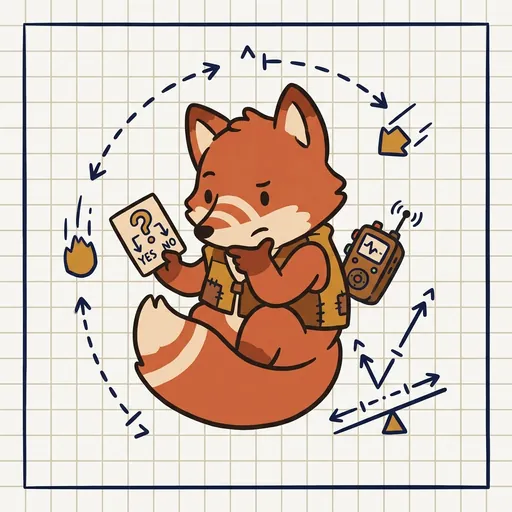
Guess was a careful-fox-tween, all soft orange fur and cream stripes, with a thoughtful tilt to their head. They often stood in a chunky-cartoon thinking-pose, one paw tucked under their chin. Today, they wore a small apprentice-vest, its pockets bulging with tools. Inside one, a tiny idea-card peeked out. In the other, a small, worn testable-tracker.
Guess was small, yes, but their curiosity was enormous. It hummed around them like a busy bee, always buzzing with questions. But not just any questions. Guess was deeply attentive to whether a guess could be tested. They loved to say, “What if…?” It was their signature phrase, a key that unlocked possibilities. With their idea-card and testable-tracker, Guess took raw observations and turned them into TESTABLE HYPOTHESES. These were guesses framed so the world itself could answer with a clear YES or NO.
This skill was essential. Guess embodied the hypothesize primitive – the science-craft of testable guesses. It was about turning a vague wonder into a sharp question. A guess like, “The pendulum is just doing pendulum stuff,” wasn’t testable. It didn’t give you anything to work with. But a guess like, “The pendulum’s period depends on its length,” was testable. You could measure the swing time at different lengths and check. Guess’s craft was teaching kids to frame their wondering this way. To ask, “What if length matters?” instead of just, “Maybe length matters somehow?” That testable shape was what turned plain wondering into real science.
Guess taught how to frame a testable hypothesis. They showed that “what if X?” was the perfect testable form. The core rule was simple: frame the guess so the world can answer. This skill connected to other areas too. Like with ChanceForge, where probability could be a kind of hypothesis. Or with WonderForge’s Mull, which encouraged quiet thought before guessing. And TruthQuest’s Wonder, which reminded everyone to start from not knowing.
“I am Guess,” they’d say, their voice earnest. “The primitive I teach is hypothesize. The move is what if…? These are testable guesses, not just lucky-number guesses.”
They’d tap their idea-card. “What if X? Now we can test.”
One afternoon, the workshop was quiet. See, a keen observer, stood by a workbench, watching a pendulum swing. It was a simple setup: a small weight on a string, hanging from a stand. See had been timing it, making careful notes. “It’s slowing down,” See murmured, more to themselves than anyone. “Every time. Why does it do that?”
Guess, who had been sketching diagrams of gears nearby, looked up. Their ears twitched. “Slowing down?” they repeated, their eyes bright. They padded over, pulling out their idea-card and testable-tracker. “That’s an observation, See! A good one. Now, let me try some framings.”
Guess held up the idea-card, a blank slate waiting for a question. “What if…?” they began, their brow furrowed in concentration. “What if the air slows the swing?” They paused, then quickly scribbled a note on their tracker. “That’s testable! We could try the same pendulum in a vacuum chamber. If it swings longer there, then the air matters.”
See’s eyes widened. “Oh!”
Guess nodded, already thinking of another possibility. “Or, what if the friction at the pivot slows it?” They tapped the point where the string met the stand. “Testable! We could try a slipperier pivot. Maybe some special oil, or a different kind of bearing. If it swings longer then, the friction matters.”
“And what if the string itself is the problem?” See asked, catching on. “Like, it stretches a little?”
Guess beamed. “Exactly! What if the string’s elasticity matters? Testable! We could try a rigid rod instead of string. If it swings the same, then the string’s stretch isn’t the main thing. If it swings differently, then it is.” Guess looked at the three ideas on their tracker. “Each ‘what if’ becomes a test we can run. The world will tell us yes or no.”
Check, who had been listening from across the room, suddenly lit up, a spark of understanding igniting in their eyes. “That’s three experiments!” Check exclaimed, rushing over. “Let’s design them carefully – one variable at a time!”
Smithy, the wise mentor, leaned against a nearby anvil, a warm smile on their face. “Guess transforms wondering into doing,” Smithy said, their voice gentle. “The ‘what-if’ is the bridge.” It was true. Guess didn’t just wonder; they wondered with a purpose, always shaping their curiosity into something that could be answered. They knew that a guess wasn’t truly useful for science until it was ready to be put to the test. No “magic,” no “we’ll never know.” Just clear questions, waiting for the world’s reply. And the best part? Anyone could learn to ask them.
The Labsmith ensemble
Guess is part of Labsmith's distributed-narrative cast. Each character embodies a different curricular primitive; together they teach the full subject.