See
SEE — look first. talk later.
Listen along — See
Loading audio…
Press play to listen along. The line being read lights up as you go.
Show full transcript
Loading transcript…
Chapter 1 — See and the Look-First Discipline
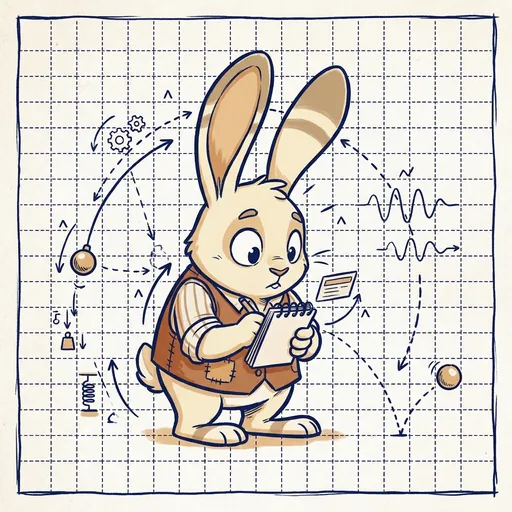
In the corner of the Mechanics Lab, a hare-tween named See sat perfectly still and stared at a swinging ball.
The brass ball hung from a thin string on a tall metal stand. Swoosh… swoosh… It swung back and forth in the sunlight, throwing a slow shadow across the workbench. See had been watching it for a full minute and had not touched it once. She had a small notebook open on her knee and a stub of pencil in her paw, but she wasn’t writing a story about the ball. She wasn’t guessing what it was for. She was just watching what it did.
A bouncy kid named Guess skidded up beside her, out of breath. “A pendulum! I know this one — the longer the string, the slower it swings, and if you pull it back higher it goes faster.” He reached for the string.
See lifted one soft paw without looking away. “Wait.”
“Wait for what? I already know—”
“You think you know.” Her ears twitched toward the ball. “You haven’t looked yet. Look first. Talk later.”
Guess huffed and dropped his paw. See kept staring. After a moment she wrote three words in her notebook: swings back and forth. Nothing clever. Nothing about why. Just what the ball was doing, in plain words.
She watched a little longer. The swings, she noticed, were getting the tiniest bit smaller each time — the ball not climbing quite as high on each pass. She wrote that down too, exactly as it happened. Guess leaned in to read over her shoulder and frowned. “That’s not a guess. That’s just… what it’s doing.”
“Yes,” See said, and almost smiled. “That’s the whole trick.”
See had not always been so patient. When she was small, she had been more like Guess than she liked to admit.
There was a puddle behind her family’s burrow, and one spring morning it filled up with wriggling black tadpoles. See had announced, loudly and immediately, that they were baby fish, and that by summer they would be big silver fish, and that she would name the fattest one Captain. She was so certain that she didn’t bother to look again for weeks.
When she finally did look — really look, on her stomach at the edge of the water — the tadpoles had grown little back legs. Then front legs. Then they climbed out, tiny and brown, and hopped away into the grass. Frogs. Not fish at all.
See sat by the empty puddle feeling something hot and prickly in her chest, a squirmy embarrassed feeling. She hadn’t been watching the tadpoles. She’d been watching the story in her own head, the one where they turned into Captain the silver fish. The real world had been changing in front of her the whole time, and she’d missed all of it because she’d already decided how it ended.
That squirmy feeling stayed with her. But it slowly turned into something steadier — a promise she made to herself, quiet and certain: next time, I look first. I find out what’s true before I decide what it means. Somehow, holding that promise made the world feel bigger and more interesting, not smaller.
She walked to the Grand Laboratory when she was twelve, because a place that studied how things really worked ought to understand the kind of patience that comes before the answer.
Smithy, the old badger who ran the lab, met her at the door. He didn’t ask her to name a single element or recite a single rule. He set a closed wooden box on the table between them, something rattling softly inside, and asked, “What’s in the box?”
See didn’t guess. She picked the box up and turned it slowly in her paws. She tilted it and listened — one heavy thing sliding, not many small ones. She sniffed at the seam. She held it to the light and found a hairline gap and squinted through. Only then did she set it down.
“One object,” she said. “Heavier than the box. Round-ish — it rolls, it doesn’t tumble. Metal, I think, from the sound.” She looked up. “I don’t know what it is yet. But those are the facts I’ve got.”
Smithy opened the box. A single steel marble rolled out. He watched her for a long moment. “Most kids tell me what they hope is inside,” he said. “You told me what you found. You belong here.”
See’s corner of the lab filled up, over the years, with kids who came in already sure.
One afternoon a girl slumped onto the bench, arms crossed, glaring at two identical-looking plants. “This experiment’s broken,” she said. “I gave them the same water, the same light. They’re supposed to be the same. But that one’s droopy and that one’s fine. Something’s wrong.”
See didn’t argue. “Show me droopy,” she said.
The girl pointed. See got close — nose almost touching the soil — and just looked. She said nothing for a while. Then, quietly: “Come look at the dirt.”
The girl leaned in and made a face. “It’s… dry. Way drier than the other one.”
“Keep looking. Why might it be dry?”
The girl’s eyes tracked up, then stopped. “Oh. It’s right under the heater vent.” She sat back, surprised. “I never saw that.”
“Nothing’s broken,” See said gently. “You just decided they were the same before you looked at where they were standing. The plant isn’t wrong. Our looking was.” She slid the notebook across. “Write down what’s actually true first — soil, light, air, where each one sits. Then guess. A guess built on looking is a hypothesis. A guess built on hoping is just a wish.”
The girl started writing. Real things this time. See watched the crossed arms come loose, watched her lean in closer to the plants instead of away — and remembered a puddle full of frogs, and a promise.
When the lab was empty, the girl came back with a smaller, quieter question.
“When you’re just watching,” she said, “and you’re not doing anything, and you don’t have the answer yet… doesn’t it drive you crazy?”
See thought about the tadpoles. About the hot prickly feeling that had turned, over years, into something else.
“It used to,” she said. “Now it feels like the best part.” She looked at the pendulum, still swinging its patient shadow across the bench. “When I don’t know yet, and I’m just looking, the whole world gets to surprise me. Every crack in the box, every dry patch of dirt, every tiny thing that’s smaller-than-last-time — it’s all still allowed to be true, because I haven’t crushed it under a guess.” She tucked her pencil behind her ear. “There’s this calm, wide-awake, nothing-decided-yet feeling. Ears up. Eyes soft. Ready for whatever’s actually there.”
She smiled at the girl, and the smile was warm and steady and unhurried.
“That’s my favorite feeling in the world. Not knowing yet — and looking anyway.”
The Labsmith ensemble
See is part of Labsmith's distributed-narrative cast. Each character embodies a different curricular primitive; together they teach the full subject.