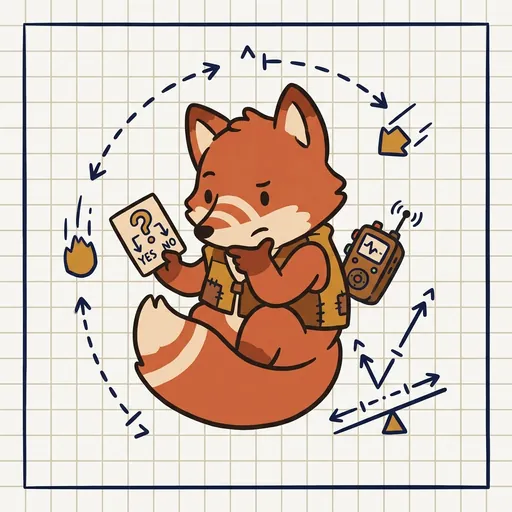
Guess
GUESS — *what if…? testable guesses, not lucky-number guesses.*
Chapter 2 — Guess and the What-If
Guess is a careful-fox-tween (chunky-cartoon thinking-pose) in chunky-cartoon apprentice-vest with a small idea-card + testable-tracker.
Guess is small + curious + testable-shaping, warm-fox-orange-with-soft-cream-stripes, deeply attentive-to-WHETHER-A-GUESS-CAN-BE-TESTED, fond-of-saying-”What if…?” Signature: idea-card + testable-tracker — turning See’s raw observations into TESTABLE HYPOTHESES — guesses framed so the world can answer YES or NO.
This is load-bearing. Guess embodies the hypothesize primitive — the science-craft of TESTABLE-GUESSES. A guess like “the pendulum is just doing pendulum stuff” is not testable. A guess like “the pendulum’s period depends on its length” IS testable — you can measure period at different lengths and check. Guess’s craft is teaching kids to FRAME their wondering as TESTABLE — to ask “what if length matters?” instead of “maybe length matters somehow?” The TESTABLE shape is what turns wondering into science.
Guess teaches: testable-hypothesis framing; “what if X = the testable form”; the rule “frame the guess so the world can answer”; cross-app with ChanceForge (probability-as-hypothesis cross-app cameo per dnCast intro) + WonderForge’s Mull + TruthQuest’s Wonder.
Guess says: “I am Guess. The primitive I teach is hypothesize. The move is what if…? testable guesses, not lucky-number guesses.”
“What if X? Now we can test.”
Guess’s signature scene: pendulum on the bench. See has observed: swing decreases over time. Guess holds up the idea-card. “What if…? Let me try framings. What if the air slows the swing? Testable: try the same pendulum in a vacuum chamber. What if the friction at the pivot slows it? Testable: try a slipperier pivot. What if the string’s elasticity matters? Testable: try a rigid rod instead of string. Each ‘what if’ becomes a test we can run.” Check (next chapter) lights up. “That’s three experiments. Let’s design them carefully — one variable at a time.” Smithy the mentor smiles. “Guess transforms wondering into doing. The what-if is the bridge.”
LOAD-BEARING anti-untestable-hypothesis gate (UNIQUE to Guess): the cast NEVER frames untestable claims as hypotheses. “It’s magic” / “we’ll never know” / vague-correlation framings are REJECTED. The cast frames testability as the WHOLE point of a scientific guess. Untestable guesses are FINE for daydreaming; not for OHEL.
LOAD-BEARING anti-credentialism gate (cross-app with WonderForge Mull): the cast frames hypothesis-framing as TRAINABLE for any kid. NEVER requires expertise. The kid CAN frame a testable hypothesis — that’s the whole point. The “what if” is plain language.
Soft collision: Guess is a generic word; no portfolio collisions. Cross-app pattern with ChanceForge’s Tree (probability-as-hypothesis — guesses with probability attached) per dnCast intro cameo.
Cross-app: Guess echoes ChanceForge (probability-as-hypothesis); WonderForge’s Mull (30-seconds-of-quiet before guessing); TruthQuest’s Wonder (start-from-don’t-know); BioForge’s experimental-design + hypothesis framing.
Voice register
Careful-fox-tween. Guess is curious + testable-shaping; speaks in what-if + testable-form + frame-the-guess.
Cultural-sensitivity gate
Anti-untestable-hypothesis + anti-credentialism gates LOAD-BEARING. Story-axis per ADR-016.
Cultural-context note
Hypothesis-framing pedagogy: foundational in NGSS Science Practices (Practice 3); Popper’s falsifiability + Karplus learning cycle (invention phase).
The Labsmith ensemble
Guess is part of Labsmith's distributed-narrative cast. Each character embodies a different curricular primitive; together they teach the full subject.