
The Solved Board (Gridley · Arbor · Rowan)
THINKING AHEAD → SOLVING — the game tree connects a human skill to a computer one. Rowan plays a move now. Arbor climbs the tree of futures a few branches deep to choose it well. And a game is "solved" when someone climbs the *whole* tree — Gridley's "how a game gets solved" story. Human thinking-ahead and machine game-solving are the *same act* at different depths: explore the tree, assume best play, back the value up.
Chapter — The Solved Board
Gridley, the family host, gathered his most different three students — a plain-move player, a tree-climber, and himself — to answer a question a kid had left on the suggestion board: “If computers already SOLVED some of these games, why should I bother playing?”
“It’s the best question anyone’s asked all year,” Gridley said, “and it takes three of us to answer it, because the answer lives in the space between how you play, how Arbor thinks, and how a machine solves. Rowan — you just make good moves. Arbor — you climb the tree. And I’ll tell the part about what happens when the whole tree gets climbed.” He set a small Connect-4 board between them. “Let’s walk from a single move all the way up to a solved game, and see if the kid still thinks there’s no point.”
Rowan went first, because he was the honest baseline. “I don’t do anything fancy,” he admitted, dropping a piece to extend his line. “I look at the board, I see where my connection could go, I make the move that helps it most. One move. Right now.” He shrugged. “I don’t map out futures. I just… play the best move I can see.” Gridley nodded, entirely unbothered. “And you win a lot of games that way — because ‘the best move you can see’ is a real skill.” He turned to Arbor. “But Rowan, how far ahead do you see?” “One move,” Rowan said. “Maybe two on a good day.” “Then watch what happens,” Gridley said, “when someone sees five.”
Arbor took the same board and began, as always, to sketch. “Rowan sees the move he’s standing on,” she said. “I climb a little way up the tree of what comes next.” She drew Rowan’s move, then the opponent’s best replies branching from it, then her replies to those. “If I go here, they’ll be forced to block there — Domino would love this — and that frees me to build a threat here, which they answer here, and then I have a double Twain would be proud of.” She traced five moves deep along just the strong branches. “I didn’t compute every future — nobody can, the tree’s too big. I pruned to the good branches and assumed you’d play your best at each fork. And backing it up, this branch wins, so I play toward it now.” Rowan stared at the sketch. “You saw my move,” he said slowly, “the same move I’d have made — but you know why it’s good, five steps before it pays off.” “Same move,” Arbor agreed. “Deeper reason. I’m just doing what you do, Rowan — picking the best move — but I picked it by visiting the future instead of guessing from the present.”
Then Gridley told the last part — the part that reached past both of them, to the machines. “Now imagine Arbor’s tree-climbing,” he said, “but instead of five branches deep, imagine going all the way — every branch, every reply, down to every finished game, win or lose, at the very tips. That’s what it means to solve a game.” He gestured at the Connect-4 board. “Someone did exactly that for this game. A computer climbed the entire Connect-4 tree — assuming best play at every single fork, backing the value up from every leaf — and proved that the first player, playing perfectly, always wins. Not usually. Always. The whole tree is known.” Arbor’s eyes were shining; this was her favorite thing in the world. “It’s what I do,” she breathed, “but complete.” “It’s exactly what you do,” Gridley said, “just without stopping at five branches. You climb part of the tree. The machine climbed all of it. Rowan climbs one branch by instinct. All three of you are doing the same act — explore forward, assume good play, choose accordingly — at one branch, at five, and at all of them.” He smiled at the three of them, standing in a row from instinct to depth to completeness. “Thinking ahead and solving a game aren’t two different things. They’re the same thing at three depths.”
Then Gridley answered the kid’s question. “So — why play a game a computer has solved?” He tapped the board. “Because knowing a fact and being able to see are different prizes. The machine solved Connect-4 so it could tell us who wins. But it can’t hand you the ability to look five moves ahead — that you have to grow, one branch at a time, the way Arbor grew it and the way Rowan is starting to.” He looked at Rowan. “Every game you play, you climb a little higher up the tree than last time. The machine’s prize was a fact. Your prize is becoming someone who sees further — and that prize works on games no computer will ever finish solving, like chess, like Go, like every real decision you’ll make where nobody’s climbed the whole tree and you have to see as far as you can yourself.” Rowan looked at Arbor’s five-deep sketch, then at his own one-move instinct, and felt the small, steadying relief of a worry lifting — the kid’s question had felt like it might make the whole game pointless, and instead it had made it feel bigger — and said, “So the point isn’t to be the computer. The point is to climb higher than I did yesterday.” “That,” said Gridley warmly, “is the whole point — of this game, and of most things worth getting good at.” And Arbor was already sketching a bigger tree, happy in the way she only ever was with one more branch left to climb.
The GridForge ensemble
The Solved Board (Gridley · Arbor · Rowan) is part of GridForge's distributed-narrative cast. Each character embodies a different curricular primitive; together they teach the full subject.
-
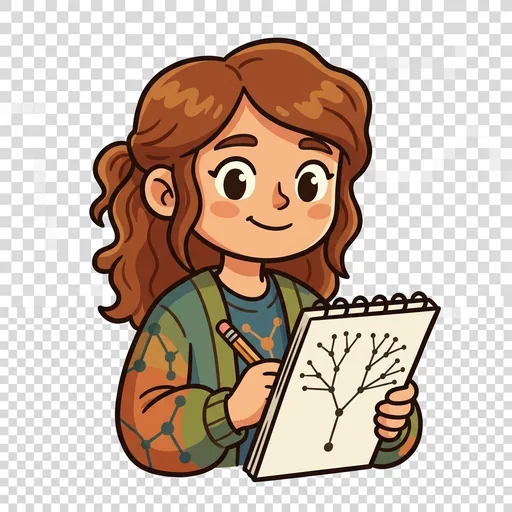
Arbor
The game tree: every position branches into the moves that follow
-
Ballast
Stability and corners: the unflippable pieces in Reversi
-
Causeway
The bridge: a virtual connection that cannot be cut in Hex
-
Domino
Forcing sequences: chaining threats to keep the initiative in Gomoku
-
Flank
Territory flip: capturing a line of pieces in Reversi
-
Mobi
Mobility: keeping more moves available than your opponent
-
Oddwin
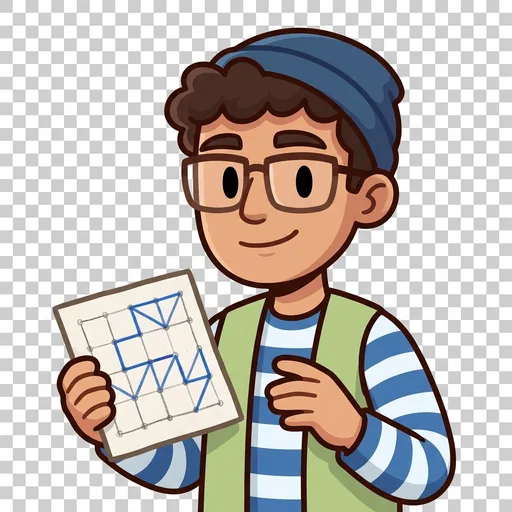
Parity: who-moves-last, the key to Dots-and-Boxes
-
Rowan
Connection: extending a chain of your pieces toward a win
-
Twain
The fork: one move that makes two threats at once