
Stride and Echo
LINEAR-AND-CONSTANT — a linear function changes at a steady rate (slope m); a constant function does not change at all (slope 0). Both are functions. The contrast between them defines what *rate of change* means.
Press play to listen along. The line being read lights up as you go.
Show full transcript
Loading transcript…

For ninety-one years, the village clock above the Linear bakery had marked the passing hours. Marn, the baker and Echo’s father, wound it carefully each Sunday morning. This clock, large and made of polished brass, was a beloved fixture. It hung from an iron bracket over the bakery’s front door, a landmark every villager passed at least twice a day. Its accuracy was remarkable for a village timepiece; it rarely strayed more than a minute off, season to season. This precision was a quiet point of pride for Marn, a testament to his Sunday-morning ritual.
Stride, a teacher at the academy, walked past the bakery every weekday at precisely seven-twelve. His route took him from the faculty cottages to the classrooms. The clock above the bakery door always matched his pocket-watch. He used the village clock to set his own timepiece once a month. Stride trusted this clock above all others, because his pocket-watch, in turn, kept time to his own steady pace.
Echo, Marn’s son, also walked to the academy each weekday morning. He left his cottage at the same predictable moment he had for the past six years. Echo rarely glanced at the clock. For him, the exact time felt unnecessary. He did not need to know the numbers. He simply left when he always left and arrived when he always arrived. The precise hour added nothing to his careful routine.
Then, one Tuesday morning in autumn, Echo passed the bakery and simply stopped. Stride, walking his usual five paces behind, paused as well. He stopped because Echo had stopped, though he didn't yet understand why. Echo gazed up at the clock above the bakery door. The clock face clearly showed seven forty-two. Stride pulled out his pocket-watch. Seven-twelve, his watch read.
"The clock has stopped," Echo said quietly.
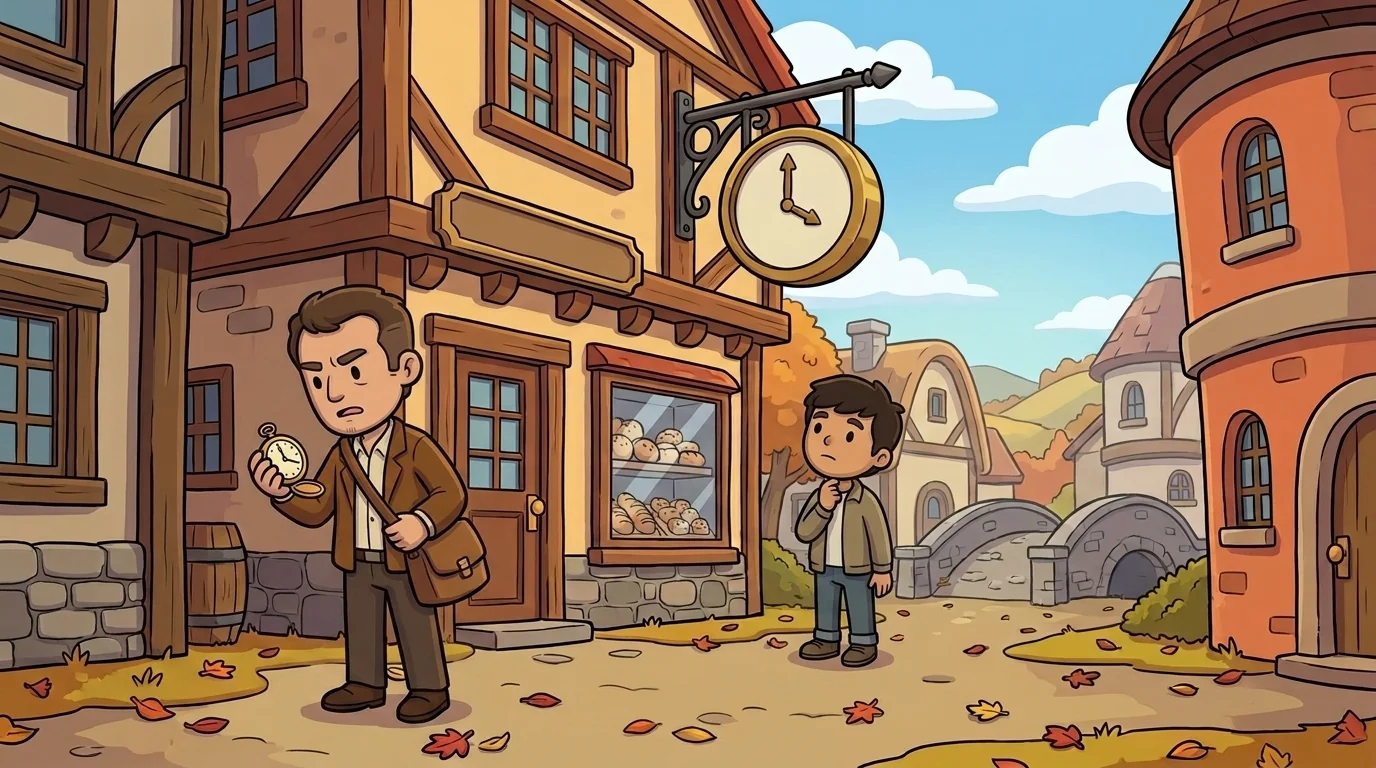
Stride studied the clock. The minute hand pointed to forty-two. The hour hand rested on seven. The second hand, however, remained perfectly still. He brought his pocket-watch closer, holding it beside the large brass face. His watch’s second hand swept smoothly around its dial. The village clock’s second hand did not move at all.
"It is stopped," Stride confirmed. "When did it stop?"
Echo considered the question. "I don't know," he replied. "I don't look at the clock. But it must have stopped recently. The angle still looks natural."
"What do you mean, the angle is still natural?" Stride asked.
"The minute hand hasn't drifted," Echo explained. "If the clock had been stopped for a long time, the hands would have settled into a slightly different position. The mechanism has a friction tilt. These hands are still in their last running position. So the clock stopped sometime between yesterday at seven-twelve and now."
Stride raised both eyebrows, surprised. He hadn't known that detail about old village clocks. He also hadn't realized Echo knew such things. Echo had spent his childhood observing the quiet constancy of the world around him. He noticed the small, unchanging features of objects. He noticed clocks, how their hands pointed, and when they didn't move.
"My father will be very upset," Echo said. "He wound it on Sunday. It shouldn't have stopped this week."
Echo sounded thoughtful, not upset.
Stride looked from the stopped clock to his pocket-watch, then back to the clock. "Echo," he said, a glint in his eye. "This is a chapter."

They stood together under the bakery’s awning for a moment.
"A chapter of what?" Echo asked.
"Of the lessons-layer," Stride replied. "Look at the clock. The clock face shows seven forty-two. It will still show seven forty-two in five minutes. It will show seven forty-two in five hours. It will show seven forty-two tomorrow. Until someone winds it, the clock face is a *constant function*."
Echo’s expression remained calm, but his attention sharpened.
Stride took a small notebook from his coat pocket. He drew a horizontal line, labeling its axis real time. Then he drew a vertical axis, labeling it what the clock says. He sketched a flat horizontal line at the seven-forty-two mark.
"The clock-face value," he explained, "is now y equals seven-forty-two. No matter how much real time passes — no matter what x is — the clock’s output remains seven-forty-two. That is a constant function. You are standing right under one."
Echo considered this, his gaze returning to the clock. Seven forty-two.
"It’s a sad constant function," Echo observed. "Normally, the clock isn't constant. Normally, it’s a *linear function*. For every minute of real time, the minute hand advances one tick. The output increases steadily."
"Exactly," Stride said, a small smile touching his lips. He flipped a page in his notebook. First, he drew a sloped line, labeling it clock running. Then, beneath it, he drew the flat line again, labeling that one clock stopped.
"This," he explained, pointing to the sloped line, "is the clock when it works. It's linear. Its slope is one tick per minute. It keeps pace with real time. If you plot the time it tells against real time, you get a straight line. Forty-five degrees of slope. Y equals X. That is a linear function."
"And the other one," Echo said, "is what the clock does now."
"Exactly," Stride confirmed. "Its slope is zero. The output never changes. Y equals seven-forty-two. That is a constant function. A constant function is actually a special kind of linear function. It’s a linear function where the slope is zero. That means its rate of change is zero, so its graph becomes a horizontal line. It uses the same equation form, Y equals MX plus B, but with M equal to zero."
"So a constant function is flat," Echo said. "And a linear function is steady. The difference is the slope."
"The difference is the *rate of change*," Stride corrected gently. "Constant: no change per unit of X. Linear: a fixed amount of change per unit of X. They belong to the same family. Just with a different M."
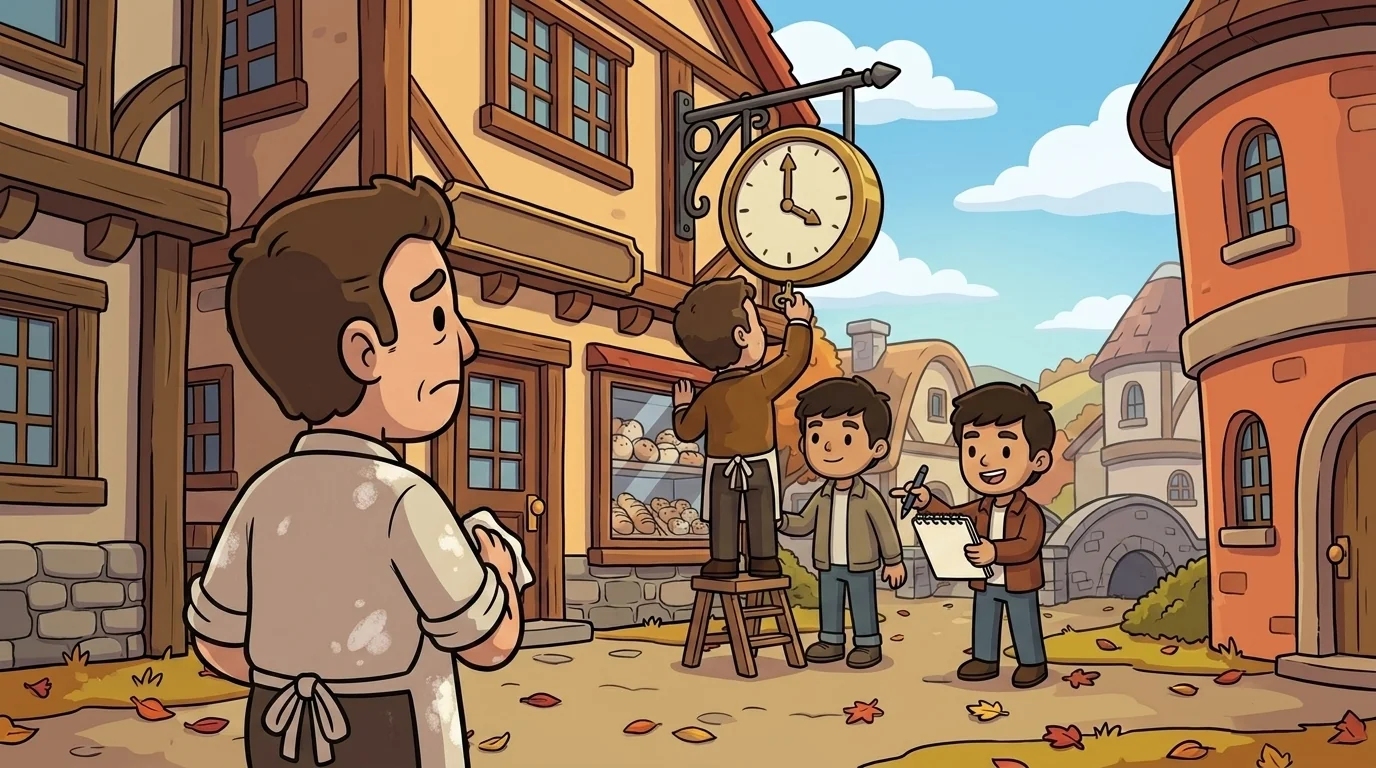
Just then, Marn the baker emerged from the front door, wiping flour from his hands onto his apron. He glanced up at the clock, then stopped wiping altogether.
"Stopped," he muttered.
"Stopped," Echo confirmed. "Recently. The hands haven't drifted."
Marn squinted at the clock, then noticed Stride and the open notebook. "You're teaching off my broken clock," he said, a hint of amusement in his voice.
"We are," Stride admitted cheerfully. "It’s a very good clock for teaching. We were just explaining how it changed from a linear function into a constant function."
"It has what?" Marn asked, bewildered.
Echo translated for his father. "It used to tick. Now it doesn't. Every minute used to add one tick. Now it adds nothing. So it used to change by a known amount each minute, but now it changes by nothing per minute. That’s the slope of the function the clock is performing. The slope used to be one. Now it is zero."
Marn looked from his son to Stride, then to the clock and back again. He was a baker, accustomed to flour and yeast, not this much mathematical discussion before breakfast.
"It just needs winding," he said, shaking his head. "Don't make a story out of it."
"Too late," Stride replied with a grin.
Echo helped his father carry a small step-stool to a spot beneath the clock. Marn climbed up, opened the brass casing, and wound the mechanism. The second hand immediately began sweeping. The minute hand jumped one tick. The clock, once still, began behaving like a linear function once more.
Marn climbed back down. He looked at Stride. "Now what?"
Stride showed him the notebook page, pointing to the two lines. "Sloped line: clock running. Flat line: clock stopped. Same family of equations, just a different M. Your clock has switched back into the sloped one and is running again."
Marn studied the diagram for a long moment. Then he said, slowly, "So if it stops once a year, that's a problem. But if it stops every Tuesday morning, that’s a *pattern*."
"That’s a higher-order function," Echo said, a faint smile playing on his lips. "We're not ready for that one yet."
"Don't be cute," Marn grumbled, but a smile touched his own face too.

That afternoon, Stride prepared a short lesson on the board for his second-period class. He sketched the two graphs they had discussed that morning: the sloped line and the flat line.
"Both of these are functions," he explained. "A function is a rule that takes an input and turns it into an output. The sloped line represents a linear function. For every unit of input, the output increases by a fixed amount. The flat line shows a constant function. For every unit of input, the output remains exactly the same."
He paused, letting the words settle.
"They aren't opposite kinds of things," he continued. "They are essentially the same kind of thing, but with different slopes. A constant function is simply a linear function whose slope is zero. You might think of a constant function as the linear function that forgot to walk; it just stands still."
A student in the front row raised her hand. "Is the village clock a function?"
Stride smiled. "Today it is. This morning it wasn't. My friend Echo and I are still discussing whether this Tuesday will become a pattern."
The class looked puzzled. They would, however, understand by the end of the week.
The FunctionForge ensemble
Stride and Echo is part of FunctionForge's distributed-narrative cast. Each character embodies a different curricular primitive; together they teach the full subject.
-

Stride the Pattern-Walker
Linear functions (constant rate of change)
-

Echo the Sameness-Keeper
Constant functions (zero rate of change; output unchanged regardless of input)
-

Arc the Curve-Catcher
Quadratic functions (parabola — symmetric rate-of-change-changes)
-

Burst the Doubler
Exponential functions (constant *multiplicative* rate of change)
-

Pivot the Rule-Switcher
Piecewise functions (different rules for different input ranges)