Burst the Doubler
EXPONENTIAL FUNCTIONS — constant multiplicative rate of change. y = a · b^x. Each step multiplies the output by a fixed factor.
Press play to listen along. The line being read lights up as you go.
Show full transcript
Loading transcript…

Burst lived with six brothers and sisters. They all shared one small kitchen.
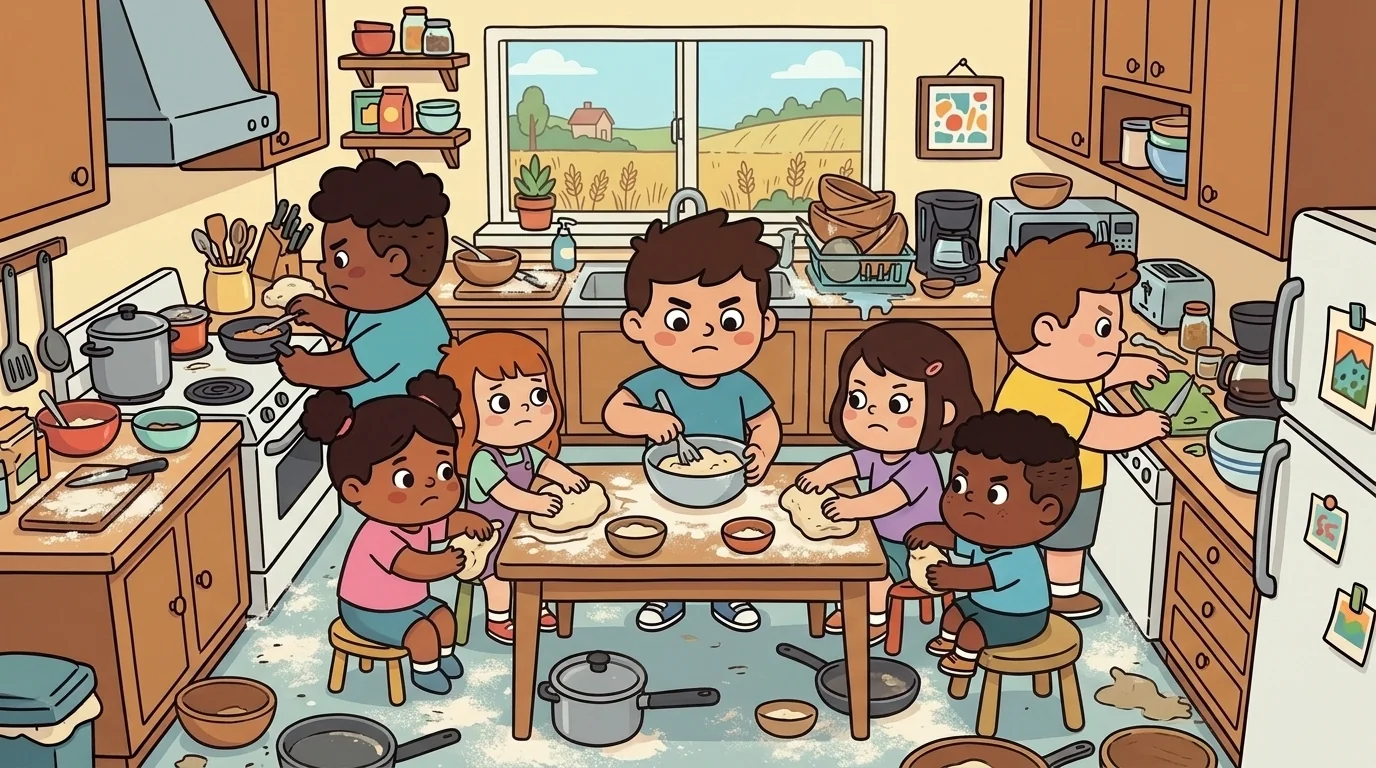
Seven kids in one kitchen? That's like having no kitchen at all. The room was tiny. It was always packed. Pots and pans covered every surface. Flour dusted the floor. Damp wooden bowls piled up. People bumped into each other. If Burst needed water, he waited. His brother was always at the sink. If he wanted toast, he waited again. His sister was busy kneading dough. Sitting at the kitchen table was a mission. You had to ask permission. You had to make a deal.
The Burstwell family lived in Yeastfield. This town sat on the kingdom's eastern edge. They were bakers. Eight generations of Burstwells had baked bread. Everyone in the kingdom seemed to bake. It was just how things were. Grain grew everywhere. So, bakers were everywhere too. Burst's family knew all about baking. It was their special skill.
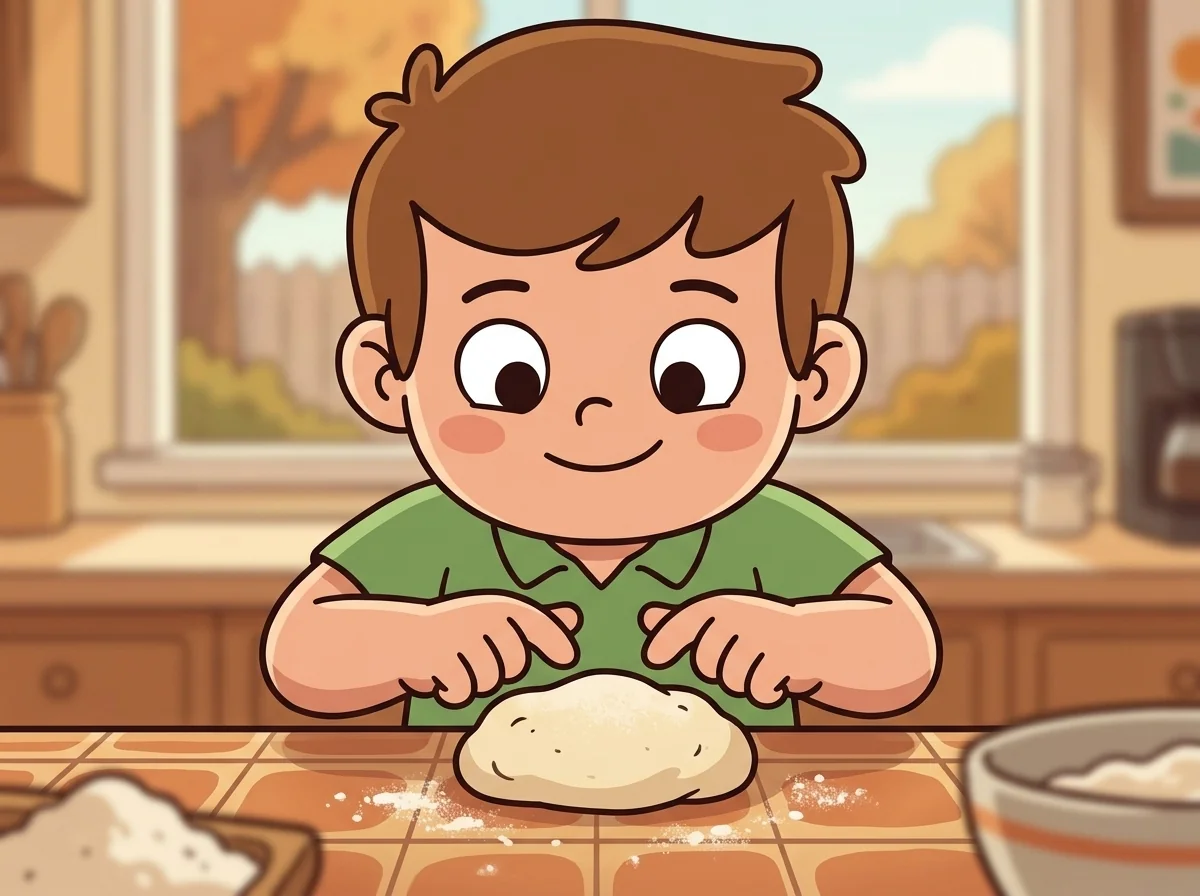
Burst's real name was Yest. It meant "yeast" in the old language. His family sold yeast-starter to other bakers. It was a side business. Burst was the youngest of the seven kids. His oldest sister was eleven years older. By the time Burst was eight, the bakery ran like a clock. Everyone had a job. Burst's job was simple. He helped where he could. He watched and learned. He learned one thing best of all. He learned about yeast. He learned how yeast doubled.
His mother, Pomona, ran everything. She ran the kitchen. She ran the bakery. People said she was the best yeast-keeper around. She taught Burst about yeast. He was only four years old. She would take a tiny ball of yeast. She put it on a warm counter. Then she pointed. "Yest," she would say. "Watch this." "In twenty minutes," she promised, "it will be twice this size." Burst watched closely. Twenty minutes felt like forever. Then, slowly, the yeast grew. It really was twice as big. His mother pointed again. "Forty minutes," she said. "Four times bigger." "One hour? Eight times bigger." "Two hours? Sixty-four times bigger." "Three hours? Five hundred and twelve times bigger." "Four hours? Four thousand ninety-six times bigger!" She always finished with a warning. "That is why we control the temperature." "If we didn't," she said, "the yeast would fill our whole kitchen!"
Four-year-old Burst was amazed. He was a little scared. He was totally hooked. By age six, he understood. Yeast doubled every twenty minutes. That was the rule. When he was eight, he could figure it out. He knew how much yeast there would be. He just needed to know how many times it had doubled. By ten, he was even better. He could tell you how many doublings it took. He could reach any amount of yeast. No one ever said the words "*exponential growth*." But Burst knew it. He just knew how things multiplied.
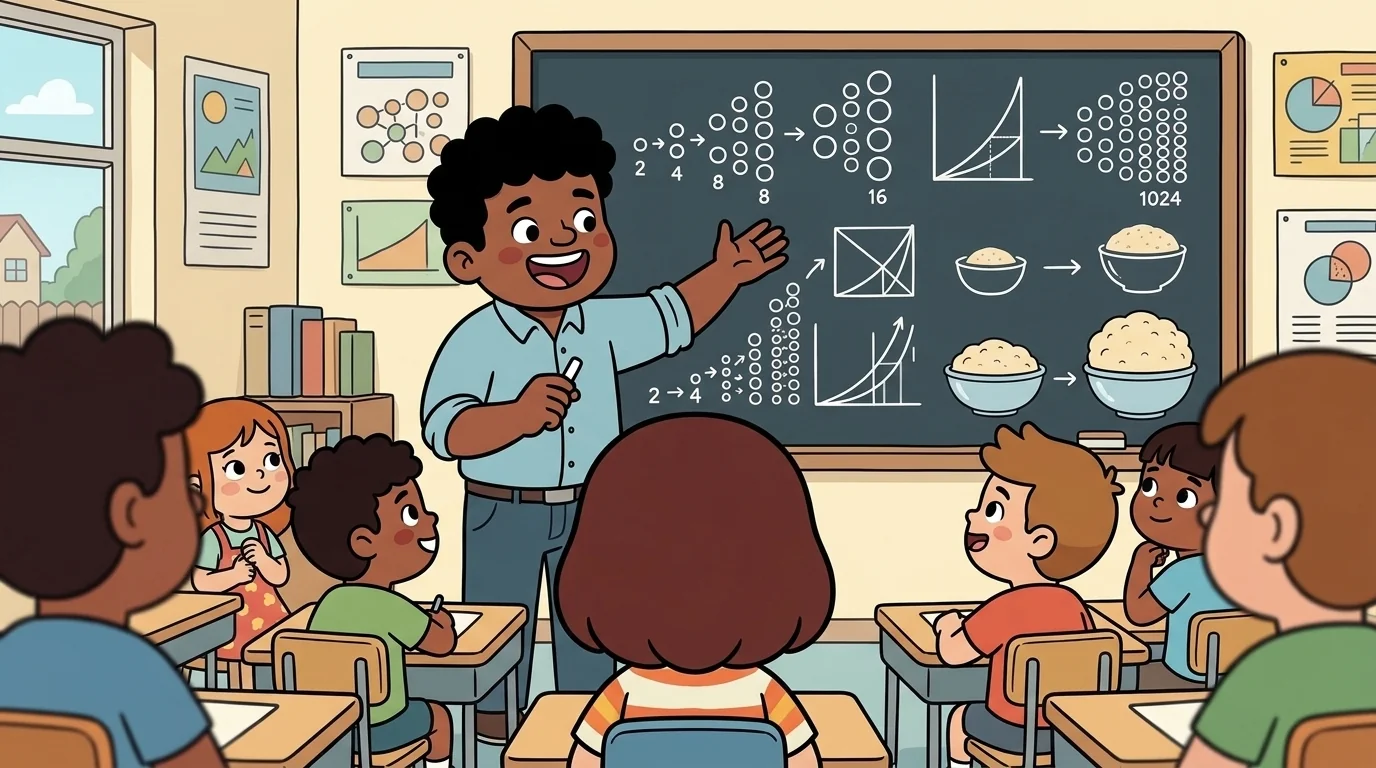
Burst started village school at thirteen. His math teacher introduced something new. She called them *exponential functions*. Burst's hand shot up. It was only ten minutes into class. He said, "That is yeast." The teacher paused. She had taught for twenty years. "What?" she asked. Burst explained. "Y equals two to the X." "That's the formula for yeast." "Y is how many times it grows. X is how many twenty-minute periods pass." "After three periods, it's two cubed. That's eight times bigger." "After ten periods, it's two to the tenth power. That's one thousand twenty-four times bigger." "My mother's formula," Burst said, "is just this math." The teacher put down her chalk. "Yest," she said. "Where do you live?" "Burstwell's bakery," he answered. "End of the lane." "That makes sense," she said. "Your mother has been teaching you this since you were four."
Burst nodded again. He had never thought of it as a lesson. It was just a fact about yeast. His teacher made it clear. He understood something special. Most kids found it hard. Small numbers could get huge, very fast. That was the secret. When Burst was eighteen, he went to the FunctionForge academy. He studied there for four years. At twenty-two, he became a teacher. He has taught *exponential functions* for nine years now.
Burst starts every first lesson the same way. He brings a small jar to class. Inside is yeast-starter. It comes from his mother's bakery. His oldest sister runs it now. He puts the jar on his desk. "This is yeast," he says. "In twenty minutes, on a warm counter, it will be twice this size." "In forty minutes, four times bigger. In an hour, eight times bigger." "In two hours, sixty-four times bigger." He widens his hands. "That is *exponential growth." "Each step multiplies the amount from before." Then he writes on the board: y = 2^x*. "This is the math," he says. "Two to the X power." "If X is 1, Y is 2. If X is 2, Y is 4. If X is 3, Y is 8." "If X is 10, Y is 1,024." "If X is 20, Y is over a million. One million, forty-eight thousand, five hundred seventy-six!" "This is what makes exponentials wild. They start tiny. They get huge. So fast."
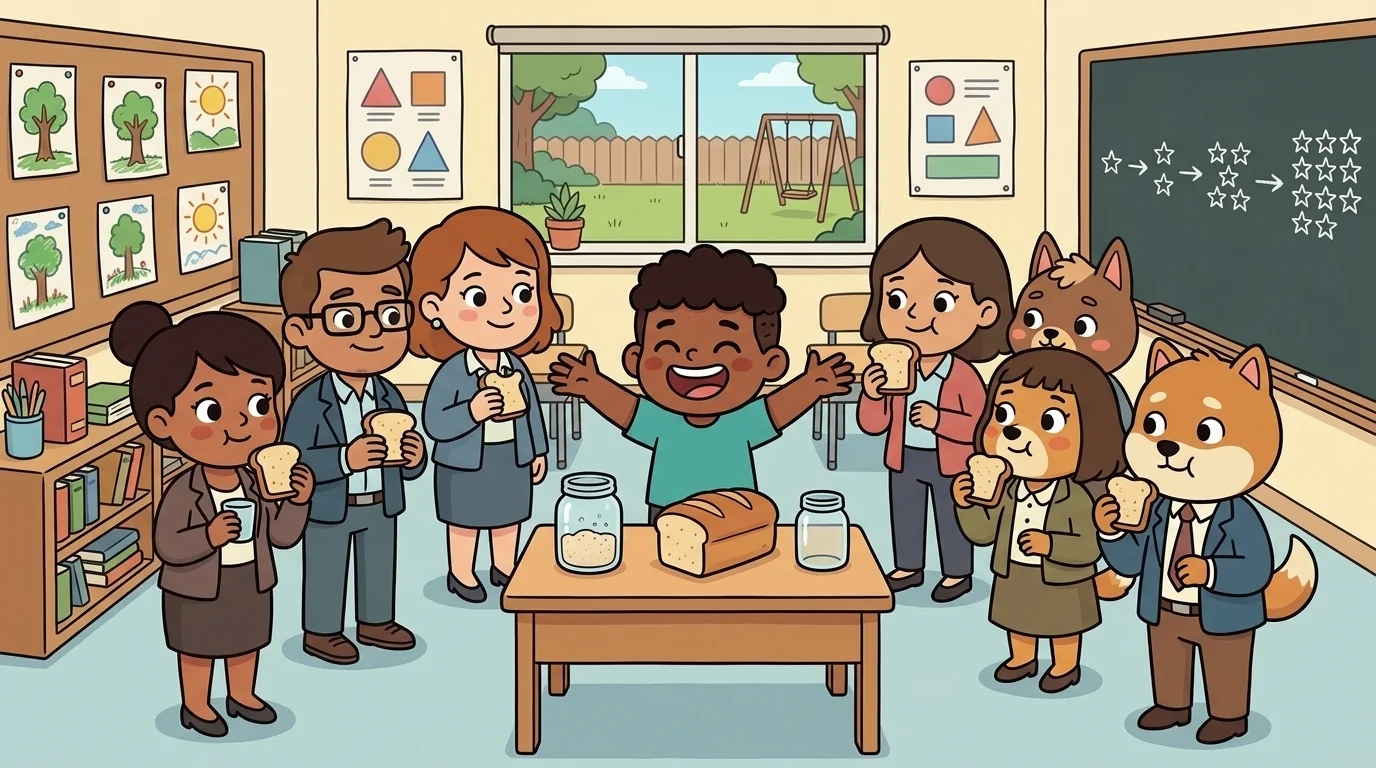
The kids are always surprised. They had heard "exponential" before. But they never truly understood. They didn't know how fast it grew. Burst spreads his hands wide. It's a big, dramatic gesture. "The yeast in this jar is small," he says. "But if we didn't control the temperature, it would fill my mother's kitchen." "My mother controls the temperature. That stops the growth." "In real life, something always stops *exponential growth*." "The food runs out. The space runs out. The resources run out." "But the math itself keeps doubling. The numbers just keep going up." "The limits are outside the math. The math keeps multiplying."
Kids often ask if *exponential functions are hard. Burst always gives the same answer. "They are not hard," he says. "They are just doublings." "Each step multiplies the last amount. It uses a certain number." "That number is called the base of the exponential." "The number of steps is the exponent*." "That's all there is to it."
Burst still keeps a jar of yeast on his desk. He brings a fresh one every school year. What happens to the old yeast? He bakes it into a fresh loaf of bread. He shares it with his fellow teachers. They eat it at the end-of-term meal. And every time he breaks the warm loaf and passes it around, Burst feels a soft, full happiness — the same cozy wonder he felt as a four-year-old, watching something small quietly become enough to share.
The FunctionForge ensemble
Burst the Doubler is part of FunctionForge's distributed-narrative cast. Each character embodies a different curricular primitive; together they teach the full subject.
-

Stride the Pattern-Walker
Linear functions (constant rate of change)
-

Echo the Sameness-Keeper
Constant functions (zero rate of change; output unchanged regardless of input)
-

Arc the Curve-Catcher
Quadratic functions (parabola — symmetric rate-of-change-changes)
-

Pivot the Rule-Switcher
Piecewise functions (different rules for different input ranges)