Arc the Curve-Catcher
QUADRATIC FUNCTIONS — parabola; symmetric rate-of-change-changes. y = ax² + bx + c. The rate of change is itself a linear function.
A story read by Arc the Curve-Catcher
Press play to listen along. The line being read lights up as you go.
Show full transcript
Loading transcript…

Arc was a juggler's daughter.
Her mother — Lila, who travelled the kingdom under the stage-name the Falling-Stars Juggler — was the most-famous juggler in three provinces. She had been juggling since she was eight. She had performed in market squares, in town halls, in the courtyards of small nobles, in front of the kingdom's eldest sons on three separate state occasions, and — once, when Arc was four — at the wedding of a duke.
Lila could juggle, comfortably and reliably, seven balls. She could juggle five flaming torches. She could juggle three rings while balancing on a small unicycle. She could, on a good day with the wind behind her, juggle nine apples (the audience would, by tradition, catch the apples that landed in the front rows and eat them).
Arc — whose given name was Aria, though everyone called her Arc since she was three — grew up backstage. Or, more precisely, next-to-stage, because her mother's stage was usually a market-square cobblestone with no actual backstage. Arc sat on a wooden crate. She watched her mother. She observed the balls.
What Arc observed was, by the time she was eight, the most important thing she would ever learn.
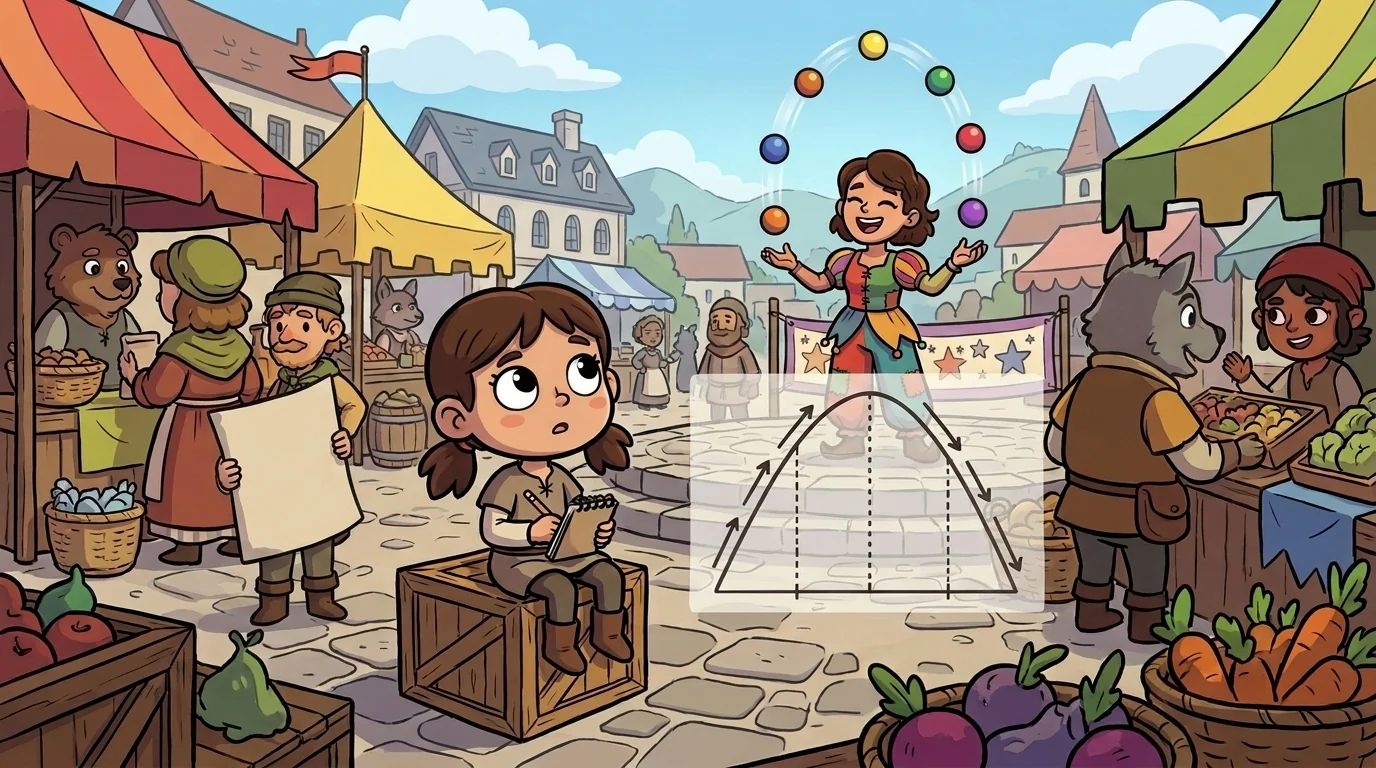
The balls all followed the same kind of curve.
Every ball, when thrown up by a juggler's hand, did the same thing. It went up. It went up slowing down — the ball's upward speed decreased as it rose. At some point — the apex — it was momentarily stationary. Then it started falling. It fell slowly at first, then faster, and faster, until it landed back in the juggler's other hand.
Up. Slowing. Stationary. Falling. Speeding up. Caught.
This was the trajectory. Every ball did it. Every ball every juggler had ever thrown had done it.
Arc, who watched her mother for hours every day, eventually understood — without anyone explaining it to her — that the trajectory was symmetric. The way the ball rose was the mirror image of the way the ball fell. If the ball took one second to rise to the apex, it took one second to fall from the apex. If the ball reached a height of three feet at the apex, it fell the same three feet back to the catching hand.
This was the parabola.

Arc did not know that word. She did not know the algebra of y = ax² + bx + c. She knew only the curve. The curve was so deeply internalized that by age eight she could catch any ball her mother threw, because she knew where the ball would land. She tracked the ball's rise, saw the apex, and walked to the landing-spot before the ball was halfway down.
This was, even by juggler-family standards, uncanny. Most children needed years of training to catch balls reliably. Arc caught them as if she were predicting them.
Lila, who was a perceptive woman, noticed. When Arc was twelve, Lila sat her down on the wooden crate after a performance and said: "You are catching the balls before they have decided where to land. How are you doing that?"
Arc said: "They have decided. The throw decides the catch. The shape of the curve is the same every time. I just see the shape and walk to the bottom of it."
Lila considered this. She had been juggling for thirty-six years. She had never thought of the curve as a shape that was the same every time. She had thought of the curve as a consequence of physics that she felt with her body but did not analyze. Arc, at twelve, had analyzed it.
Lila said, slowly: "You are doing mathematics. The thing you are seeing has a name. It is called a parabola. It is the shape any thrown object follows. I had no idea you had figured this out."
Arc was, briefly, embarrassed. She had not thought of it as figuring-out. She had thought of it as looking at the balls. But Lila was clear: Arc had reasoned her way to the parabola without instruction.
The next year, Lila wrote a letter to the FunctionForge academy. The letter said: "My daughter, age thirteen, can predict the landing-spot of any thrown ball within an inch. She has internalized the parabola without instruction. She does not yet know the algebra. I think she might want to learn the algebra. Would you take her?"
The academy master wrote back: "Send her. We will teach the algebra. She has the geometry already."
Arc went to the academy at thirteen. She studied for seven years (a long course; she went straight through to the faculty path). She joined the FunctionForge teaching faculty when she was twenty. She has been teaching quadratic functions for fourteen years.
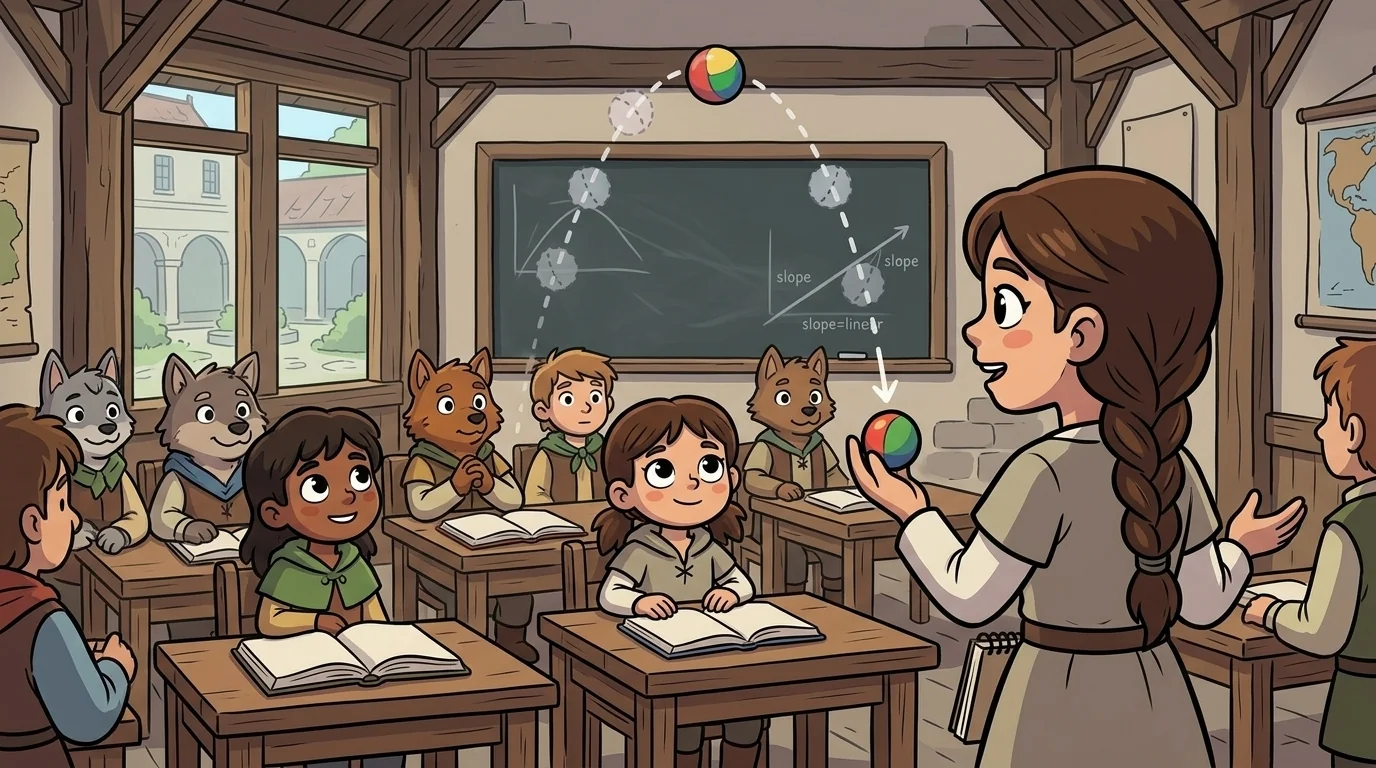
In her classroom, she begins every first-day lesson the same way. She brings a small soft ball. She stands at the front of the room. She tosses the ball into the air, gently, in a high arc. The ball rises, slows, hangs momentarily at the apex, then falls. Arc catches it.
She says: "That was a parabola. The ball followed a curve. The curve is symmetric — the rising-half mirrors the falling-half. The shape of the curve is the same every time. That is a quadratic function."

Then she writes on the board: y = -x² + 4x. She says: "Here is the algebra. This is a parabola opening downward. The peak is at x = 2. The output starts at zero, rises to a maximum at x = 2, falls back to zero at x = 4. Just like the ball."
She graphs it. The graph is a perfect upside-down parabola. She points at it. She says: "My mother throws balls. I throw equations. Same shape."
When children ask whether quadratic functions are hard, Arc always says the same thing:
"They are not hard. They are parabolas. The rate of change changes — but the rate of change of the rate of change is constant. That is what makes the curve symmetric. The ball going up slows at a constant rate. The ball coming down speeds at the same constant rate. The math is the same on both sides of the apex."
She still juggles. She is not as good as her mother (her mother is now seventy-three and still juggles seven balls). But she can juggle five, and she does so in her classroom on the last day of every academic year as a small farewell to her students.
She always invites her mother to that last-day demonstration. Her mother, when she can travel, comes. And when the two of them juggle side by side — her mother's seven balls and Arc's five, all tracing the same gentle curve through the air — Arc feels a warm, steady gladness settle in her chest, the quiet happiness of catching something you love and knowing, deep down, exactly where it will land.
The FunctionForge ensemble
Arc the Curve-Catcher is part of FunctionForge's distributed-narrative cast. Each character embodies a different curricular primitive; together they teach the full subject.
-

Stride the Pattern-Walker
Linear functions (constant rate of change)
-

Echo the Sameness-Keeper
Constant functions (zero rate of change; output unchanged regardless of input)
-

Burst the Doubler
Exponential functions (constant *multiplicative* rate of change)
-

Pivot the Rule-Switcher
Piecewise functions (different rules for different input ranges)