
Clang
ONOMATOPOEIA — a word that sounds like the noise it names. Buzz. Splash. Crash. Hiss. When you say the word, your mouth makes a little echo of the real sound, so the reader almost hears it.
Press play to listen along. The line being read lights up as you go.
Show full transcript
Loading transcript…

Trope's detective cast met Clang near the old clock tower, and they heard him before they saw him.
Clang was a small, round creature made of dented copper, like a little walking bell. When he hopped, his body rang. When he splashed through a puddle, the splash seemed to live in the very shape of his mouth. He didn't just make sounds — when he said a word, the word seemed to carry the sound right inside it. He said the word for a bee's noise, and you could almost hear the bee. He said the word for a door's creak, and you could almost hear the door.
"Your words sound like the things they mean," a young detective said.
Clang gave a happy little ring. "That's my whole trick!" he said. "My name is Clang. I keep the sound-words — the ones that sound like the noise they name." He hopped, and his copper body chimed. "Say the word for thunder. Feel it rumble in your mouth? Say the word for a snake's warning. Feel it hiss between your teeth? The word is a little echo of the real sound."
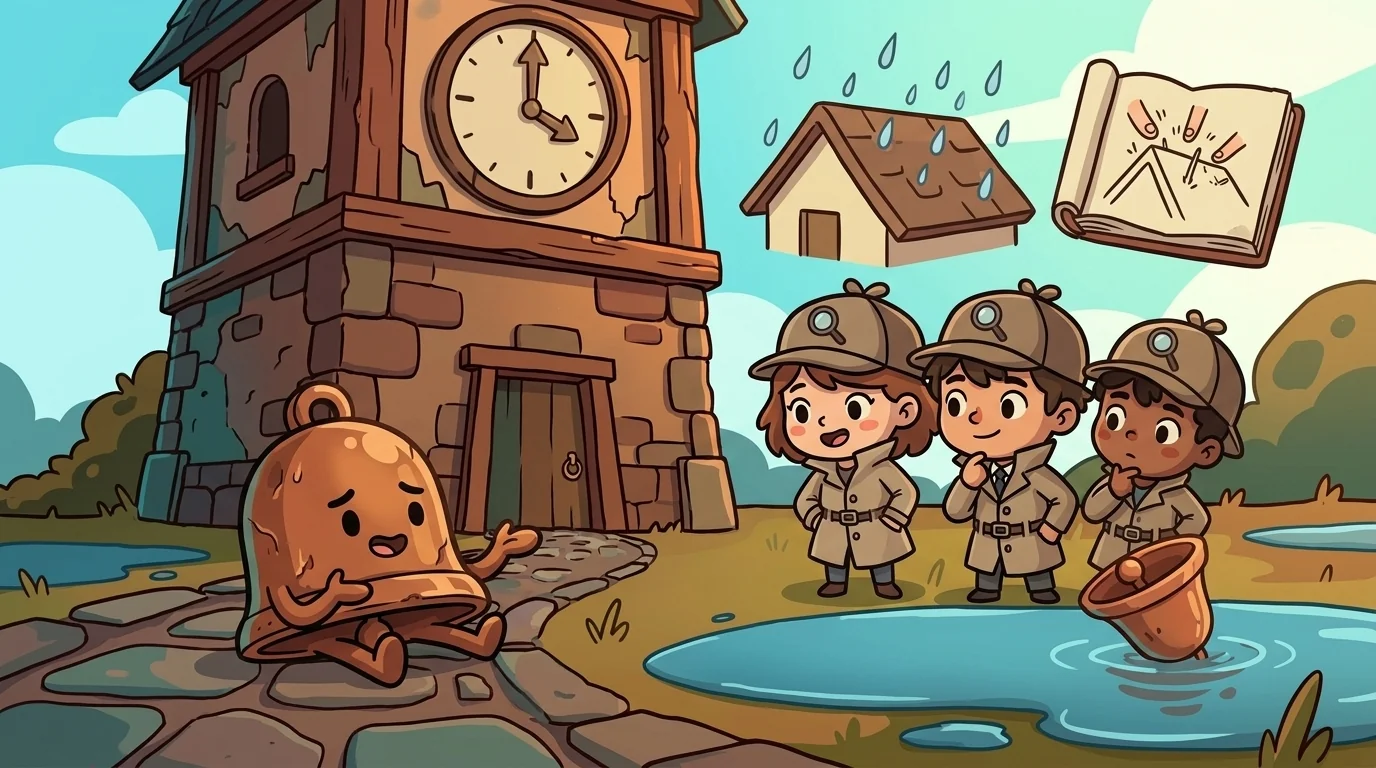
The detectives gathered close. "Show us how it works in a sentence," one said.
Clang thought, then spoke a flat, plain line: "The rain fell on the roof." Nothing happened; the detectives just pictured rain. Then he spoke it again, but slid in a sound-word: "The rain went pitter-patter on the roof." And suddenly the detectives could hear it — the little tapping, right inside the word. The sentence wasn't just telling them about rain anymore. It was letting them hear the rain.
"That's the magic," Clang rang softly. "A sound-word puts the noise right inside the sentence. The reader doesn't just picture it — they almost hear it. The word does the listening for them."
A young detective's eyes lit up. "So the word is like a tiny recording of the real sound!" "Exactly," Clang chimed, delighted.

Trope asked Clang to join the detective cast. "These young word-detectives are learning the figures of speech," Trope said. "And they write flat, silent sentences. I think you could teach them to put a sound inside their words."
Clang rang all over with joy. "Oh, yes!" he said. "I'll teach them words you can hear!"
So Clang joined the cast, and the detectives' sentences began to make noise.

When Trope teaches onomatopoeia, Clang leads — ringing. "Find the noise in your scene," he tells the detectives. "Is something buzzing? Crashing? Whispering? Then reach for the word that sounds like that noise. Say it out loud. If your mouth makes a little echo of the real sound, you've found a sound-word."
A young detective had written "the fire was loud." Flat, silent. Clang had her find the sound the fire made — and she wrote "the fire crackled and popped." Suddenly you could hear it. "You didn't just tell us it was loud," Clang said. "You let us hear the crackle. That's the difference."
"And here's the clue to remember," Clang added, "because we're detectives, after all. A sound-word is easy to spot: read the sentence aloud, and listen for the word where your mouth makes the actual noise. Buzz buzzes. Hiss hisses. Boom booms. The word and the sound are the same. That's how you catch one in the wild."

After the lesson, Clang sat with the detectives as the clock tower chimed the hour, his copper body ringing softly along with it.
For a long time, Clang had felt a little silly — a creature who was basically just noises, all clangs and buzzes and splashes, while the other figures of speech seemed so clever and deep. He'd wondered if making sound-words was a shallow sort of trick.
But ringing gently along with the tower bells, Clang understood his gift more warmly. Sound-words weren't shallow. They did something no other figure could: they reached past a reader's eyes and touched their ears. They put a real noise into a silent line of words on a page — a little piece of the actual world, captured in a sound you could say. And there was a simple, joyful magic in that. A warm ring of contentment hummed through his copper body. He wasn't silly. He was the one who let a reader hear. And he chimed along with the clock, glad to be a word you could listen to.
The FigureForge ensemble
Clang is part of FigureForge's distributed-narrative cast. Each character embodies a different curricular primitive; together they teach the full subject.
-

Ferry
Metaphor — 'X IS Y' direct comparison; carries meaning across
-

Ripple
Simile — 'X is LIKE Y' softer comparison
-

Knot
Idiom — fixed expressions whose meaning isn't literal
-

Twin
Analogy — extended comparison / X:Y::A:B parallel mapping
-

Hum
Personification — non-human takes on human qualities
-

Mask
Hyperbole + understatement + irony cluster — say one thing, mean another
-

Chain
Alliteration — living-chain creature whose links lock when words share a first sound (big blue balloon); a little is catchy, too much is a tongue-knot
-

Token
Symbolism — quiet creature with a many-pocketed cloak of small objects that stand for big ideas (a dove = peace); shows the meaning instead of saying it
-

Twain
Oxymoron — two-toned creature (one half warm, one half cool) who places two opposite words side by side (bittersweet); the clash says something truer than either alone