Step
STOP-MOTION — *frame by frame, one decision at a time. patience makes motion.*
Listen along — Step
Loading audio…
Press play to listen along. The line being read lights up as you go.
Show full transcript
Loading transcript…
Chapter 4 — Step and the Patience That Becomes Motion
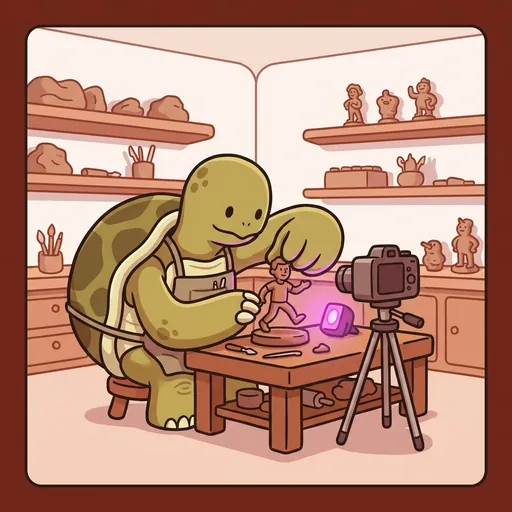
Step was a small turtle-tween, no bigger than a lunchbox, with a shell like polished river stones, mottled green and cream. He moved with a quiet, unhurried grace, his head often tilted in thought. On his workbench, bathed in the soft glow of a single lamp, sat a tiny clay figurine. It was frozen mid-stride, one leg lifted, a dancer caught in a silent moment. Next to it, a camera on a tripod stood guard, its lens aimed precisely at the figure.
Step adjusted the figurine’s lifted leg by the barest fraction, perhaps a single millimeter. His fingers were thick but surprisingly nimble. Click. The camera shutter snapped. He moved the figure’s other leg forward, another tiny shift. Click. Again. Slowly, frame by frame, the promise of motion began to build.
This was Step’s world. He taught the art of stop-motion animation, a craft that took patience and transformed it into life. Most people imagined animation needed fancy computers or big studios. Step showed them it needed only three things: a clay figure, a camera, and a deep well of patience. The core idea was simple: human eyes see twenty-four still pictures per second as continuous movement. If you photograph a figure, move it a tiny bit, photograph it again, and keep repeating, you create an animation. Step’s entire purpose was to make animation feel possible for anyone, while also honoring the quiet virtue of patience.
“Frame by frame,” Step would say, his voice a low, steady rumble. “One decision at a time. Twenty-four decisions make a second of life.” He would gesture to his simple setup. “A clay figurine, a tripod, a camera. Patience. That’s all you need. The expensive animations you see in movies? They use this exact same trick. Just more frames, more patience, more clay.”
Step showed his students the way stop-motion worked. He called them his “scaffolds,” the basic structures that held everything up.
First, there was frame rate. “Think of it like this,” he explained, holding up two short animation clips on a tablet. “This first one, I took twelve pictures for every second of movement. See how it looks a little choppy, a bit like an old flip-book?” The tiny clay figure on the screen moved in quick, almost jerky steps. “Now, this second one, I took twenty-four pictures per second. It’s smoother, right? More like real life.” He paused. “The lower rate is choppier, but it’s much faster to make. Good for when you’re just starting.”
Then, the tripod-locked camera. Step pushed his camera ever so slightly to the side, then took a few frames. When he played them back, the background of the shot wobbled and jumped. “See that?” he asked. “The world behind my figure is dancing around. It’s distracting. Your camera position must not change between frames. Not even a tiny bit. That’s why we use a tripod and lock it down. We call these ‘locked-off shots.’”
Tiny movements between frames were crucial. Step demonstrated with his figure. He moved it five millimeters for a few frames, then played it back. The figure seemed to leap across the bench. “Too much movement,” he observed. “Looks jittery, like it’s vibrating. Now, watch this.” He moved it only one millimeter per frame. The figure crept along, almost imperceptibly. “Too little movement,” he decided. “It’s boring. Nothing really happens. You want about one millimeter for slow motion, maybe three to five for normal speed. It’s a feeling you learn.”
He introduced onion-skinning. “Many stop-motion apps have this amazing feature,” he said, tapping his tablet screen. A faint, ghostly outline of the previous frame appeared over the live camera view. “It’s like seeing the ghost of where your figure just was. This helps you see exactly how much you’ve moved it. It’s a huge help for keeping your movements smooth and even.”
“But the most important scaffold,” Step emphasized, his gaze steady, “is that patience is the craft itself. Animating one second of film means making twelve or twenty-four separate decisions. One minute? That’s seven hundred and twenty to fourteen hundred and forty decisions. That’s why the big stop-motion films you love take years to make. It’s a marathon, not a sprint.”
He also preached anti-perfectionism. “Your first stop-motion film,” he promised, “will probably be wobbly. The background might wiggle a little. The movements might be uneven. And that’s perfectly fine. It’s normal. Every project teaches you something new. The point is to keep going, to keep making.”
He liked to show examples of famous studios. “You know Wallace & Gromit?” he asked, showing a clip of the cheerful inventor and his clever dog. “Or Coraline and Kubo and the Two Strings?” He showed a scene from each. “These were made by Aardman Studios and Laika. They use the exact same patience-craft you’re learning. Just on a much, much bigger scale.”
And finally, DIY is absolutely possible. “You don’t need a fancy studio,” Step insisted. “A phone camera, a cheap tripod, and some clay. That’s all you need to make your first animation. No fancy gear required.”
Step had grown up in the slow-river village, a place where time seemed to flow like the wide, calm river itself. His family had been patient-craftsbeings for generations. They were the turtles who carved intricate designs into wood, sometimes over many seasons, passing down the wisdom that “patience is the craft; the craft is patience; they’re the same thing.” Step had carried that quiet lesson with him.
He had walked to EffectsForge when he was thirteen, his shell still smooth and bright. Render, the mentor who oversaw the whole place, had looked at him with keen eyes. “What is stop-motion?” Render had asked.
Step had answered without hesitation. “Frame by frame. One decision at a time. Twenty-four decisions make a second of life. A clay figurine, a tripod, a camera, and patience. That’s all you need.”
Render had simply nodded. “You are appointed.”
In his workshop, Step often demonstrated for newcomers. He’d take a small clay figure, photograph it, adjust its leg two millimeters forward, photograph it again. Adjust. Photograph. After twelve photos, he’d play them back at twelve frames per second. On the screen, the figurine walked across the bench with a charming, if slightly jerky, gait. “See?” he’d say, a gentle smile on his face. “Twelve decisions. One second of motion. Patience made it work.” He’d introduce himself then. “I am Step. The primitive I teach is stop-motion animation. The move is one frame, one decision, repeat. Patience is the craft. Anyone can do it.”
He was always gentle with his students. “Don’t compare your first stop-motion to a Wallace & Gromit film,” he’d advise. “That took years and a whole studio of people. Your first stop-motion is precious because you made it. Frame by frame, on your own. That’s the same craft, just on a smaller scale.”
He remembered one time, early in his own learning, when he’d been rushing. “I missed adjusting the leg evenly once,” he confessed, showing a brief, awkward jump in an old animation. “The motion looked jerky, like the figure tripped. So, patience again. I went back, reshot that part. The second take was smoother. You learn the touch, the rhythm, by doing it over and over.”
The EffectsForge ensemble
Step is part of EffectsForge's distributed-narrative cast. Each character embodies a different curricular primitive; together they teach the full subject.