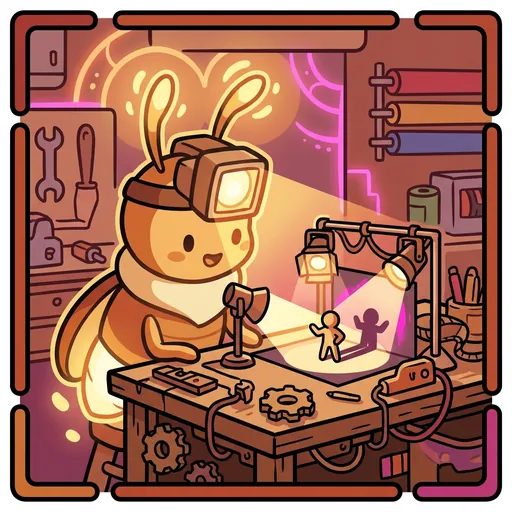
Lamp
LIGHTING DESIGN — *the silent author of mood. shadows tell the audience what to feel before the actor says a word.*
Listen along — Lamp
Loading audio…
Press play to listen along. The line being read lights up as you go.
Show full transcript
Loading transcript…
Chapter 5 — Lamp and the Silent Author of Mood
The little puppet on Lamp’s workbench looked terrified.
Lamp hadn’t touched the puppet at all. She’d only slid her key light around to the far side, low and hard, so one whole half of the wooden face fell into deep shadow. A single blade of amber caught the puppet’s cheek and left everything else in the dark.
“See how scared he looks?” Lamp said. She was a firefly no bigger than a thumb, glowing warm as a candle, a chunky spotlight strapped to her head like a hard hat. She reached over and nudged the fill light up, softening the shadow until both sides of the little face were gently lit. The puppet stopped looking scared. It looked, if anything, a bit sleepy and content.
“Same puppet,” Lamp said. “Same face. I never carved a new expression. The light did that.” She wiggled her antennae. “I moved a lamp four inches and told you a completely different story. That’s the whole game.”
She’d first learned the game in Evening Meadow, where it was always dusk and her whole family were fireflies who hung the festival lanterns.
Little Lamp used to think hanging lanterns was just about being able to see. Then, one festival, she watched her grandmother place a single lantern low behind the storyteller’s chair. Suddenly the storyteller had a long, wavering shadow that climbed the tent wall like a giant. The little kids gasped. Some hid behind their parents. The storyteller hadn’t even started yet.
After the tale, Grandmother moved the lantern high and added two more at the sides. The giant shadow shrank away. The tent went cozy and golden, and the same kids crept back out, yawning, ready for a gentle bedtime story.
“You saw it,” Grandmother said, catching Lamp staring. “Before a single word. The light told them how to feel.” Lamp never forgot the giant on the wall — or how easily Grandmother had sent him home.
She walked to EffectsForge the summer she turned thirteen, spotlight bouncing on her head the whole way.
Render, the old head mentor, met her at the door and asked what she made. Lamp didn’t answer with a speech. She asked for a lamp and a chair. Render, curious, brought both.
She sat him in the chair and lit him hard from below, the way you’d hold a flashlight under your chin. His kind old face turned instantly spooky, all deep sockets and looming brow. Render actually flinched at his own reflection in the window.
Then Lamp lifted the lamp up and to the side, angled it soft, and Render’s face relaxed into someone you’d trust with a secret. “Same you,” Lamp said. “I just told the room whether to be afraid of you.” Render laughed — a warm, surprised laugh — and showed her straight to a workshop of her own.
Her first real student was a fidgety kid named Pell who wanted to light a birthday-party scene but kept complaining it looked “creepy.”
Lamp peered at Pell’s setup. One harsh light, way off to the side, throwing a hard black slice across the little party table. “There’s your creepy,” she said, tapping the shadow. “You’ve got a mystery-movie shadow at a birthday party. The light disagrees with your story.”
She showed him her three lamps. “Bright one here — that’s the key, your main light. Softer one over here — that’s the fill; it walks into the shadows and calms them down.” She dialed the fill up until the hard slice melted into a gentle gray. The table looked cheerful at once. Then she clicked on a third lamp behind the cake. “And that’s the back light. Watch the cake pop away from the wall.” It did — suddenly the cake looked like a real object in a real room, not a sticker.
Pell moved the fill himself, watching the mood swing from spooky to sunny and back. “It’s like a dial for feelings,” he breathed. Lamp beamed. “Direction, brightness, color. That’s your dial. You don’t need a movie studio. Three cheap lamps and the nerve to keep sliding them around.”
Later, alone, Lamp reset her three lamps and lit the little puppet one last time — warm key, soft fill, a gentle glow behind — until it looked safe and golden, like a kid tucked in.
She thought about her first week here, when she’d forgotten the back light entirely and her puppet had vanished into the dark curtain like it was made of the same cloth. She’d been so embarrassed. She’d fixed it, of course, once she remembered to check the scene from where the camera stood, not just from her own perch.
But the memory didn’t sting anymore. Now it just made her smile. Her glow went soft and even, and her small shoulders came loose and easy. Getting it a little wrong the first time didn’t scare her — it felt, honestly, like the best part of the whole thing.
The EffectsForge ensemble
Lamp is part of EffectsForge's distributed-narrative cast. Each character embodies a different curricular primitive; together they teach the full subject.