Trick
FORCED PERSPECTIVE — *what's close looks big. what's far looks small. the camera doesn't know which is which.*
Press play to listen along. The line being read lights up as you go.
Show full transcript
Loading transcript…
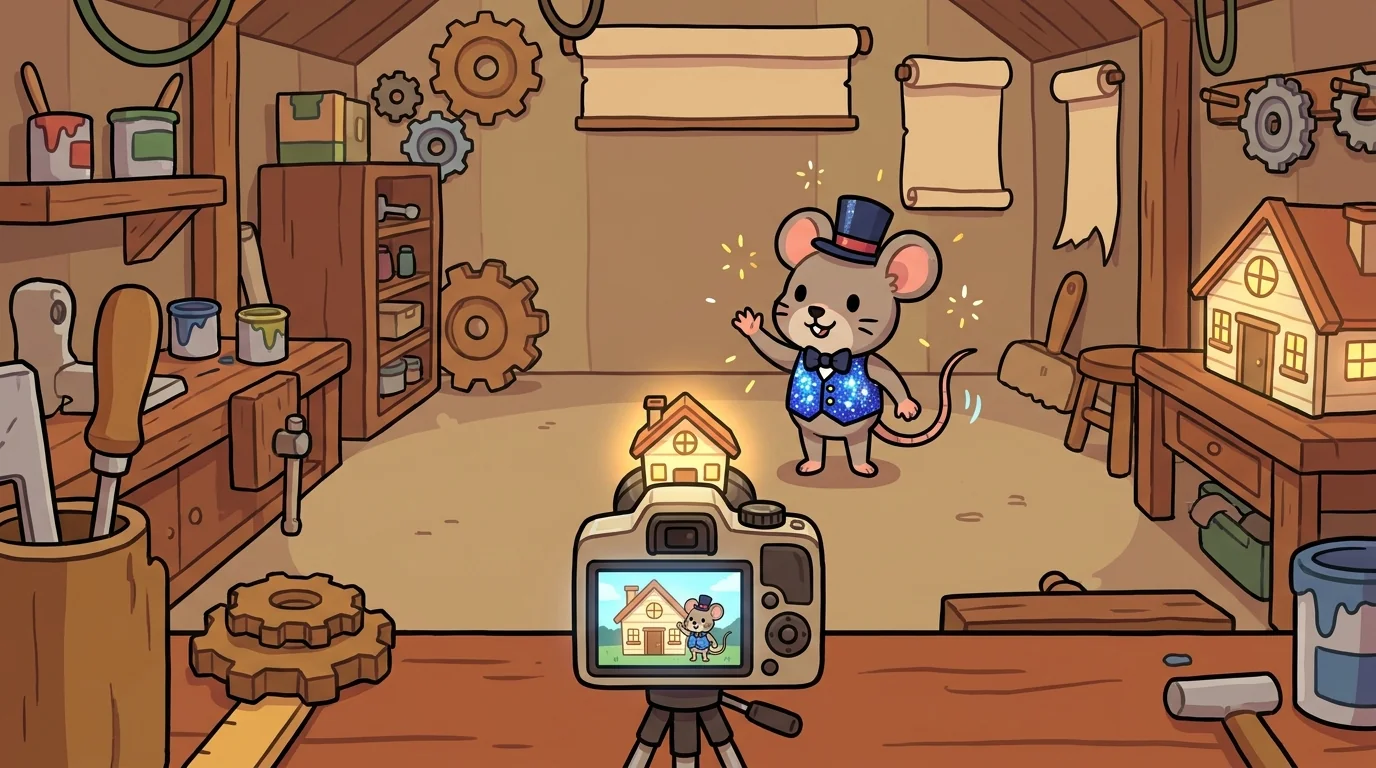
Trick set the little tripod down and stepped back, counting twenty paces under his breath, his tail flicking on each one. He was a small magician-mouse in a spangled vest, and the workshop light caught the sequins so that he seemed, for a second, to scatter sparks across the floor. In one paw he held a house no bigger than his thumb — a tiny model with painted windows that glowed like they had candles inside.
He lifted the house until it hovered right in front of the lens. Then he waved his other paw at the empty air behind it. "Right there," he murmured. "Perfect." He pressed the shutter. The camera blinked once. When the picture came up on the little screen, Trick grinned: it showed him standing next to a full-sized house, its door towering over his head, and no tiny model anywhere.
He never got tired of that moment. "Same camera," he liked to say, tapping the lens. "Same room. Just placement. The camera doesn't know which is which. It only sees flat."
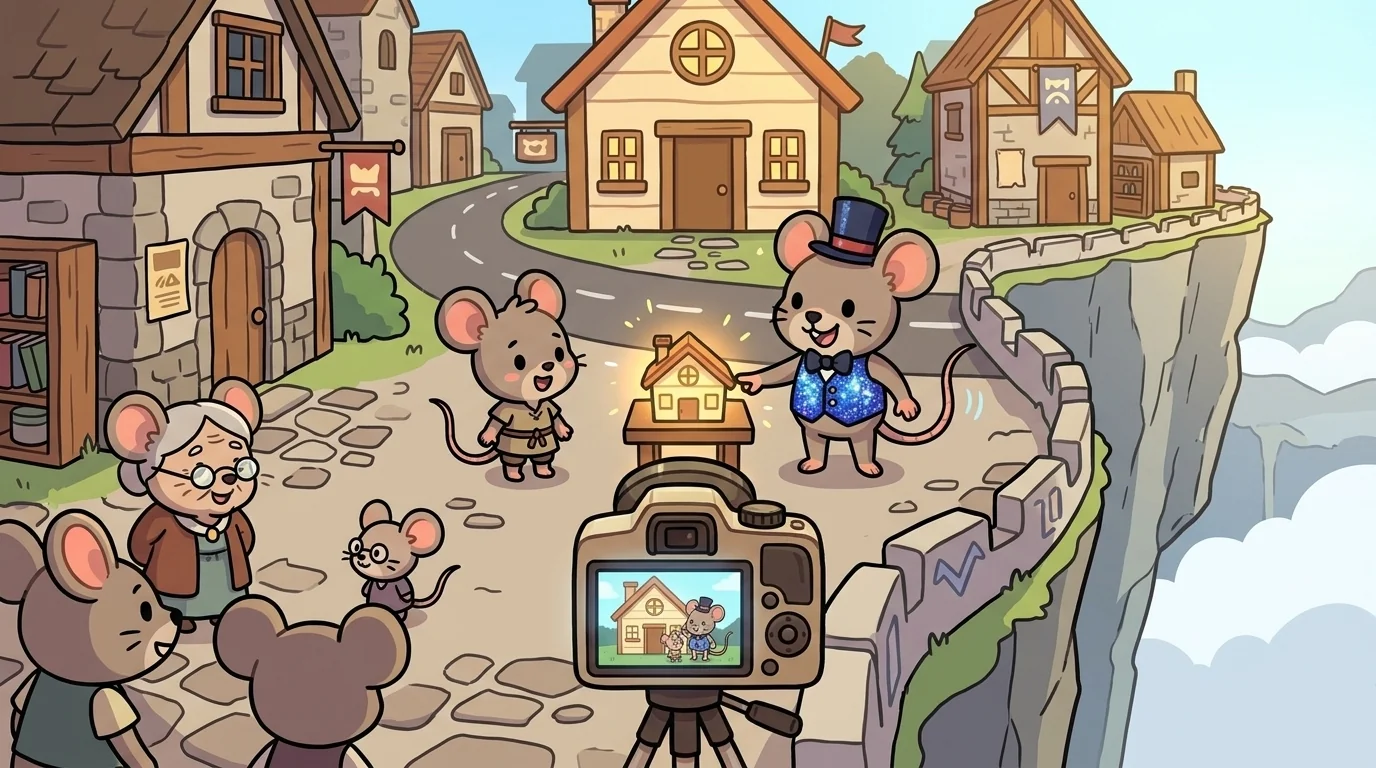
He hadn't been born knowing this. He'd learned it, the way you learn most true things, from someone older and slower than himself.
Trick grew up in a village on the edge of a cliff, where his family had made illusions for the festival longer than anyone could remember. They were called the Puzzle-Makers. Travelers would climb the winding road and stop dead in the square, staring at a painting that seemed to lean out of its own frame, or at a real cottage set beside a dollhouse placed so cleverly that for one dizzy second you couldn't tell which was which. People gasped. People laughed. Sometimes people got a little cross at being fooled, and that was the part Trick's grandmother cared about most.
She was a tiny mouse with spectacles slipping down her nose, and she pulled young Trick aside the first time he bragged about fooling a traveler. "Listen," she said, not unkindly. "The eye can be fooled. Everyone's can — mine, yours, the cleverest person on this road. But the fooling has to be a gift, not a theft." She turned him to face a laughing child in the crowd. "We don't fool people to feel bigger than them. We fool them so they walk away amazed at their own eyes. Delightful, not deceptive. Say it back."
"Delightful, not deceptive," Trick repeated. He was seven, and it stuck.
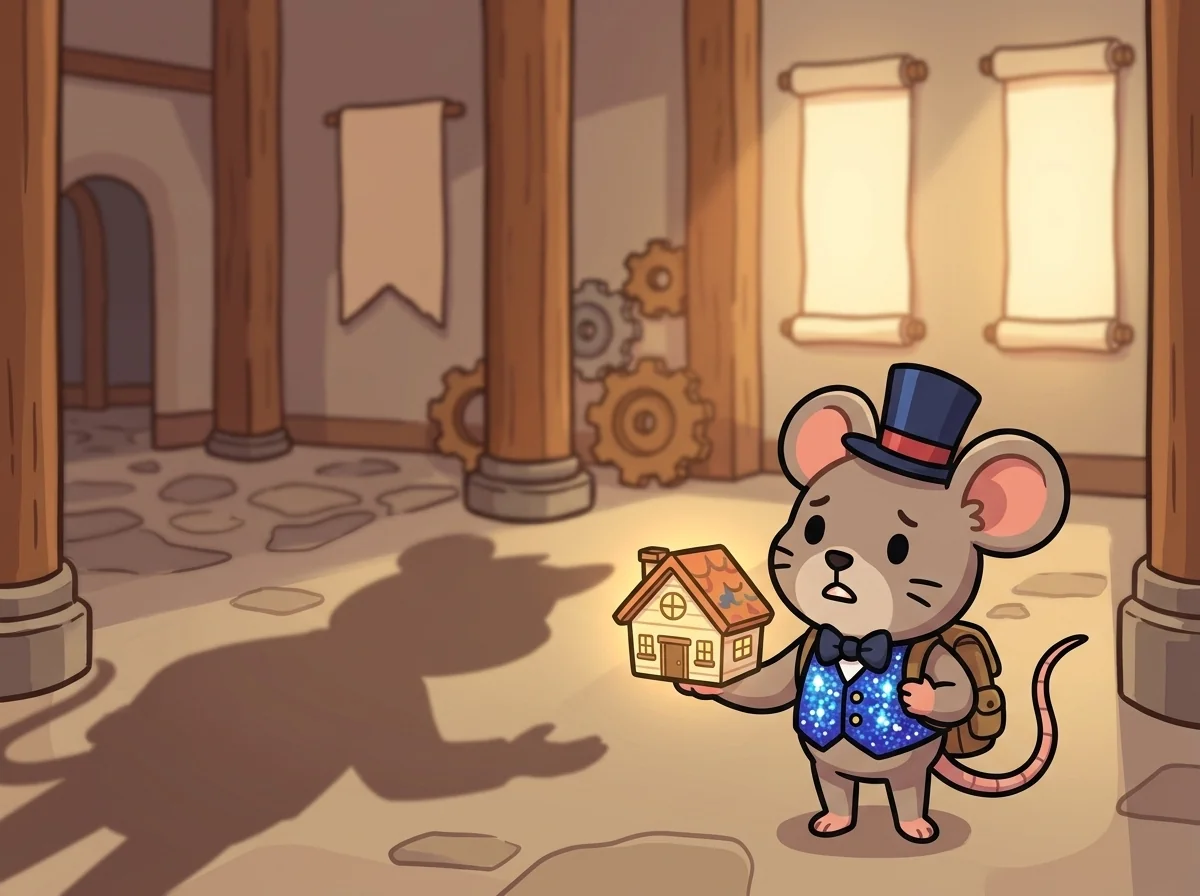
When he was twelve, he walked the whole long road down from the cliff to EffectsForge, alone, with the little house wrapped in cloth in his pack. He stood in the big echoing entrance hall with his heart pounding, and waited for Render.
Render was the mentor there, and his voice, when it finally came, was low as stones shifting in a canyon. "Young Trick. What is forced perspective?"
Trick had practiced a hundred fancy answers on the road down. Standing there, he forgot all of them and told the plain truth instead. "It's an illusion that resizes the world, sir. Whatever's close to the lens looks big. Whatever's far looks small. The camera can't tell the difference — it only ever sees one flat picture. So if you place things carefully, near and far, you can make a mouse look like a giant. No expensive computers. Just placement, and patience, and holding still."
Render looked at him for a long, long moment — long enough that Trick's ears began to droop. Then a slow smile broke across the old face like sun over the canyon rim. "You are appointed," Render said. And that, wonderfully, was that.
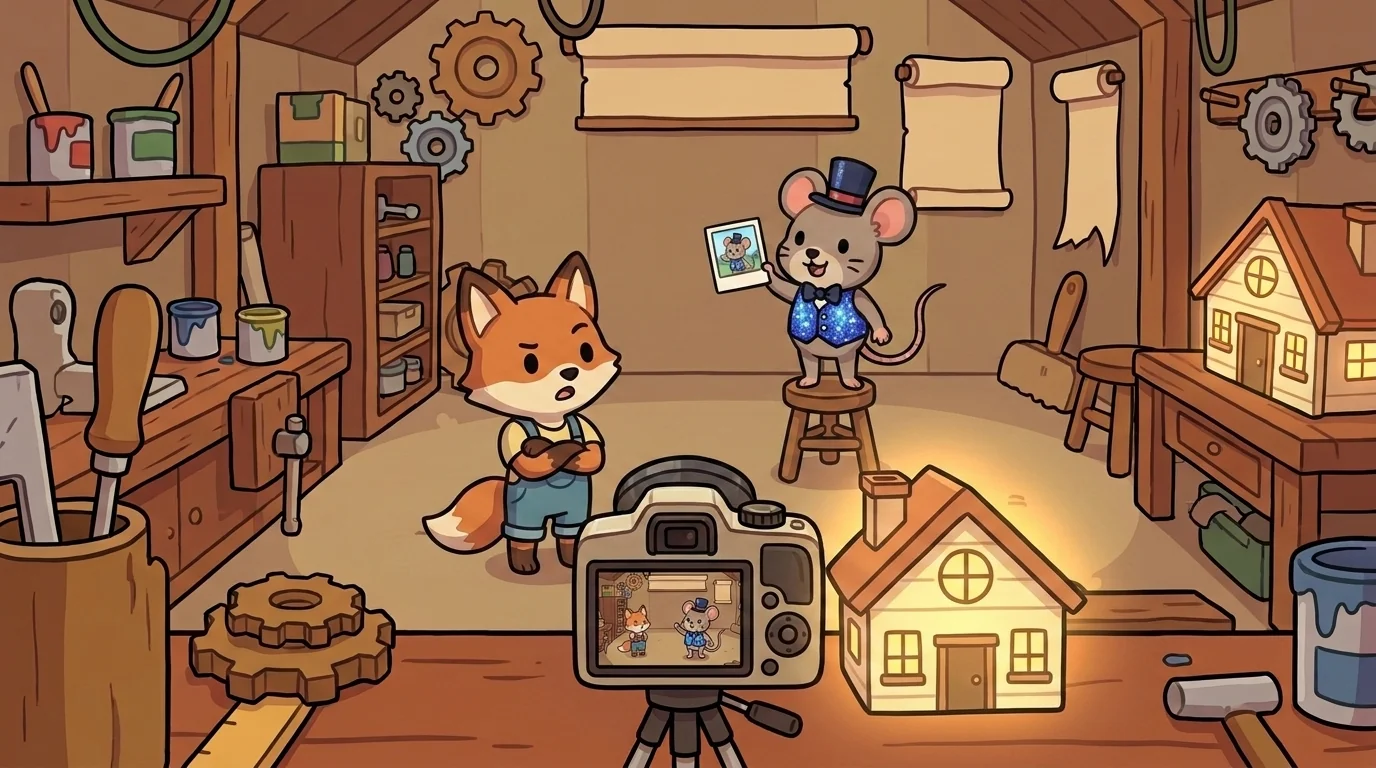
Years later, a group of young makers crowded into Trick's workshop, and one of them — a skeptical fox-kit with her arms folded — said flatly that movie magic obviously needed a Hollywood budget, and this was all a waste of time.
Trick's ears perked up. This was his favorite kind of doubt. "Watch," he said. He set the little house right against the lens, walked to the far wall, turned, and stood very still. "Three, two, one." Click. The photo showed him small in a giant doorway. The fox-kit's arms slowly unfolded. "Now watch it break," Trick said, and nudged the camera a whisker to the left. Click. This time the house was plainly a toy on a stand. "See? The illusion only lives at one angle. Move the camera and it dies. That's why you lock it down — no pans, no zooms, no wandering. A locked shot, or no shot."
He held up the first photo again. "There's one more secret, and it's the one that beat me for a whole year." His voice dropped. "Everything has to be sharp — the house up close AND me far away, both crisp at the same time. That means squeezing the lens's eye down small, so it can hold near and far in focus together." He pointed at a blurry old print pinned to the wall, a fuzzy blob next to a fuzzy mouse. "My first hundred tries looked like that. Ghost houses. I thought I'd never get it." He clicked the shutter one more time, and the fresh photo slid out clean and clear. "Placement makes the giant. Focus makes it believable. Miss the focus and the whole thing falls apart — and the worst part is you can't always tell until you look."
The fox-kit leaned in close to the sharp photo. "So it really is just... where you stand."
"Just where you stand," Trick agreed. "Free as looking."
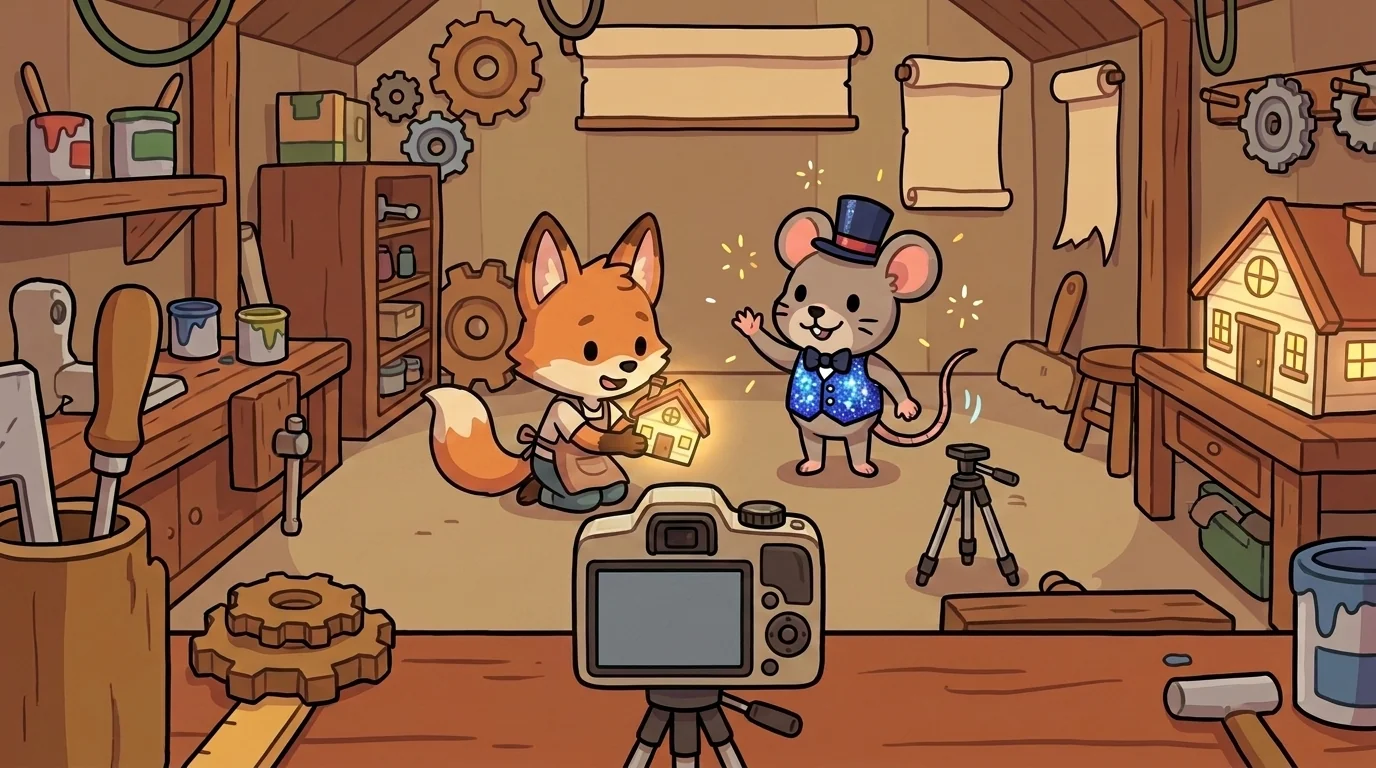
After the others had gone, the fox-kit stayed by the tripod, turning the little house over in her paws.
"I tried this at home last week," she admitted, not meeting his eyes. "It came out terrible. Everything blurry. I figured I was just bad at it." She set the house down carefully. "But it wasn't me, was it. It was only the focus. One thing."
"One thing," Trick said gently. "The house held. Your placement held. You had the whole trick and missed a single dial." He watched her take that in — watched the tightness she'd carried in since she walked through the door ease out of her shoulders, the way a held breath finally lets go. "That's the part nobody tells you. When an illusion breaks, it almost never breaks everywhere. It breaks in one small place. Find the place, and the whole thing comes back."
The fox-kit let out a small, surprised laugh, and Trick felt the old festival-square gladness rise warm in his chest — the delight that was never about fooling anyone at all, but about watching someone discover that their own eyes were far cleverer, and their own mistakes far smaller, than they'd feared. She tucked the little house under her arm to try again, and Trick stood there in the sparkle of his vest a while longer, quietly, happily full.
The EffectsForge ensemble
Trick is part of EffectsForge's distributed-narrative cast. Each character embodies a different curricular primitive; together they teach the full subject.