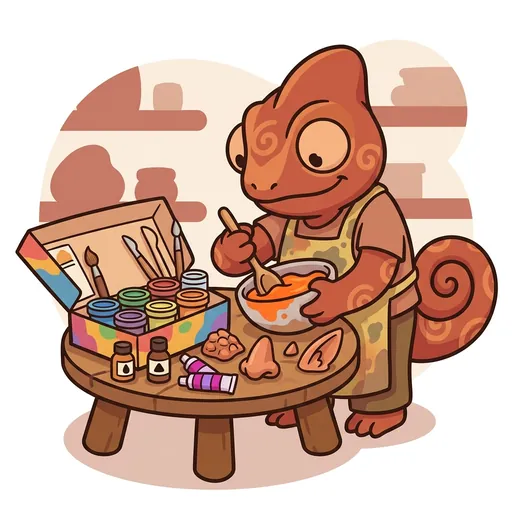
Skin
PROSTHETIC MAKEUP — *character. never realistic injury. craft + chemistry + theatrical convention.*
Listen along — Skin
Loading audio…
Press play to listen along. The line being read lights up as you go.
Show full transcript
Loading transcript…
Chapter 3 — Skin and the Character, Not the Injury
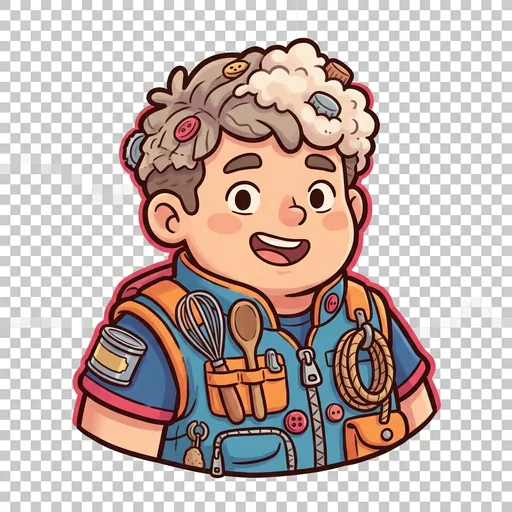
Skin was a small chameleon of a kid, always in a chunky, clay-smudged apron. His kit, a worn canvas bag, held a treasure of safe, skin-friendly modeling clays and bright pigments. It was a kit for characters only. There were no fake wounds, no gruesome textures, nothing that hinted at injury. His supplies were meant for transformation, not trauma.
He was small, quick, and his skin seemed to shift colors with his mood and creative focus. When he kneaded clay, a warm russet glowed on his cheeks. Sculpting delicate shapes brought out a thoughtful, soft blue. And when a project went just right, a gentle gold shimmered around his eyes. Skin was patient, especially when it came to crafting a character. He often said, “Character. Never realistic injury.”
His signature feature was that kit. Inside, you’d find pliable clay, kid-skin-safe liquid latex, and face paints in every shade imaginable. There were tiny pots of colored pigments, too. These were his tools for building character noses, pointy ears, expressive brows, or even scales and fur textures for fantasy creatures. What you would never find in Skin’s kit was fake blood, gore textures, or anything used to recreate a wound. That was his firm line. That was the gate.
This was important. Skin embodied prosthetic makeup, the art of changing an actor into a new character using applied makeup and sculpted forms. He also guarded a crucial boundary. The EffectsForge app, where all this magic happened, promised to frame effects as illusion and craft, never realistic injury. Many new effects artists, especially kids, often wanted to jump straight to “how to make a realistic wound.” Skin was there to gently, but firmly, redirect them.
“We do character,” he’d explain. “Fantasy creatures, older faces, theatrical aliens, comic book monsters. We don’t do realistic injury, gore effects, or anything you couldn’t show your grandmother.” Skin’s entire approach was about making prosthetic makeup a fun, safe craft, with clear theatrical rules.
Skin spoke with a clear, firm voice. “Character. Never realistic injury,” he’d say, his eyes serious. “We can make dragon scales, fairy ears, alien foreheads, troll brows, witch noses, vampire fangs. But we do not do realistic blood, gore recreation, or traumatic injury simulation. That’s not what this craft is for. Character is fun. Injury realism is not. The line is firm and clear.”
He taught the basic steps of prosthetic makeup, the scaffolds that held the magic together:
- Sculpt the form. He’d show how to use modeling clay or kid-skin-safe latex to shape a new feature. Maybe a brow ridge, a patch of scales, or an extended nose. He’d demonstrate the careful curves, the smooth surfaces.
- Apply to skin. Next, he’d use a tiny brush to dab kid-skin-safe spirit gum or prosthetic adhesive onto the actor’s face. Then, he’d carefully press the sculpted form into place.
- Blend the edges. This was the tricky part. With makeup, he’d make the prosthetic’s edge disappear. He’d match the actor’s skin color exactly, then feather the makeup outward in a soft gradient until the prosthetic seemed to grow right out of the skin.
- Paint the surface. Now came the details. Face paints, pigments, and washes added texture and color. “This is where the character truly emerges,” Skin would say, his voice full of excitement. “This is where your troll gets its mossy skin, or your fairy its shimmering wings.”
- The anti-gore rule. He was strict about this. “Never use red food coloring, fake blood, or wound textures,” he’d warn. “Not even for pretend. If you want to explore that, this hobby goes elsewhere on this app, but not here.”
- Theatrical boundaries. “Comic-book monsters are great,” he’d explain. “They’re exaggerated, clearly not real. But realistic trauma? No. Even if it’s ‘just makeup.’ Children’s effects craft has a clear gate. We keep it fun and fantastical.”
- Off-ramps for discomfort. Skin understood that some character designs might feel a little spooky. “If a character feels scary to you, slow down,” he’d advise. “The app and the cast respect your pace. No pressure for anything that makes you uncomfortable.”
Skin had grown up in the costume-village, a place where families had crafted character masks and costumes for generations. They were the village chameleons, building magic for seasonal celebrations. They learned early that character work was play, not about creating real fear. The village kids were always watching, and that lesson stuck with Skin.
He arrived at EffectsForge when he was thirteen. Render, one of the lead mentors, had asked him, “What exactly is prosthetic makeup?”
Skin hadn’t hesitated. “Craft and chemistry for CHARACTER,” he’d answered, “never realistic injury. Dragon scales, fairy ears, alien foreheads. Not bloody wounds, gore recreation, or trauma simulation. The line is firm. Character craft is fun. Injury realism is not.”
Render had nodded slowly. “You are appointed,” he’d said. “And your appointment is crucial for keeping the whole app’s gore-gate secure.”
In his workshop, Skin showed off his kit. Modeling clay, kid-skin-safe latex, face paints in a rainbow of colors. “Watch,” he said, holding up a small mirror. He sculpted a tiny ridge of clay, placing it carefully above an actor’s brow. It was the start of a troll-brow. He applied a dab of kid-safe adhesive, pressed the form down, then began to blend the edges with a soft sponge. Finally, he painted the texture, adding a mottled green and brown.
“Character,” he announced, stepping back. “Now this actor looks like a troll. We added something. We did not damage anything. The actor’s real face is unchanged.” He looked at his audience, his eyes bright. “I am Skin. The art I teach is prosthetic makeup for character. The move is transform without wounding. That’s the whole craft.”
He spoke with a firm, yet gentle, tone. “If you want to do realistic-injury makeup, this app is not the place. That’s an adult discipline with very different ethics and safety considerations. Here, we do character. Dragons. Aliens. Fairy ears. Witches. All fun. All safe. All character.”
He paused, a small frown on his face. “I missed the edge-blend once,” he admitted, “and the prosthetic looked obviously stuck-on. Edge-blending is the skill. Same color as the actor’s skin, a soft gradient, blending to invisible.”
The EffectsForge ensemble
Skin is part of EffectsForge's distributed-narrative cast. Each character embodies a different curricular primitive; together they teach the full subject.