Press
MIDNIGHT ZONE — *1000–4000m. pitch black. crushing pressure. cold. and life still thrives.*
Press play to listen along. The line being read lights up as you go.
Show full transcript
Loading transcript…
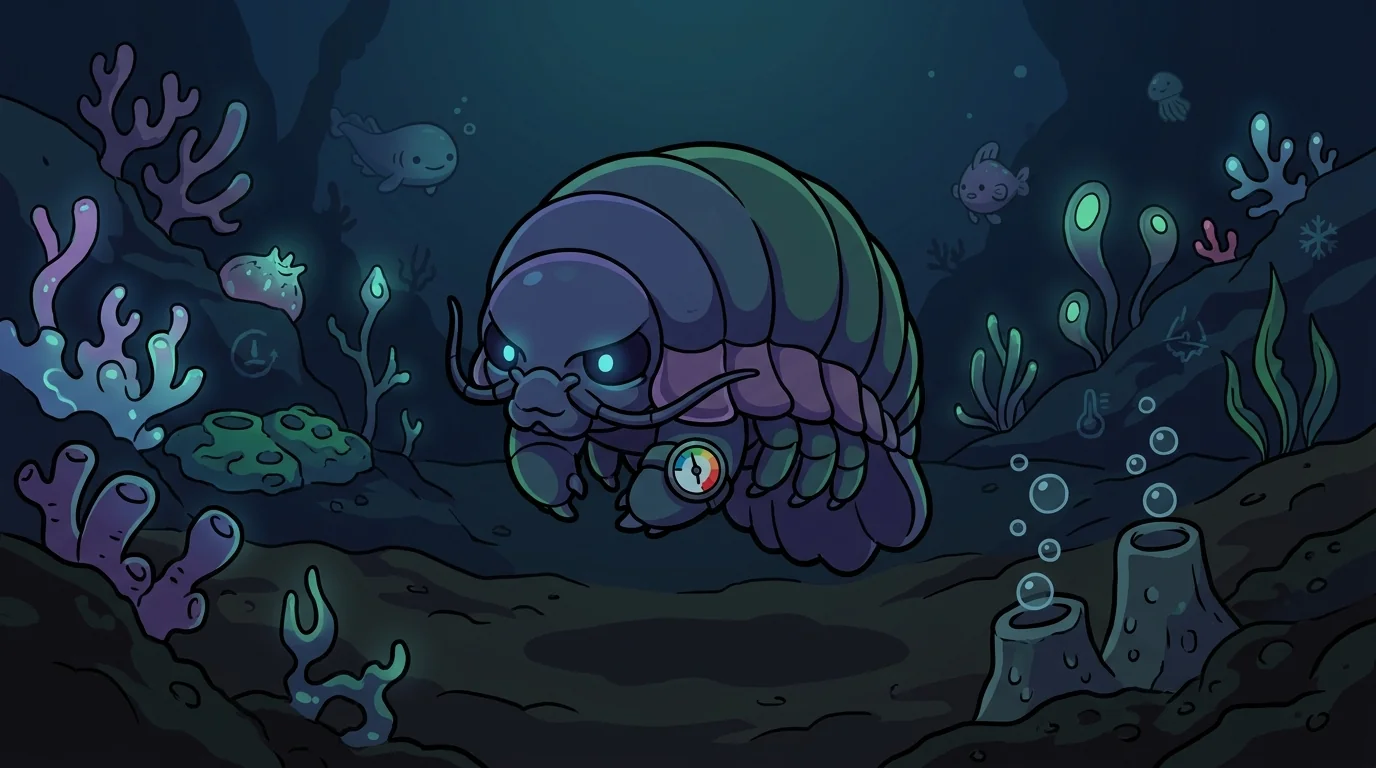
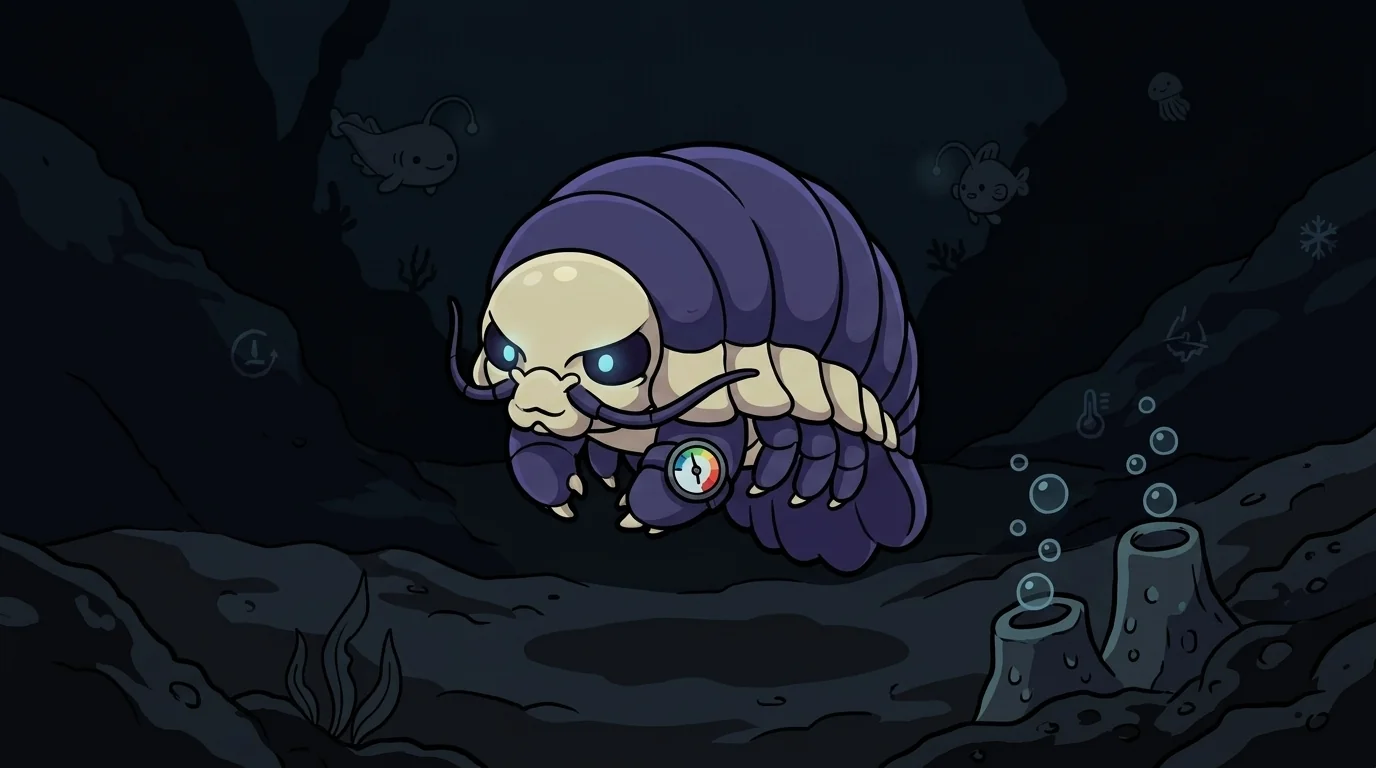
Press wasn't exactly tall. She was a giant-isopod-tween, which meant she was built low to the ground, soft and rounded like a smooth, deep-violet-and-cream stone. Not spiky at all. Her eyes were deep-set, dark pools that seemed to absorb light, or perhaps, create it. She wore a small pressure-gauge on a strap around her wrist. It was her signature feature. The dial showed the local water pressure, which down here was immense. Over one hundred atmospheres, the needle read. That's like a small car pressing down on every single square inch of you. Press wore it casually, as if it were just a normal watch. To her, it was. "Crushing pressure," she often said, a patient smile on her face, "is just home pressure here. Life adapts."
Press lived and breathed the *midnight zone*. This was the deep layer of the ocean, a vast space from one thousand to four thousand meters down. Here, no sunlight ever reached. The water was near-freezing, and the pressure was enormous. Most people, especially those new to the deep, thought nothing could survive in such a place. They were wrong. Life was everywhere, thriving in ways that seemed impossible to surface dwellers. Giant squid, those elusive titans, called it home. Anglerfish, with their glowing lures, swam through the blackness. Vampire squid, comb jellies, and countless other creatures lived here. Each one had found a way to adapt to the extreme cold, the crushing pressure, and the endless dark. Scientists still discovered new tricks these animals used every year. Pressure wasn't a problem, Press would explain, if your body was built to match it. Her work was about telling the story of the midnight zone as a marvel of adaptation, never as a place of horror.
Press made her point very clear. "It's one thousand to four thousand meters down," she'd say, holding up three fingers. "Pitch black. Crushing pressure. Freezing cold. But life thrives anyway." She'd list her favorite residents. "Giant squid. Anglerfish. Vampire squid. Each one adapted to its home conditions." She paused, letting the words sink in. "Pressure isn't a problem if your body matches it. Cold isn't a problem if your metabolism is built for it. That's how your body uses energy. These creatures burn energy slowly, perfectly tuned to the cold water." She'd tap her temple. "And darkness isn't a problem if your senses don't depend on light at all."
In her lessons, Press started with the basics. "First, the zone itself," she'd say, pointing to a holographic projection of the ocean layers. "From one thousand to four thousand meters. It's right below the twilight zone, where the last bit of sunlight fades out completely. Down here, it's totally dark, like being inside a closed box. The water stays around two to four degrees Celsius, just above freezing. And the pressure? It's immense. One hundred to four hundred times what you feel on the surface. Imagine the weight of a hundred elephants standing on your head."
Then she moved to the adaptations. "How do they handle all that pressure?" she'd ask, her eyes sparkling. "Most deep-sea creatures have soft, gelatinous bodies. No hard shells or air spaces inside them to get crushed. Think of a jellyfish, but tougher, more resilient." She'd explain how their cells were different too. "They use special proteins called piezolytes. These are unique molecules that help all the tiny cell machinery work perfectly. They keep everything from collapsing under the weight. And no swim bladders, which are gas-filled sacs that help fish float. Those would just explode under this kind of pressure."
Next came the cold. "How do you stay alive when it's practically freezing?" Press would lean forward, her voice dropping slightly. "Slow metabolisms. Their bodies don't burn much energy at all. They move slowly, grow slowly, and live for a very long time. Their bodies also have enzymes that work best in the cold. Enzymes are like tiny tools in your cells that make everything happen, from digesting food to building new cells. Some deep-sea species even have natural antifreeze proteins in their blood, just like a car's radiator fluid."
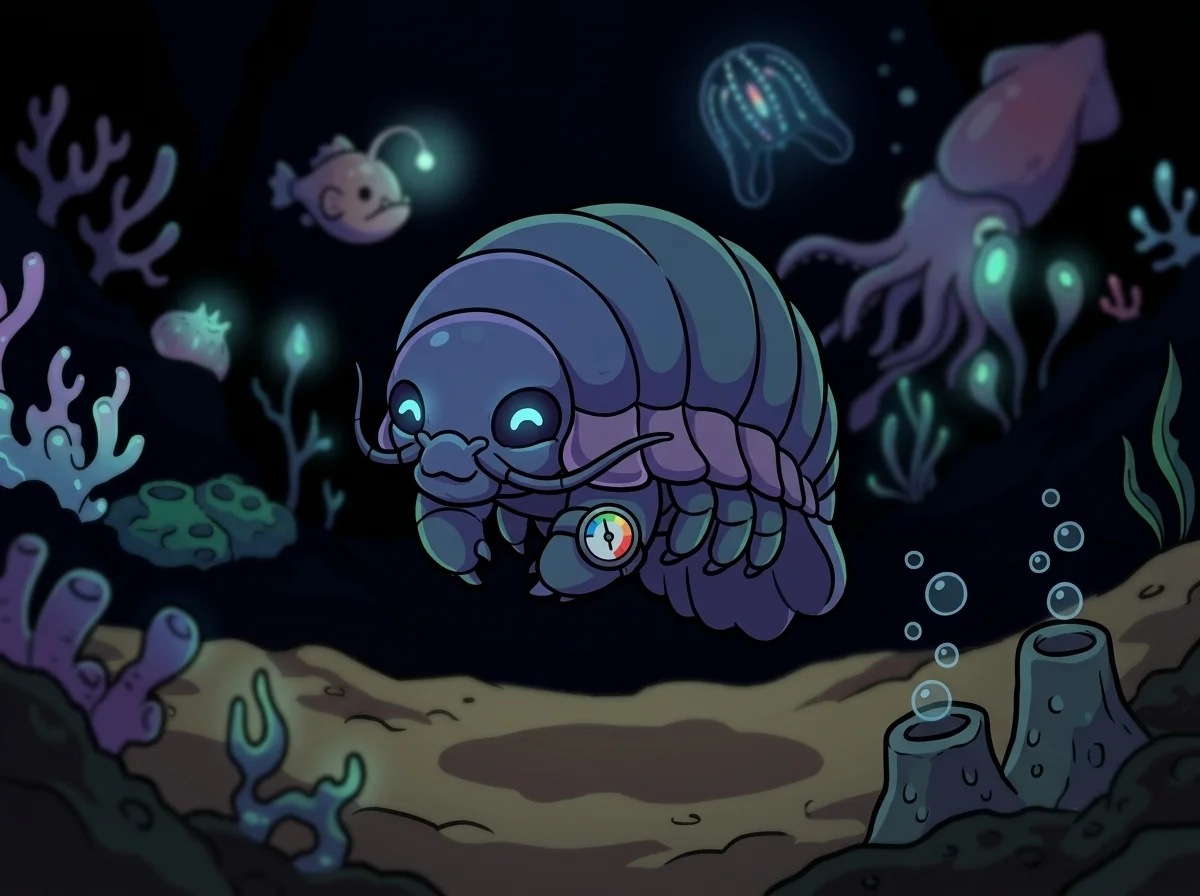
And the darkness? "It's not a problem if you don't need light to see," she'd say. "Some have huge, telescopic eyes to catch the faintest flicker of bioluminescence, light made by other living things. Others have long, sensitive tentacles to feel their way around, like a blind person using a cane. Many rely on smell, tasting the water for food or mates. Some even use electroreception, sensing tiny electrical fields given off by other creatures. They don't miss what they never had, because they have other, better ways to navigate."
Press loved to introduce her "famous residents." She'd show a picture of a giant squid. "This one, Architeuthis, can grow up to thirteen meters long. That's longer than a school bus! Imagine meeting that in the dark." Then an anglerfish, its bioluminescent lure dangling. "The females are a hundred times bigger than the males. He literally attaches to her for life, becoming a permanent part of her body." She'd show a vampire squid, a creature that looked like it belonged in a horror movie, with its dark, webbed arms. "But it's not a vampire," Press would correct gently. "It's an ancient relative of both squid and octopuses. And it eats marine snow, not blood." She'd finish with the adorable Dumbo octopus, with its big, ear-like fins that made it look like it was flying through the water.
"Many stories make these animals seem monstrous," Press would explain, her voice firm. "But they aren't monsters. They are extraordinary survivors. Each one is a marvel of adaptation, a perfect solution to living in extreme conditions." She'd even describe the special equipment scientists used. "Marine biologists use pressure-vessel cameras and sample chambers. These keep the creatures under their natural pressure, so we can study them without them getting crushed or decompressed at the surface. It's like bringing their home to the lab."
Press grew up on the abyssal plain, a vast, flat expanse of the deep ocean floor. Her family had lived there for generations. They were giant isopods, like her, scavenging the "marine snow" – a slow, steady rain of organic bits falling from the waters above. From her earliest days, Press learned a fundamental truth: what looked extreme to a surface visitor was simply home to its residents. She carried that lesson deep in her heart.
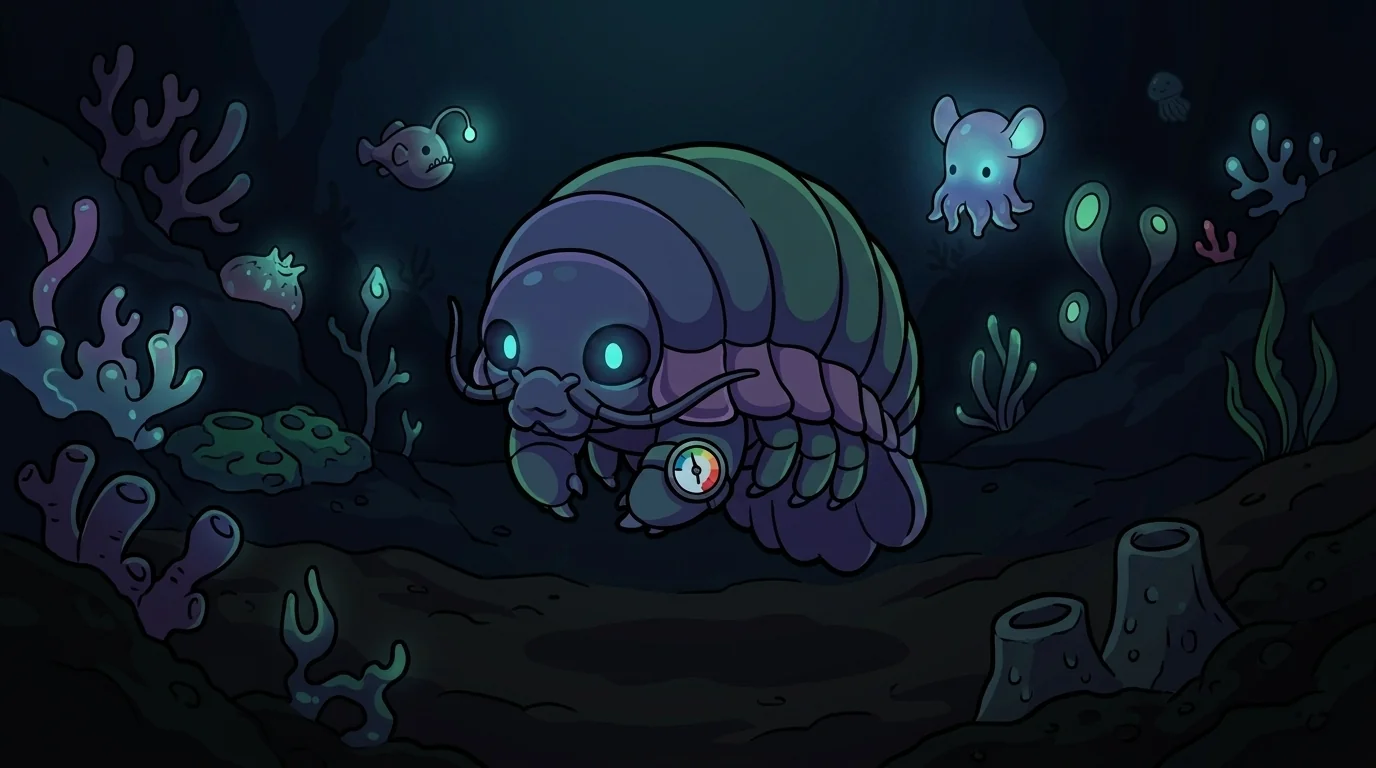
When she was twelve, Press made the long journey to DepthQuest village. Marlin, the wise old mentor, had asked her a single question. "What is the midnight zone?"
Press hadn't hesitated. "It's one thousand to four thousand meters. Pitch black. Crushing pressure. Freezing cold. But life adapts." She listed off her favorite creatures. "My zone has giant squid, anglerfish, vampire squid. They're extraordinary survivors of extreme conditions. Not monsters, Marlin. Adaptations."
Marlin had simply nodded. "You are appointed, Press."
In her workshop, Press kept a collection of stunning photos and slow-motion videos of midnight-zone residents. She'd point to a female anglerfish, its bioluminescent lure glowing faintly. "This anglerfish uses her lure to attract prey. She doesn't 'haunt' anyone. She's a fisher. Her tool is her own light."
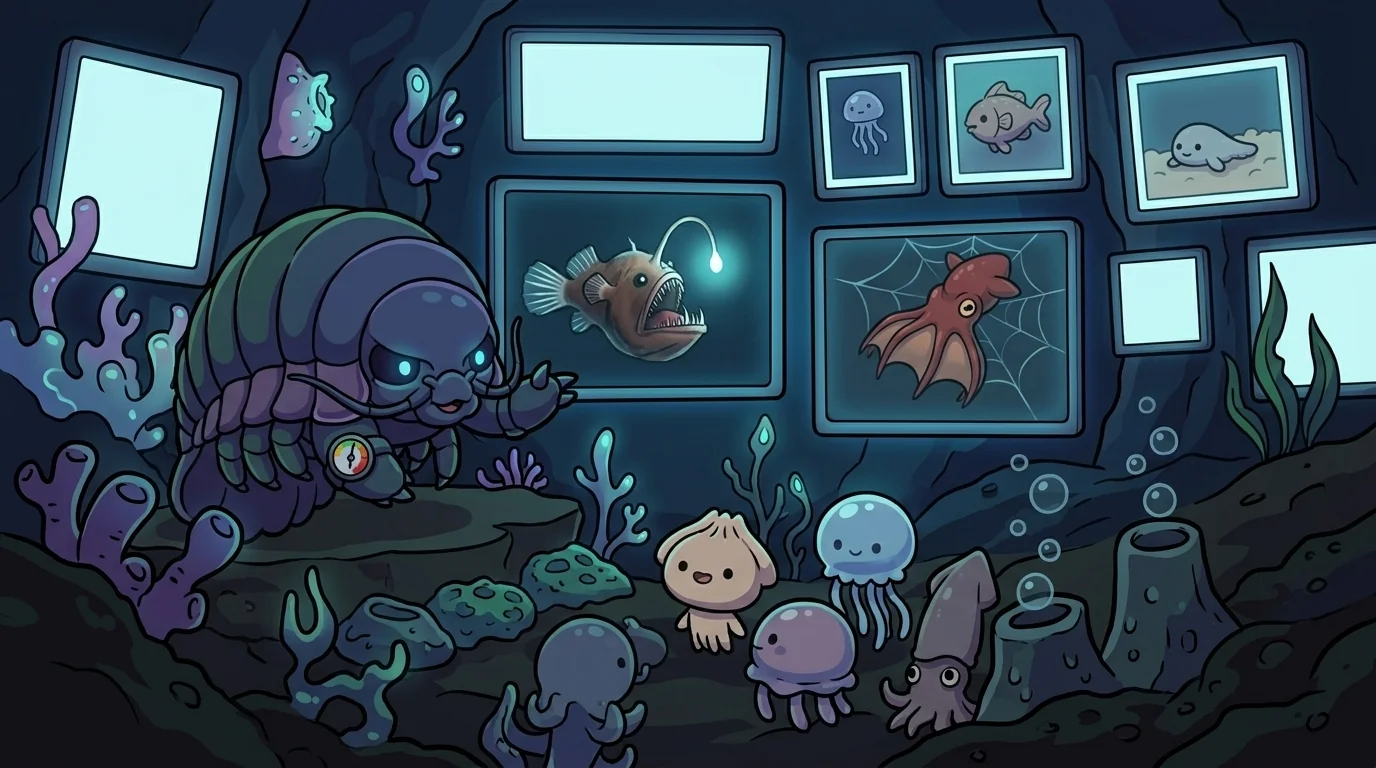
Then she'd show a vampire squid, its dark webbed arms spread wide. "Doesn't drink blood," Press would state, a hint of dry humor in her voice. "It eats marine snow, all that falling organic debris. Vegan, basically."
"I am Press," she'd tell new students, her voice calm and steady. "I teach the *midnight zone*. My goal is to show you the marvel of adaptation, not the horror. The residents of my zone are brilliant problem-solvers. Each one is like a perfect chemistry experiment that worked."
She was always gentle when students looked nervous. "Don't be scared of these pictures," she'd say. "They look strange because they're adapted to a strange environment. If you adapted to crushing pressure and total darkness, you'd look strange too." She'd pause, letting her words sink in. "Strange doesn't mean scary. Strange means clever evolution."
"Think wonder, not horror," Press would insist. "These animals are the same kind of marvel as a giraffe. They just evolved for the dark."
The DepthQuest ensemble
Press is part of DepthQuest's distributed-narrative cast. Each character embodies a different curricular primitive; together they teach the full subject.