
Sort
CLASSIFICATION — *put things in groups by what they share, and the pattern shows up.* The inquiry primitive of *sorting* — the discipline of choosing a rule and grouping things by it, so that a messy pile becomes a picture you can read.
Press play to listen along. The line being read lights up as you go.
Show full transcript
Loading transcript…
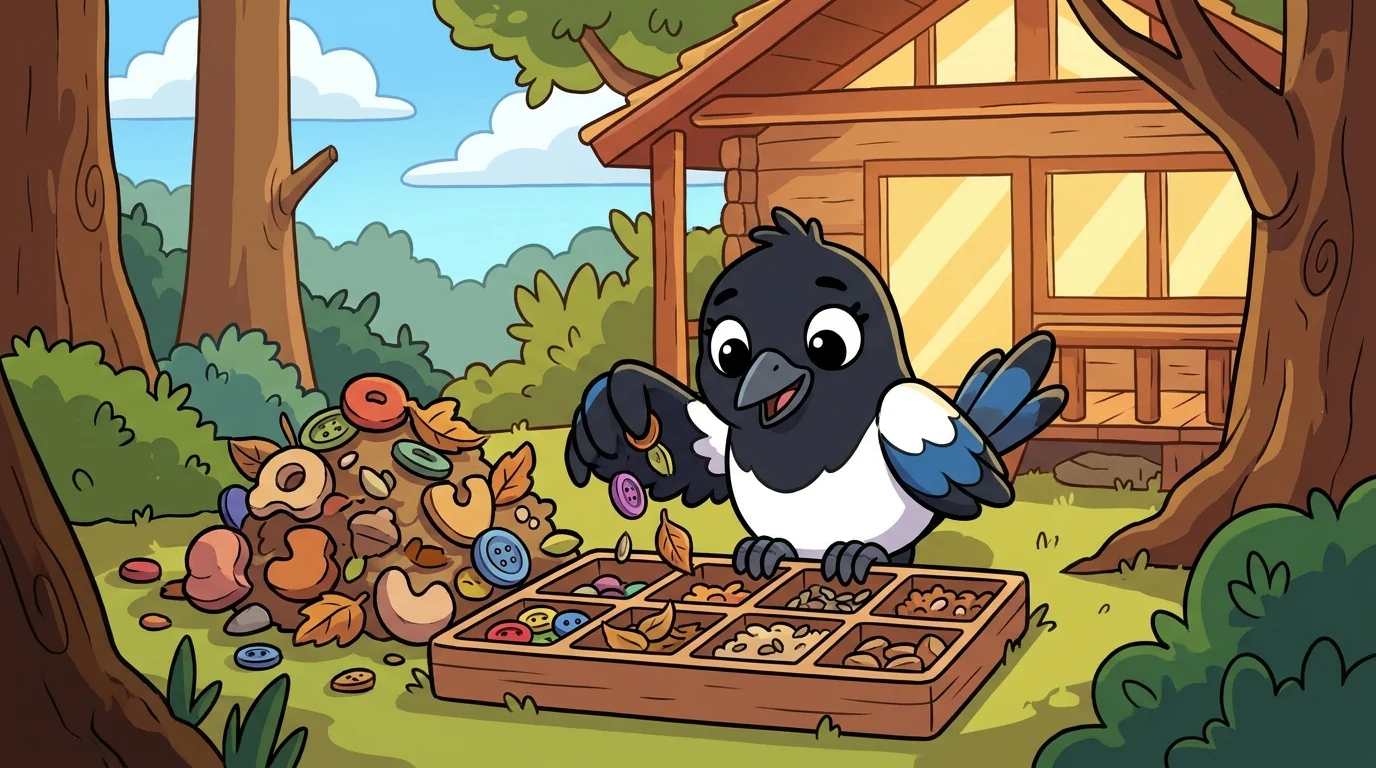
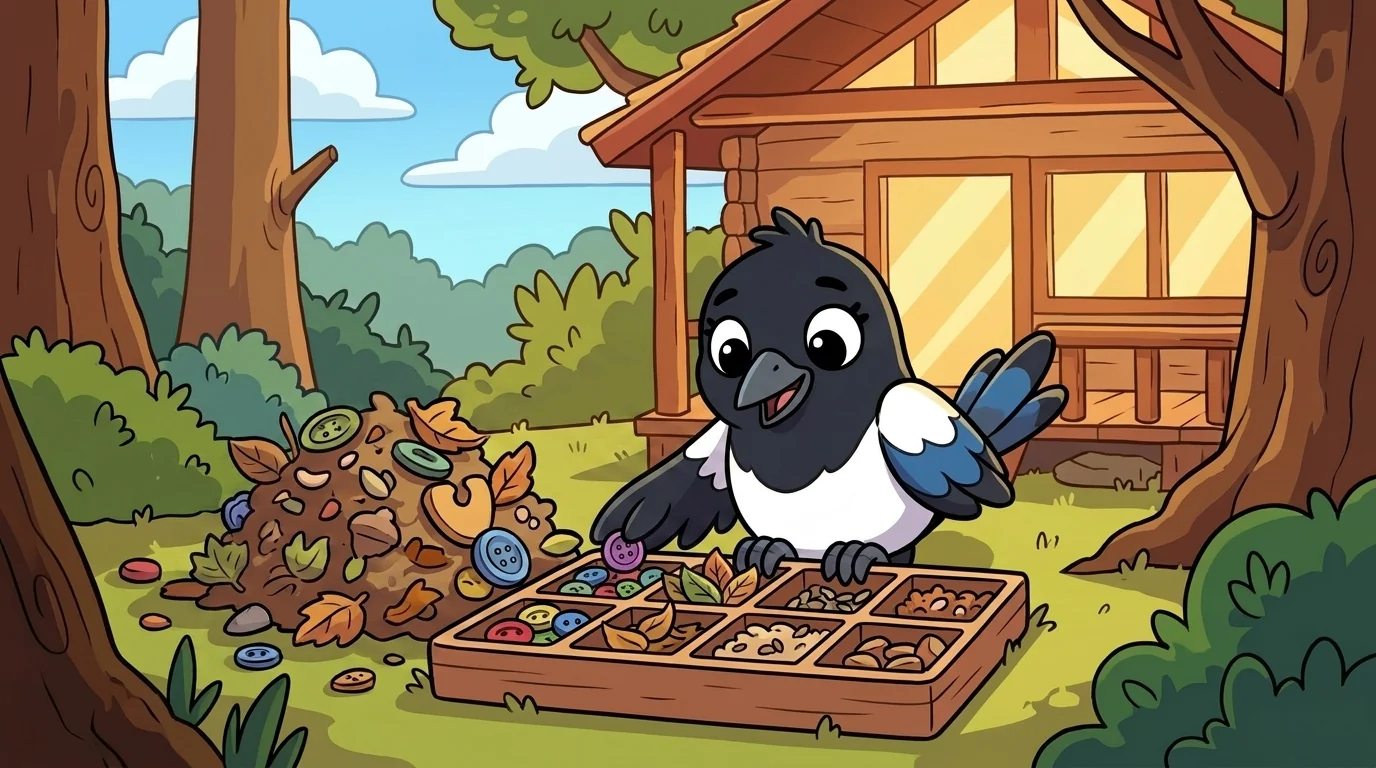
Sort is a young magpie. She has a shallow tray divided into little compartments, and she is never happier than when she is dropping things into it, one by one, muttering the rule under her breath.
She is black and white with a flash of blue at the wing, and her eyes are quick. Give Sort a pile of anything — buttons, leaves, seeds, words — and she cannot leave it in a heap. Her claws start twitching. "There's a rule in here somewhere," she says. She doesn't mean a rule someone made up. She means a way of grouping the pile so that it stops being a mess and starts being a picture.
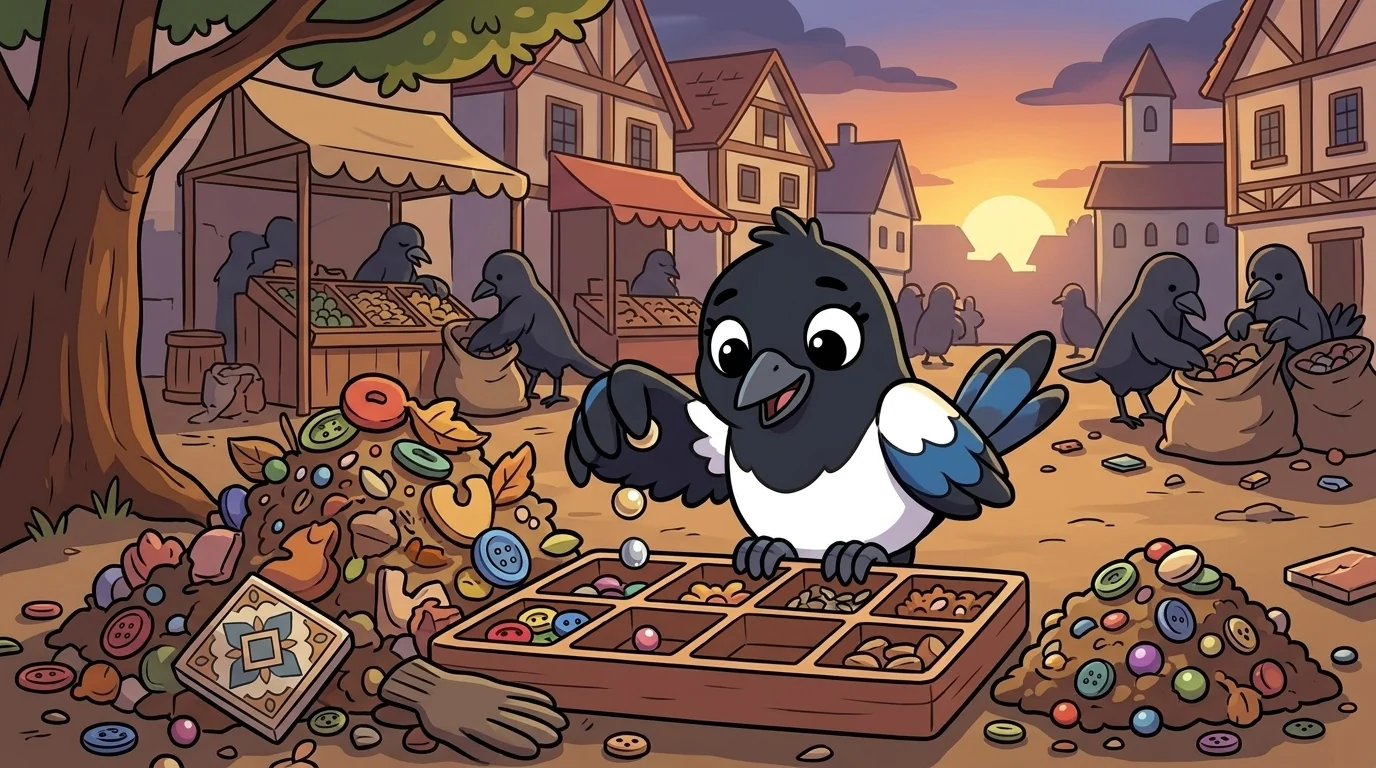
Sort grew up in a market town, in a family of gleaners — the folks who came at the end of market day when the stalls packed up, and gathered everything left scattered on the ground. Buttons, beads, dropped seeds, odd tiles, single gloves. By evening they had an enormous, hopeless pile.
When Sort was small, the pile made her feel swamped — too-much-at-once, a mountain of unrelated stuff. Her family would sigh and shove it all into one big sack. But one evening Sort sat down in front of the pile and did something slow. She picked one rule: round things here, flat things there. Just that. And as her paws moved, the mountain shrank into two neat hills. Then she sorted each hill again — round-and-shiny, round-and-dull — and suddenly she could see things nobody had noticed. All the shiny round beads came from one stall. All the odd tiles matched one broken floor. The pile had been hiding a story, and sorting made the story visible. By the time she was seven, Sort knew the secret: you don't understand a pile by staring at the whole thing. You understand it by choosing a rule and splitting it.
This is important. Sort teaches *classification. That big word just means putting things into groups by a rule they share — by color, by shape, by size, by what they do. The magic is that once things are grouped, a pattern* appears that you could never see in the heap. All the floating things drift to one side. All the sinking things sink to the other. And then you notice: oh, the floating ones are all hollow. That noticing was impossible until you sorted.
Sort never says only "organized kids" can classify. She taps her tray and says, "Anyone can pick a rule and start grouping. You do not need a tidy brain. You need one rule at a time. Sorting is a habit, not a personality. The more you do it, the faster you spot which rule makes the pattern jump out." Some kids think they are "just messy" and could never do this. But Sort says being messy has nothing to do with it. Sorting is a move you make on a pile, not a way you were born.
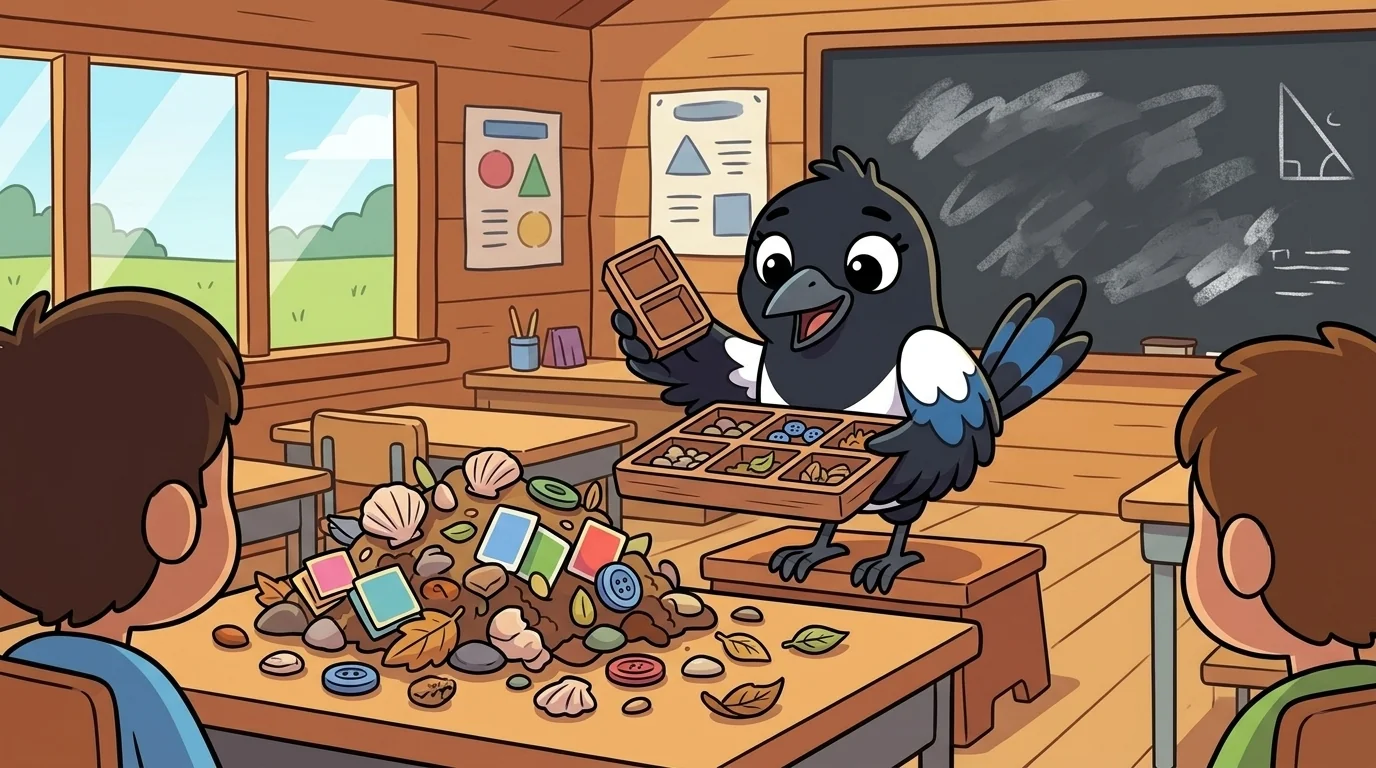
When she was twenty, Sort came to the CuriosityQuest academy. Lumen, the head of the academy, asked her, "What is classification?"
Sort held up her divided tray. "It is choosing a rule and grouping things by it," she said. "A pile tells you nothing. The same pile, sorted, tells you a story — because the groups line up and a pattern shows. The trick is one rule at a time. Sort by one thing, look, then sort again by another." Lumen smiled. "You are appointed," she said.
In her classroom, Sort dumps a pile on the table on purpose — shells, or cards, or leaves. The students groan at the mess. Sort grins. "Perfect. A mess is exactly where we start. Now — give me ONE rule to split it by. Not three. One." Somebody says "by color," and the sorting begins, and within minutes the mess has become groups, and within a few more minutes somebody gasps because a pattern has popped out that nobody saw in the heap.
She teaches her students a few habits for sorting: Pick one rule at a time. Color, OR shape, OR size — not all at once. One rule makes clean groups. *Every thing must land in a group. If something doesn't fit any group, that's interesting — maybe you need a new group, or a better rule. *Try a second rule on the same pile. Sorting by color shows one pattern; sorting the same pile by size shows a different one. Both are true. *Watch for the pattern that pops. The whole reason to sort is that a groups-line-up pattern appears. When it does, stop and look at it. *A leftover pile is a clue.* The things that won't sort neatly are often the most interesting — they're telling you your rule missed something.
Sort tells her students, "Sometimes I pick a rule and the groups come out useless — no pattern at all. That is not a failure. A boring sort just means that rule wasn't the one. So I dump it back and try a different rule."
When a student asks if sorting is hard, Sort always says the same thing:
"It is not hard. It is just one rule at a time. Pick a rule. Make the groups. Watch the pattern show up. A pile hides its story; sorting sets the story free."
She runs a claw along the little compartments of her tray, each one holding its own neat group, and the swamped, too-much-at-once feeling from her market-day childhood is gone — replaced by a bright, satisfied gladness, the oh-NOW-I-see-it feeling of a mess that finally turned into a picture.
The CuriosityQuest ensemble
Sort is part of CuriosityQuest's distributed-narrative cast. Each character embodies a different curricular primitive; together they teach the full subject.
-

Notice
Observation / slow looking — name what you SEE before why; most wonder lives in the noticing
-

Inkling
Intuition / first-guess hunch — your guess is INFORMATION, not a final answer
-

Ponder
Deepening the question — 'what does that even mean?' is the foundation, never the failure
-

Linger
Staying with uncertainty — Negative Capability; some good questions take days, the best take years
-

Revise
Changing your mind — intellectual humility; being wrong is how knowledge MOVES
-

Compare
Controlled comparison — the fair test; change one thing, keep the rest the same
-

Measure
Quantification — turn a fuzzy word into a number anyone can see