
Sort
CLASSIFICATION — *put things in groups by what they share, and the pattern shows up.* The inquiry primitive of *sorting* — the discipline of choosing a rule and grouping things by it, so that a messy pile becomes a picture you can read.
Press play to listen along. The line being read lights up as you go.
Show full transcript
Loading transcript…
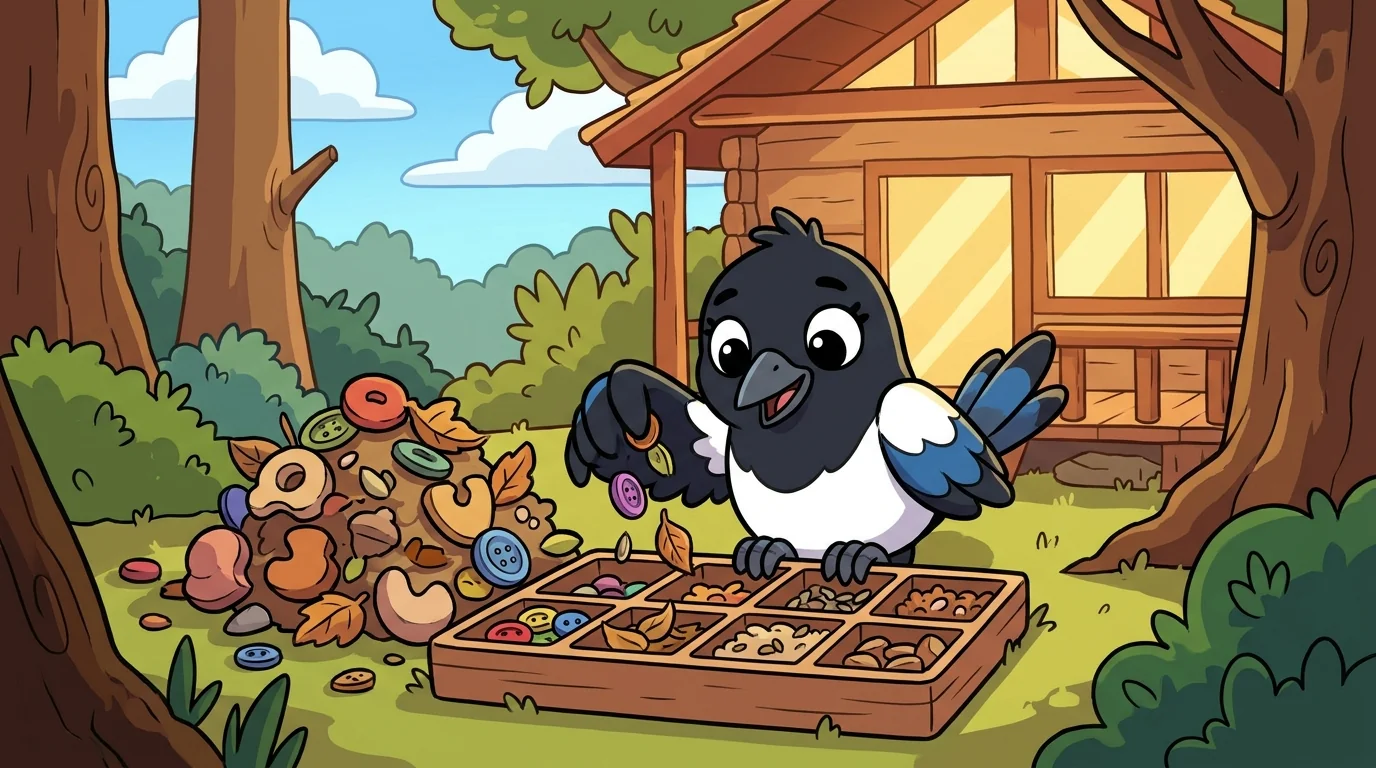
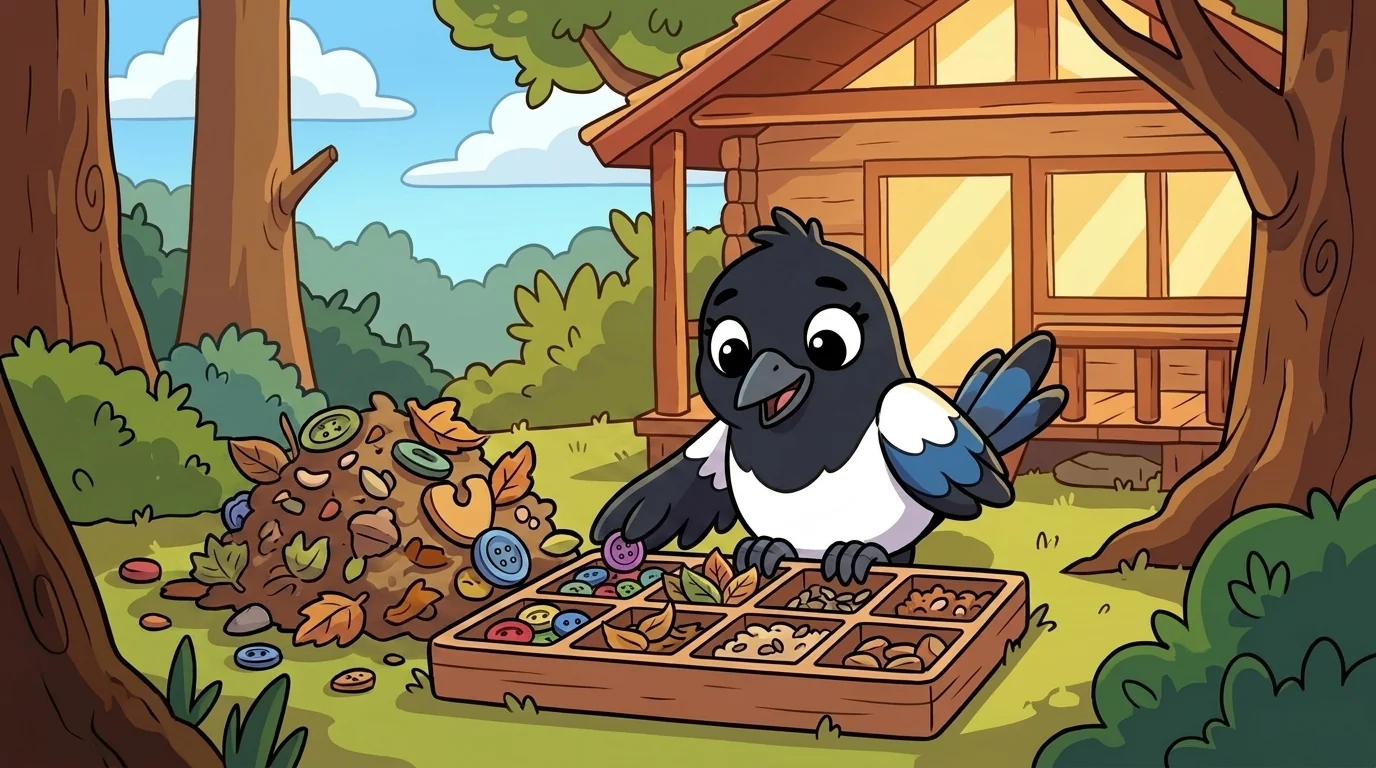
Sort was a magpie, which meant she had a natural affinity for things that caught the light. But unlike her cousins, she did not just want to hoard them in a messy nest. Her prized possession was a shallow tray of sanded plumwood, divided into twelve identical square compartments. She was never happier than when she was dropping oddments into those little boxes, one by one. As her claws worked, she muttered her current rule under her breath like a spell.
Her feathers were mostly a sharp, clean black and white, though a sudden flash of iridescent blue showed when she stretched her wings. Her eyes were dark and incredibly quick. If you gave Sort a pile of anything—brass buttons, dried maple seeds, or old postage stamps—she could not simply walk past it. Her talons would twitch.
"There's a rule in here somewhere," she would whisper.
She did not mean a rule that some schoolmaster had written down in a dusty ledger. She meant a hidden logic, a way of grouping the chaos so that it stopped being a mess and started being a picture.
Sort grew up in Low-Water, a market town that smelled of wet straw, river silt, and roasted chestnuts. Her family were gleaners, which meant they made their living from the things other people dropped or discarded. They were the quiet folk who waited until the sun dipped below the slate roofs and the merchants began packing up their wooden stalls. While the town went home to supper, Sort and her parents swept between the empty carts, searching the mud.
They gathered whatever had slipped through the cracks of the cobblestones, working quickly before the street sweepers arrived. They found dropped brass buttons, glass beads, stray pumpkin seeds, single leather gloves, and cracked tiles. By the time the streetlamps were lit, they had filled their canvas sacks to the brim. Back in their small kitchen, they dumped their findings onto the pine table. It was always an enormous, hopeless heap, smelling of damp earth and old metal.
When Sort was very small, that nightly pile made her feel entirely swamped. It was a mountain of unrelated things, pressing in on her eyes. She would stare at the jumble, and her head would ache from the sheer noise of it. Her father would sigh, rub his tired eyes, and shovel the whole jumble into a large burlap sack to sell by weight. Selling the jumble by weight brought in only a few copper coins, which barely paid for their supper.
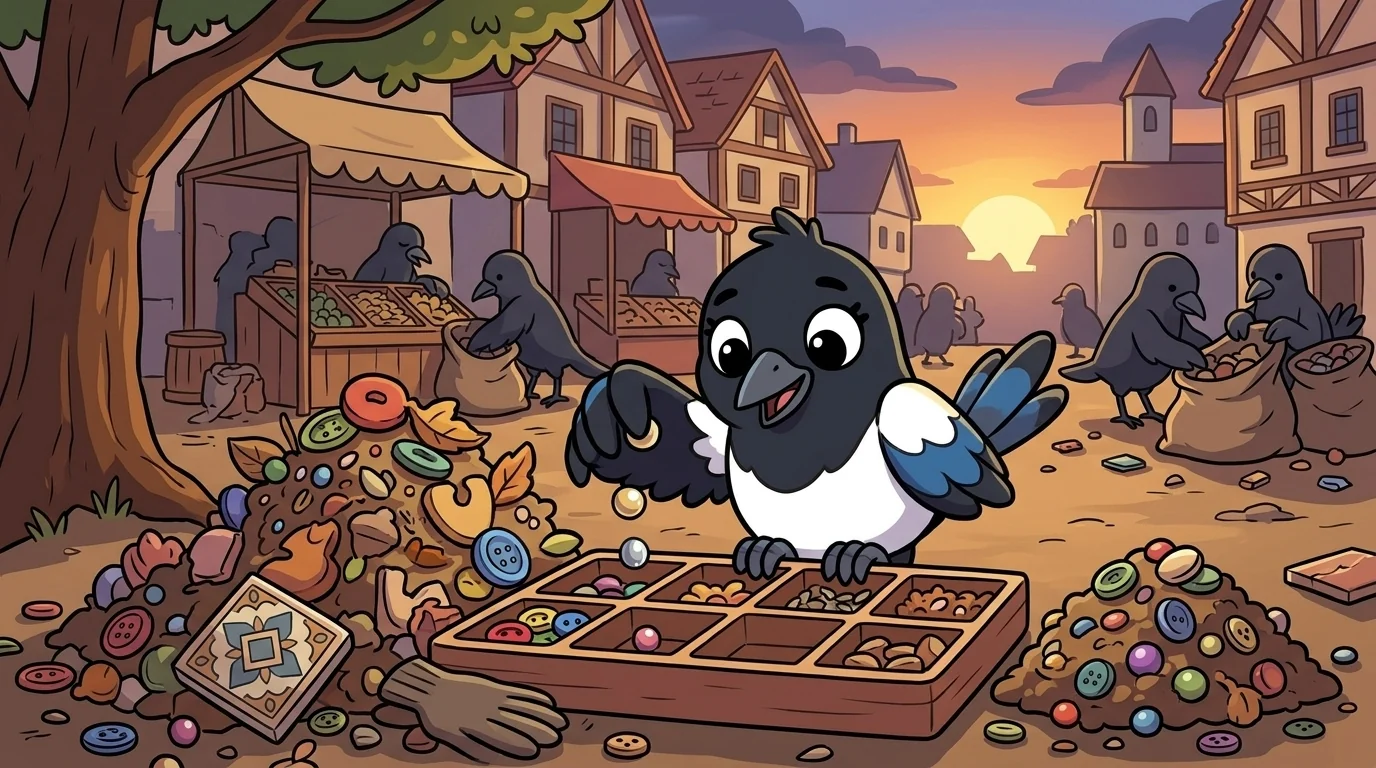
But one rainy Tuesday evening, when she was seven, Sort did not run away from the table. The rain was drumming against the windowpane, and the oil lamp flickered, casting long shadows. She sat on a three-legged stool, pulled the massive heap toward her, and decided to try something slow. She picked a single, simple rule: things that are round go on the left, and things with corners go on the right.
Her claws darted in and out of the jumble, clicking softly against the wood. Slowly, the mountain shrank into two distinct hills. As the wood cleared, the heavy, swamped feeling in her chest began to lift with it. She looked at the round hill and decided to sort it again, using a new rule: shiny on one side, dull on the other.
Suddenly, she saw things that had been completely invisible in the giant heap. All the shiny brass beads belonged to the jeweler who worked near the high street. All the blue-glazed ceramic tiles matched the broken floor of the bakery by the canal. The pile had been hiding a secret story, and her rules had made it visible. By the time she was nine, she knew the great secret of the market town. You cannot understand a mountain by staring at it. You have to choose a rule and split it.
This simple act of division lay at the very heart of the lessons Sort taught her students. She called it *classification*, a long word that simply meant putting things into groups based on a rule they shared. You could group objects by their color, by their shape, or even by what they were designed to do. The magic of the method was that once the items were grouped, a pattern appeared that was impossible to see in the heap.
If you sorted a bucket of pond water, all the floating bits drifted to one side, and the heavy bits sank to the other. Only then did you notice that the floating things were all hollow. That realization was impossible until you sorted them first.
"You do not need a tidy brain to do this," Sort often told her students. "Sorting is not a personality trait."
"It is just a move you make on a pile."
When Sort turned twenty, she flew to the CuriosityQuest academy for an interview with Lumen, the headmistress. Lumen’s high-ceilinged office smelled of dried lavender, beeswax polish, and centuries of old paper.
Lumen looked at the young magpie and asked, "What is classification, really?"
Sort placed her plumwood tray on the dark oak desk and looked up with bright, steady eyes. "It is choosing one rule and sticking to it until the pile is gone," she said. "A heap tells you nothing."
"But when you sort it, the groups line up, and the story reveals itself."
Lumen smiled, her eyes crinkling at the corners as she studied the young bird. "And if the rule does not work?"
"Then you dump the tray and try a different rule," Sort replied. "The mess is still there."
"You have lost nothing."
"You are appointed," Lumen said.
In her classroom at CuriosityQuest, Sort liked to start her lessons with a theatrical flourish. She would carry a heavy canvas sack to the front of the room, lift it high, and dump its contents directly onto the center table. The objects would clatter, roll, and thump across the scarred wood in a wild wave. It was a magnificent disaster of sea glass, rusted keys, dried seed pods, broken watch gears, and mismatched porcelain shards.
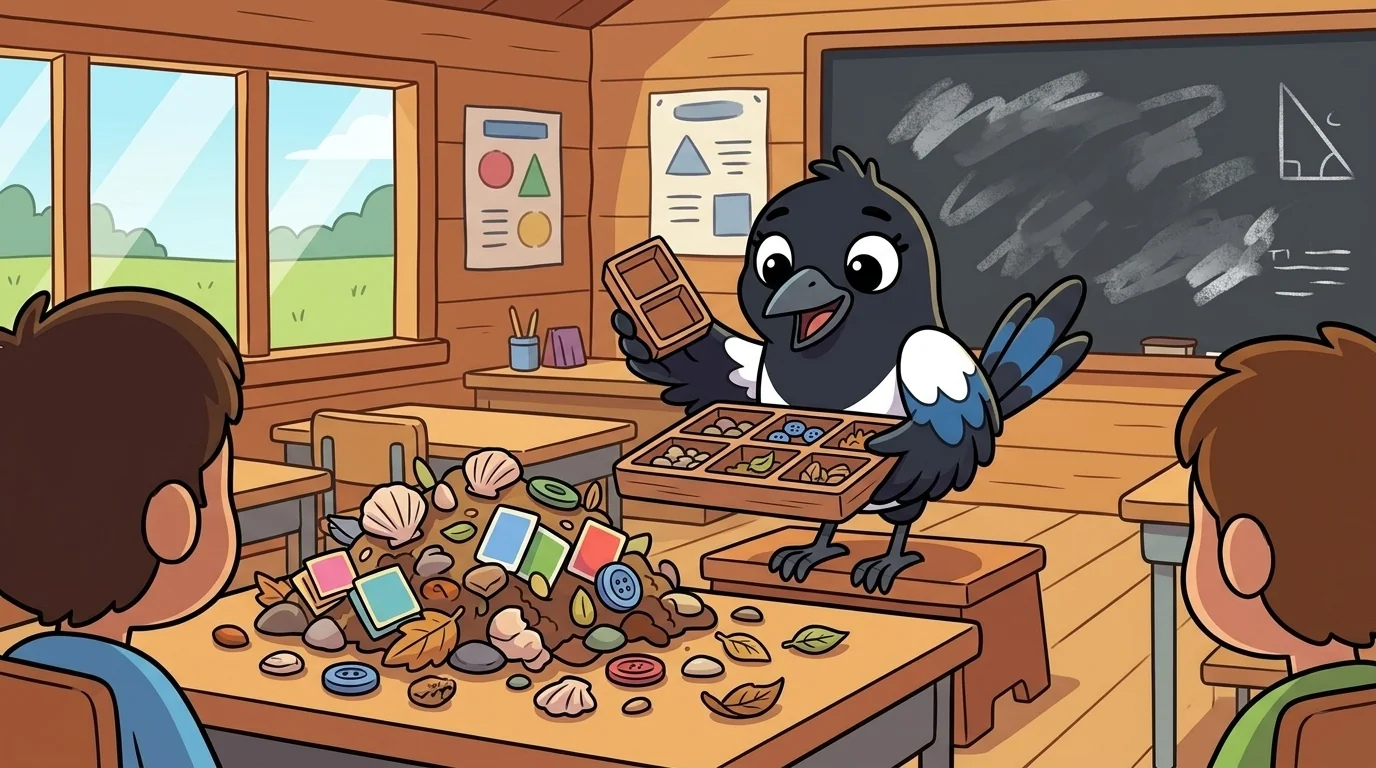
The students would inevitably groan, leaning back in their chairs as if the mess might swallow them. To the untrained eye, the table looked like an impossible chore that would take hours to clear.
Sort only grinned, her blue wing-feathers shimmering in the morning light. "Perfect," she would say, her voice bright with the anticipation of a game. "A beautiful mess is always the best place for us to start."
"If everything were already neat, we would have nothing to discover."
"Now, give me one rule to split it by. Only one. Do not try to be clever yet."
"We could group them by things that are metal!" Barnaby suggested. He was a boy who kept his pencils lined up by length and hated when his ink smudged.
"Excellent choice," Sort said, tapping her beak against the edge of her tray. "Metal in the left corner, non-metal in the right. Go."
The students leaned in, their fingers flying over the table. The initial anxiety vanished as they focused on that single instruction. Within minutes, the chaotic heap was gone, replaced by two neat piles. For the first time all morning, the wooden tabletop actually looked spacious again.
"Now," Sort said, running a claw along her plumwood tray. "Look at the metal pile. Forget the rest. What do you notice about these specific pieces?"
Maya, who usually sat in the back, squinted at the keys and washers. "They all have holes in the middle," she whispered.
"Exactly," Sort said, her dark eyes shining as she looked around the room. "A pattern that was completely invisible when they were buried under the seed pods and sea glass."
"The groups did that work for us."
She taught her students five specific habits for dealing with any mess: Pick one rule at a time. Do not try to sort by color and size at once, or your groups will tangle. *Every single thing must find a home. If an object does not fit your rule, that is where the real interest begins. *Try a second rule on the same pile. Sorting by material shows one pattern; sorting by weight shows another. *Watch for the pattern that pops. The entire point of grouping is to see what the groups tell you when they stand side-by-side. *Treat the leftover pile as a clue.* The oddments that do not fit are often the most important pieces of the puzzle.
Sometimes, a student would get frustrated when a rule led to a boring result. Sort would gently nudge their shoulder with the soft edge of her blue-tipped wing.
"A boring sort is not a failure," she would say. "It just means that rule was not the key. Dump it back and try another."
Whenever a new student asked if the work was difficult, Sort gave them the same steady look.
"It is only hard if you try to do everything at once," she said. "Pick one rule. Make your groups. Let the pattern do the heavy lifting."
She would run a polished claw along the edge of her plumwood tray. The old, overwhelming feeling of the market-day heap was gone, replaced by the quiet satisfaction of a puzzle solved.
The CuriosityQuest ensemble
Sort is part of CuriosityQuest's distributed-narrative cast. Each character embodies a different curricular primitive; together they teach the full subject.
-

Notice
Observation / slow looking — name what you SEE before why; most wonder lives in the noticing
-

Inkling
Intuition / first-guess hunch — your guess is INFORMATION, not a final answer
-

Ponder
Deepening the question — 'what does that even mean?' is the foundation, never the failure
-

Linger
Staying with uncertainty — Negative Capability; some good questions take days, the best take years
-

Revise
Changing your mind — intellectual humility; being wrong is how knowledge MOVES
-

Compare
Controlled comparison — the fair test; change one thing, keep the rest the same
-

Measure
Quantification — turn a fuzzy word into a number anyone can see