Ponder
QUESTION-DEEPENING — *"what does that even mean?" is the foundation, never the failure.* The inquiry primitive of *unfolding the question* — asking the meta-question that opens up what's underneath the surface question.
Press play to listen along. The line being read lights up as you go.
Show full transcript
Loading transcript…
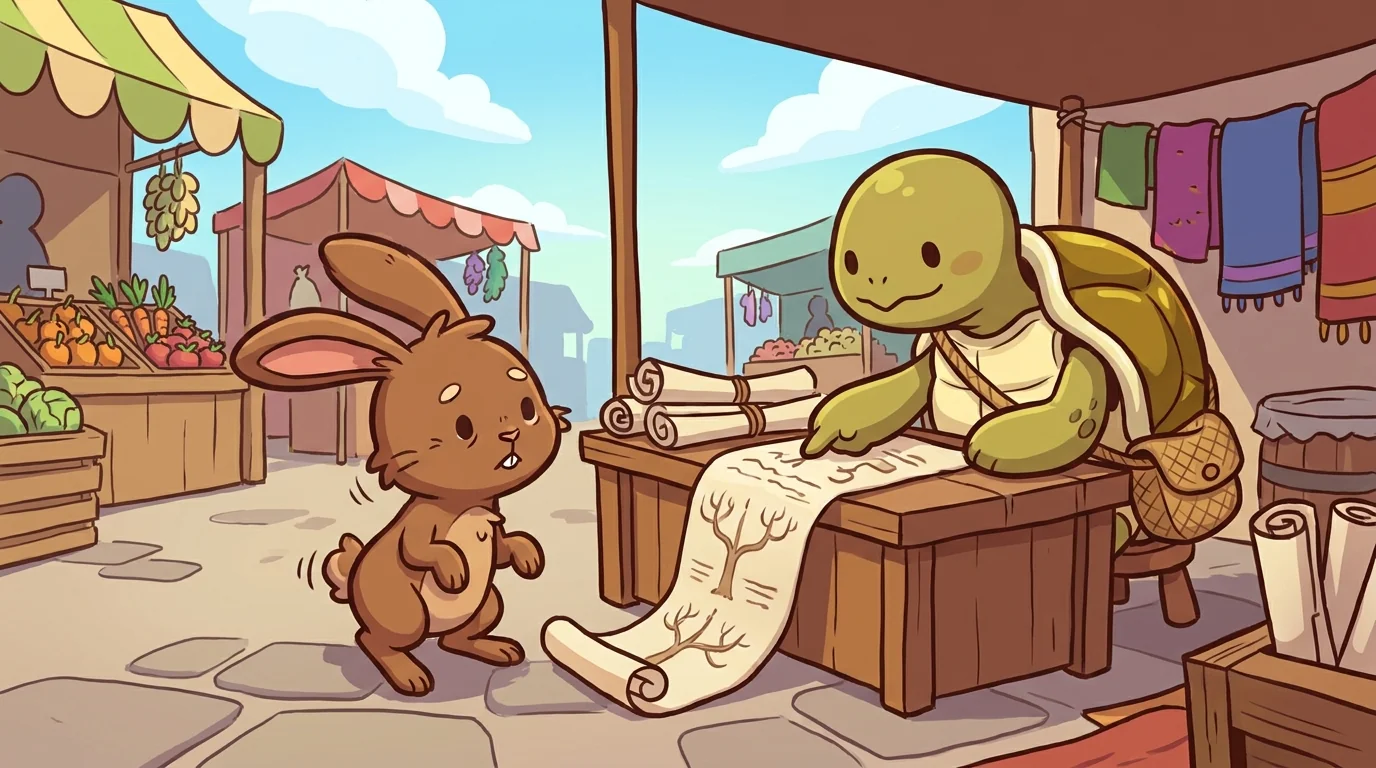
The market square was loud with morning, and a young rabbit came skidding up to Ponder's stall, out of breath.
"Why does the river go faster near the bridge?" she asked, all in one rush. "Just tell me quick, I have to get home."
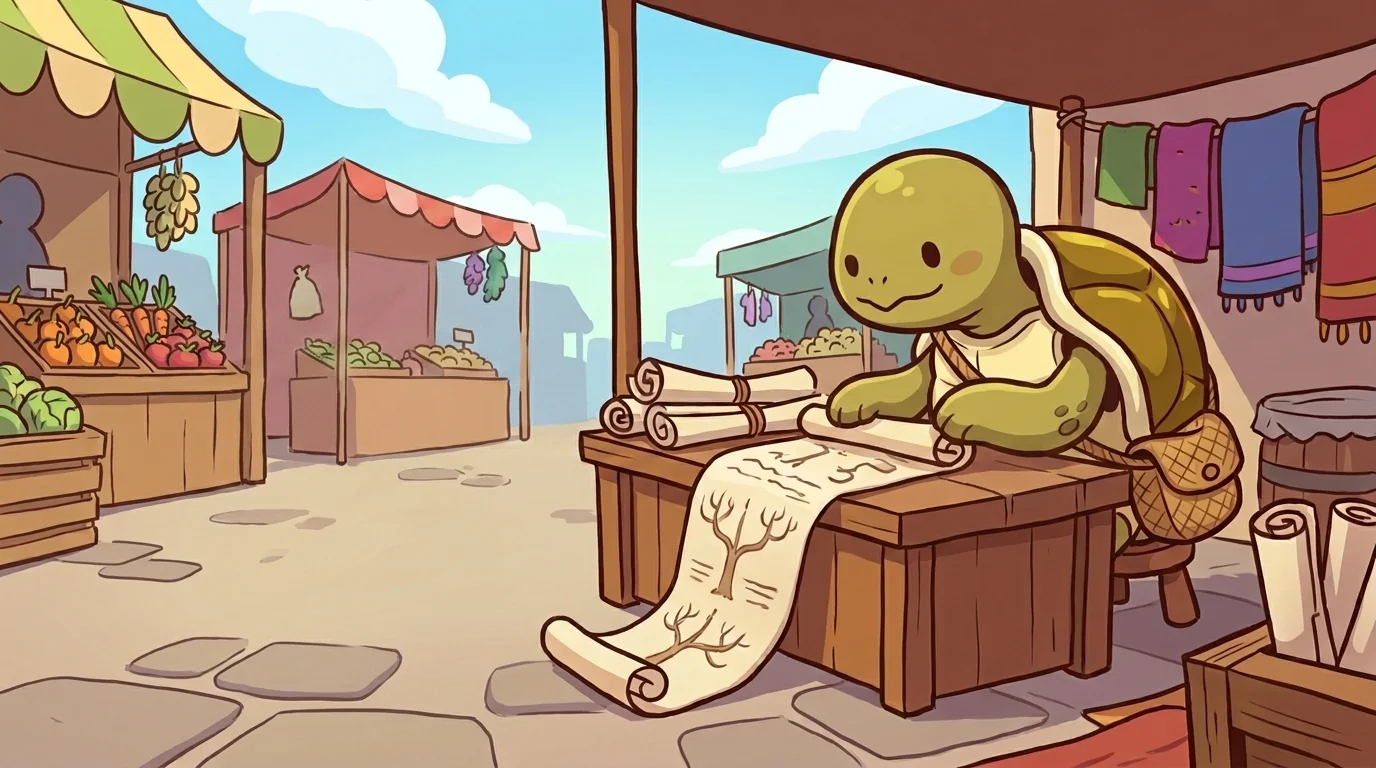
Ponder was a small turtle, still a tween, warm-olive and cream, his shell polished smooth from years of slow walking. He did not answer quickly. He almost never did. Instead he took a long breath, reached into the little woven satchel resting on top of his shell, and drew out a roll of paper thin as an onion skin.
He set it on the stall and let the top of it unfurl. A single line of writing showed at the very top. Below it, the paper opened into smaller questions, and below those, smaller ones still, like a tree growing downward instead of up.
"Before we chase the river," Ponder said gently, "look here for one moment. What do you mean by faster? Faster than the middle of the river, or faster than yesterday? And what do you mean by near — right beside the stone, or a whole stretch before it?"
The rabbit blinked. She had been so sure her question was simple.
"Your question wasn't small," Ponder said, and unfurled one more leaf. "It just hadn't been opened yet. Underneath it are these quieter questions. Ask those first, and the river will almost explain itself."
She leaned in, forgetting for a moment that she was in a hurry. That was the thing Ponder loved most — the moment a person stopped rushing past a question and started to sink into it.
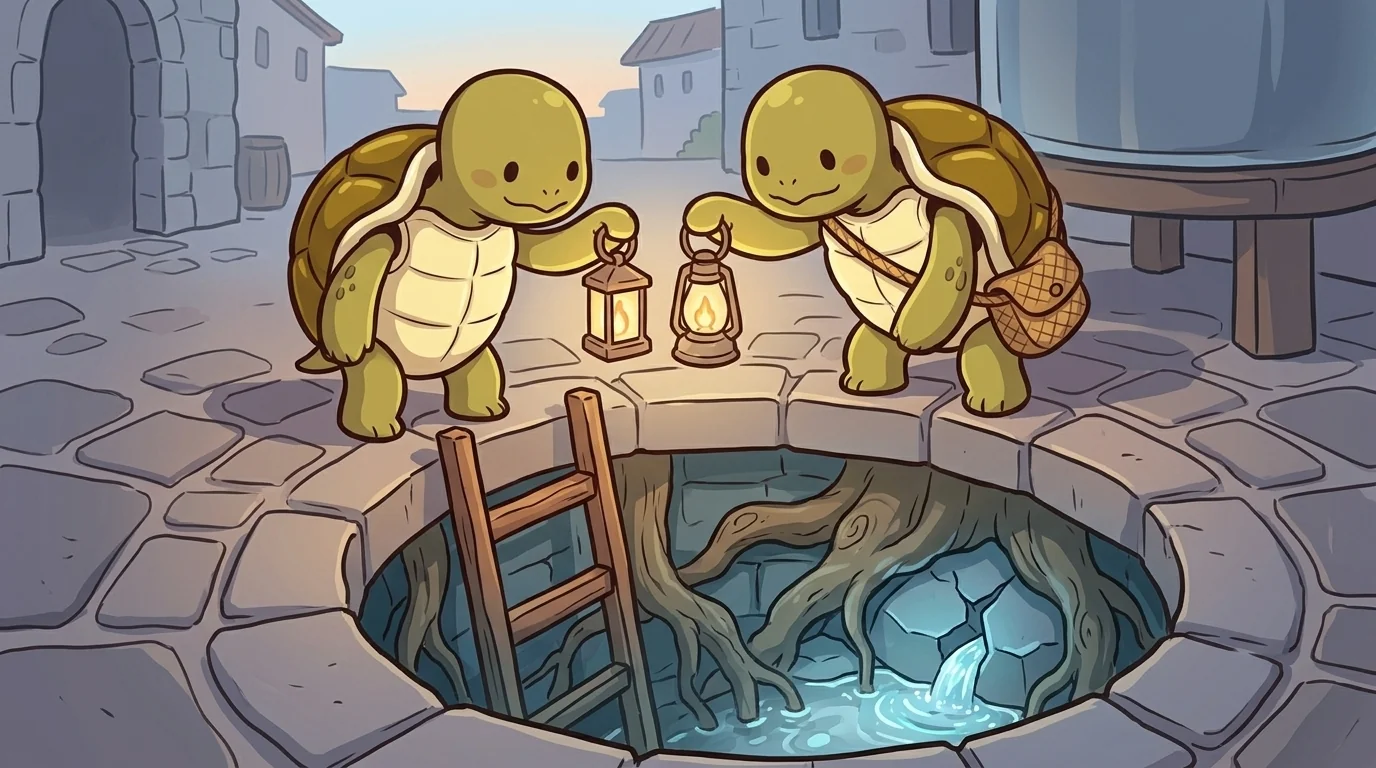
Ponder learned to sink into things long before he could explain why.
He grew up in a small village where his family were the roots-keepers. They were the turtles who looked after everything underground — the well, the cool root-cellar, the great water tank at the edge of town. It was quiet work, and hidden, and it taught him early that the important part of a thing is usually the part you cannot see.
When he was very small, he would sit at the lip of the village well and stare down into the dark. The water was clear and cold and never ran dry, and one evening he asked his grandmother why.
"Because of the spring," she said. "Far below. Deeper than the deepest root."
"But why does the spring not run dry?" Ponder asked.
His grandmother smiled and did not answer. She only handed him a lantern and let him climb down the ladder to see for himself. Down there, in the cool and the quiet, he understood something he could not yet say in words: whatever you saw at the top depended on what was hidden at the bottom. The clear water needed the deep spring. The cool cellar needed the long roots. If you wanted to understand the surface, you had to spend real time in the depth.
By the time he was six, he had turned that feeling into a habit. He never took a question at its face. He always climbed down the ladder first — down into what the question really meant.
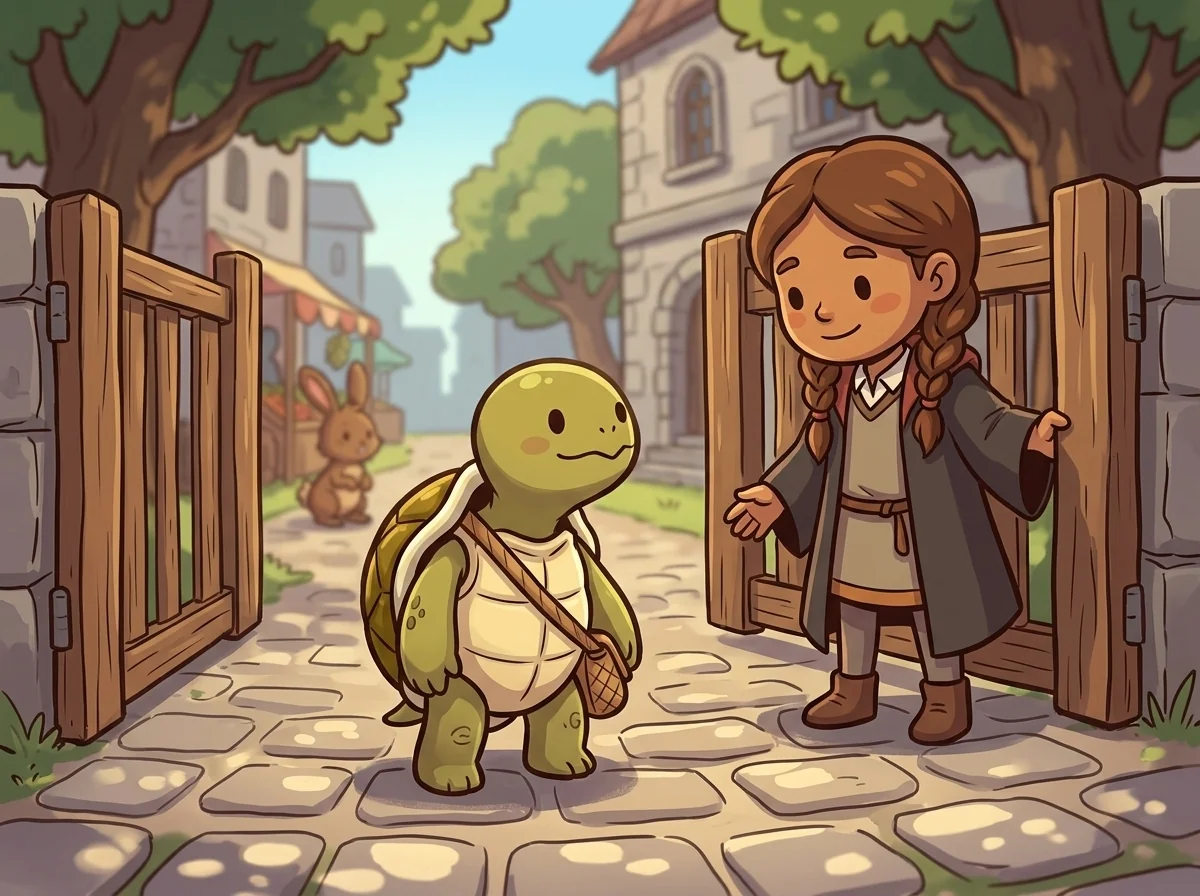
When Ponder was twenty-two, he tucked the question-tree into his satchel and walked the long road to the CuriosityQuest academy.
Lumen, who ran the academy, met him at the gate. She was known for asking hard, plain questions, and she asked him one now.
"Tell me," she said, "what is it you actually do?"
Ponder took his slow breath. He did not reach for his tree; he simply answered.
"I unfold questions," he said. "When someone asks me something, I don't rush to the bottom of it. I ask what the words mean first — what does that even mean? Every question has quieter questions folded up inside it, and the unfolding is the real thinking. The one on the surface rests on the ones underneath, the way the well rests on the spring. So I go slowly. I keep asking what the words mean until the meaning turns clear."
Lumen studied him for a long moment. Then a slow smile crossed her face, and she opened the gate wide.
"Then you belong here," she said.
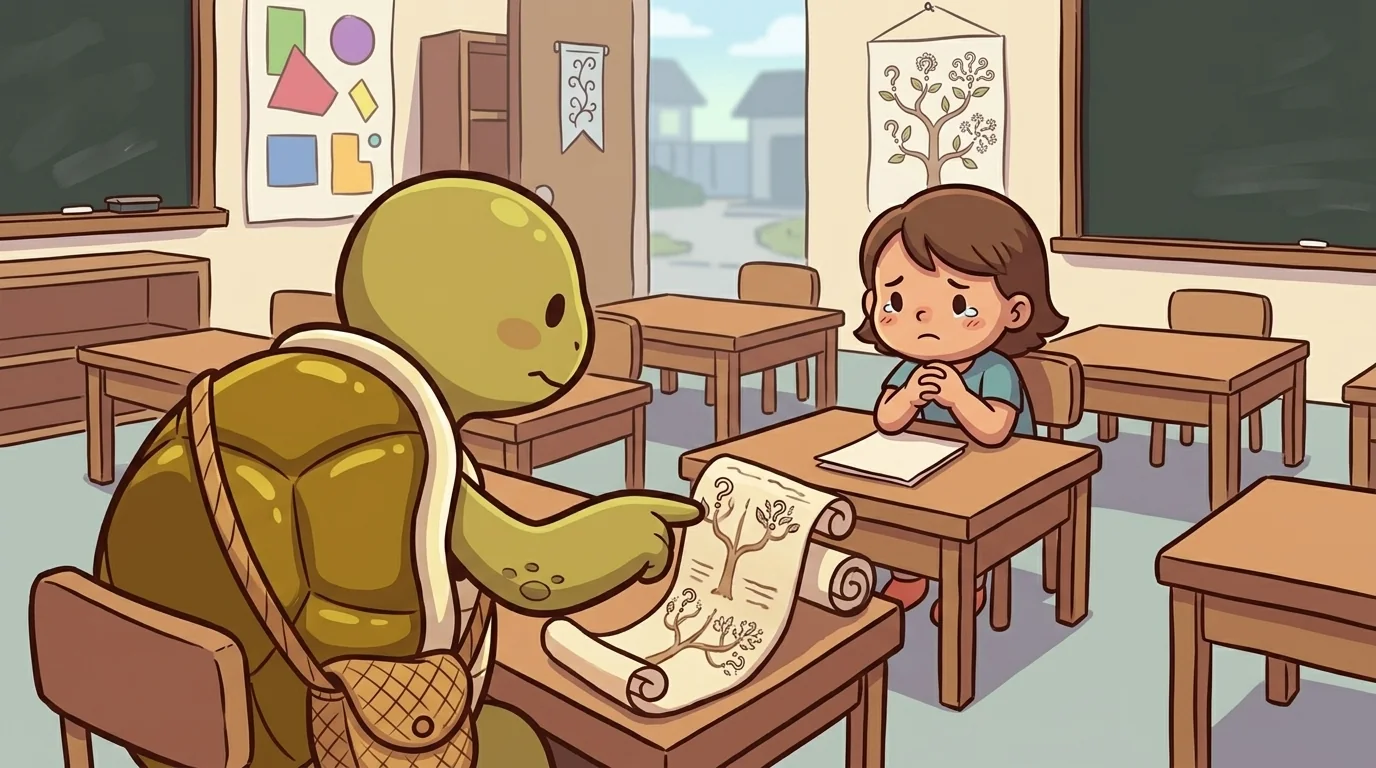
In his very first class, a small student named Wren sat at the back with her question folded up tight, and when it finally slipped out, it came with an apology.
"Is this a stupid question?" she whispered. "I don't even really get what the assignment is asking."
The room went a little quiet. Ponder did not laugh, and he did not hurry. He walked over, drew out the question-tree, and unfurled the first three leaves on her desk so she could see them.
"There are no stupid questions in this room," he said, his voice calm and steady. "There are questions we've unfolded, and questions still folded up. What does that even mean is the most useful question anyone can ask. Everything else waits on it."
He pointed to Wren's worry. "You said you don't get what the assignment is asking. Good. That's the foundation. Let's open it. What word in the assignment feels the fuzziest to you?"
"'Compare,'" Wren said after a second. "I don't know what they want me to compare to what."
"There," said Ponder warmly. "You found the hidden question underneath the loud one. Now — say 'compare' in your own words."
Wren chewed her lip. "Show how two things are the same and different?"
"If you can say it in your own words, the meaning is turning clear," he said. "That's the whole trick. When you're stuck, ask what does that even mean. Pick the fuzziest word. Say it your own way. And if you're still stuck, ask why — then ask why again, and once more. The third why usually points at the real thing you wanted to know."
Wren tried it, muttering her three whys under her breath, and halfway through the third one her eyes went wide. "Oh," she said. "They want to know which one is bigger and why. That's — that's actually not scary at all."
"It never was," Ponder said. "It was only folded."
After the others had gone, Wren lingered by his desk. She looked a little embarrassed, the way people do when they want to ask one more thing.
"Can I tell you something?" she said. "I've had that same question for weeks. I was too scared to ask it. I thought everyone else already knew."
Ponder folded the question-tree slowly, leaf into leaf, and tucked it back into his satchel.
"The question you're most scared to ask," he said, "is very often the one everybody else is quietly hoping someone will ask out loud. You didn't fail today. You unfolded."
Wren nodded, and something in her shoulders came loose — the tight, held feeling she'd carried in with her simply let go, and she walked out lighter than she came.
Ponder sat a while in the empty room. The next leaf of the tree was already waiting to open, and a warm, patient gladness settled over him — the safe, unhurried calm of knowing that here, in this room, every single question is welcome.
The CuriosityQuest ensemble
Ponder is part of CuriosityQuest's distributed-narrative cast. Each character embodies a different curricular primitive; together they teach the full subject.
-

Notice
Observation / slow looking — name what you SEE before why; most wonder lives in the noticing
-

Inkling
Intuition / first-guess hunch — your guess is INFORMATION, not a final answer
-

Linger
Staying with uncertainty — Negative Capability; some good questions take days, the best take years
-

Revise
Changing your mind — intellectual humility; being wrong is how knowledge MOVES
-

Compare
Controlled comparison — the fair test; change one thing, keep the rest the same
-
Measure
Quantification — turn a fuzzy word into a number anyone can see
-
Sort
Classification — group by one rule and the pattern pops out