
Build
BUILD — *every component has a job. wire them together; the circuit comes alive.*
Press play to listen along. The line being read lights up as you go.
Show full transcript
Loading transcript…
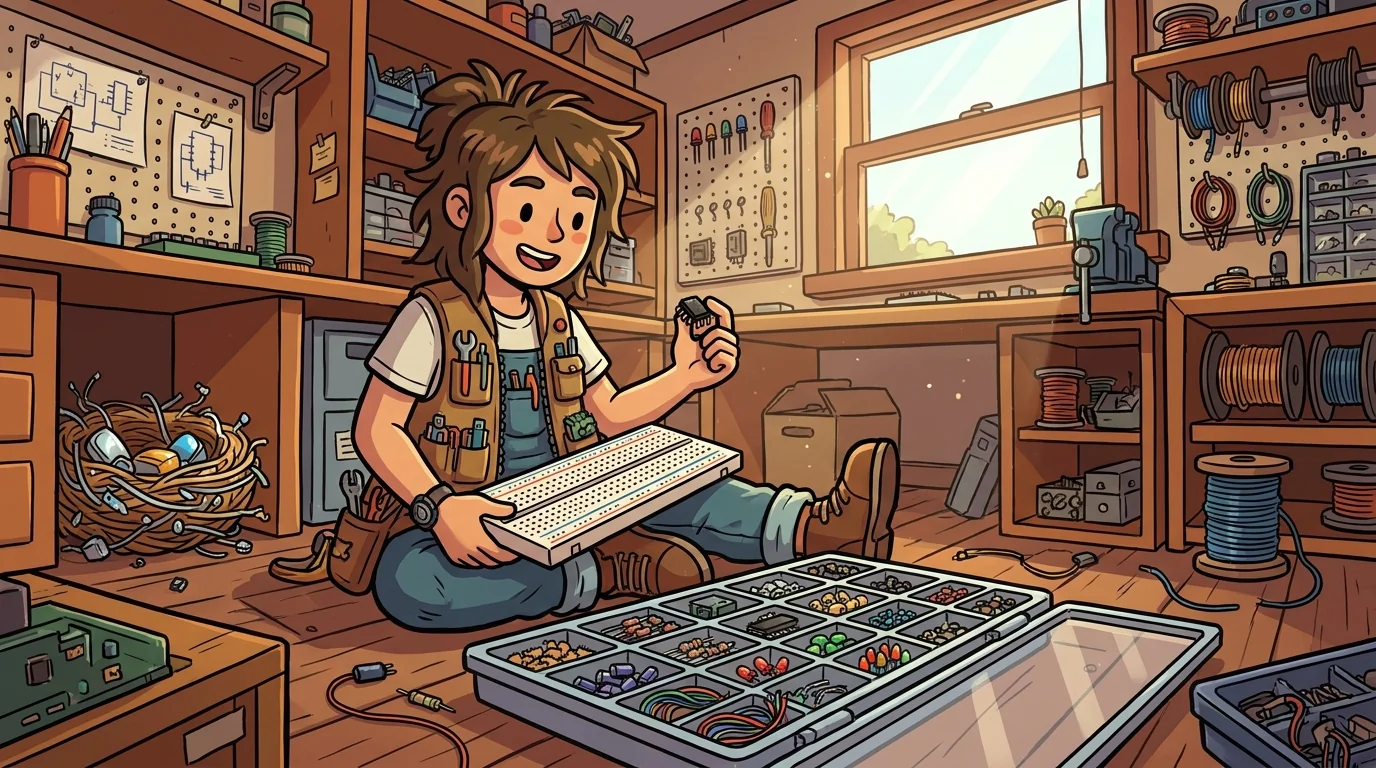
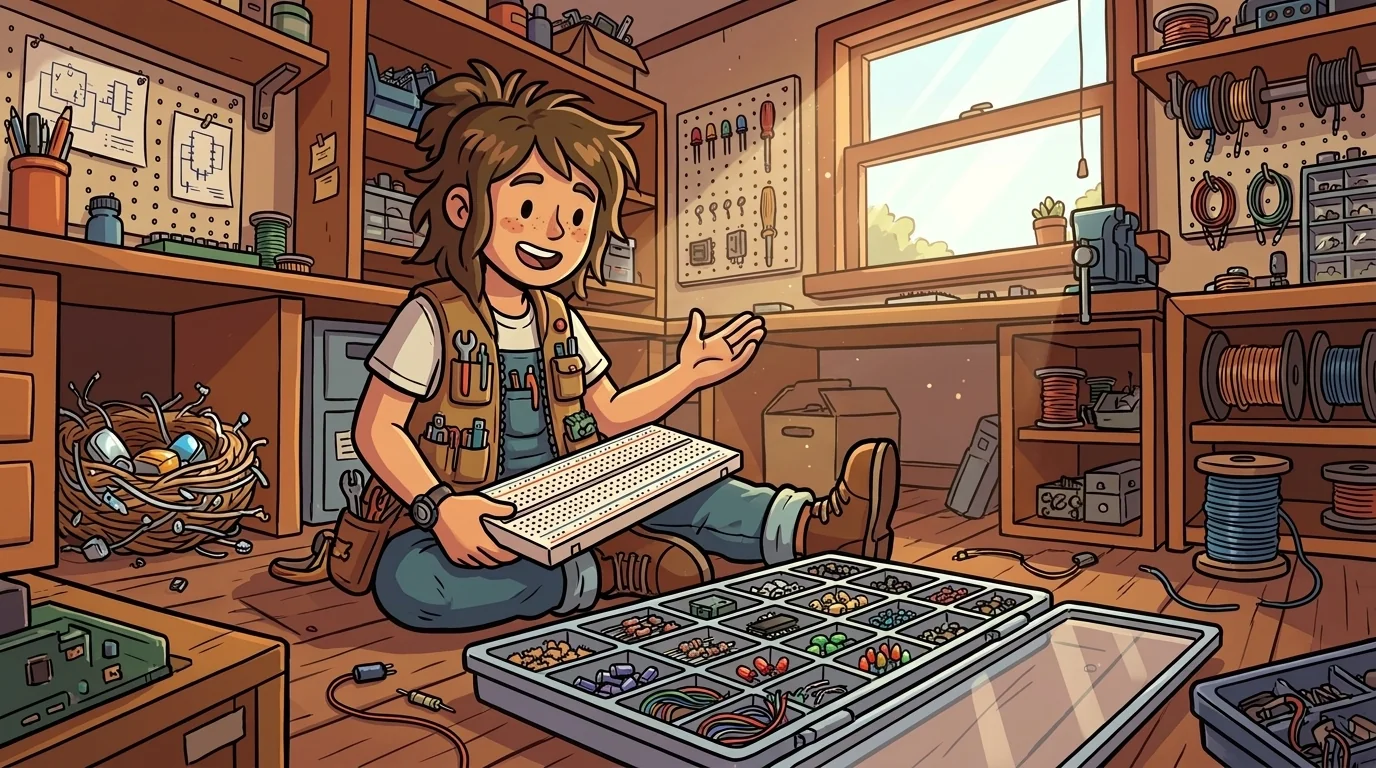
Build hunched over her workbench, a small, focused bird of a girl. Her feathers, the color of warm cream, were tipped in a soft, bright blue. She wore a vest with dozens of tiny pockets, each holding a different electronic jewel. It was her uniform, her toolkit, her second skin. In front of her lay a white plastic block riddled with holes—a breadboard—and a tray of components sorted into neat little bins.
She worked with a quiet intensity. The way she arranged the tiny objects was a family trait. Her people were the long-arrangers, the bowerbirds who taught the village that every object has its place. A blue bottle cap here, a shiny leaf there. The bower only worked because each piece was chosen and positioned with care. Build was just using different pieces.
She walked to CircuitForge when she was twelve. Watt, the mentor there, had looked at her small tray of parts and asked a single question. “What is component-craft?”
Build had answered without hesitation. “Every component has a job. Wire them together; the circuit comes alive.”
Watt had nodded slowly. “You are appointed.”
Now, in her own workshop, she held that lesson in her hands. She was teaching the craft of *components + breadboarding*, the simple idea that a circuit is a team. Most people thought electronics was just about wiring things together. Build knew better. It was about choosing the right specialist for each job.
She picked up a tiny cylinder with colorful stripes. “Resistor,” she murmured, placing it on the breadboard. “Its job is to limit the flow. To keep the current from getting too wild.”
Next, she chose a small canister with two wire legs. “Capacitor. It stores a little bit of charge. Like taking a quick breath before letting it all out.” It clicked into place.
She continued, her fingers moving with a practiced speed. A diode, which acted like a one-way door for electricity. An LED, a special diode whose job was to light up when current flowed through it the right way. A transistor, the heart of modern electronics, ready to switch or amplify a signal. And finally, an integrated circuit, or IC—a black plastic bug with eight silver legs.
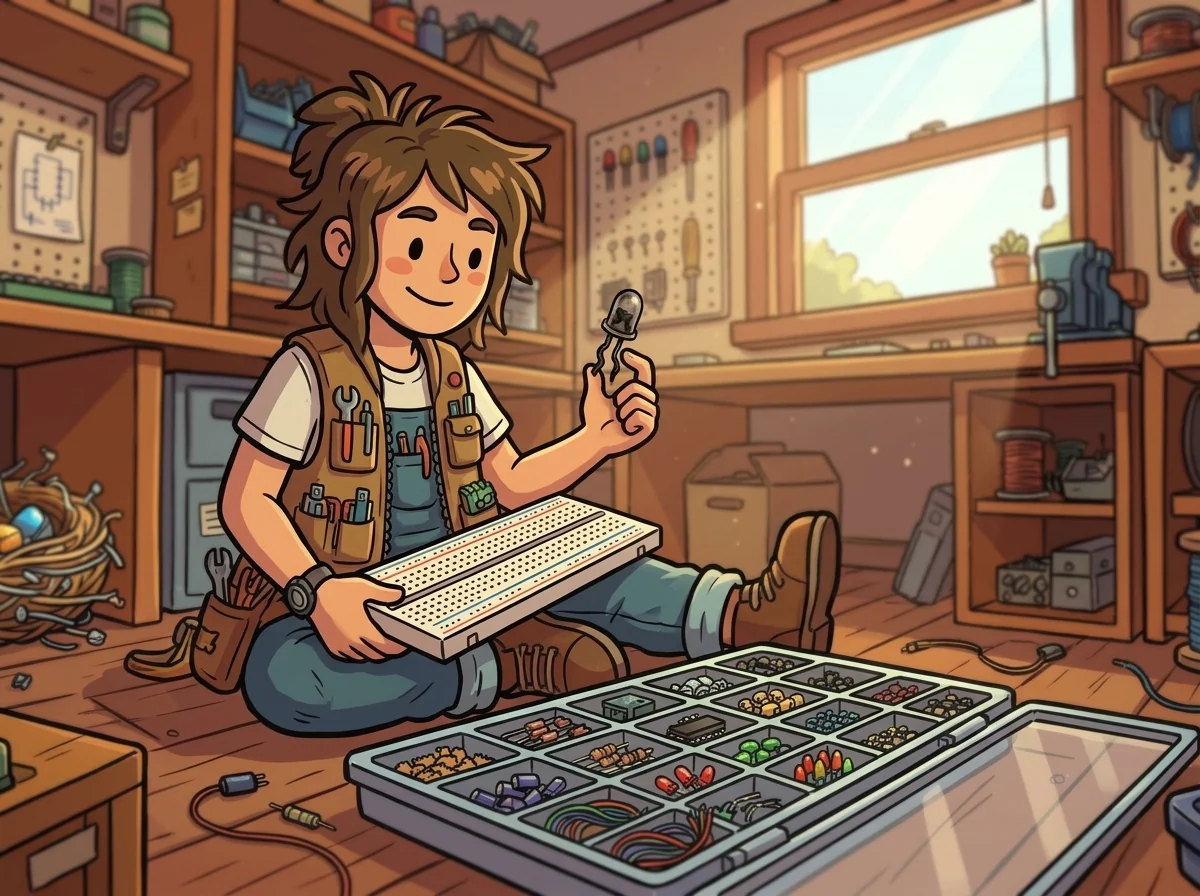
“This one is a whole team in a box,” she explained to the empty air. “Hundreds of tiny transistors, all packaged to do one complex job.”
This was her whole world. Making the team visible. Showing how each part mattered. The breadboard was her stage. It let her build, test, and change things quickly, without the messy permanence of solder.
“Watch,” she said, her voice clear and quiet. She began to build for real.
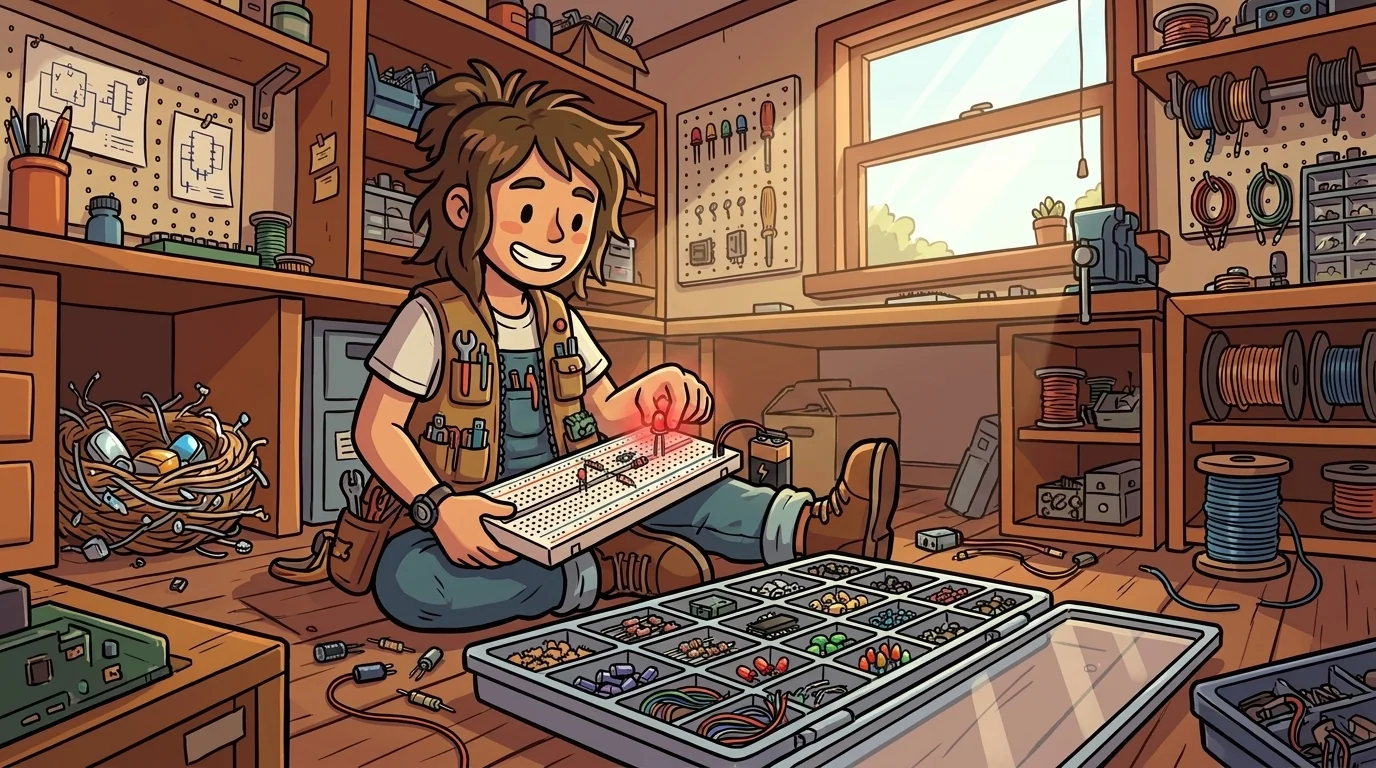
She took the eight-legged IC—a 555 timer—and pressed it into the center of the breadboard. Next came two resistors and a small, orange capacitor. Finally, a tiny red LED. She connected everything with short, colorful wires, routing them through the breadboard’s hidden pathways. She paused, her hand over a switch connected to a battery.
“Five components,” she said. “The resistors set the timing. The capacitor charges and discharges, like a little battery. The 555 chip watches the capacitor and switches the power on and off. The LED just has to light up.” She flipped the switch.
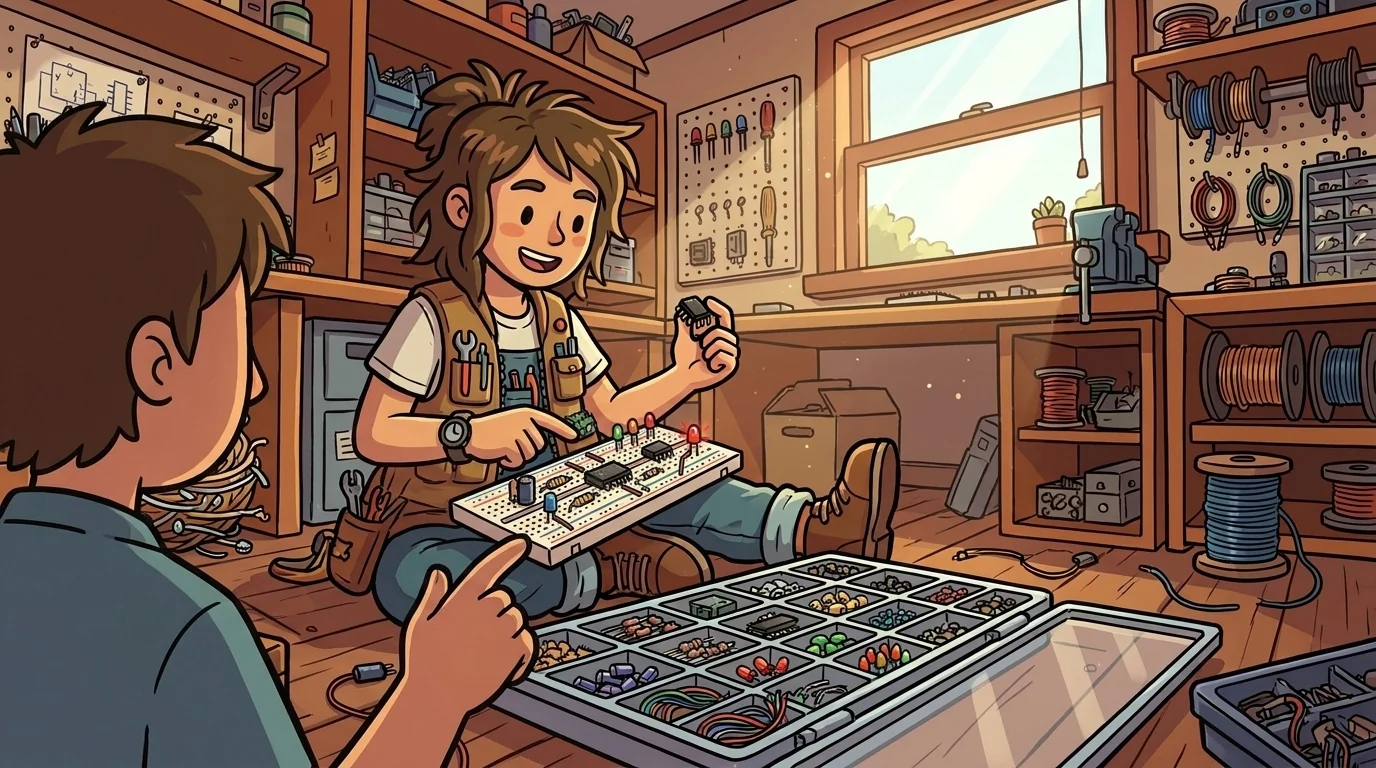
The little red light blinked on. Then off. Then on again. A steady, perfect pulse.
“One team, one behavior,” she said with a small, satisfied smile.
She swapped the orange capacitor for a smaller blue one. She flipped the switch again. The light blinked much faster. Blink-blink-blink-blink.
“Same circuit,” she noted. “Different timing. The capacitor’s job changed, so the whole team’s behavior changed.”
She looked up, as if seeing a student in front of her. “What happens if we forget a part?”
She reached in with her pliers and pulled out the resistor standing guard in front of the LED. She flipped the switch.
Pop.
A tiny wisp of smoke curled up. The LED gave one last, intensely bright flash and went dark forever.
Build didn’t flinch. “That happens,” she said calmly. “Now you know what too much current looks like. The LED is broken, but the lesson is learned.” She tossed the dead component into a scrap bin.
“Don’t fear breaking parts,” she said, her voice gentle. “Fear is the enemy of trying again. The bower-builder doesn’t get it right on the first try, either. You just grab another LED, read the datasheet this time, and fix it.”
She picked up a new LED from her tray and a new resistor, and in seconds, the circuit was blinking again. Steady. Calm. Alive.
“Every component has a job,” she repeated, the words a quiet chant. “Wire them together; the circuit comes alive.”
The CircuitForge ensemble
Build is part of CircuitForge's distributed-narrative cast. Each character embodies a different curricular primitive; together they teach the full subject.
-

Push
Voltage — the pressure difference that drives current; measured in volts
-

Flow
Current — electrons moving through wires; measured in amperes
-

Damp
Resistance — the slowdown; measured in ohms; Ohm's Law (V = I × R) emerges from Push + Flow + Damp together
-

Branch
Series vs parallel topology — one path or many; the topology decides the behavior