Push
PUSH — the pressure difference. measured in volts.
Press play to listen along. The line being read lights up as you go.
Show full transcript
Loading transcript…
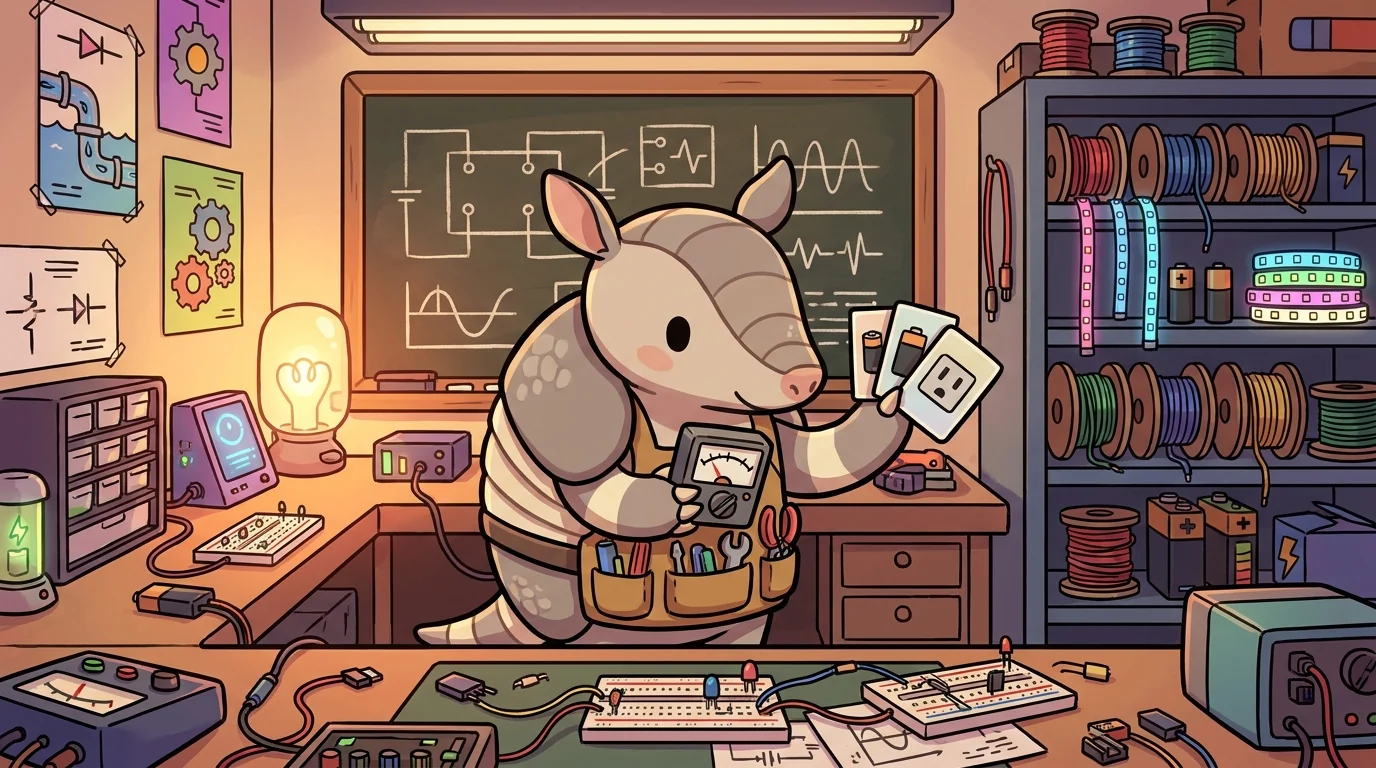
- beat-after: 1 prompt: "Have you ever pushed hard on something that wouldn't move — a stuck door, a heavy cart — and felt the effort pile up in your arms with nowhere to go? Where did you feel that build-up in your body?" - beat-after: 4 prompt: "Think of a time someone gave you exactly the right nudge to get started — a hand on your back, a quiet 'go.' What did that little push feel like?" ---
On the workshop bench, a young armadillo named Push touched two thin metal probes to the ends of a small battery, and a number blinked awake on his little meter.
"One and a half," he said, mostly to himself. "One and a half volts of push."
A boy leaning on the bench frowned. "The battery isn't doing anything. It's just sitting there."
"It's ready," Push said. He set the battery down and picked up a chunkier, square one, pressing the probes to its two knobs. The meter jumped: nine. "This one's ready harder. Six times the push, packed and waiting." He wired the square battery to a tiny light with a little part beside it to keep the light safe, and the bulb bloomed a warm gold across the bench.
"There." Push's eyes went bright. "The battery didn't move. It just leaned on the wire. And the leaning is what made the light come on."
He moved the probes to one side of the little safety part, then the other. "About seven volts get spent here," he said, and shifted them onto the glowing bulb, "and about two here. Seven and two. Nine." He tapped the meter, satisfied. "It all comes back out to what the battery started with. Nothing goes missing. The books always balance."

Push grinned, because that was exactly the right question, and it was going to take him back a long way to answer it.
Push had grown up underground, in the deep cool burrows his family had dug for generations.
The tunnels weren't straight. His grandmother designed them to bend and open just so, and if you sat still in the right spot, you could feel a slow breath of air move past your whiskers — cool in summer, warm in winter, always drifting the same direction.
The first time young Push tried to dig his own tunnel, he'd sealed both ends by accident. He crouched in the middle, proud, and waited for the breeze.
Nothing came. The air sat there, thick and still and stuffy. His chest got tight. He'd done all that digging and the tunnel just felt dead.
His grandmother crawled in beside him and didn't scold. She pressed a paw to one wall. "Feel how packed the air is on this side?" Then the other. "And how thin over here?" He hadn't noticed, but once she said it, he could almost feel it — one side heavy, one side hungry.

Years later, staring at a battery, he thought: that's all a battery is. A crowded side and an empty side, leaning. And he smiled the way you smile when a stuck door finally gives.
He walked to CircuitForge when he was twelve, because a place full of wires and lights ought to understand pushing.
The famous inventor Watt met him at the door and asked only one thing. "What is electricity about?"
Push didn't reach for a big word. He pulled the battery card from his vest, then the matching battery, and set them side by side. "It's about the difference," he said. "One side crowded, one side hungry. The crowded side leans on the wire until something moves." He touched his meter to the ends. The number lit. "You can even feel how hard it's leaning. You just read it off, in volts."
Watt looked at the little armadillo and his little glowing screen for a long moment.

"Then you belong here," Watt said.
Push's corner of the workshop filled up with kids who mixed things up, and he loved them for it.
The boy from the bench came back the next day, still frowning at the quiet battery. "Okay. But if it's just leaning, why did my brother yelp when he touched the fence out back?"
Push set down two batteries — a small round one and a heavy square block from an old cart. "Feel this," he said, and let the boy hold each. They weighed different, but that wasn't the point. "This little one leans soft. This big one leans hard. Same idea, way more of it." He wired the small one to the safe little light: a gentle gold. "The lean is what pushes the electricity through whatever it touches. Your brother's fence had a big lean. Enough to shove a little current right through him — just enough to make him jump."

The boy nodded slowly, turning the little battery over in his paws, and for the first time it didn't look like it was doing nothing.
Late that afternoon, when the benches had gone quiet, the boy lingered by the door.
"When it's just sitting there," he said, "and nothing's moving yet — how do you know the push is really in there?"
Push thought about the sealed tunnel. About the tight chest, and the thick dead air, and the moment his grandmother's paw opened a hole and the breeze slid cool across his face.
"You feel it," he said. "That's the honest answer. It's like standing at a stuck door with your shoulder against it — nothing's moving, but you can feel the whole weight of you, ready, leaning. That readiness isn't emptiness. It's everything, packed against one side, waiting for somewhere to go."
The CircuitForge ensemble
Push is part of CircuitForge's distributed-narrative cast. Each character embodies a different curricular primitive; together they teach the full subject.
-

Flow
Current — electrons moving through wires; measured in amperes
-

Damp
Resistance — the slowdown; measured in ohms; Ohm's Law (V = I × R) emerges from Push + Flow + Damp together
-

Branch
Series vs parallel topology — one path or many; the topology decides the behavior
-

Build
Component-wiring craft — every component has a job; wire them together and the circuit comes alive
-

Store
Capacitance — a tank that fills with charge and hands it back; smooths bumps
-

Coil
Inductance / electromagnetism — a wound wire turns current into a magnetic reach
-

Relay
Switching / control — a gate the circuit can flip itself; small flips big