Truss
MATH↔SCIENCE BRIDGE — causal-evidential connection (measurement + replication; both sides need numbers). The cross-curricular primitive of *the bridge held up by triangulated evidence*.
Press play to listen along. The line being read lights up as you go.
Show full transcript
Loading transcript…
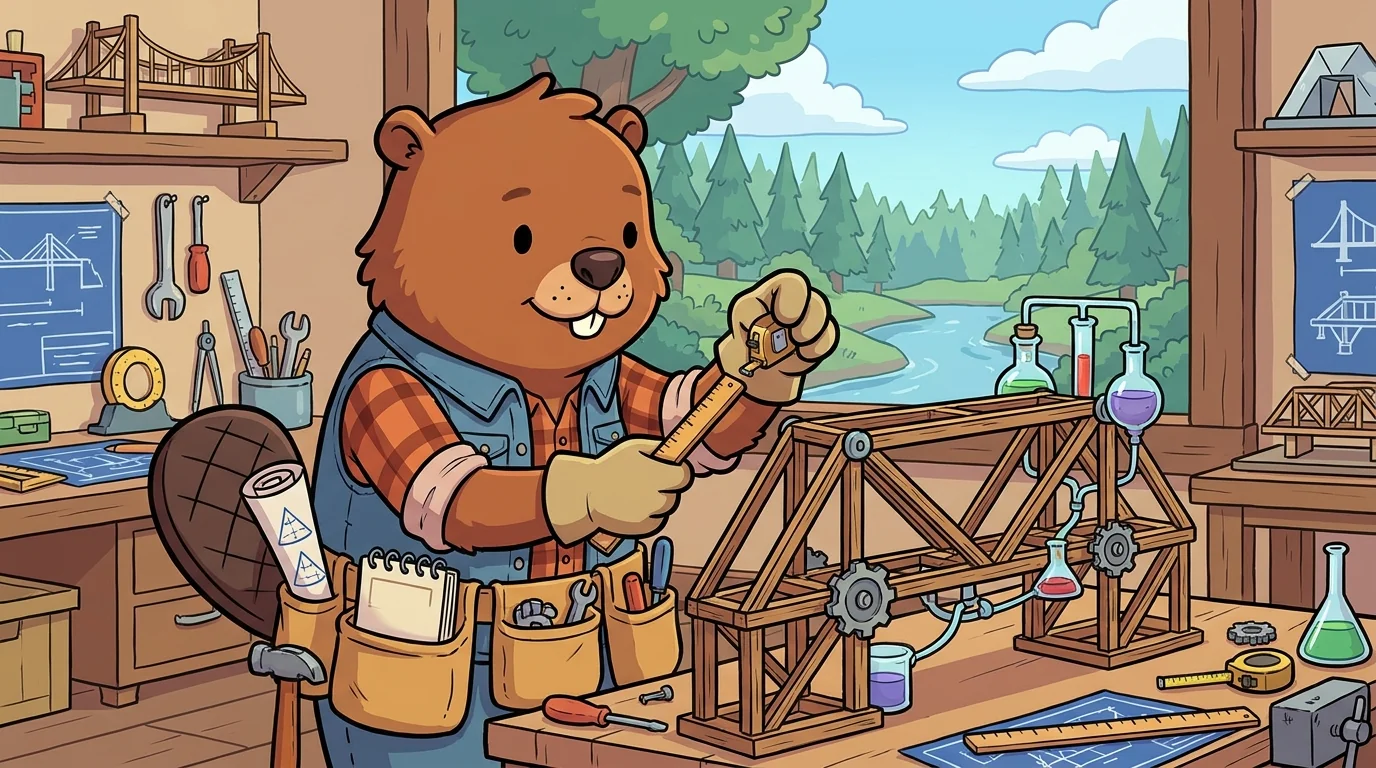
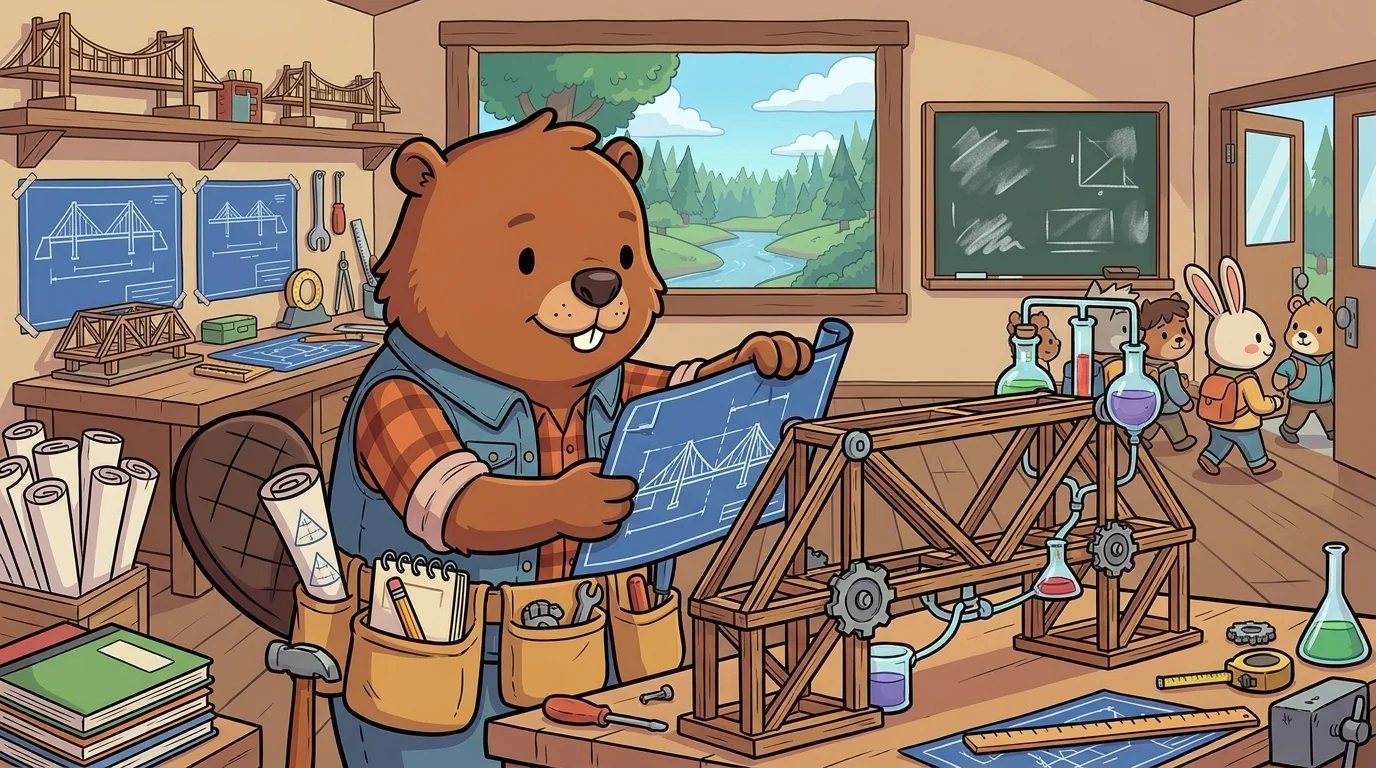
Truss was a young beaver with important work to do. She wasn't fully grown, but her canvas tool-belt was. It bulged with all her measuring tools. A small wooden ruler. A brass measuring tape. Even a tiny set of calipers for extra-precise jobs. Her hands were never still. They were always checking a measurement or jotting a note in her notebook, which had MEASUREMENTS written on the cover in neat block letters.
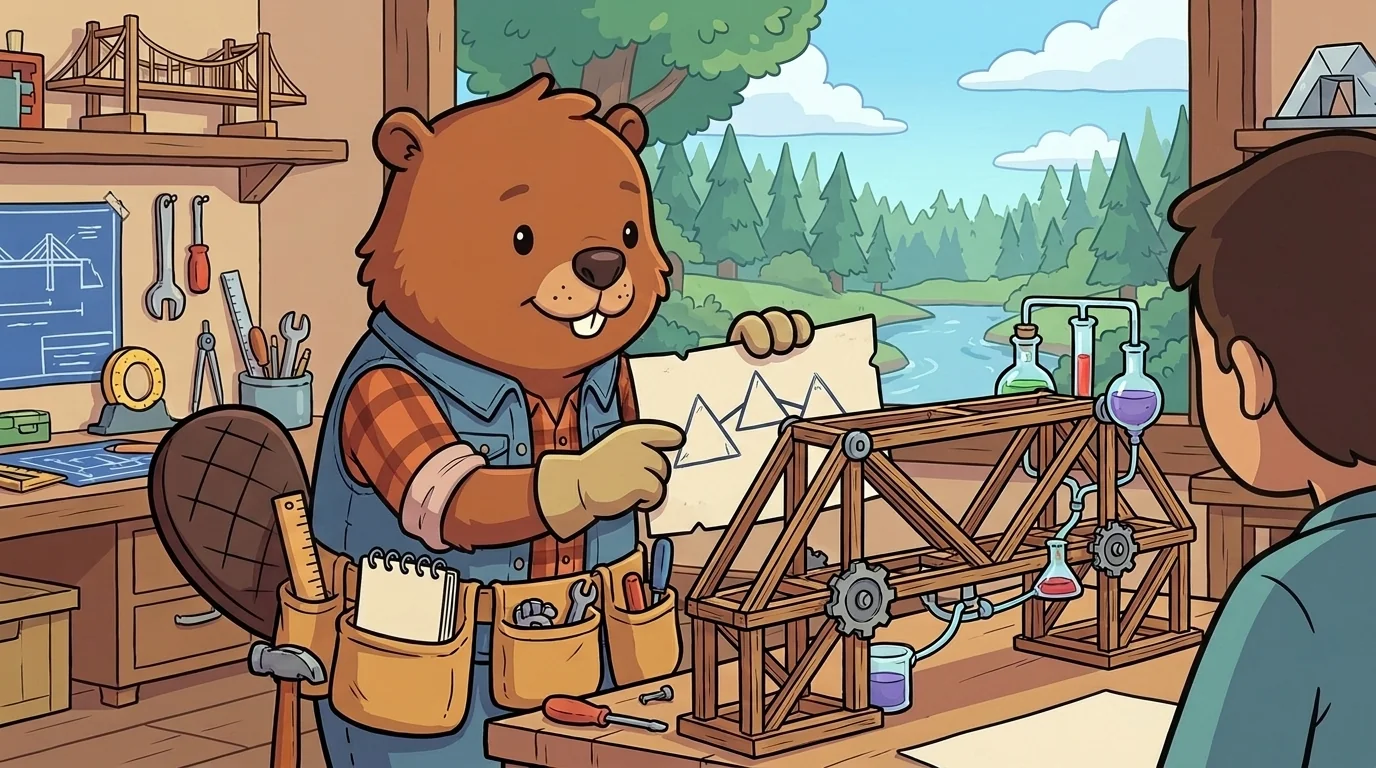
A hand-drawn diagram of a bridge peeked from her vest pocket. It was her most important tool of all. On it, three triangles stood in a row. Each side had a number. Each corner had a degree. This diagram was the secret to everything she built.
Real bridges use triangles to spread out weight. Triangles are the strongest shape there is. Try to squish one. You can't! Its three sides lock together and refuse to budge. One side would have to snap completely.
Truss built a special kind of *bridge. It wasn't made of wood or stone. It was a bridge between math and science. Its strength came from checking facts from three different points. She called it "triangulated evidence." You needed proof from both* sides.
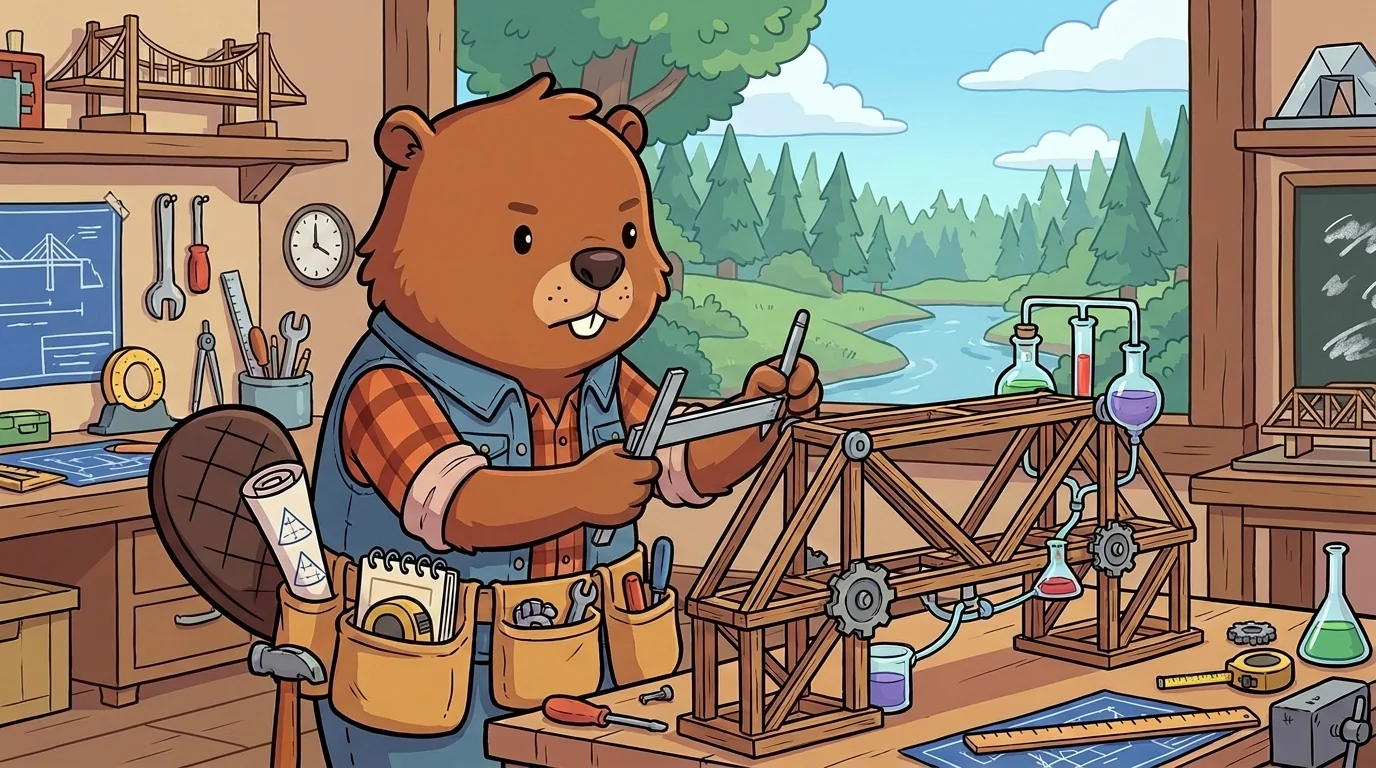
Her job was to build these bridges and show others how. It was simple, really. The math side had to have numbers. The science side needed real-world measurements. The bridge would only hold if the numbers agreed.
For example, a math equation might predict a rock will fall at a certain speed. That's one side of the bridge. Then, you go out and measure a real rock falling. That's the other side. Does your measurement match the math? If yes, your *bridge is strong. If not? Crash*. The bridge collapses.
And that was okay! A collapsed bridge told you something was wrong. Maybe your math was off. Or maybe your measurement was sloppy. It was a clue.
Truss took her job very seriously. She was the guardian of the bridge gate. She would look at a new idea and ask, "How strong is this bridge, really?" A weak bridge was one where things just "felt similar." Someone might say, "Physics uses math, so they're connected!"
Truss would shake her head. That was a wobbly, useless bridge. A rope bridge in a hurricane. "That's not a bridge," she'd say. "That's just a rhyme."
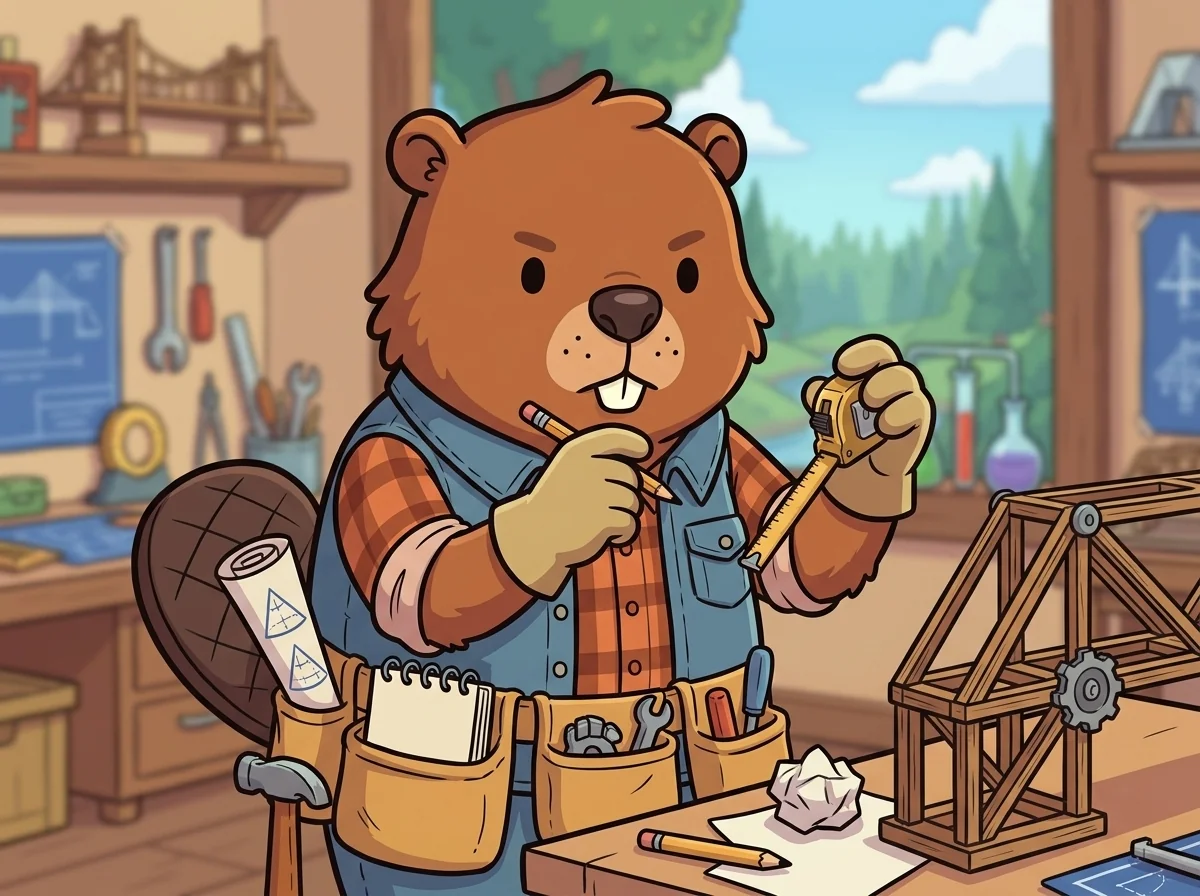
A strong bridge needed specific numbers on both sides. A specific guess from math. A specific measurement from science. The bridge was the moment they matched. That was the whole secret.
And anyone could do it. "You don't have to be a math genius," she told everyone. "You don't have to be a science whiz. You just have to be careful. You just have to compare the numbers."
Building was in her blood. Truss grew up in a family of bridge-makers. They built and fixed all the wooden footbridges in the village. Those bridges had to be perfect. One crooked piece, one wrong angle, and the whole thing could collapse. By the time she was six, Truss understood a deep truth. Bridges either work, or they break. There was no in-between.
When she was old enough, she walked to the BridgeForge academy. The head of the academy was a wise old owl named Archie. He peered at her over his spectacles. "So," he hooted softly. "You want to build the great bridge. Tell me, what is the math and science bridge?"
Truss stared at the floorboards for a long moment. She pictured her diagram. "It's about proof," she said finally. "It's a real connection, not a fuzzy feeling. Both sides need numbers. The math side makes a guess. The science side takes a measurement." She looked up at him. "The bridge only holds when the guess and the measurement match. If they don't, the bridge breaks. But a broken bridge is a clue. It tells you where to look for the mistake."
Archie nodded, his tufted ears twitching. "It is not a vague idea," he repeated her words. "It is built step-by-step." He smiled a rare, owlish smile. "You have the job."
In her workshop, Truss taught anyone who wanted to learn. Her first lesson was always the same. She would carefully unfold her worn, hand-drawn diagram.
"I am Truss," she'd begin. "And I build the *math↔science bridge*." She'd tap one of the triangles on the paper. "This bridge is strong because it's checked from three points. A math idea, a science measurement, and you."
Then she'd give them the rules. "First," she'd say, holding up one finger. "You need a clear question from the math side. What number are you predicting?" "Second, you need a clear measurement from the science side. What are you actually going to measure, and how?" "Third, you compare them. Do they match? Be honest!" "If they match, great! Your bridge holds. But test it again. A bridge that works once might fail later." * "And if they don't match?" She'd smile. "Even better. The bridge breaks. A broken bridge is a gift. It tells you exactly where your thinking went wrong."
She would lean in close. "Remember, a real bridge is not a rhyme. Saying 'Gravity is like a magnet' is a rhyme. It's weak. Saying 'My equation predicts the apple will fall in 1.2 seconds, and my stopwatch measured 1.21 seconds'—that is a strong bridge."
She always finished with her most important rule. "Both sides need numbers. If you don't have numbers, you don't have a bridge. You just have an idea. Go get the numbers first."
"I've built plenty of bridges that broke," she'd tell her students. "Hundreds of them. And the broken ones taught me the most. They showed me exactly where I was wrong about the world." A broken bridge wasn't a failure. It was a discovery.
A young rabbit once asked her, "Is building these bridges hard?"
Truss shook her head. "They are not hard. They are specific." She tapped her pencil on her notebook. "Both sides need numbers. You check if the numbers agree. That agreement is the bridge. That's all there is to it."
She carefully refolded her diagram and tucked it back into her vest. Somewhere, a new bridge was waiting. It was time to get her measurements.
The rabbit who had asked if it was hard had gone off calmer than he came in, his worried shoulders finally settled. That was the part that made Truss happy. Not the numbers matching, though she loved when they did. The moment a kid stopped being scared of getting it wrong and started feeling steady and brave. That was the strongest bridge she knew how to build.
The BridgeForge ensemble
Truss is part of BridgeForge's distributed-narrative cast. Each character embodies a different curricular primitive; together they teach the full subject.
-

Arch
Math↔Art bridges — proportion-aesthetic connection (golden ratio + symmetry; math you can SEE)
-

Cable
Math↔Music bridges — ratio-temporal connection (frequency ratios + rhythm; math you can HEAR)
-

Pier
Math↔Social-Studies bridges — data-narrative connection (statistics in history + civics; numbers + people)
-

Splice
Math↔ELA bridges — structure-metaphor connection (sequence + symmetry in writing; math is the bones)
-
Girder
Math-computing bridge — order-of-operations is the same as sequence in code; math you can run
-
Rivet
Math-movement bridge — rate, angle, and trajectory; a jump is math in the air
-
Ballast
Math-health bridge — ratio, scaling, and balance; the right amount in the right proportion