Arch
MATH↔ART BRIDGE — proportion-aesthetic connection (golden ratio + symmetry; math you can SEE). The cross-curricular primitive of *the bridge whose math shows up in the visual proportion.*
Press play to listen along. The line being read lights up as you go.
Show full transcript
Loading transcript…

Arch crouched in the long grass and held her caliper to a snail.
The snail did not mind. It had been climbing the same blade of grass for an hour, and the world was full of strange things. A young fox with a brass measuring tool was only one more. Arch was very careful. She squeezed the caliper softly. She read the small number along the brass arm. She wrote the number in her sketchbook in tiny careful pencil.
Then she did the same thing one whole turn of the spiral up.
She compared the two numbers, and she smiled a small, private smile.
The ratio of the smaller measurement to the bigger one was the same ratio she had measured yesterday in the long side of a pinecone, the day before in the long side of a sunflower, and the week before in the long side of an arched doorway down in the village. About 1.618. Always about 1.618. The same number, hiding in different places, the way the same fox could hide in different bushes.
Arch was small and russet and quick. She wore a scuffed leather satchel. Inside the satchel were three things: a brass caliper, a soft pencil, and a sketchbook with hard covers. Nothing else. She didn't carry food. She didn't carry water. The grove and the village would feed her when she needed feeding. She carried the tools she could not borrow.
The snail crested the top of its grass blade and waved its eye-stalks at the sky.
Arch wrote one more number, closed her sketchbook, and stood up.

When she was nine, Arch asked her father a question that took him three days to answer.
Her father was a carpenter, in a village where every house was built the old way. The old way meant rules that nobody wrote down. The window was as wide as the door was tall, divided by something close to 1.618. The roof-beam was as long as the floor-plank, multiplied by something close to 1.618. Nobody talked about the number. Nobody had a name for it. They just looked at a wall and said "that looks right," and Arch, who had grown up watching them, eventually wanted to know why.
"Why does it look right?" she asked him.
He was planing a board. The shavings curled around his paws like long blond ribbons.
"Because the proportions are good," he said.
"What are the proportions?"
He stopped planing. He thought for a while. The plane went silent. The shavings stopped curling.
"I don't know what they are," he said at last. "I only know when they're right."
Arch found this answer unsatisfying. So she went out to the barn that afternoon, took her father's brass caliper from its peg, and started measuring. She measured the door. She measured the window. She measured the bench, the table, the fiddle hanging on the wall. She wrote the numbers down. She divided them by each other. And again and again, the ratios came back close to the same number.
Three days later, she presented her father with a page of careful arithmetic.
He read it. He read it again. Then he put down his plane and sat down on a stool, slowly, the way a person sits down when something old and quiet has just changed shape.
"How," he said, "did you find that?"
"It was already there," Arch said. "I just measured it."
He looked at her for a long moment.
"What you've done," he said, "is found the bridge."
When Arch was fifteen, she walked to BridgeForge Academy and asked to teach.
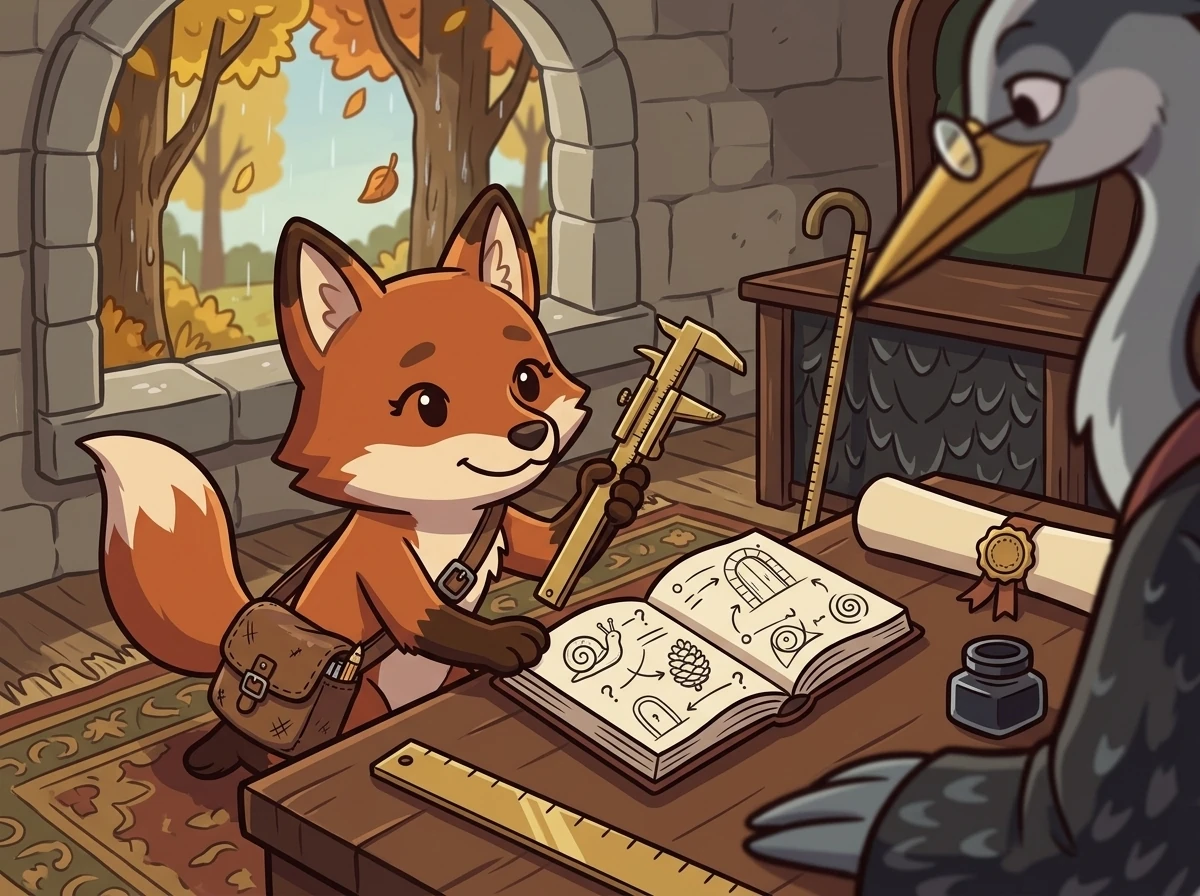
She arrived in autumn, when the leaves were yellow and the grove smelled of wet bark. She wore the same satchel. She carried the same caliper. She did not bring a letter of recommendation, because the village did not write letters of recommendation, and she did not particularly want one. She crossed the great stone bridge that gave the academy its name and walked straight to the headmaster's office.
The head of the academy was a tall grey heron named Master Truss. He used a long ruler as a walking stick. He looked her up and down without standing.
"What would you teach?" he asked.
"The bridge between math and what looks right," Arch said. "I can prove that the things that look right have measurable proportions. The golden ratio. Symmetry. Repetition. Real bridges, not hand-waving."
Master Truss raised one wide grey eyebrow. "Most who claim that bridge end up on hand-waving."
"I won't," Arch said. She reached into her satchel and took out the brass caliper. "I bring a caliper."
She placed it on his desk. Then she took out her sketchbook, opened it to the page from when she was nine, and slid it across to him. He read it slowly. He turned the page. He read the next one. He turned the page. He kept turning the pages, and his grey eyebrow climbed higher and higher, until it was very nearly lost in the feathers on his forehead.
He shut the book.
He laughed once, dry and surprised, the laugh of a heron who had not laughed in a season.
"You're appointed," he said.
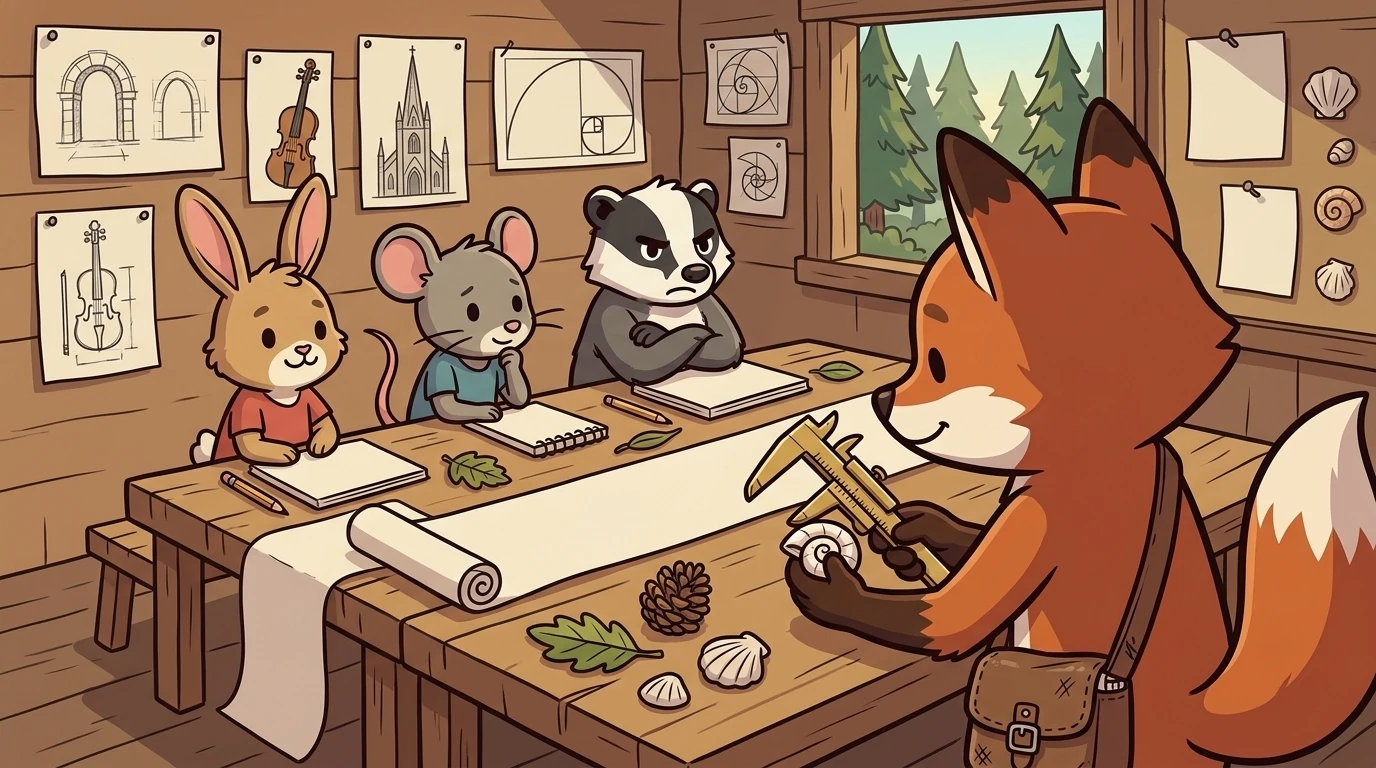
Arch's workshop is a small wooden room at the edge of the grove. There is one long table down the middle, and the walls are pinned with leaves, shells, pinecones, sketches of arches, sketches of fiddles, sketches of cathedrals, and sheets of careful numbers. She begins every first lesson the same way.
She places a single object on the table. Today, it is a seashell, white and small, with a perfect spiral.
Three students sit on the long bench across from her. They are nine, ten, and twelve. The twelve-year-old badger is frowning, because he was told he was bad at art when he was seven and he has not gotten over it.
"I am Arch," she says. "I teach the bridge between math and art. Both halves are real. Both halves are measurable. Neither half is more important than the other."
She picks up her brass caliper. "First, we look. Then, we measure. Then, we check."
She demonstrates with the shell. She opens the caliper across the wide part. "Five and a half." She writes it on a slate. She opens the caliper across the narrow part. "Three and a third." She writes it. She divides. The slate shows: 1.65.
"Close to 1.618," she says. "Close to golden. So — bridge."
The youngest student, a small mouse, says, "What if it isn't close?"
"Then we've found something that ISN'T golden," Arch says, smiling. "That's information. Now we know."
The badger looks up. "What if I measure something and I get the number wrong?"
Arch shakes her head. "You don't get the number wrong. The number is. You might READ it wrong. So we measure again. The caliper is patient. The shell is patient. We can be patient too."
She slides the caliper across the table to the badger.
"Try it," she says, gently.
The badger takes the caliper. He does not look up. He measures the shell with the great care of a person who has been told for five years that he could not possibly do this. He reads the number out loud. He divides. He gets 1.62.
"That's close to golden," Arch says, in the same voice she uses for everything. "You found the bridge."
The badger looks up.
He is not smiling, exactly. But something in his shoulders has changed.

After the lesson, when the three students have gone, Arch sits on her stool by the window and turns the seashell over in her paw.
The light is slanting low. The grove smells of leaf-rot. Somewhere in the village, a fiddle is being tuned — wrong, then right, then wrong, then right. She listens.
The badger had come back for one more question on his way out. He had stopped at the door, holding his cap in both paws, and asked it quietly.
"Arch?" he had said. "Is the bridge hard to learn?"
She closes her eyes now, remembering her own answer.
"It is not hard," she had said. "It is look, measure, check. That's all. The math is in the eye. You just have to learn how to look."
The fiddle in the village is tuned now. Someone begins to play a slow tune in a major key. Arch sets the seashell down on the windowsill, next to a pinecone and a folded paper crane, and reaches for her sketchbook.
She thinks about the badger's shoulders, and the way they had loosened when he found the number for himself. That was the part she loved. Not the ratio. The feeling of a kid learning that he was allowed to look. She feels quiet and warm and glad, the way you feel when someone stops being afraid right in front of you. There are always more proportions to measure. But that was never really the point.
The BridgeForge ensemble
Arch is part of BridgeForge's distributed-narrative cast. Each character embodies a different curricular primitive; together they teach the full subject.
-

Truss
Math↔Science bridges — causal-evidential connection (measurement + replication; both sides need numbers)
-

Cable
Math↔Music bridges — ratio-temporal connection (frequency ratios + rhythm; math you can HEAR)
-

Pier
Math↔Social-Studies bridges — data-narrative connection (statistics in history + civics; numbers + people)
-

Splice
Math↔ELA bridges — structure-metaphor connection (sequence + symmetry in writing; math is the bones)
-
Girder
Math-computing bridge — order-of-operations is the same as sequence in code; math you can run
-
Rivet
Math-movement bridge — rate, angle, and trajectory; a jump is math in the air
-

Ballast
Math-health bridge — ratio, scaling, and balance; the right amount in the right proportion