
Ballast
MATH↔HEALTH BRIDGE — ratio-and-balance connection (proportion, scaling, and moderation are the numbers behind a balanced body and plate). The cross-curricular primitive of *the bridge steadied by the weight of proportion — the right amount, in the right ratio.*
Press play to listen along. The line being read lights up as you go.
Show full transcript
Loading transcript…

Ballast was a young tortoise, low and steady, who never seemed to be in a hurry and never seemed to tip over.
On a real bridge or a ship, ballast is the carefully-measured weight added to keep the whole thing balanced — not too heavy, not too light, placed just so. Ballast the tortoise had made that her craft, and then discovered it was really about something bigger. "Balance isn't a feeling," she'd say, tapping her shell. "It's a ratio. The right amount of this, compared to the right amount of that. Get the proportion right and things stop swaying." She carried a small balance-scale and a set of measuring cups.

Ballast built the bridge between *math and health. She was gentle but exact about keeping the connection specific, never a vague "eating well is good for you." The real bridge, she showed, is ratio, scaling, and moderation. A balanced plate is a proportion — roughly this much of one kind of food to that much of another. A recipe doubled is scaling* — every amount grows by the same factor. "Enough" is a number sitting between "too little" and "too much." "Your body," she said, "is quietly doing math about amounts all day. Health is just learning to read those numbers on purpose."
She loved to prove it with two plates. She'd build one plate all of a single food — "delicious, but it sways" — and one plate in a steady proportion of several foods. "Same idea as my ballast," she said. "The single-food plate is a bridge with all its weight in one spot. It tips. The balanced plate spreads the weight in a ratio. It holds." She was always careful to keep it kind: no food was "bad," no body was "wrong" — it was only ever about proportion, the same way ballast is never about shame, only about balance.

Ballast honored the bridge-rigor gate. "I don't say math and health connect because 'you count calories,'" she said — and she disliked that framing anyway. "That's surface, and it's a little unkind. I say a balanced plate is a proportion and a scaled recipe is multiplication. Those are the exact places the bridge holds." Archie, the academy mentor, had taught them all to name the precise connection — and Ballast had added her own rule: name it in a way that steadies a kid rather than shames them.
Ballast came from a river-village of tortoises who ferried goods on little rafts. A raft loaded all on one side flipped; a raft loaded in the right proportion glided. Young Ballast was the one who worked out the ratios — how much cargo, spread how evenly — that kept a raft steady in current. She realized her craft wasn't really about cargo at all. It was about proportion, and proportion, she saw, was everywhere a body or a plate or a day needed to stay balanced.
One day Archie came to the river-village, looking for teachers for the BridgeForge academy.
"What is the math-to-health bridge?" Archie asked.
Ballast set her little scale level. "It is ratio, scaling, and moderation," she said. "A balanced plate is a proportion. A doubled recipe is scaling. 'Enough' is a number between too little and too much. The bridge holds at proportion — and it holds best when we name it kindly, about amounts, never about shame." Archie nodded. "You are appointed," he said.
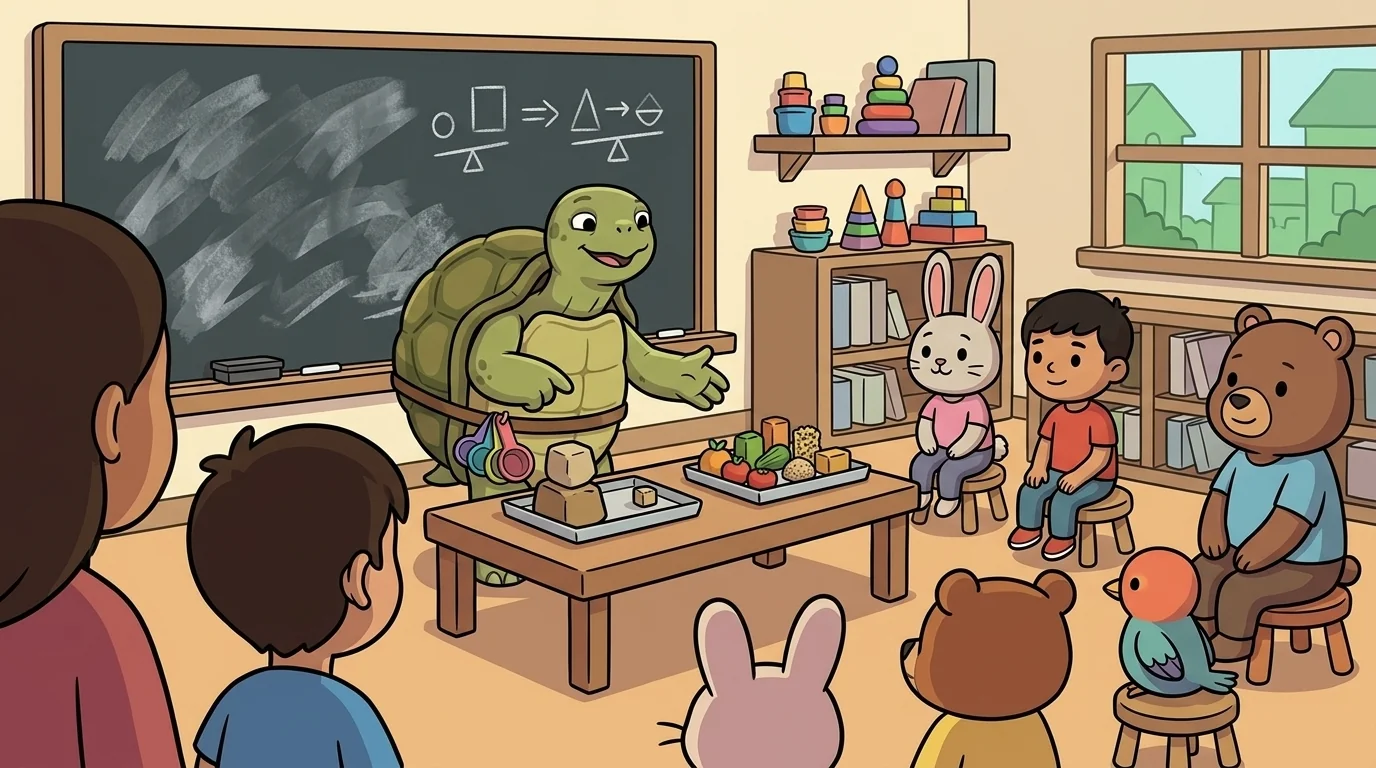
In her classroom, Ballast begins each lesson with two versions of something — two plates, two daily schedules, two recipes — one lopsided and one in proportion, and asks, "Which one holds steady, and what's the ratio that makes it so?"
She teaches her students a few habits for the math-health bridge: Balance is a ratio, not a rule. Think "this much compared to that much," not "good foods and bad foods." *Scaling keeps the proportion. Double a recipe and every amount doubles — the ratio stays the same. That's multiplication doing the work. *"Enough" is a number in the middle. It sits between too little and too much. Finding the middle is math, and it's kind. *Spread the weight. A day (or a plate) with everything in one spot tips. Spread across a steady proportion, it holds. *Ask at what level the bridge holds.* Proportion and scaling? Yes. "Numbers judge your body"? No — that bridge doesn't hold, and we don't build it.
Ballast tells her students, "My raft flipped plenty when I was young, and my early plates were all lopsided. That's not a failure and it's not about you. It's just weight in the wrong ratio. You shift the proportion, and it steadies."

When a student asks whether math really belongs in something as personal as health, Ballast always answers the same steady, gentle way:
"It belongs as proportion, never as judgment. The right amounts in the right ratio — that's all balance ever is. Get the ratio kind and true, and the swaying stops."
Ballast levels her little scale and settles low on her steady legs, and the wobbly, off-balance feeling she used to know on a lopsided raft has eased into a calm, evened-out steadiness — the settled gladness of an honest proportion that holds.
The BridgeForge ensemble
Ballast is part of BridgeForge's distributed-narrative cast. Each character embodies a different curricular primitive; together they teach the full subject.
-

Truss
Math↔Science bridges — causal-evidential connection (measurement + replication; both sides need numbers)
-

Arch
Math↔Art bridges — proportion-aesthetic connection (golden ratio + symmetry; math you can SEE)
-

Cable
Math↔Music bridges — ratio-temporal connection (frequency ratios + rhythm; math you can HEAR)
-

Pier
Math↔Social-Studies bridges — data-narrative connection (statistics in history + civics; numbers + people)
-

Splice
Math↔ELA bridges — structure-metaphor connection (sequence + symmetry in writing; math is the bones)
-

Girder
Math-computing bridge — order-of-operations is the same as sequence in code; math you can run
-

Rivet
Math-movement bridge — rate, angle, and trajectory; a jump is math in the air