
Girder
MATH↔COMPUTING BRIDGE — step-order connection (sequence + logic + algorithm; a program is math you can run). The cross-curricular primitive of *the bridge whose spine is an ordered set of steps that must run in order.*
Press play to listen along. The line being read lights up as you go.
Show full transcript
Loading transcript…
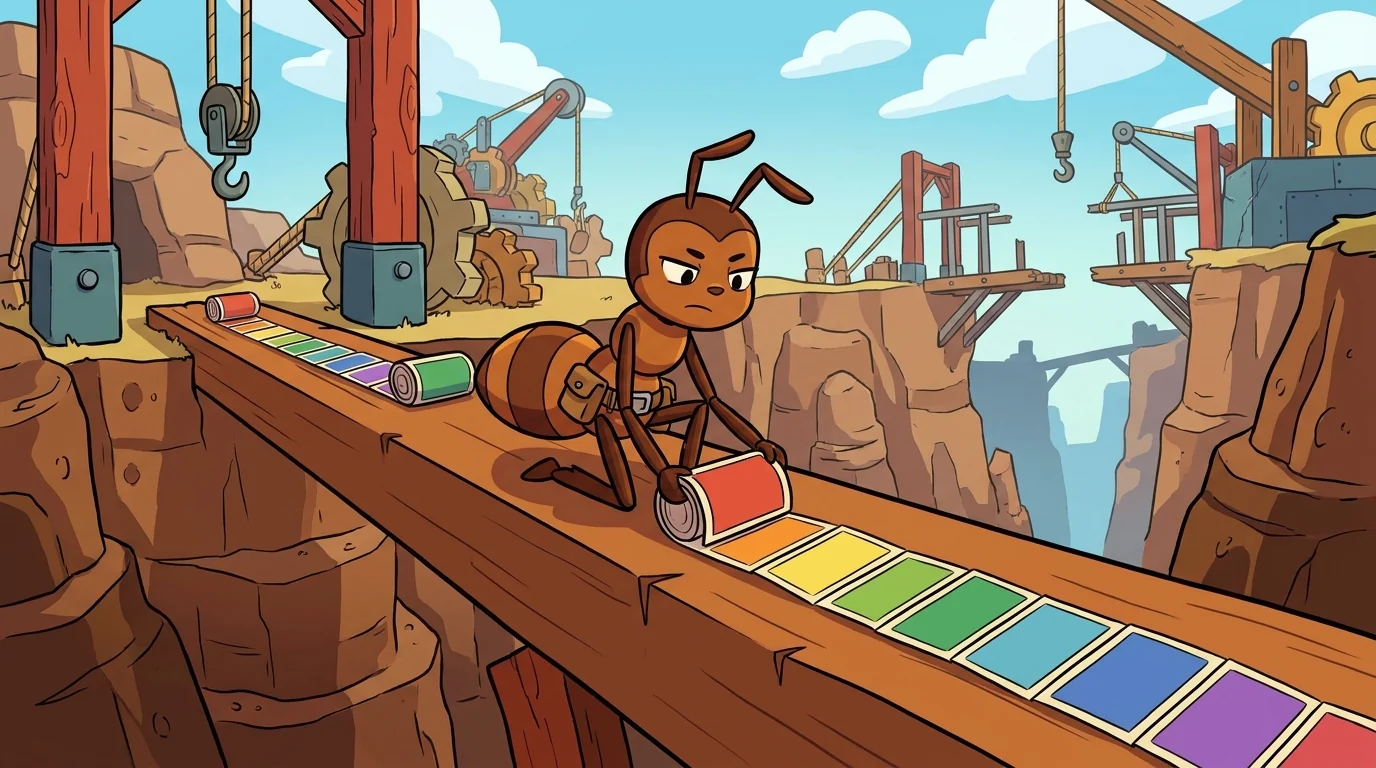
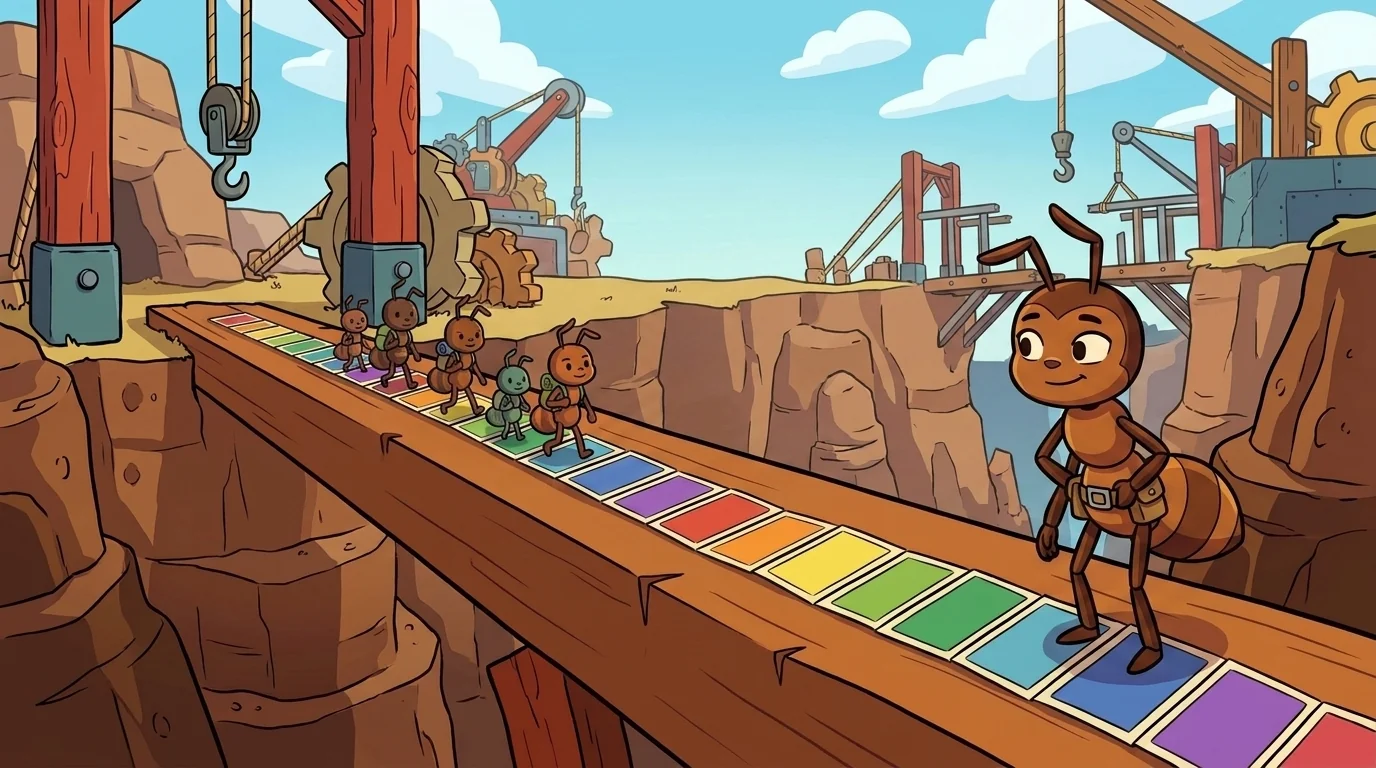
Girder was a young ant with a long, straight back and a serious face.
Ants are famous for following a trail exactly, in order, one step after another — and Girder had turned that into a craft. A girder, she liked to explain, is the long straight beam that runs the length of a bridge and carries everything across it. "A program is the same," she'd say. "It's a beam of steps. The traffic runs across it in order. Change the order and the whole thing can collapse." She carried a folding strip of numbered cards, each card one step, and she was forever laying them out in a row and checking the order.
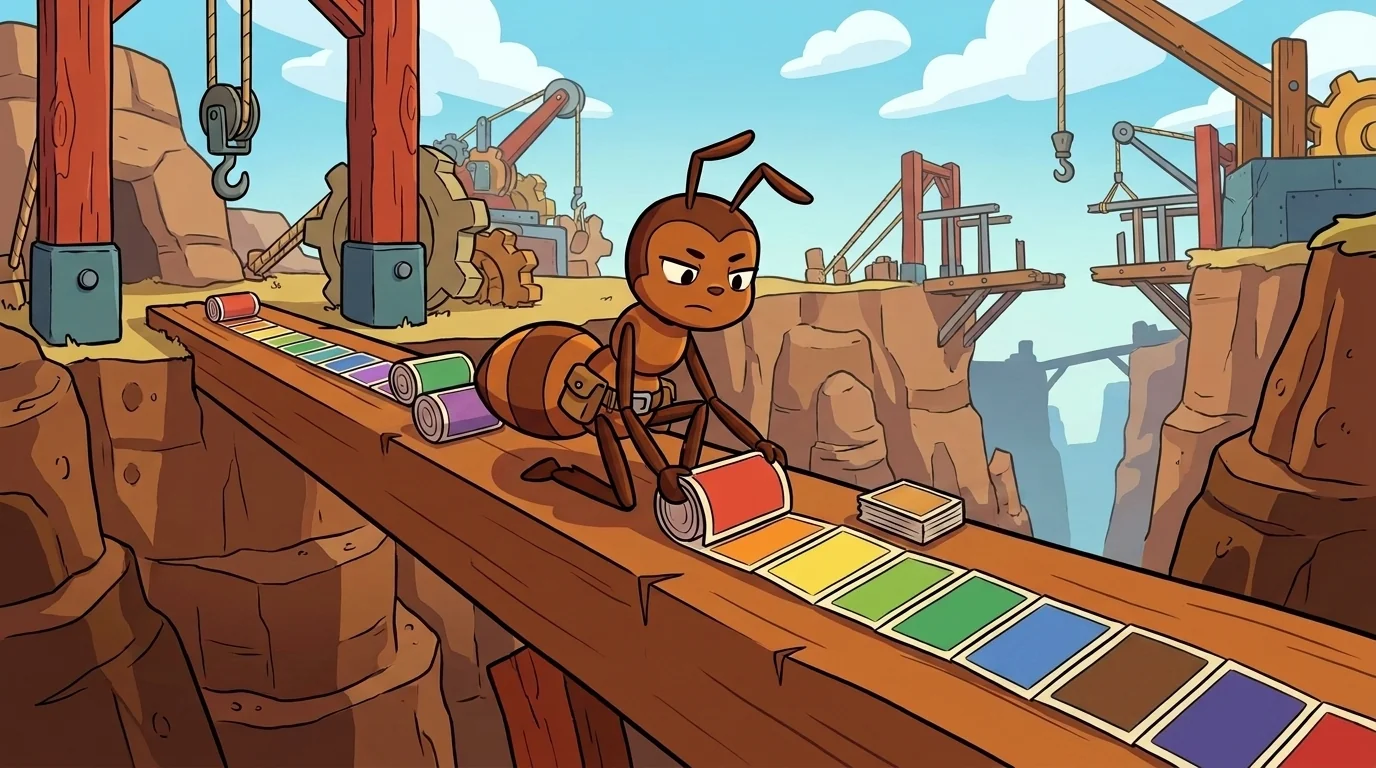
Girder built the bridge between *math and computing. At first that sounds like a stretch — but she was strict about making the connection specific, not a vague "computers use math." The real bridge, she showed, is step-order: an algorithm is a sequence, exactly like the ordered operations in a math problem. "Three plus four, then times two" gives twenty. "Three, then plus four times two" gives eleven. Same numbers — different order, different answer. "That," Girder said, "is a program. Math already taught you that order changes everything. Computing just lets you run* it."
She loved to show the bridge with a simple recipe-machine. She'd give the students a row of step-cards — POUR, then STIR, then HEAT — and run them in order: fine. Then she'd swap two: HEAT, then POUR, then STIR — and the imaginary pot cracked. "Same steps," she said. "Wrong order. The math of sequence and the logic of code are the same idea wearing two hats."
Girder was careful about the bridge-rigor gate — the family rule that a connection has to actually hold. "I don't say math and computing are connected because they both use numbers," she said. "That's surface rhyming. I say they're connected because order-of-operations in math IS sequence in an algorithm. That's a specific bridge, and I can point to exactly where it holds." Archie, the academy's mentor, had drilled that into all of them: name the two sides, name the exact connection, and ask at what level it holds.
Girder came from a colony that ran a message-relay — ants passing a signal down a line, each doing one step in turn. If one ant did its step out of turn, the message arrived scrambled. Young Girder was the one who figured out that the order was the whole message, more than any single ant. She understood then what her life's work would be: a sequence is a kind of math, and getting the order right is getting the answer right.
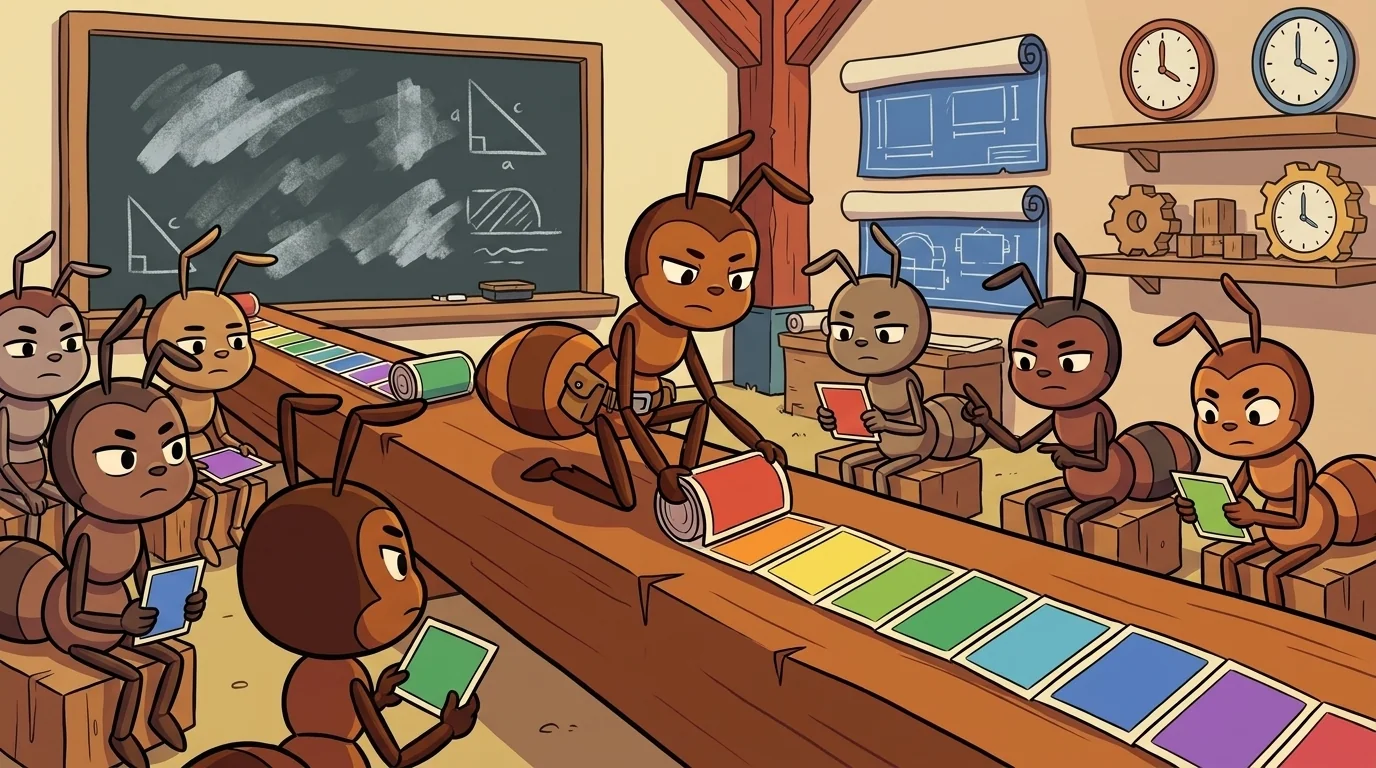
One day Archie came to the colony, looking for teachers for the BridgeForge academy.
"What is the math-to-computing bridge?" Archie asked.
Girder laid her step-cards in a careful row. "It is step-order," she said. "An algorithm is a sequence, and order-of-operations already taught us that sequence decides the answer. Same idea, two subjects. The bridge holds at the level of ordered steps — not at the vague level of 'both use numbers.'" Archie nodded. "You are appointed," he said.
In her classroom, Girder starts every lesson by handing out step-cards and asking, "What has to happen first? What has to happen before what?" The students arrange, run the sequence, watch it work or break, and rearrange.
She teaches her students a few habits for the math-computing bridge: Name the exact connection. Not "both use numbers." Say "order-of-operations in math is the same as sequence in code." Point to where the bridge lands. *Order is the message. The same steps in a different order are a different program — and often a different answer. *Run it and watch it break. A wrong sequence usually fails in a specific place. That place tells you which step is out of order. *A loop is just a step that repeats. "Do this four times" is math (multiplication) and code (a loop) at once — same idea. *Ask at what level the bridge holds.* Sequence? Yes. "Computers are basically brains"? No — that bridge doesn't hold; don't build it.
Girder tells her students, "I put steps in the wrong order all the time, and my little machine cracks. That's not a failure. The crack shows me exactly which step jumped the line. I move it back, and it runs."
When a student asks whether math and computing are really the same thing, Girder always answers the same careful way:
"Not the same thing — but joined at a specific place. Order decides the answer, in both. Get the sequence right and the whole beam carries the load."
Girder lays her last step-card in place, the row finally in perfect order, and the baffled, out-of-order feeling she used to get from a scrambled relay has settled into a steady, click-it-ran calm — the quiet satisfaction of a sequence that runs clean from one end to the other.
The BridgeForge ensemble
Girder is part of BridgeForge's distributed-narrative cast. Each character embodies a different curricular primitive; together they teach the full subject.
-

Truss
Math↔Science bridges — causal-evidential connection (measurement + replication; both sides need numbers)
-

Arch
Math↔Art bridges — proportion-aesthetic connection (golden ratio + symmetry; math you can SEE)
-

Cable
Math↔Music bridges — ratio-temporal connection (frequency ratios + rhythm; math you can HEAR)
-

Pier
Math↔Social-Studies bridges — data-narrative connection (statistics in history + civics; numbers + people)
-

Splice
Math↔ELA bridges — structure-metaphor connection (sequence + symmetry in writing; math is the bones)
-

Rivet
Math-movement bridge — rate, angle, and trajectory; a jump is math in the air
-

Ballast
Math-health bridge — ratio, scaling, and balance; the right amount in the right proportion