
The Jam
PLAYING TOGETHER — *the rhythm section locking in. a groove is not one player being clever; it is pulse, subdivision, accent, and syncopation all agreeing at once.*
Press play to listen along. The line being read lights up as you go.
Show full transcript
Loading transcript…
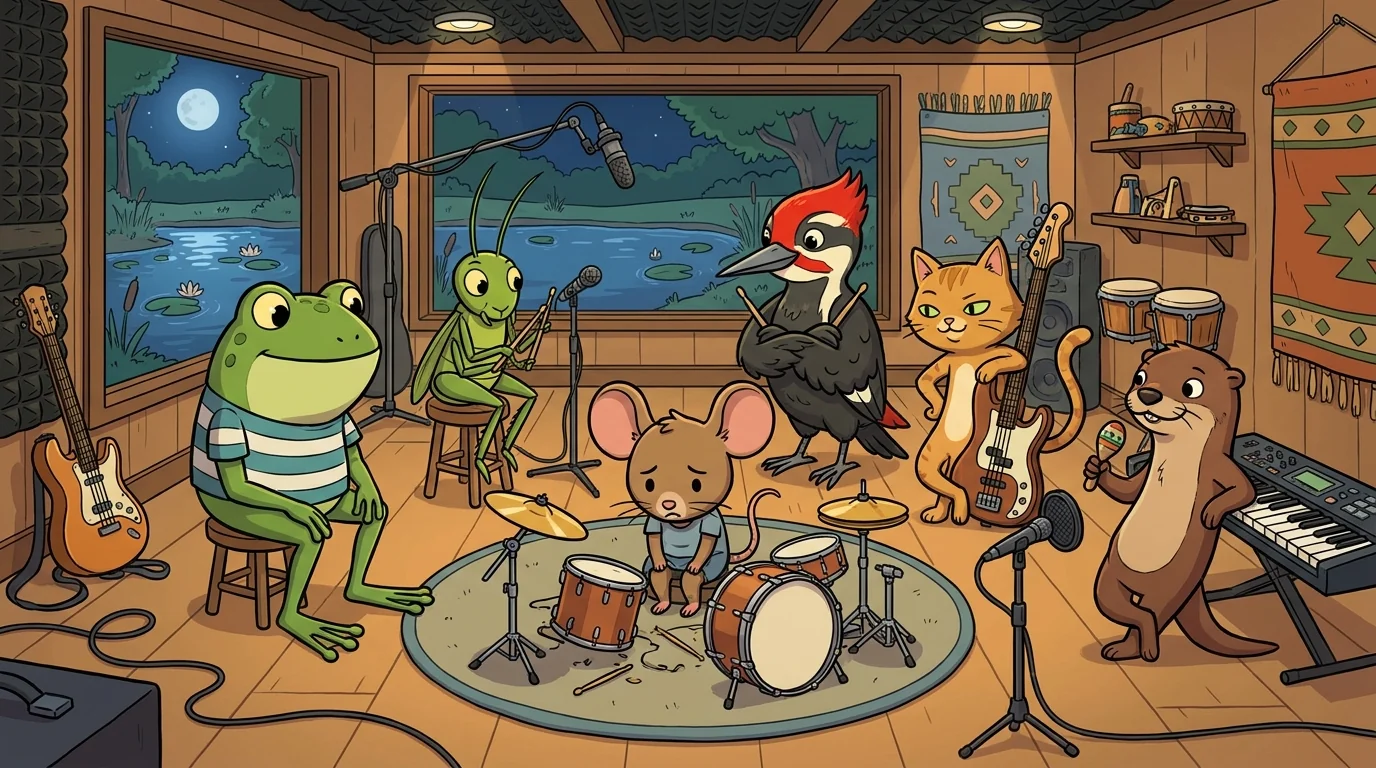
Pip's beat was a mess, and she knew it.
The little mouse sat in the middle of the pond-side recording studio, surrounded by her drum, and every time she tried to play a groove it fell apart. Too fast, then too slow. Loud in the wrong spots. Notes crammed everywhere. "I've got all the pieces," she said miserably, "I know about pulse and accents and all of it — and it still sounds like a bucket falling down the stairs. I'm trying to do everything at once and it's just... noise."
Around her, five friends set down their instruments and pulled their stools into a circle. Throb the frog, calm as a heartbeat. Snap the cricket, quick and precise. Hammer the woodpecker, strong and sure. Tilt the cat, sly and loose-limbed. And Spin the otter, who never sat quite still. None of them was worried. They'd fixed a hundred messy beats, and they knew the secret Pip didn't: a groove isn't one player being clever. It's everyone holding one simple job, at the same time, together.
"You're trying to be the whole band by yourself," Throb said gently, tapping his steady foot. "Let's not do that. Let's build it the way a real groove gets built — one job at a time, and nobody hogging. Watch. I'll start, because everything starts with me."
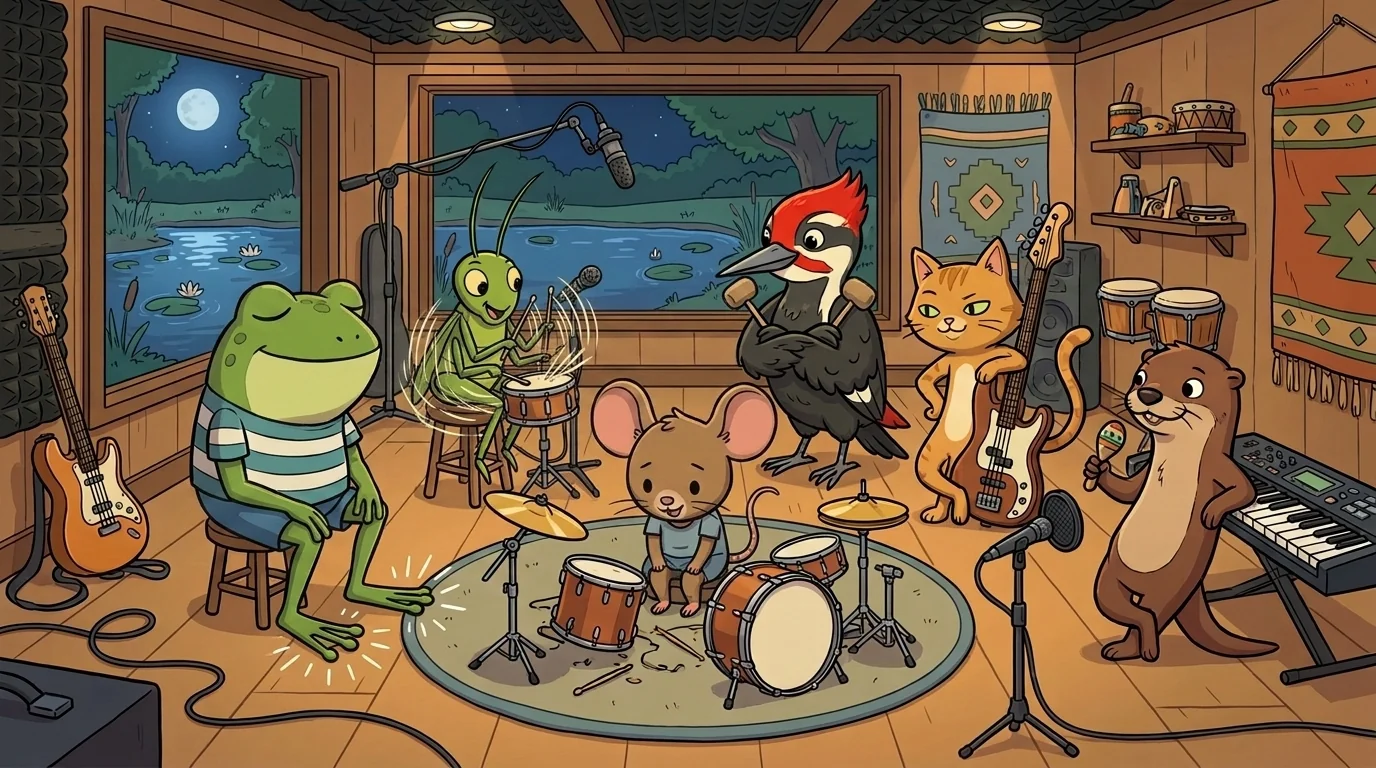
Throb closed his eyes and began to tap: pulse. pulse. pulse. pulse. A steady, unhurried clock, the same as a calm heartbeat. "This is the floor everything stands on," he said. "The pulse. It never rushes and never drags. If I wobble, the whole groove wobbles. So my only job — my whole job — is to stay steady. Nothing fancy. Just true."
Snap the cricket grinned and leaned in. "And my only job is to fill in the spaces between his beats — evenly." She began to tick, twice for every one of Throb's pulses, then four times, splitting each beat into neat equal pieces. "Subdivision. I take Throb's big steady steps and slice them into smaller even ones, so there's a fine grid to hang everything on. But — and this is the thing — I have to lock exactly to him. If I speed up even a hair, the grid tilts and everything slides off."
Throb and Snap played together, and something clicked into place: a clean, even lattice of time, pulse and subdivision locked tight. The Grid, they called it — the two of them as a pair, one holding the big steady beat, one filling it evenly. It wasn't a groove yet. But it was solid, and you could feel that you could build anything on top of it.
"See?" Throb said to Pip. "Two players. Two simple jobs. Already it's steadier than everything you were trying to do alone."
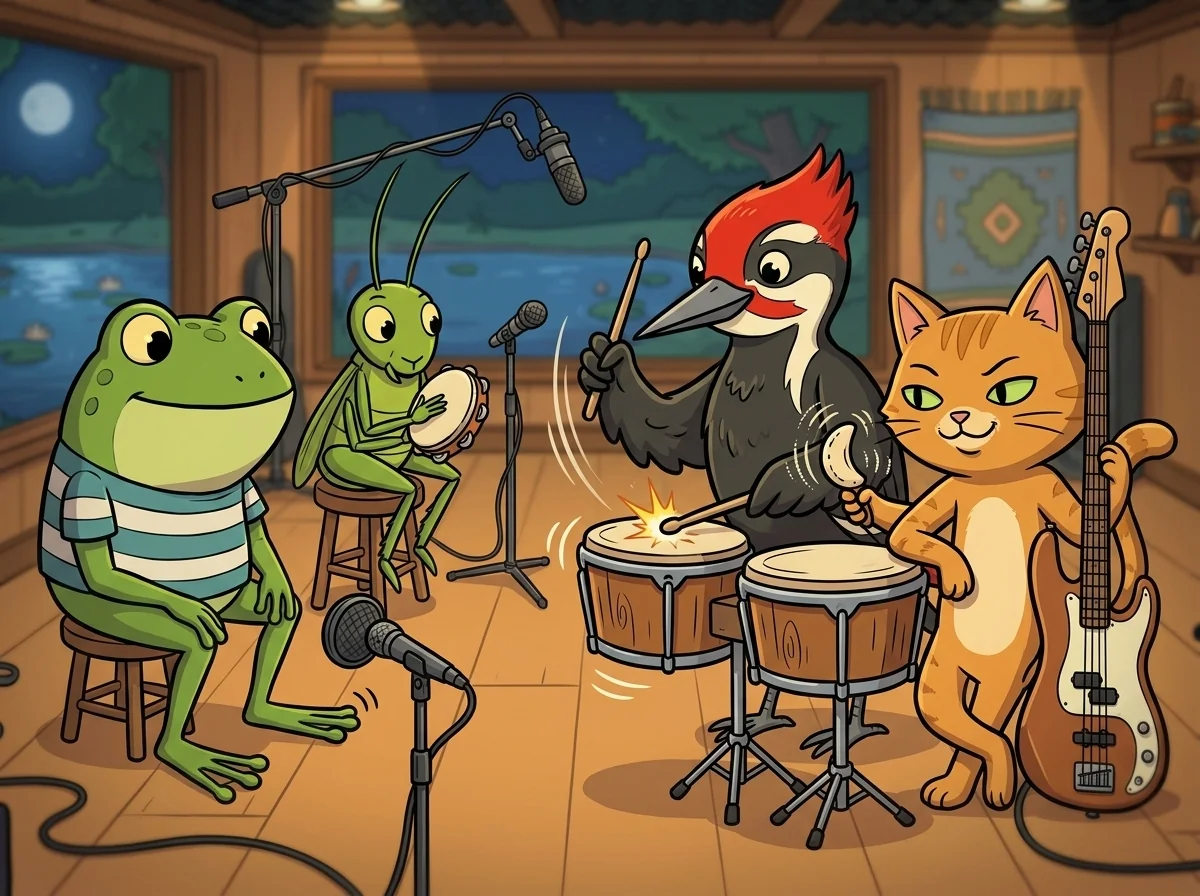
"Now the boring-but-solid part gets some muscle," said Hammer, and the woodpecker struck a single strong note right on the first beat of every group of four. BAM. "Accent. I lean hard on the important beats — usually the downbeat — so the groove has a shape, a place where it plants its feet. Without accents, a beat is just a flat tick-tick-tick. The accent tells your body where the one is."
But Tilt the cat only smiled a lazy smile. "Which is exactly why I do the opposite," she purred. She began placing her notes not on the strong beats, but in the gaps just off them — a little early, a little late, always where you didn't expect. "Syncopation. I put weight where the ear isn't ready for it. On its own it sounds wrong — like tripping. But against Hammer's solid accents?" She played her off-beats against Hammer's downbeats, and suddenly the rhythm started to lean and swing, pulling at your shoulders. "That's the tension that makes a groove feel alive. The surprise, held against the solid."
Hammer and Tilt played together — strong-and-expected against sly-and-surprising — the Feel, the two of them as a pair. And now, over Throb and Snap's steady grid, the whole thing had started to move.
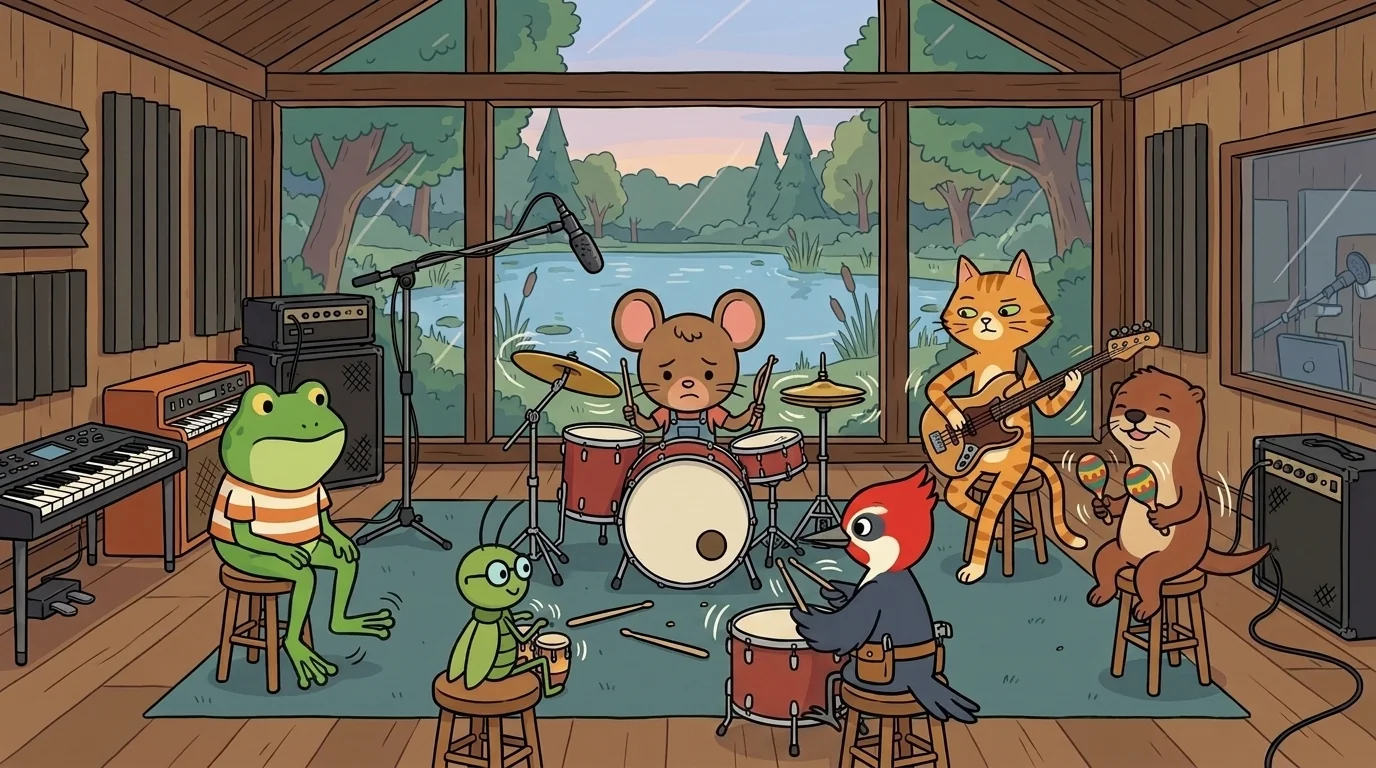
Then Spin the otter, who had been waiting, slid in — and did almost nothing clever at all. He just started to loop. He took the four of them — pulse, subdivision, accent, syncopation — and rode the pattern they were already making, around and around, smoothing it into one repeating, breathing cycle.
And that was the moment it happened.
The five of them locked. Throb's steady floor, Snap's even grid, Hammer's strong plant, Tilt's sly pull, Spin's endless loop — all of it agreeing at once — and the noise that had been a bucket down the stairs became a groove. A real one. The kind that reaches into your chest and taps your foot for you. Nobody was showing off. Every single one of them was doing one small, simple job. And together they'd made something none of them could have made alone.
"That's the jam," said Spin, riding the loop with his eyes half-closed. "The groove isn't any one of us being clever. It's all of us agreeing. Feel it?"
Pip could feel it. Her foot was already tapping. "I feel it," she whispered.
"Then stop watching and get in," said Throb. "Play the pulse with me. Just the pulse. Your one job. Trust the rest of us to hold ours."
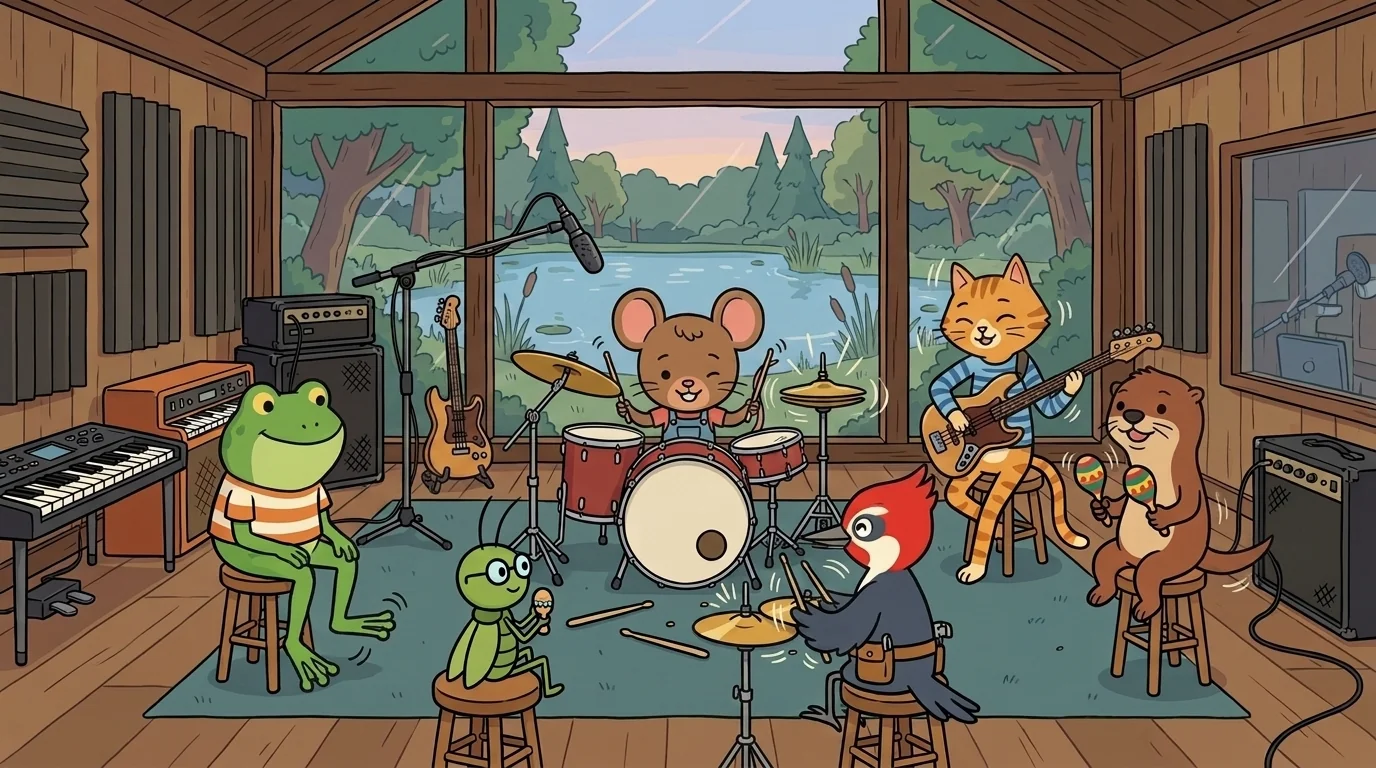
So Pip played. Not everything at once — just the steady pulse, locked to Throb, her one simple job. And around her the groove held: Snap's grid, Hammer's plant, Tilt's pull, Spin's loop, and now Pip's steady heartbeat right at the center of it. She wasn't fighting the whole band alone anymore. She was one player, holding one part, inside something bigger — and the something-bigger held her right back.
They played the groove around and around, and Pip stopped thinking about getting it right and just felt it: the click of everyone locked in, the pull of it, the way the room seemed to breathe in time. Her messy, lonely, everything-at-once beat was gone. In its place was a jam — five friends and a mouse, each holding one small true thing, making a groove far bigger than the sum of them.
"I stopped trying to do it all," Pip said, half-laughing, tapping her steady pulse, "and it finally... worked. It felt like flying."
"That's the secret of every band that ever locked in," said Throb, his foot never wavering. "Nobody carries the groove. Everybody holds one piece of it, and trusts everyone else to hold theirs. And when you all agree—" he smiled, eyes closed, deep in the pocket— "the groove just appears, and it lifts everybody up at once."
Pip played her one steady pulse inside the warm circle of the jam, and the anxious, everything-at-once loneliness melted into a bright, buoyant belonging — the pure joy of locking in and being lifted by a groove no one of them could have made alone.
"One job each. Everybody agreeing," said Spin, riding the endless loop. "Feel how good it feels, being part of the jam?"
The BeatForge ensemble
The Jam is part of BeatForge's distributed-narrative cast. Each character embodies a different curricular primitive; together they teach the full subject.
-

Throb
The steady pulse — the underlying clock every other rhythm hangs from
-

Snap
Subdivision — splitting a beat into equal smaller parts (eighths, sixteenths, triplets)
-

Hammer
Accent — emphasis on specific beats (the downbeat, the backbeat, polyrhythmic emphasis)
-

Tilt
Syncopation — placing weight off the expected beat to create pull and forward motion
-

Spin
Groove — the looping pattern that emerges when pulse + subdivision + accent + syncopation cohere; the thing that makes a beat feel like a particular genre
-
Lull
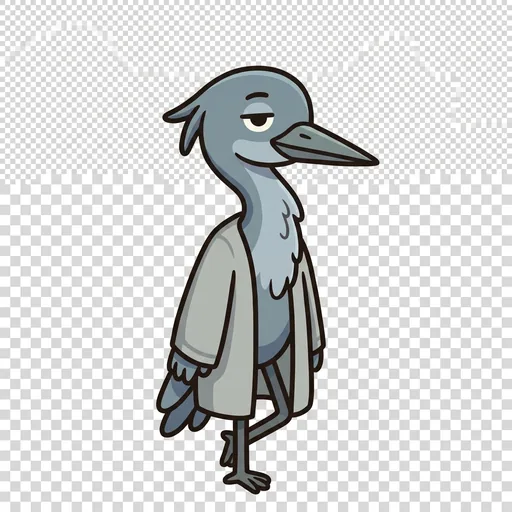
The rest — the beat you leave empty on purpose; silence counted as part of the music, so the next sound lands bigger
-

Crest
Dynamics — how loud or soft the music is, swelling louder and easing softer to give a song its waves
-

Rush
Tempo — how fast the pulse runs, and speeding up or slowing down to steer the whole mood of a song
-

Volley
Call-and-response — one player calls a phrase and the others answer it back; music as a conversation traded around a circle
-
Flurry
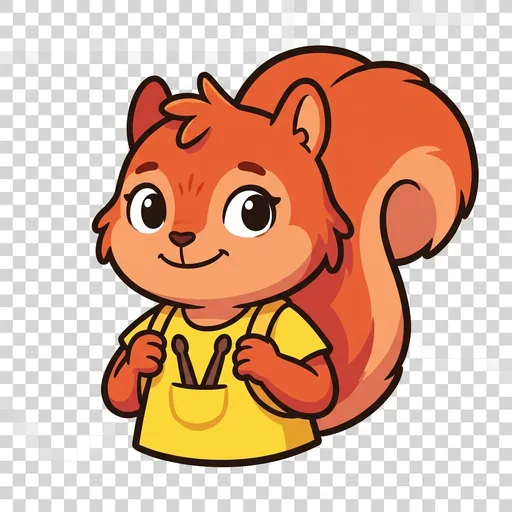
The fill — the quick burst of drum notes that carries a song across the turn from one section into the next