
Flurry
FLURRY — *the fill. the quick burst of notes a drummer plays to carry a song across the turn from one section into the next. the musical doorway between two rooms.*
Press play to listen along. The line being read lights up as you go.
Show full transcript
Loading transcript…
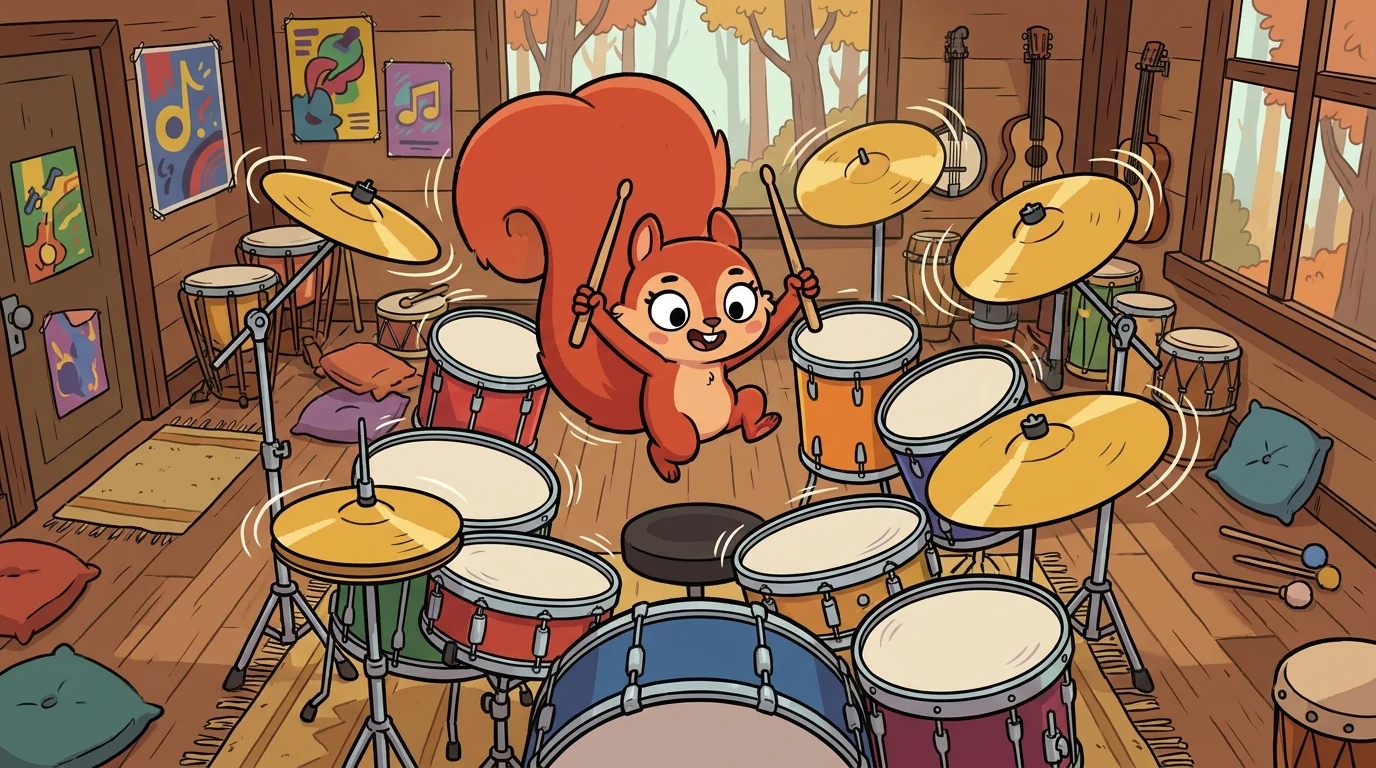
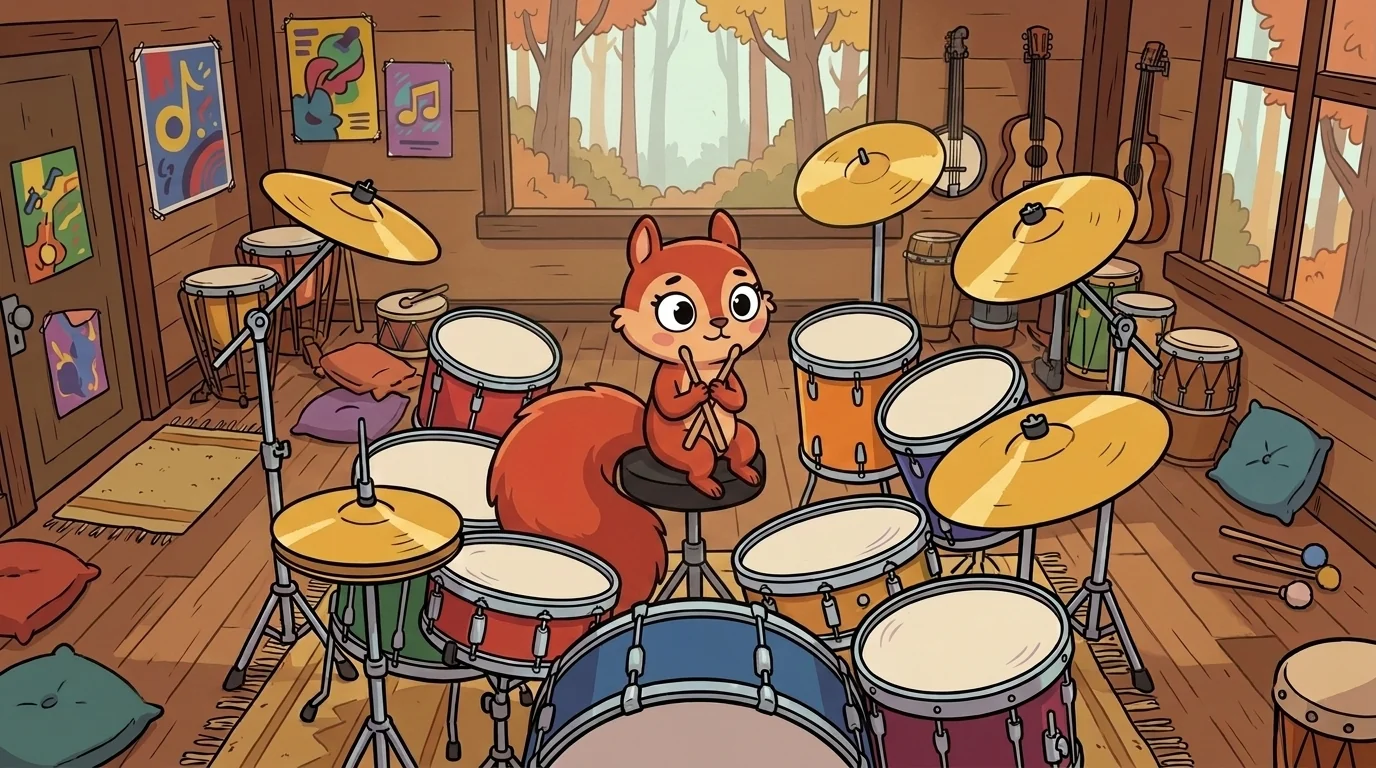
Flurry could not hold still, and she wasn't going to pretend otherwise. She was a red squirrel-tween, small and quick, with a tail that puffed twice her size when she got going and a set of drumsticks she twirled so fast they hummed. Her room was full of drums arranged in a ring, and when the class came in she was in the middle of them, mid-explosion — a blur of sticks tumbling around the whole kit, badadadada-BOOM — ending on a crash that made the cymbals shiver.
"HI!" she shouted, freezing with both sticks in the air, tail enormous. "Sorry, sorry, I was just — okay, but did you hear that? That little tumble at the end? That's the whole reason you're here. That's a *fill*."
Pip tilted her head. "It just sounded like a bunch of fast hits."
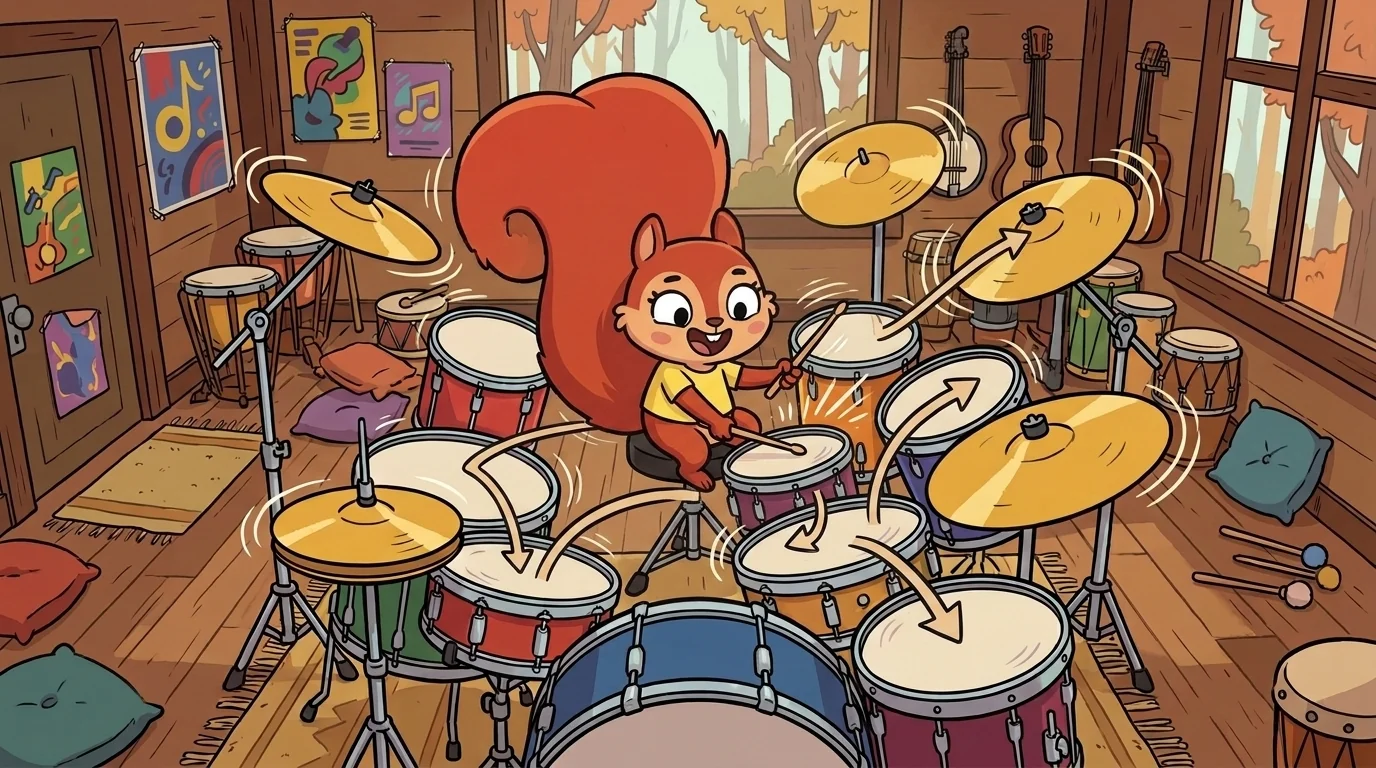
"It IS a bunch of fast hits," Flurry said, delighted, "but it's where they go that matters." She sat down at a single drum and played a steady, calm groove — a nice even pattern, four beats, over and over, the kind you could nod your head to. "Okay, this is a song rolling along. It's got a groove. It's happy. But a song has parts — a verse, then a chorus, then another verse. And when you go from one part to the next, you turn a corner. Right at that corner —" she played the groove up to the very last beat, and then her sticks erupted into a quick tumbling burst all around the kit — badada-dum-BAP! — and dropped straight back into a new, bigger groove.
Pip's ears shot up. "Oh! The fast part was like a little bridge! Between the two grooves!"
"A doorway," Flurry said, eyes shining. "That's exactly it. A fill is the doorway between two rooms of a song. The steady beat is walking through a room. The fill is the moment you open the door and step into the next one. It tells everybody listening: get ready — here comes a change."
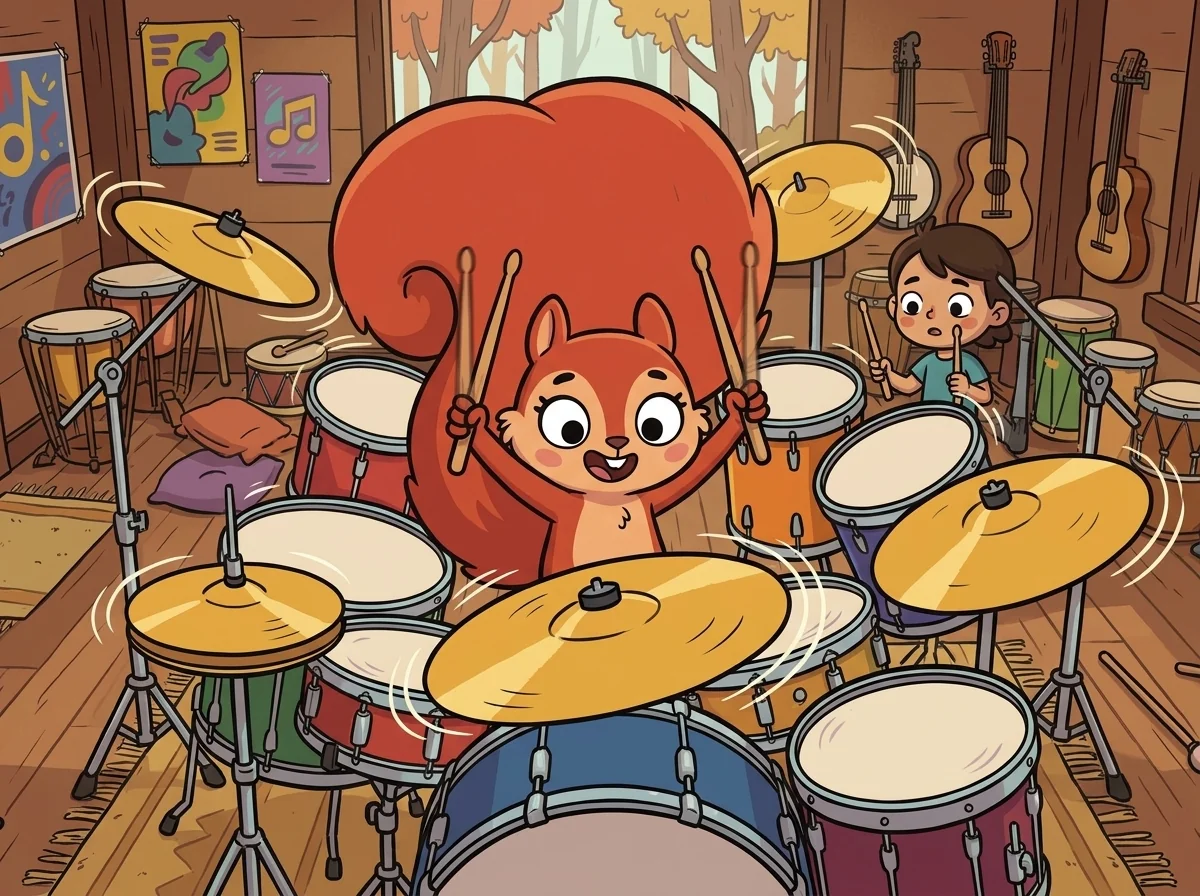
She handed Pip a pair of sticks. "Try it. Play a nice easy groove — four beats, keep it steady — but on the very last beat before you'd start again, do a little burst. Anything. Just tumble a few quick hits and then land back into the groove."
Pip played her steady four beats, and then at the corner she scrambled a quick messy little roll and crashed back in, and even though it was sloppy, it worked — it felt like a tiny door swinging open.
"YES!" Flurry's tail went supernova. "Did you feel that? For one second, everybody leans in — ooh, something's about to happen — and then BAM, you drop them into the next part. A fill is a little burst of excitement right at the turn. It's the run-up before the jump. It's the drumroll before the surprise. It's the deep breath you take right before you leap off the diving board."
Pip did another one. And another. Each doorway felt a little more like she'd built it on purpose.
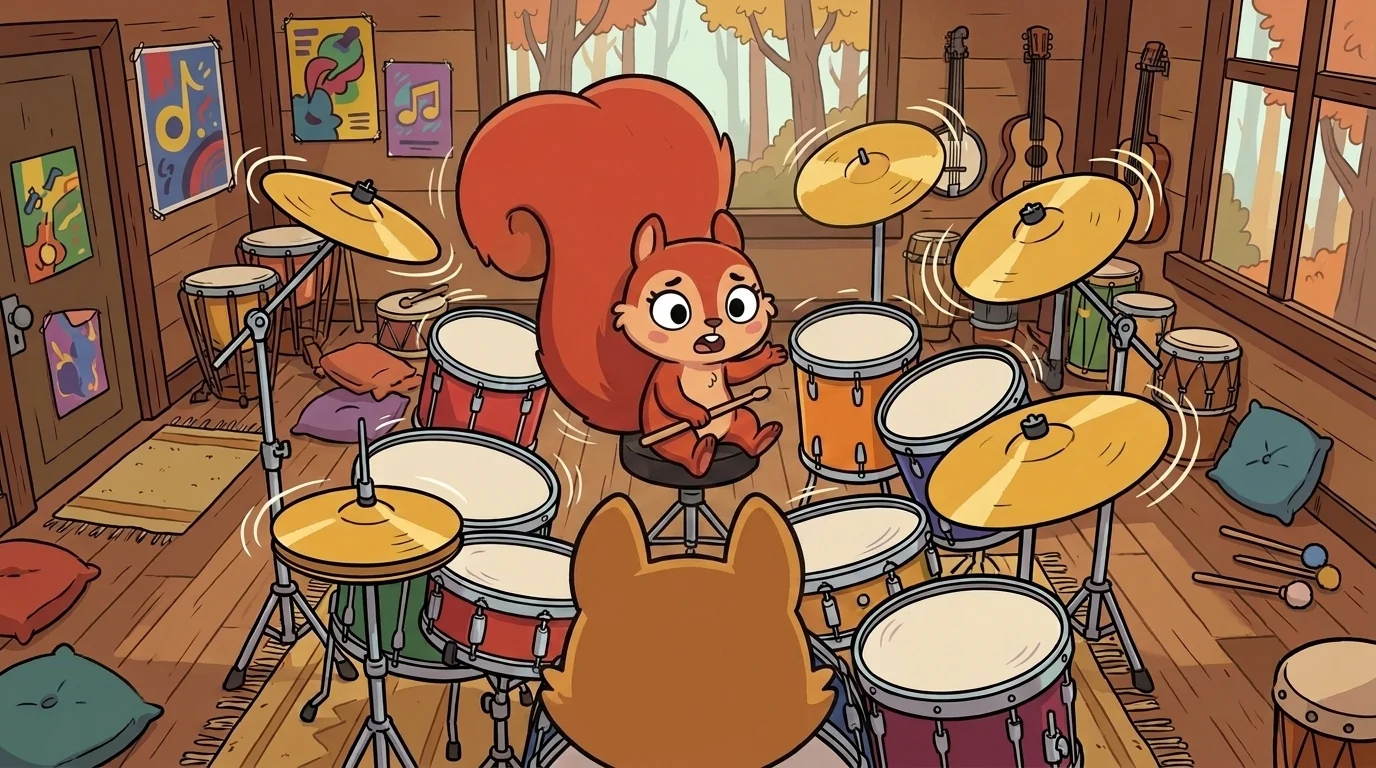
"Okay, but," Flurry said, and she made herself sit on her paws to keep from twirling a stick, "I have to tell you the mistake I made, because you're gonna want to make it too." She looked almost embarrassed. "When I first learned fills, I put one everywhere. Every single gap. Every four beats — badadada-BOOM! — every time. I thought, if fills are exciting, then a million fills must be a million times as exciting!"
She played it that way — a groove that never got two beats without a chaotic tumble crashing over it — and it was, honestly, exhausting. Pip actually winced.
"Right?" Flurry laughed. "It's too much. When everything is a doorway, nothing feels like walking into a new room — it's just tripping down a hallway of doors forever. I had to learn the hardest thing: save it. Keep the groove steady, patient, plain — and then put your fill right at the real turn, the moment that actually matters. A fill only feels exciting because most of the song isn't one." She shrugged, sheepish. "Turns out the trick to being exciting is knowing when to hold back."
Later, while Pip helped her stand the cymbals back up, Flurry was quieter than usual, her tail finally at rest. "Can I tell you the real thing?" she said. "About why I love fills so much?"
"Sure."
"It's the feeling right before the burst," Flurry said. "That last steady beat before the doorway. That little gathering. Everybody in the room takes a breath at the same time without meaning to, because they can feel the corner coming." She pressed a paw to her chest. "That's my favorite moment in all of music. Not the crash. The held breath right before the crash. The 'here it comes.' The run-up before the leap."
Pip thought about the top of the high diving rock — that flutter in your stomach, that gathering, that half-second where you're not falling yet but you already know you will. "I know that feeling," she said softly.
"Everybody does," Flurry said, and for once she was perfectly, warmly still. "That's why fills work. When you play one, you're handing the whole room that flutter — that gather-up, that ready? — and then you get to leap together." She twirled one stick, slow this time, almost tender. "So don't spend it cheap. Save the leap for when it counts. And when it counts —" her tail gave one happy puff "— jump big."
Pip climbed her own imaginary diving rock in her head, felt the flutter gather in her chest, and grinned. She couldn't wait to build a doorway somebody would leap through.
The BeatForge ensemble
Flurry is part of BeatForge's distributed-narrative cast. Each character embodies a different curricular primitive; together they teach the full subject.
-

Throb
The steady pulse — the underlying clock every other rhythm hangs from
-

Snap
Subdivision — splitting a beat into equal smaller parts (eighths, sixteenths, triplets)
-

Hammer
Accent — emphasis on specific beats (the downbeat, the backbeat, polyrhythmic emphasis)
-

Tilt
Syncopation — placing weight off the expected beat to create pull and forward motion
-

Spin
Groove — the looping pattern that emerges when pulse + subdivision + accent + syncopation cohere; the thing that makes a beat feel like a particular genre
-

Lull
The rest — the beat you leave empty on purpose; silence counted as part of the music, so the next sound lands bigger
-

Crest
Dynamics — how loud or soft the music is, swelling louder and easing softer to give a song its waves
-

Rush
Tempo — how fast the pulse runs, and speeding up or slowing down to steer the whole mood of a song
-

Volley
Call-and-response — one player calls a phrase and the others answer it back; music as a conversation traded around a circle
-
The Jam
The whole rhythm section playing together — how pulse, subdivision, accent, and syncopation lock into one groove that lifts everybody up at once