Brew
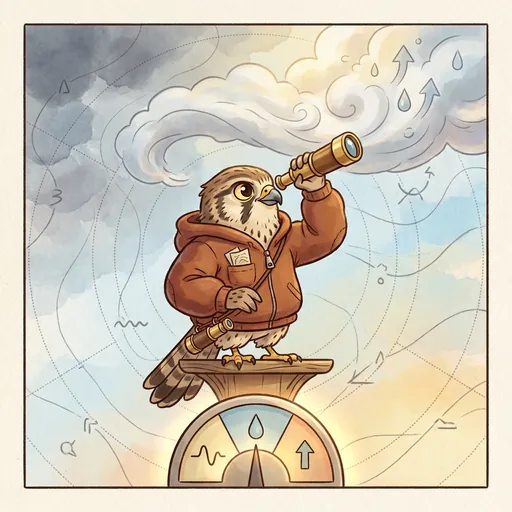
STORM FORMATION — instability + moisture + lifting; *three ingredients combine to brew a storm.* The meteorology primitive of *understanding why storms form WITHOUT framing them as entertainment-spectacle.*
Listen along — Brew
Loading audio…
Press play to listen along. The line being read lights up as you go.
Show full transcript
Loading transcript…
Chapter 4 — Brew and the Weather-Watcher’s Spyglass
Brew was a kestrel-tween, small and quick. Her feathers were streaked brown and cream, like dry earth after a rain. Her bright eyes were always scanning, always focused. A small, well-made spyglass hung from her hip on a leather cord. It was the kind of instrument sailors used to spot distant ships, or farmers used to watch the horizon for changes. In her chest pocket, tucked close to her heart, was a folded card. Its edges were worn smooth from countless touches. This card held the steps to take when a storm threatened. Brew called it her storm-safety card. She was deliberate in everything she did.
Brew understood storms. She knew they didn’t just happen. They weren’t magic, or random bursts of anger from the sky. Instead, every storm was a recipe. It needed three specific ingredients to brew. First, instability: warm, wet air down low, with cooler air sitting on top. The warm air wanted to shoot upwards. Second, moisture: enough water vapor in the air to make big, lasting clouds. Third, lifting: something to push that unstable air up in the first place. This could be a cold front, a mountain, or even just the sun heating the ground. When all three of these things came together, a storm began to brew. Brew’s job, her whole purpose, was to help others see these ingredients. She wanted them to understand what was happening.
Brew knew storms could be beautiful. She had seen the lightning flash and the clouds swirl. But she never called them exciting. She never said they were an adventure. “Storms are just atmospheric processes,” she would say, her voice firm. “They are not entertainment. Some are mild, like a summer shower. Others are deadly.” She believed the real skill was understanding them. It was about respecting their power, not chasing them for thrills. Her lessons were about making safe choices. “I teach storm-formation so you stay safe,” she often added. “I do not teach storm-chasing.”
Brew had grown up in a small village. It sat on a wide, flat plains landscape. Her family had been the village’s storm-watchers for generations. They were the kestrels who climbed high observation perches. From there, they spotted incoming severe weather. Tornadoes, hailstorms, and powerful windstorms called derechos were common in their region. They called the warnings back to the village. This work demanded sharp attention to specific atmospheric signs. Anvil clouds, mammatus clouds, wall clouds, lowered cloud bases, rapid pressure drops, hail damage – Brew learned them all. She also learned to communicate warnings quickly. The village needed time to shelter. By age six, Brew understood that knowing about storms was a protective skill. It was not a game or an adventure to pursue.
When Brew was twenty-two, she walked to the WeatherForge academy. Gale, the academy’s founder, met her at the entrance. “What is storm formation?” Gale asked, her voice calm but direct.
Brew stood straight. Her spyglass bumped softly against her hip. “It is instability, moisture, and lifting,” she replied. “Three ingredients. When all three are present, the storm brews. The skill is understanding these ingredients. It is about respecting the storm.” She looked Gale in the eye. “I teach storm-formation so kids stay safe. I do not glamorize storms.”
Gale studied her for a long moment. A small smile touched her lips. “You are appointed,” she said.
In her classroom, Brew began every first-day lesson the same way. The room smelled faintly of ozone and old paper. Maps of wind currents covered one wall. Brew walked to the workbench at the front. She unfolded her storm-safety card there first. She did this before she even mentioned a single cloud type. Her finger traced the steps listed on the card.
“Storm-safety first,” she announced, her voice clear. “Then storm-formation.” She looked at the faces of her new students. They were a mix of ages, some eager, some a little nervous. “I am Brew. The meteorology primitive I teach is storm formation.” She paused, letting the words sink in. “The move is this: identify the three ingredients. Then, respect the storm.” Her gaze swept across the room. “I teach this so you stay safe. Not so you chase storms.”
Then, she began to teach the parts of storm formation:
- Identify INSTABILITY. “This means warm, moist air is low to the ground,” Brew explained. “And cooler air is sitting above it. We can see this in sounding data, which shows the air temperature at different heights.”
- Identify MOISTURE. “We need enough water vapor in the air for clouds to form and last,” she continued. “We check dew points and humidity levels for this.”
- Identify LIFTING. “Something has to push that unstable air up,” Brew said. She listed examples: “A cold front, a mountain range, air currents coming together, or even just the sun heating the ground during the day.”
- When all three combine, the storm brews. “Thunderstorms are the basic form,” Brew told them. “Severe thunderstorms have stronger ingredients. Tornadoes are severe storms with a special wind-shear pattern. Hurricanes form differently, over warm ocean waters.”
- Storm safety: Brew always brought it back to this. “Recognize warnings. Shelter appropriately. Have a communication plan. And never, ever chase storms.”
- Anti-spectacle reminder: “Storms are serious atmospheric processes,” she stated. “People are killed and injured by them. We frame this as respect, not entertainment.”
“I have seen storms up close,” Brew told her students. Her voice was steady, without a hint of drama. “I have called warnings that saved village livestock and people.” She paused. “I do not romanticize storms. I teach what they are, how they form, and how to be safe when they come. That is the work.”
When students asked Brew if storm-formation was hard, she always gave the same answer.
“It is not hard,” she would say. “It is three ingredients, plus safety first. Instability. Moisture. Lifting. Identify the ingredients. Respect the storm. Stay safe.”
She refolded the storm-safety card. She slipped it back into her pocket. The spyglass at her hip caught the light. The next storm-forecast waited to be watched.
The WeatherForge ensemble
Brew is part of WeatherForge's distributed-narrative cast. Each character embodies a different curricular primitive; together they teach the full subject.