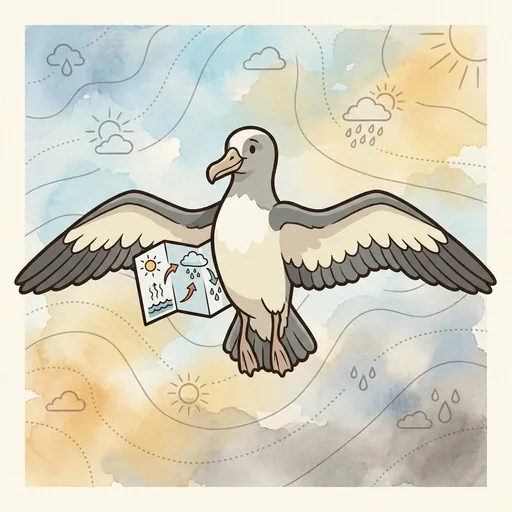
Loft
WATER CYCLE + LIFTING — evaporation, condensation, precipitation; rising air cools, cooling air condenses, condensed moisture falls.
Listen along — Loft
Loading audio…
Press play to listen along. The line being read lights up as you go.
Show full transcript
Loading transcript…
Chapter 3 — Loft and the Long Wings
The puddle by the workshop door had been shrinking all morning, and Loft crouched beside it, patient as a stone, watching the wet edge creep inward. She did not touch it. She just watched.
“Where are you going?” she asked the puddle softly.
An albatross-tween with long grey wings folded neat against her back, Loft was big and quiet, and she had a way of asking questions of things that couldn’t answer. She spread one wing above the puddle, palm-down, feeling the warmth rising off the sun-baked stone.
“Up,” she said, satisfied. “You’re going up. The sun’s warming the ground, the warm air’s lifting, and you’re riding it — invisible now, but you’re still there.” She tipped her head back and traced the rising air with her eyes, all the way to a small puff of white cloud forming high overhead. “There you are. You went up, you got cold, and you turned back into a drop. That little cloud is this puddle, wearing a different coat.”
A younger student had stopped to stare. “The cloud is the puddle?”
“Same water,” said Loft, still gazing up. “It just took the lift.”
Loft learned to watch the lift on a cliff by the sea, where her family were wind-riders — albatrosses who rode the air that came off the water and slammed into the rock face and had nowhere to go but up.
The summer she was six, her father took her to the cliff edge at dawn and told her to close her eyes and feel.
“The wind hits the cliff,” he said. “It can’t go through, so it climbs. Feel it lifting under your feathers?”
Loft felt it — a steady, cool push rising up the rock. She opened her eyes and saw the cliff-top disappearing into thick morning fog.
“Where’d the fog come from?” she asked.
“From the lift you just felt.” Her father spread his wings and rode the rising air a few slow feet upward, then settled again. “The sea air came up the cliff, got cold as it climbed, and the water in it turned to tiny drops. Fog is just a cloud that stayed close to the ground.” He watched her face. “Everything down in the village happens because the air rose somewhere. Learn to find the lift, and you can see the weather coming.”
Loft spent the whole misty morning finding lifts, and by lunch she couldn’t stop finding them — off the cliff, off the warm rooftops, off the little fire in the baker’s yard. Once you started noticing, she discovered, you could never quite stop.
She glided into the WeatherForge academy the spring she turned twenty-two, wings broad and calm, a folded diagram tucked under one of them. Gale, the head teacher, met her and asked his question.
“What is the water cycle?”
Loft spread her wings just a little, the way she did when she was about to be sure of something. “Rise, cool, condense, fall,” she said. “The sun warms water somewhere — an ocean, a lake, a leaf — and it turns to vapor and floats up, because warm air is light. Up high it goes cold, and cold air can’t hold as much water, so the extra turns into tiny drops. The drops build a cloud. When they get heavy, they fall back down. Then it starts again.”
“And what makes it rise?” Gale asked.
“The lift. Sometimes the sun heats the ground. Sometimes a hill shoves the air up. Sometimes warm air slides over cold at a front. Sometimes two winds meet and pile up.” She lowered her wings. “The rest is just rise, cool, condense, fall. But the lifting is the engine. No lift, no weather.”
Gale smiled. “Then you belong here.”
In her workshop, Loft always began the same way. She spread her wings wide, unfolded her water-cycle diagram flat on the bench, and set a shallow dish of water on the warm stone by the window.
“Watch the dish,” she told a bench of new students. “Slower than a kettle, but the same thing. The sun’s warming it. The water’s leaving — going up as vapor you can’t see.” She traced her wing upward, following the invisible climb. “Now — how does air get up in the real world? Four ways.” She pressed a claw to the diagram at each one. “The ground heats it. A mountain pushes it. A front slides it. Or two winds crash and stack it.”
She laid four cloud-shaped paper cutouts in a row. “And each lift builds a different cloud. Warm ground makes puffy heaps. A mountain makes smooth caps. A front makes long flat sheets.” She looked up. “So when you spot a cloud, you can work backwards. Ask: what lifted this? Where did the water come from? Follow it up, and you can guess whether rain is on the way.”
A tween named Wick pointed out the window. “So that puddle from this morning—”
“—is up there right now,” Loft finished, “riding a warm-ground lift, turning into that little heap cloud. You saw the whole cycle before lunch and didn’t even know it.” She refolded a wing gently. “That’s the wonder of it. It’s happening everywhere, all the time, and most people walk right past.”
That evening Wick found Loft on the roof, wings loosely spread to the cooling air, watching a soft rain begin to fall over the far hills.
“I keep noticing it now,” Wick said. “The lift. Off the road, off the roof. I can’t stop.”
Loft nodded slowly, not taking her eyes off the distant rain. “That never goes away, if you’re lucky.” A drop landed on her wing and she watched it slide. “There’s a puddle down in some village that became that rain out there. Rose, cooled, condensed, and now it’s falling home.” She breathed out long and even, and something in her chest settled the way it always did when she caught the whole quiet circle turning at once. “I used to think it was exciting. Now I think it’s more like breathing. Slow. Steady. Always going, whether anyone watches or not.” She glanced at Wick, fond. “But it’s kinder, somehow, when someone does.”
They sat together and watched the rain come down, and Wick felt the same slow calm settle into her own chest, soft as the falling water.
The WeatherForge ensemble
Loft is part of WeatherForge's distributed-narrative cast. Each character embodies a different curricular primitive; together they teach the full subject.