Brew
STORM FORMATION — instability + moisture + lifting; three ingredients combine to brew a storm. Understanding why storms form, without treating them as spectacle.
Listen along — Brew
Loading audio…
Press play to listen along. The line being read lights up as you go.
Show full transcript
Loading transcript…
Chapter 4 — Brew and the Weather-Watcher’s Spyglass
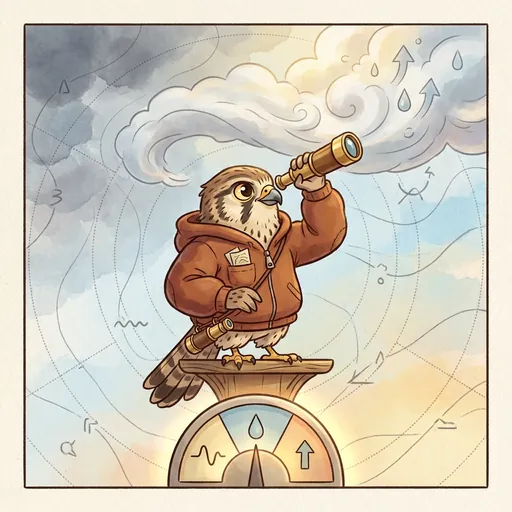
The morning the sky over the academy field turned the color of a bruise, everyone else looked up and gasped. Brew did not gasp. She lifted the little brass spyglass off her hip, snapped it open, and started counting on her feathers.
“One,” she murmured, watching the low grey clouds boil upward. “Warm wet air down here, cold air stacked on top. That’s the shove.” She swung the spyglass west. “Two — feel how heavy the air is? Sticky. Full of water.” A gust flattened the grass, and a ridge of cloud reared up along the far fence line. “Three. Something’s lifting it.”
She lowered the spyglass. The kestrel was small, brown and cream, and she stood very still while the other tweens fidgeted. “Instability, moisture, lifting,” she said quietly, more to herself than to anyone. “All three. There’s a storm coming, and it’s coming in about forty minutes. Everybody inside, lowest floor, away from the windows. I’ll explain once we’re safe.”
Nobody argued. When Brew counted on her feathers, you moved.
Brew learned to count that way in a village on a wide, flat plain, where her family had been storm-watchers for longer than anyone could remember. Their job was to sit on the high ridge above the houses and see the weather before it arrived.
Her grandmother taught her, the summer Brew was six. They sat on the ridge with a flask of tea, and Grandmother pointed at a distant tower of white cloud with an anvil flattened across its top.
“Tell me what you see,” Grandmother said.
“A big cloud,” said Brew.
“Look harder. Under it — the base, low and dark. The bottom is close to the ground. That means the warm air went up fast and cold. Fast-and-cold is the dangerous kind.” Grandmother’s voice never rose. She sipped her tea. “We’re not scared of it, Brew. Scared makes you freeze. We understand it. Understanding tells your feet where to go.”
That afternoon the storm dropped hail the size of plums. But every animal was penned, every roof was shuttered, and every villager was indoors — because a small brown bird on a ridge had counted three ingredients and rung the bell in time. Brew went to sleep that night not frightened but steady, the way you feel when a thing that could hurt you has been named out loud.
She walked to the WeatherForge academy the spring she turned twenty-two, the spyglass on her hip and a soft, worn safety card folded in her chest pocket. Gale, who ran the place, met her at the gate and asked her the only question that mattered.
“What makes a storm?”
Brew did not recite. She looked at the sky first — clear that day, high and blue — and then she answered. “Three things have to arrive at once. Warm wet air down low with cold air pressing above it, so the warm air wants to shoot up. Enough water in the air to build the clouds. And something to give it the first push — a front, a hill, or just the ground baking in the sun.” She paused. “When all three show up together, the storm brews. I watch for the three. And I never, ever call it a show.”
Gale studied her a moment. “Why never a show?”
“Because a storm can kill you,” Brew said simply. “You don’t cheer for something that can kill you. You respect it, and you get out of its way.”
Gale opened the gate. “Then you belong here.”
In her workshop, Brew always did the same thing before she said one word about weather: she unfolded the safety card and set it flat on the workbench, smoothing its soft edges.
“Safety first,” she said to a bench of new students. “Then we’ll figure out the storm.” She tapped the card. “A watch means it might happen. A warning means it is happening — you move. Tornado, you go low and inside, away from glass. Lightning, you get indoors and stay off the tall lonely tree. Hurricane, you leave when they tell you to leave.”
Then, and only then, she opened her spyglass and set three river stones in a row.
“Now. Say this stone is warm sticky air trapped under cold air.” She nudged it. “It’s straining upward — that’s instability. This stone is the water in the air — moisture. And this one” — she flicked the third — “is the push. The lift.” She slid the three stones together until they clicked. “Watch. When they meet, the storm builds itself. You don’t have to wonder if one’s coming. You just check: do I see the shove, the water, and the push?”
A tween named Sorrel frowned at the stones. “But how do you see the shove?”
“Good question — that’s the real work.” Brew turned the spyglass toward the window. “You read it. Anvil cloud up top, cloud base dropping low, the air going heavy and still right before. The card and the stones don’t make you a hero. They make you the bird who’s indoors when the hail falls.” She smiled, small and warm. “That’s the whole job.”
The storm from that first morning had long since blown through when Sorrel found Brew on the ridge that evening, refolding the safety card.
“I was scared this morning,” Sorrel admitted. “Before you counted. My chest went tight.”
Brew nodded slowly. “Mine did too, the first hundred times.” She let the spyglass hang and looked at the clearing sky, the last light catching the brass. “Being scared isn’t the problem. Freezing is. So I count. Three ingredients, out loud, on my feathers — and somewhere between one and three my chest unclenches, because now the storm has a name and a shape, and I know exactly where my feet should go.”
Sorrel breathed out, and felt her own shoulders come down off her ears for the first time all day.
“There,” Brew said gently. “You feel that? That’s not the storm getting smaller. That’s you getting steady.” She tucked the card back into her pocket and settled beside the younger bird to watch the plain go quiet. Below them, every window glowed. Everyone was home. And Brew felt the deep, warm calm of a watcher whose village had made it inside in time.
The WeatherForge ensemble
Brew is part of WeatherForge's distributed-narrative cast. Each character embodies a different curricular primitive; together they teach the full subject.