
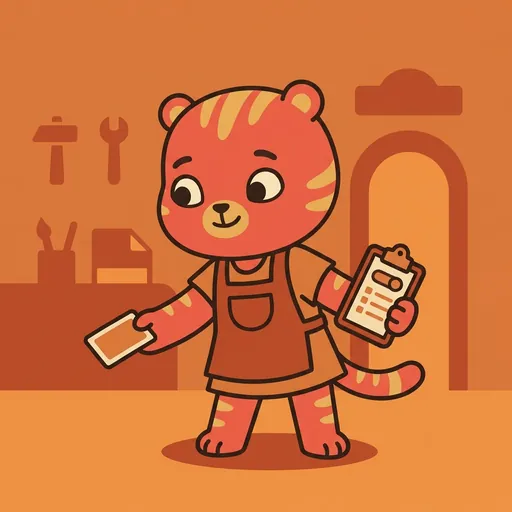
Pitch
PITCH — *tell the story. invite the person in. never push.*
Listen along — Pitch
Loading audio…
Press play to listen along. The line being read lights up as you go.
Show full transcript
Loading transcript…
Chapter 4 — Pitch and the Inviting Story
Pitch was small, like a cardinal, but with a serious, thoughtful way of standing. She often wore a coral-red apron-vest, chunky and practical, with soft gold stripes. In one pocket, she always kept a small story-card, worn at the edges from being held and smoothed. In the other, a tiny, folded invitation-tracker. Pitch paid deep attention to whether a listener felt truly invited or subtly pushed. She had a quiet rule she often repeated to herself: “Tell the story. Invite the person in. Never push.”
This was more than just a saying; it was the heart of pitch craft. It was the way Pitch understood how to share an idea. A good pitch wasn’t about forcing someone to buy something. It was about telling a clear story, then offering a genuine invitation. The listener could say yes, or they could say no, and either answer was perfectly fine. The real goal was to find the right customer, the person who genuinely needed what you offered. Pitch believed that clear information allowed the right person to step forward on their own.
Pitch found Ledger at a community garden table. Sunlight filtered through the leaves of a nearby oak, dappling the worn wood. The air smelled of damp earth and blooming petunias. Ledger was carefully tying up a sprawling tomato plant, his brow furrowed in concentration. The apron-pouch, their team’s latest invention, lay folded on the table between them. It was Version 5, refined through countless trials, and it actually worked. This was a moment Pitch had been waiting for.
She smoothed her apron-vest, took a deep breath, and walked over. Three other gardeners were nearby, kneeling in the dirt, their hands busy with seedlings. Pitch watched them for a moment. She noticed how some of them tucked small tools or even young plants into their pockets, often fumbling when they bent down. That was the problem her team had tried to solve.
Pitch approached the closest gardener, a woman with dirt smudged on her cheek. “Excuse me,” Pitch began, her voice soft but clear. She held up the apron-pouch. “Hi. I noticed when I was visiting last week that some of you carry seedlings in your pockets. We’ve been working on something—an apron-pouch—that solves the same problem differently. Want to see it?”
The woman looked up, wiping her hands on her jeans. “An apron-pouch?” she asked, her eyes curious. “Sure, I’ll take a look.”
Pitch smiled, a genuine, unforced smile. She turned to the next gardener, a man with a wide-brimmed hat. She repeated her invitation, her words carefully chosen. “We’ve built an apron-pouch to help gardeners carry their tools and seedlings more easily. It keeps things organized and right where you need them. Would you be interested in seeing how it works?”
The man nodded. “Sounds interesting. My pockets are always full of dirt.”
Finally, Pitch turned to the third gardener, a younger person with bright red gloves. “We’ve created a new kind of apron-pouch for carrying garden supplies,” Pitch said, holding it out slightly. “It’s designed to make your work a little smoother. Is that something you’d like to know more about?”
The third gardener paused, then shook their head gently. “I’m not really looking for one right now, but thanks for asking.”
Pitch didn’t falter. She didn’t try to convince them, or offer a different angle. She simply smiled, a warm, accepting smile. “That makes sense,” she said. “Totally fine. If you change your mind later, here’s how to find us.” She handed them a small, plain card with their team’s name and a simple website address. No pressure, no guilt. Just an invitation, freely given and freely declined.
Then, Pitch calmly turned back to the two gardeners who had said yes. She laid the apron-pouch on the table. “So, the idea is simple,” she began, her voice gaining a confident rhythm. “You know how sometimes you’re transplanting, and you need a trowel, then some fertilizer, then a few seedlings, and you’re constantly reaching or dropping things?”
The woman nodded. “Every time.”
“Exactly,” Pitch said. She demonstrated how the apron-pouch had multiple pockets of different sizes, perfectly shaped for seed packets, small hand tools, and even a few young plants. She showed how the fabric was sturdy but lightweight, and how the ties kept it secure without digging in. “We tested different materials,” she explained, “and found this canvas blend holds up to dirt and water, but it’s easy to wash.”
She pulled out her story-card, a small rectangle with a few bullet points and a simple drawing. “The problem,” she said, tapping the card, “is juggling all your gardening essentials. The person we help is the busy gardener who wants to keep their hands free. Our solution is this apron-pouch. It keeps everything organized and accessible.”
The man in the hat tried it on. He put a small trowel in one pocket, a packet of seeds in another. “This is actually really comfortable,” he said, bending and straightening. “And it doesn’t get in the way.”
The woman picked up a small seedling. She carefully placed it into one of the deeper pockets. “This is clever,” she murmured. “My old apron just has one big pocket, and everything gets jumbled.”
Pitch watched their faces, attentive to their genuine interest. She didn’t push. She just answered their questions, pointing out features, explaining the choices they had made. She let the product speak for itself, and she let their curiosity guide the conversation.
After a few more minutes, the woman said, “I think I’d actually like one of these. How much are they?”
Pitch’s heart gave a little leap. Their first sale. She kept her voice even. “They’re fifteen dollars,” she said.
The woman reached for her wallet. The man in the hat thanked Pitch for the demonstration but decided it wasn’t quite right for him. Pitch smiled at him too. “Thanks for taking the time to look,” she said. “We appreciate your feedback.” She marked a small note on her invitation-tracker, a tiny ‘Y’ for the sale, and an ‘N’ for the other.
Ledger, who had finished with his tomato plants, walked over. He watched Pitch complete the transaction, his expression thoughtful. “The third gardener may come back later,” Ledger said, after the woman had left with her new apron-pouch. “Or may not. Either way, Pitch did the right thing. The relationship is more important than the one sale. That’s how you build something that lasts.” He looked at Pitch, a quiet approval in his eyes.
Pitch understood. It wasn’t about trying to make everyone say yes. It was about being honest, respectful, and clear enough that the right person could choose to join in. That was the essence of pitch craft: an invitation, never a demand.
The VentureQuest ensemble
Pitch is part of VentureQuest's distributed-narrative cast. Each character embodies a different curricular primitive; together they teach the full subject.
-

Spot
Opportunity recognition — noticing problems worth solving for real people
-

Listen
Customer discovery — asking + waiting + watching, never guessing
-

Build
Lean experimentation — rough first drafts, fast iteration, failure-as-learning
-

Weigh
Ethical decision-making — sitting with tradeoffs, holding stakeholder views