
Listen
LISTEN — ask. then wait. the silence is where the truth lives.
Listen along — Listen
Loading audio…
Press play to listen along. The line being read lights up as you go.
Show full transcript
Loading transcript…
Chapter 2 — Listen and the Silence That Tells You Everything
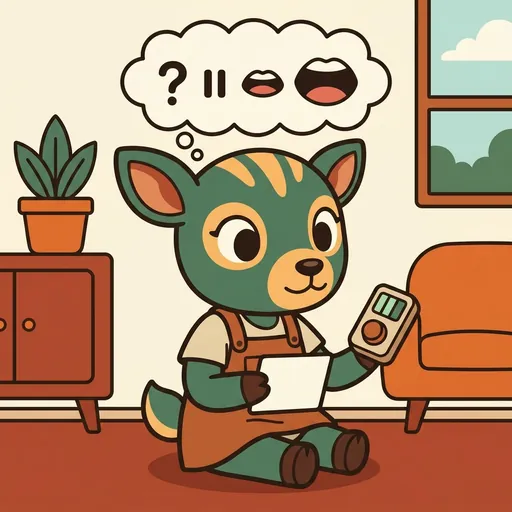
At the edge of the community garden, a deer-tween named Listen crouched beside Mrs. Higgins’s tomato plants and asked one small question — then said nothing at all.
“Tell me about the last time carrying things in the garden gave you trouble,” Listen said. She held a little card and a stub of pencil, and she waited.
“Oh, it’s not really a problem,” Mrs. Higgins said, wiping her hands. “I manage just fine.”
Listen didn’t push. She didn’t fill the gap. She just kept her pencil ready and let the quiet stretch. Five seconds. Ten. A bee drifted past. Mrs. Higgins shifted her weight and glanced down at her muddy boots.
“Well,” she said slowly, “last week I did drop a whole tray. Soil everywhere. Had to start my marigolds all over.” Her mouth pulled down. “It was such a bother.”
There it is, Listen thought, and wrote it down.
A younger fox — Spot — was hopping from foot to foot behind her. “Why didn’t you say something?” he whispered when Mrs. Higgins turned away. “She said it was fine, then you just stood there being weird, and then — the tray thing came out!”
“I wasn’t being weird,” Listen said. “I was waiting.”
“For what?”
“The second answer.” She tapped her card. “The first answer is the one people think you want. The real one comes after — but only if you leave a hole big enough for it to climb out of.” She smiled a little. “Ask. Then wait. The silence is where the truth lives.”
Listen had learned to wait the slow way, when she was small.
Back then she talked too much. She was the kind of deer who finished other animals’ sentences, who guessed what they meant before they got there, who was always so sure. Once, her little brother had come to her scared about his first day at a new school, and she’d jumped in right away — don’t worry, it’ll be great, everyone’s nice, you’ll make tons of friends — and he’d gone quiet and walked off. She’d felt good. She’d been so helpful.
He came home that afternoon with red eyes and wouldn’t tell her why.
It gnawed at her all evening, a tight, wrong feeling under her ribs, the feeling of having missed something important that had been right in front of her. Their grandmother found her sitting on the step.
“You answered him before he finished asking,” Grandmother said. Not unkind. Just true.
“I was trying to help.”
“I know. But you told him the ending before he’d found out his own middle.” Grandmother sat down slowly. “Next time, ask him one thing. Then close your mouth and count to ten. It’ll feel like forever. Do it anyway.” She looked out over the darkening yard. “The most important things people say come out sideways, in the pause after you’d normally interrupt. If you talk over that pause, you bury the answer. And you never even know you buried it.”
The next morning Listen asked her brother one question and then, with her whole body itching to jump in, she waited. Counted. It was agony. And on the count of nine he said the real thing — that a big kid had laughed at his backpack — and she finally understood what she’d been stepping on all those years. The itch to fix it faster than anyone could feel it.
She walked to VentureQuest at twelve, because a place that helped animals build things people actually wanted ought to know how to find out what people wanted.
The old mentor met her at the workshop and didn’t ask her to pitch anything. She asked one question. “How do you know what to build?”
Listen didn’t answer with a plan. She pulled out her card, walked over to a frog carrying a stack of pots, and asked what the hardest part of his morning had been. The frog said, “Nothing, really.” Listen waited. The workshop went quiet around them. The frog set down his pots, thought, and said, “Well — I keep making three trips because I don’t trust myself to carry it all at once.”
Listen wrote it down and looked up. “I don’t know what to build yet,” she said. “But I know how to find out. You ask. Then you wait. Then you ask ten more, and around the eighth one, the same true thing starts showing up in different mouths.” She shrugged. “That pattern is the thing to build. Not my guess. Theirs.”
“You belong here,” the mentor said.
Listen’s corner of the workshop was always the quietest, which was strange for a place where so much got figured out.
One afternoon Build burst in, already sketching. He’d heard about Mrs. Higgins’s spilled tray and drawn a beautiful wheeled cart. “It’s perfect,” he said, beaming. “A rolling tray! Problem solved!”
Listen didn’t tell him he was wrong. She spread her notes on the bench. “Look at these two,” she said, pointing. “These gardeners don’t use trays at all. Because of the drops.”
Build’s pencil slowed. “They don’t? Then how do they carry the seedlings?”
“Pockets. Little buckets.” Listen tilted her head. “So — is the problem really how to carry a tray?”
Build stared at his drawing. ”…No. It’s how to move seedlings without one.”
“Right.” She said it gently, the way you’d hand something back that someone had dropped. “Your idea wasn’t bad. It just answered the first story. When I waited past the first story, a different problem climbed out.” She slid the notes toward him. “Nobody in these ten talks asked for a cart. Two of them told us carts are the thing they’re avoiding. That’s not a small detail. That’s the whole shape of it — but only if you’re quiet long enough to hear it.”
Build was quiet himself now. He turned to a fresh page. “So what do I sketch instead?”
“I don’t know yet,” Listen said, and grinned. “That’s the fun part. Two more conversations and we might.”
Later, when the workshop had emptied out, Build came back with one more question. He was slower now, thoughtful.
“When someone says everything’s fine,” he said, “and you can’t see the real thing yet… how do you know it’s in there to wait for?”
Listen thought about the step, and her brother’s red eyes, and the count to nine.
“You feel it,” she said. “That’s the honest answer. There’s this little tug when someone’s answer is too smooth, too quick — like a door that shut before you saw what was behind it. That tug isn’t nothing. It’s the true thing, still in there, deciding whether it’s safe to come out.” She set her pencil down. “So you don’t grab. You don’t fill the quiet with your own idea. You just leave the door open a beat longer than feels comfortable, and you let them decide to walk through.”
Build nodded slowly.
Listen looked at her stack of cards, all those waited-for answers, and felt the thing she always felt at the end of a good day of listening — not clever, not right, just close to people. Warm and a little bit humbled. Like she’d been let in.
The VentureQuest ensemble
Listen is part of VentureQuest's distributed-narrative cast. Each character embodies a different curricular primitive; together they teach the full subject.
-

Spot
Opportunity recognition — noticing problems worth solving for real people
-

Build
Lean experimentation — rough first drafts, fast iteration, failure-as-learning
-

Pitch
Pitch craft — plain-language story, inviting people in, never pressuring
-

Weigh
Ethical decision-making — sitting with tradeoffs, holding stakeholder views