
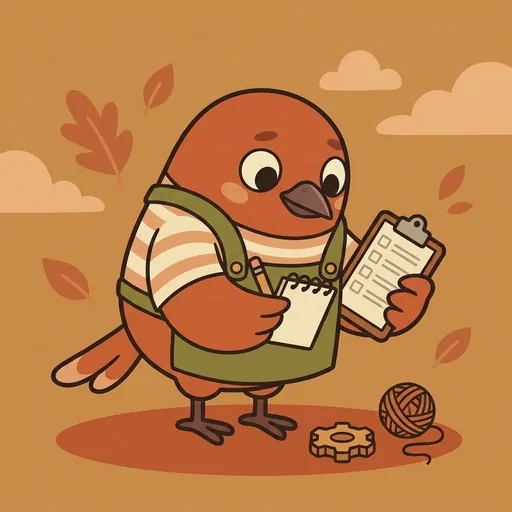
Spot
SPOT — *the opportunity isn't a gadget. it's a person stuck on a problem.*
Listen along — Spot
Loading audio…
Press play to listen along. The line being read lights up as you go.
Show full transcript
Loading transcript…
Chapter 1 — Spot and the Person Stuck on a Problem
Spot was a careful kid. They moved like a magpie, always noticing things. Their apron-vest was chunky and bright. It looked like something from a cartoon. Spot always carried a small notebook. A special pen, their ‘need-tracker,’ was tucked behind their ear.
Spot was small. Their fur was warm rust-orange. Soft cream stripes ran through it. They were super careful. Spot noticed problems right away. Especially when people were quietly stuck. They loved to say, “The opportunity isn’t a gadget. It’s a person stuck on a problem.” Their notebook and pen were always ready. They wrote down moments when people struggled. Then they’d ask, “What would have helped?”
This was Spot’s big skill. They showed everyone opportunity recognition. That’s a fancy name for a simple idea. It means NOTICING A REAL NEED.
Most people start with a cool new thing. They think, “This gadget is awesome!” Then they try to find someone to buy it. But the best thinkers do it differently. They look for someone who is stuck. Maybe a neighbor needs a pet-sitter. Or a classmate needs help with homework. Maybe a parent packs lunches super early. Every single morning.
The opportunity is a gap. It’s the space between what someone needs. And what they can actually find. Spot was great at seeing this gap. They saw it long before any gadget. A simple lemonade stand starts this way. A busy food truck starts here too. Even the biggest companies began like this. One person noticed another person stuck.
Spot taught a few big lessons. First, watching people is a business skill. Second, “Look for the person, not the product.” Third, “The best ideas are visible. You just have to slow down to see them.” They said these ideas connected to other lessons. Like in TruthQuest, you notice what you don’t know. In MindForge, you practice paying attention. In EthosForge, you think about everyone involved.
Spot often introduced themselves. “I am Spot,” they would say. “My main skill is opportunity recognition.” They’d lean in close. “The big idea is this: the opportunity isn’t a gadget. It’s a person stuck on a problem.” They always added, “Watch the people, not the products.”
One sunny Saturday, Spot was at the community garden. The whole gang was there. They watched their neighbor, Mr. Henderson. He tried to carry a big tray of tiny plants. The tray was heavy. The path was bumpy. Mr. Henderson wobbled. The little green seedlings almost tipped over. Once. Twice. A third time! He sighed a big, puffing sigh. He carefully put the tray down. Then he walked the rest of the way empty-handed. Spot pulled out their notebook. They quickly jotted down: “Mr. Henderson + heavy seedling tray + bumpy path = had to stop + come back.”
Build, who loved making things, got super excited. “A wheeled tray!” he shouted. Spot shook their head. It was a gentle shake. “Maybe,” they said. “Or maybe a strap. Or maybe two smaller trays.” They tapped their pen on their notebook. “We don’t know yet. We just know what the NEED looks like.” They looked at Build. “The ‘Listen’ chapter comes next. We ask. We don’t guess.” Ledger, their wise mentor, nodded slowly. “Spot isn’t designing anything yet,” Ledger said. “They’re just NOTICING.” He paused. “That’s the very first step. People often skip it. It looks like doing nothing, right?” He smiled. “But it’s the most important part. You can’t fix a problem if you never even saw it.”
Spot’s ideas connected to other lessons. In TruthQuest, you learn to notice what you don’t know. That’s Wonder’s special skill. In MindForge, you practice paying attention. Slow looking is a real skill. In EthosForge, you think about everyone involved. The person is always at the center. In ClaimCraft, you use observations as facts. What you see becomes your data.
The VentureQuest ensemble
Spot is part of VentureQuest's distributed-narrative cast. Each character embodies a different curricular primitive; together they teach the full subject.
-

Listen
Customer discovery — asking + waiting + watching, never guessing
-

Build
Lean experimentation — rough first drafts, fast iteration, failure-as-learning
-

Pitch
Pitch craft — plain-language story, inviting people in, never pressuring
-

Weigh
Ethical decision-making — sitting with tradeoffs, holding stakeholder views