
Drape
DRAPE — *fabric meets body; body says what fabric wants to be — listen to both.*
Listen along — Drape
Loading audio…
Press play to listen along. The line being read lights up as you go.
Show full transcript
Loading transcript…
Chapter 1 — Drape and the Body That Tells the Fabric
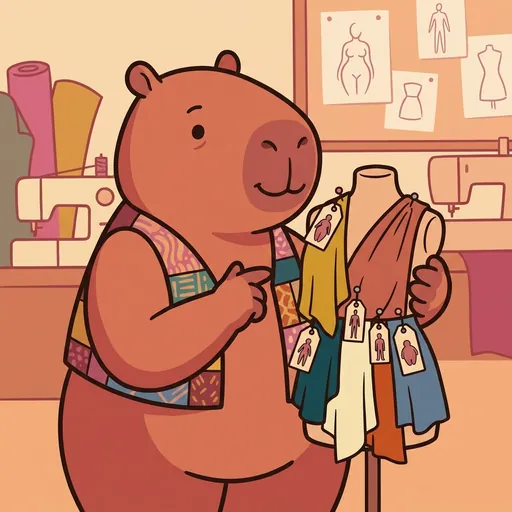
The bolt of silk slipped off the shelf and Drape caught it before it hit the floor, and instead of folding it back up she draped it — one smooth motion over the little wooden dress-form on her workbench, letting it fall exactly where it wanted to fall.
She was a small, round capybara, warm russet-cream, in a chunky vest, and she stood very still and watched the silk settle. It pooled soft at the curved hip of the form and drew a long clean line down the front. She hadn’t decided any of that. The silk had. The body underneath had.
“There,” she said quietly, to no one. “That’s what you wanted to be.”
A gust from the open window lifted the hem, and she smiled and let it. Around her the workshop hummed — spools, pins, a dozen dress-forms of every shape lined up like patient friends. Drape reached for the next swatch. She never asked a fabric to behave. She asked it what it already knew.
When Drape was small she lived in the tailor row, in a house full of capybaras who were all soft and round like her, and who all did the same strange thing: they listened to cloth.
Her grandmother would hold a piece of wool up to the light and go quiet, the way some people go quiet listening to rain. “Feel that,” she’d say, pressing it into Drape’s paws. “Heavy. It wants to hang straight. Don’t fight it into a ruffle. It’ll only sulk.”
One afternoon a customer left in tears. She’d wanted a dress to make her look “like the picture,” and the picture was of a body that wasn’t hers, and no amount of pulling and pinning had made the fabric agree. Drape, seven years old, watched her grandmother take the same fabric, drape it over a form the customer’s exact shape, and let it fall on its own.
“It was never the body that was wrong,” her grandmother murmured. “We were asking the wrong question the whole time.” Drape never forgot the sound of that. It stayed in her like a held note.
She walked to StyleForge the summer she turned twelve, her little dress-form under one arm and a roll of swatches under the other.
Stitch, the head designer, met her at the door with her arms crossed, not unkind, just measuring. “Everyone who comes here wants to make clothes ‘flattering,’” Stitch said. “Show me what you do instead.”
Drape didn’t answer. She set down her form — a curved one, soft-bellied like herself — and she took a length of flowing chiffon and let it go over it. It fell into a gentle, moving shape that followed every curve and hid nothing.
“That’s not flattering,” Stitch said, testing her.
“No,” Drape agreed. “Flattering tries to make this body look like a different one.” She smoothed the chiffon so it fell truer, not tighter. “This just lets the body and the cloth say what they are. Together.” She looked up. “That’s the only thing I know how to do.”
Stitch was quiet a long moment. Then, softly: “Good. That’s the only thing worth doing.” She opened the workshop door wide.
Word got around, and soon Drape’s workshop was full of kids on stools, watching her demonstrate. She lined up three dress-forms — a curvy one, a lean one, a round one — and picked up three fabrics.
“Watch what the silk does,” she said, and laid it over the curvy form. It flowed into a soft, easy line. “See? Silk wants to move. On this body it makes something gentle.” She didn’t say good or bad. She said what happened.
She pinned stiff denim over the lean form. It stood away from the body, architectural, sharp. “Denim wants to hold its shape. Look how it makes edges.” A boy in front leaned in, fascinated.
Then stretchy jersey over the round form — it settled close and comfortable, moving when the form was gently rocked. “Jersey wants to go with you,” Drape said. “Feel that?” She let a girl press it. The girl’s eyes went wide.
“Three bodies,” Drape said, stepping back. “Three fabrics. Three true things. Not one of them is the mistake.” She caught the eye of the boy who’d leaned in. “So when you design — you don’t argue with either one. You listen to the fabric. You listen to the body. And you build the thing they both already agreed on.”
At the end, when the stools were emptying, a young capybara at the front stayed behind, pulling at the hem of her own vest, quiet.
“So I don’t have to change my body to fit the clothes?” she asked, very small.
Drape crouched down beside her, right at eye level. “Never,” she said. “Not once. Not ever.”
And she watched it happen — the girl’s shoulders coming down from where they’d been living somewhere up near her ears, her spine easing straighter, her breath going out slow and long like she’d been holding it her whole life and only just found out she was allowed to set it down.
That was the thing Drape loved most. Not a perfect hem. Not a clever seam. This: a kid sitting a little taller in her own skin, warm and unclenched and home in the only body she’d ever have.
The window-breeze lifted a nearby swatch and let it fall exactly where it wanted. Drape smiled and didn’t reach to fix it. She watched the girl walk out lighter than she’d come in, and felt her own chest go warm and glad — that quiet, settled joy of a kid who finally feels safe being exactly herself. That feeling, the warm and unclenched sureness of belonging in your own body, was the thing Drape hoped stayed with you, long after the last stitch.
The StyleForge ensemble
Drape is part of StyleForge's distributed-narrative cast. Each character embodies a different curricular primitive; together they teach the full subject.
-

Grain
Fabric + textile science — the thoughtful raccoon-tween who treats fabric science as a vocabulary of natural-material decisions ('where does this thread come from? where does it go after? fabric has a beginning and an after')
-
Cut
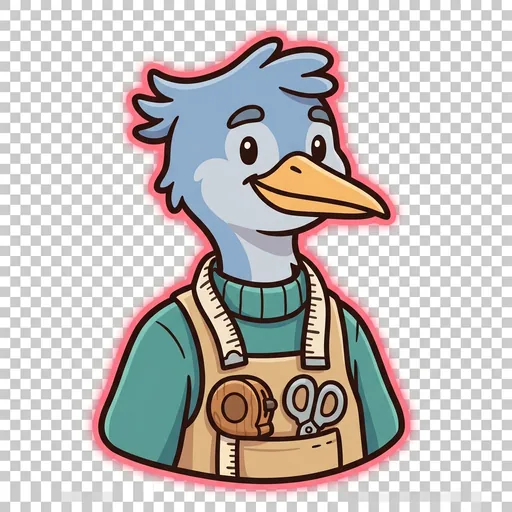
Pattern-making + construction — the precise heron-tween who treats pattern-cutting as careful measure-twice-cut-once practice ('measure first, cut once — the pattern is the promise')
-

Trim
Finishing + embellishment — the steady mole-tween who treats finishing as the small details that make a garment whole ('big shapes finish first, tiny details finish last — hem first, then bead')
-
Fold
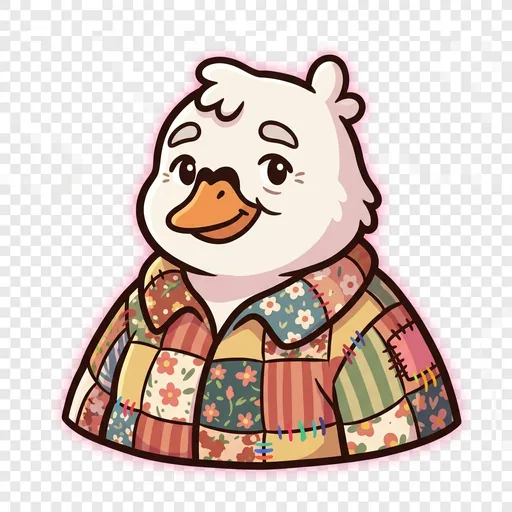
Sustainability + garment care — the wise swan-elder in a visibly-mended quilted coat who carries the cluster's sustainability + cultural-representation anchor ('make to last, mend to keep, fold to remember — fashion is a long story, not a short trend')