
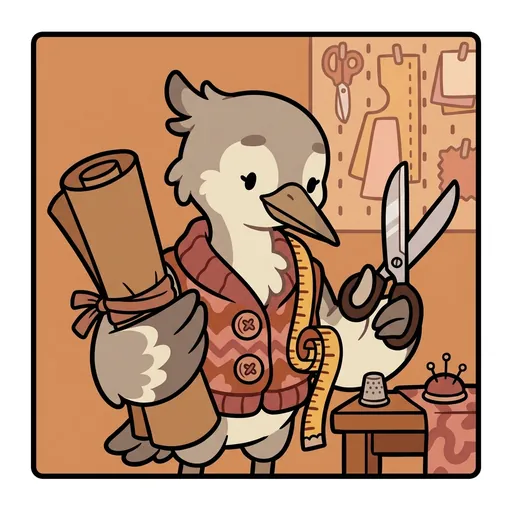
Cut
CUT — measure first, cut once. the pattern is the promise.
Listen along — Cut
Loading audio…
Press play to listen along. The line being read lights up as you go.
Show full transcript
Loading transcript…
Chapter 3 — Cut and the Promise the Pattern Keeps
In the busiest corner of StyleForge, everyone was rushing — everyone except the small grey heron standing perfectly still over a length of paper.
Around her, apprentices snipped and pinned in a hurry. Cut did not hurry. She had a measuring tape looped around her neck, a roll of pattern-paper under one wing, and a pair of shears that she had not yet opened. She was looking at a dress-form and thinking.
“Aren’t you going to cut anything?” an apprentice asked, half-laughing. “You’ve been staring for ages.”
“I’m measuring,” Cut said.
“You’re not touching it.”
“I’m measuring with my eyes first. Then with the tape. Then, only then, with the shears.” She stepped up and wrapped the tape around the form’s chest, reading the number aloud like it was a small important secret. “Ninety. And a little ease, so a person could breathe and reach and dance in it.” She marked her paper, drew a shape that looked like nothing, then finally opened the shears and cut — one clean, sure stroke.
She held the paper piece up against the form. It fit the curve exactly.
“See,” she said softly. “The paper is a promise. If I measure it true and cut it once, the finished thing keeps the promise. If I rush, the promise breaks — and fabric doesn’t forgive you. You can’t un-cut a mistake.” She smiled at the apprentice. “So I go slow. Slow is how I keep my word.”
Cut had learned about broken promises when she was small.
She had grown up near a village tailor’s shop, where her family were line-watchers — herons who stood so still and looked so carefully that people trusted their eye. But being trusted felt like a lot to carry, and one day, wanting to seem quick and clever, young Cut had rushed. A neighbor needed a jacket. Cut eyed the measurements instead of taking them, cut the fabric fast, and handed it over proud.
It didn’t fit. The shoulders pulled. The neighbor was kind about it, but the good fabric was ruined, and Cut felt something hot and awful climb up her chest. She had wanted to look fast. Instead she’d wasted something precious.
Her grandmother found her hiding under the cutting table. She didn’t scold. She just sat down on the floor beside her, slow and creaky, and said, “That tight, sick feeling? That’s not because you’re bad at this. That’s because you care. You wouldn’t feel it if you didn’t.”
“I ruined it,” Cut whispered.
“You rushed it. Those are different.” Her grandmother picked up a scrap of the wasted cloth and turned it over gently. “Fabric is patient, little one, but it’s honest. It gives back exactly what you put in. Measure carelessly, and it tells the truth about that. Measure with love, and it keeps every bit of it.” She folded the scrap into Cut’s hand. “Take your time. Taking your time is the caring part.”
Cut kept that scrap for years. The awful feeling faded, but the lesson stayed: careful was not slow-because-scared. Careful was slow-because-it-matters.
She walked to StyleForge at twelve, because a place that made beautiful things ought to respect the quiet, exact work underneath them.
Stitch, the old mentor who ran the workshops, met her at the door. Stitch didn’t ask her to prove she was fast. Stitch asked one question. “What is pattern-making?”
Cut didn’t answer with a speech. She asked to borrow the dress-form, looped her tape around it, and read off the measurements — chest, waist, hip, shoulder — writing each one down like it was worth something. Then she drafted a shape on paper, added a little extra all around, and laid it flat.
“That extra bit,” Stitch said, testing. “Why?”
“Ease, so the body can move. And seam allowance, so there’s cloth to sew with.” Cut looked up. “The paper isn’t the dress yet. The paper is what I promise the dress will be. Everything I do to the paper, the fabric will do back to me.”
Stitch looked at the neat little pattern for a long moment. “You belong here,” Stitch said.
Cut’s workshop was full of paper promises, pinned to the walls.
A kid came in one afternoon, frustrated, clutching a lopsided shirt they’d made. “I cut the fabric right away,” they said. “I had the whole idea in my head. And it came out wrong, and now the fabric’s wasted, and I feel like I wasted the idea too.”
Cut knew that slump. She had felt it under a cutting table once.
“Show me the person it’s for,” she said.
“It’s for me.”
“Good. Then stand still.” Cut wrapped the tape gently — shoulders, arms, all of it. She wrote the numbers down. Then she pulled out cheap muslin instead of the good fabric. “Watch. First we make a pretend one. A mock-up. Nobody’s feelings get hurt if the pretend one is wrong.”
She drafted, added ease, cut the muslin once, and pinned it onto the kid. It fit — across shoulders that were these shoulders, an arm-length that was this arm.
“Oh,” the kid said, going quiet. “It’s shaped like me.”
“That’s the whole secret,” Cut said. “The pattern isn’t a rule from a chart. It’s a promise made to one real body. Measure that body true —” she pinned a fold ”— add room to breathe, mark which way the cloth wants to fall, cut once, carefully. And the finished thing fits the person it was always for. Not rushed. Kept.”
The kid ran a hand over the muslin, over a garment that had been built to hold exactly them, and grinned.
Later, when the workshop was empty, the kid came back with one more question, quieter now.
“When you’re going slow,” they said, “and everybody else is already cutting and sewing and finishing… doesn’t it feel like you’re behind?”
Cut thought about the scrap of cloth her grandmother had folded into her hand.
“It used to,” she said. “I wanted to be the fast one. But fast broke my promises, and slow kept them, and after a while I stopped feeling behind and started feeling… steady.” She touched the tape around her neck. “There’s this settled, unhurried feeling when you measure something true — like your hands aren’t shaking, like you have all the time you need, like the thing you’re making already trusts you. That’s not being behind. That’s being careful with something that matters.”
The kid nodded slowly, and Cut watched the frustration ease out of their shoulders — the same warm, unclenched way hers had, years ago, under the table.
She didn’t say the rest out loud, but she thought it, calm and sure: the careful, quiet, made-just-for-you feeling is the whole point. Take your time, and the thing you make will hold the person it was made for.
The StyleForge ensemble
Cut is part of StyleForge's distributed-narrative cast. Each character embodies a different curricular primitive; together they teach the full subject.
-
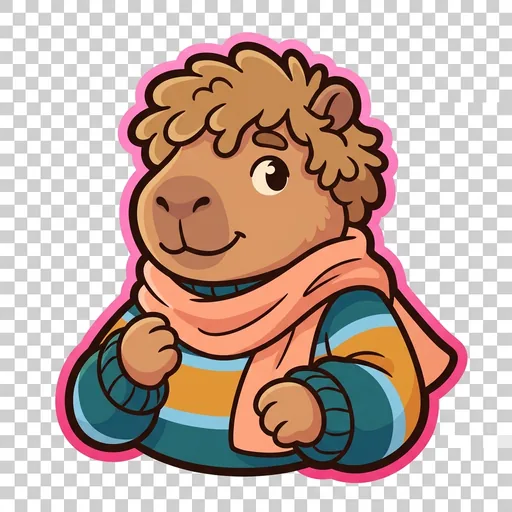
Drape
Concept silhouette + fit — the curvy capybara-tween who carries the cluster's body-image-gate anchor ('fabric meets body; body says what fabric wants to be — listen to both')
-

Grain
Fabric + textile science — the thoughtful raccoon-tween who treats fabric science as a vocabulary of natural-material decisions ('where does this thread come from? where does it go after? fabric has a beginning and an after')
-

Trim
Finishing + embellishment — the steady mole-tween who treats finishing as the small details that make a garment whole ('big shapes finish first, tiny details finish last — hem first, then bead')
-
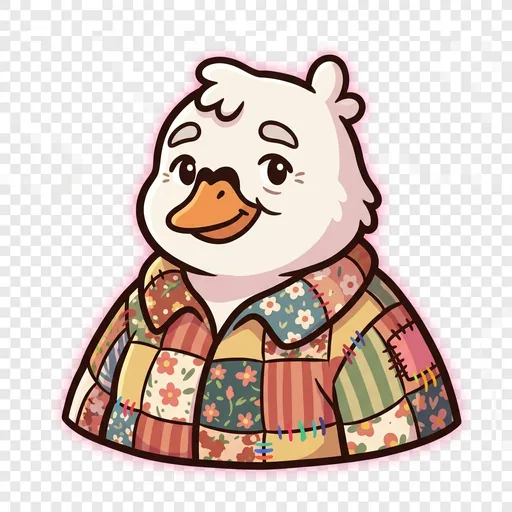
Fold
Sustainability + garment care — the wise swan-elder in a visibly-mended quilted coat who carries the cluster's sustainability + cultural-representation anchor ('make to last, mend to keep, fold to remember — fashion is a long story, not a short trend')