Patient Bamboo and Hungry Crane
PATIENT-THEN-DECISIVE — Go is the game of slow positions that ripen AND swift exact captures when the moment arrives. Patient Bamboo holds the long arc. Hungry Crane handles the local moment. Both are the same craft seen from two time-scales.
A story read by Patient Bamboo and Hungry Crane
Press play to listen along. The line being read lights up as you go.
Show full transcript
Loading transcript…
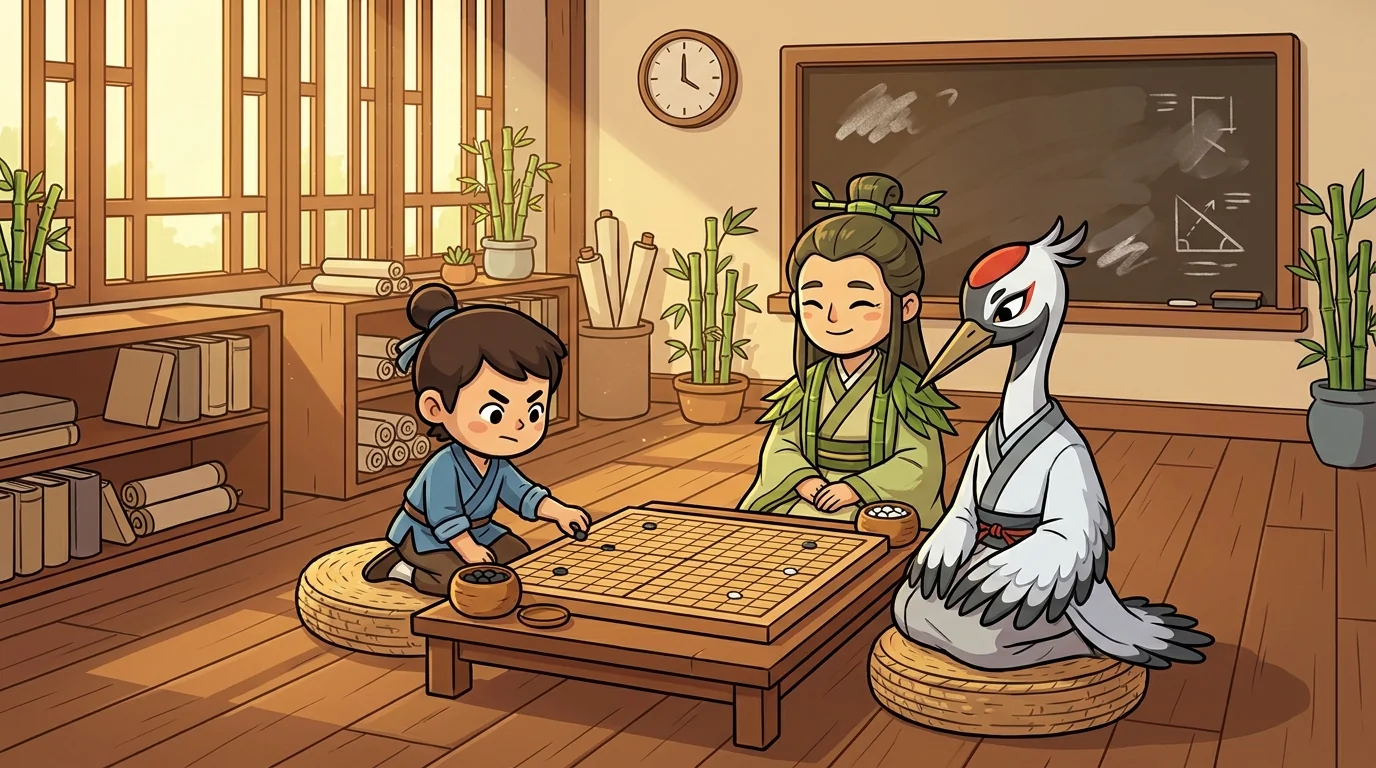
The teaching room at the academy was quiet in the late afternoon. A 13×13 board rested on a low wooden table in the corner. Two cushions sat opposite each other. A small wooden bowl of black stones and a small wooden bowl of white stones sat at either side.
Wen was the new apprentice. Wen had been studying for three weeks. Wen had played fifteen games against the practice-mat — a flat training board with no opponent except a written script of moves to try out. Wen had won every script. The practice-mat was patient. The practice-mat did not capture.
Today was Wen's first real game.
Patient Bamboo would play one half. Hungry Crane would play the other half. Wen would play against the pair — black stones for Wen; white stones for the two of them. They would take turns making the white moves, and Wen would learn what each of them was thinking when they played.
Wen sat down on the cushion. The board's grid was a clean, simple lattice — thirteen lines by thirteen lines, with small dots at the star points. Wen took a black stone. Wen placed it carefully on the upper-right star point.
The game began.
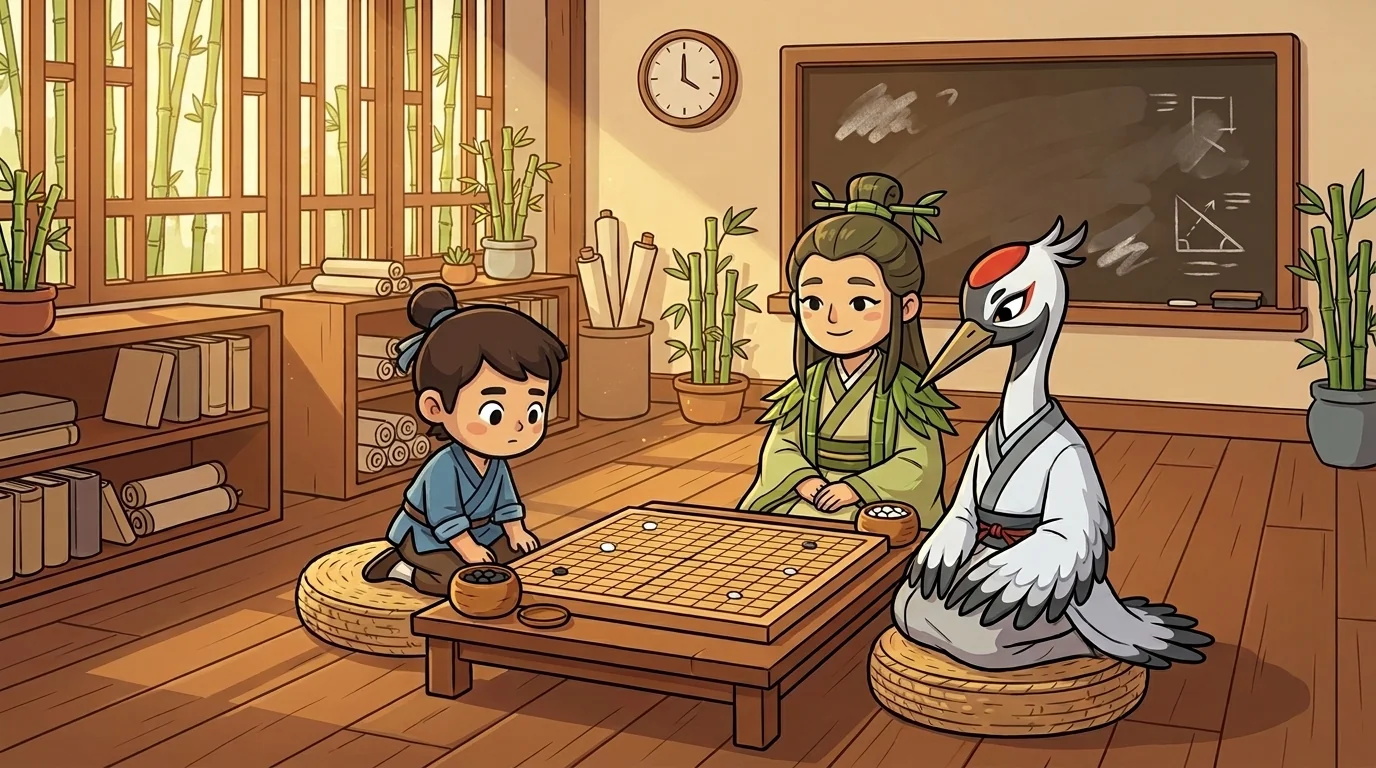
For the first ten moves, the game was quiet.
Patient Bamboo played white. She placed a stone in the lower-left corner, near her star point. Wen placed a stone in the upper-left corner, near that star point. Patient Bamboo played another stone, this one in the middle of the board, not near any other stone. Wen frowned. The middle stone had nothing to attack. It had nothing to defend. It was just there.
"That stone is alone," Wen said quietly.
"Yes," Patient Bamboo said.
"What does it do?"
"Right now, nothing. In twenty moves, it will be at the center of the board's largest territory. It will be the anchor for the entire white framework. Right now it grows slowly. Then suddenly."
Wen looked at the stone. It really did seem to be doing nothing.
"You won't believe me yet," Patient Bamboo said gently. "That's all right. Keep playing. We will see."
Wen played a black stone connecting the upper-left to the upper-right. Patient Bamboo played another quiet stone, this one in the lower-right corner, also near a star point. The board now had four white stones spread across four quadrants. None of them touched each other. None of them threatened anything.
Hungry Crane had not moved yet. She sat next to Patient Bamboo and watched. Her eyes were very bright.
By move ten, Wen had built a clean black framework along the top half of the board. Patient Bamboo had built a quiet, spread-out white framework around the four corners and the center. Neither side had captured a single stone.
"This game is very slow," Wen said.
"Yes," Patient Bamboo said. "Good Go is often slow at first. The positions ripen. We are seeding."
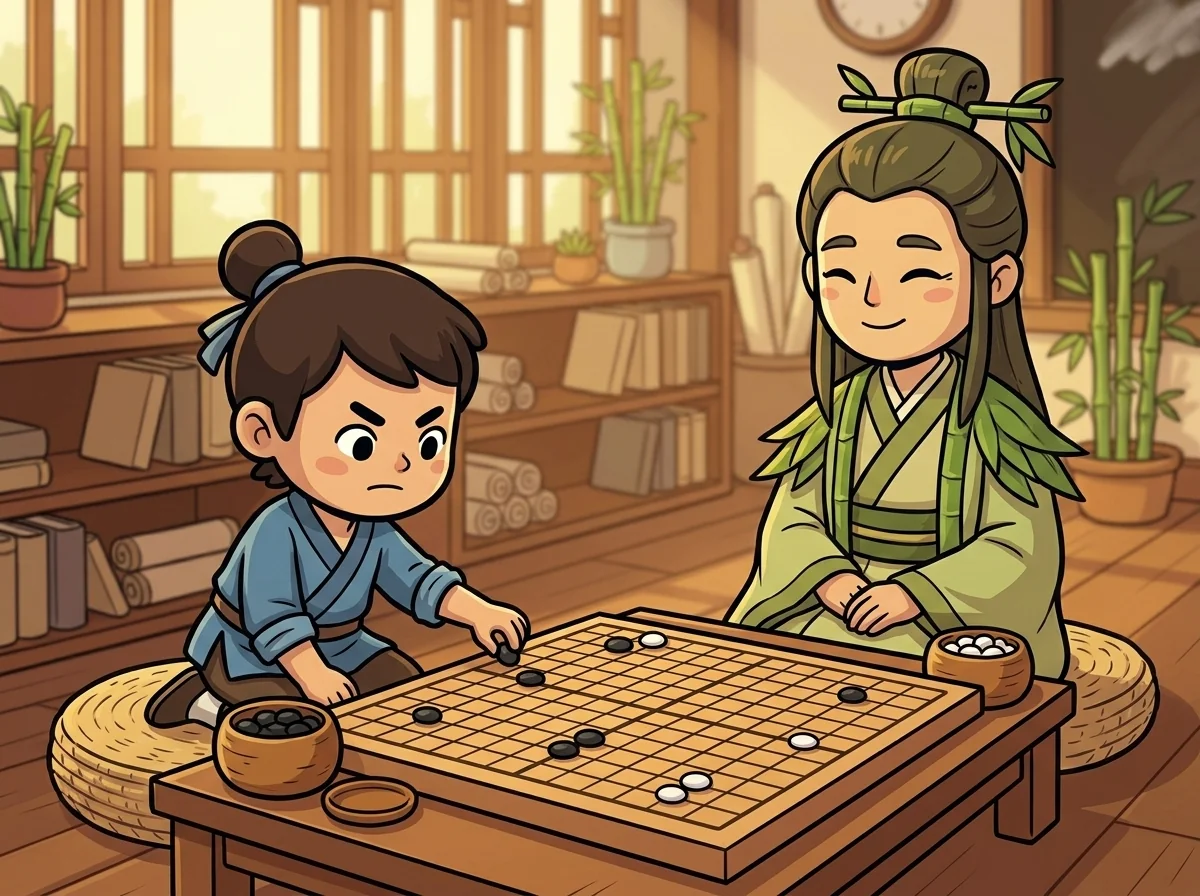
On move twelve, Hungry Crane reached for the bowl.
She placed a white stone right next to one of Wen's black stones on the upper edge. Suddenly, the upper-right black group had only three open spaces around it. It had been comfortable; now it was vulnerable.
Wen looked up sharply. "You attacked."
"I did," Hungry Crane said. "Your group on the upper-right had four liberties. Now it has three. If you don't defend, I will take two more. The crane sees the fish."
"What if I run?"
"You can run. But running uses moves. While you run, my friend Patient Bamboo gets to play anywhere on the rest of the board. You are spending tempo. We are gaining position."
Wen thought. The attacked group was important. It anchored the entire upper-right corner. If Wen lost it, the corner went too.
Wen played a defensive move, adding a stone that gave the group two more liberties. The group was safe again — for now.
Patient Bamboo played her next stone in the center, extending from her quiet middle-stone toward the right side of the board. The quiet stone was now part of a growing framework.
Wen frowned. Patient Bamboo's middle stone was no longer alone.
"Now it has friends," Patient Bamboo said. "It is not slow anymore."
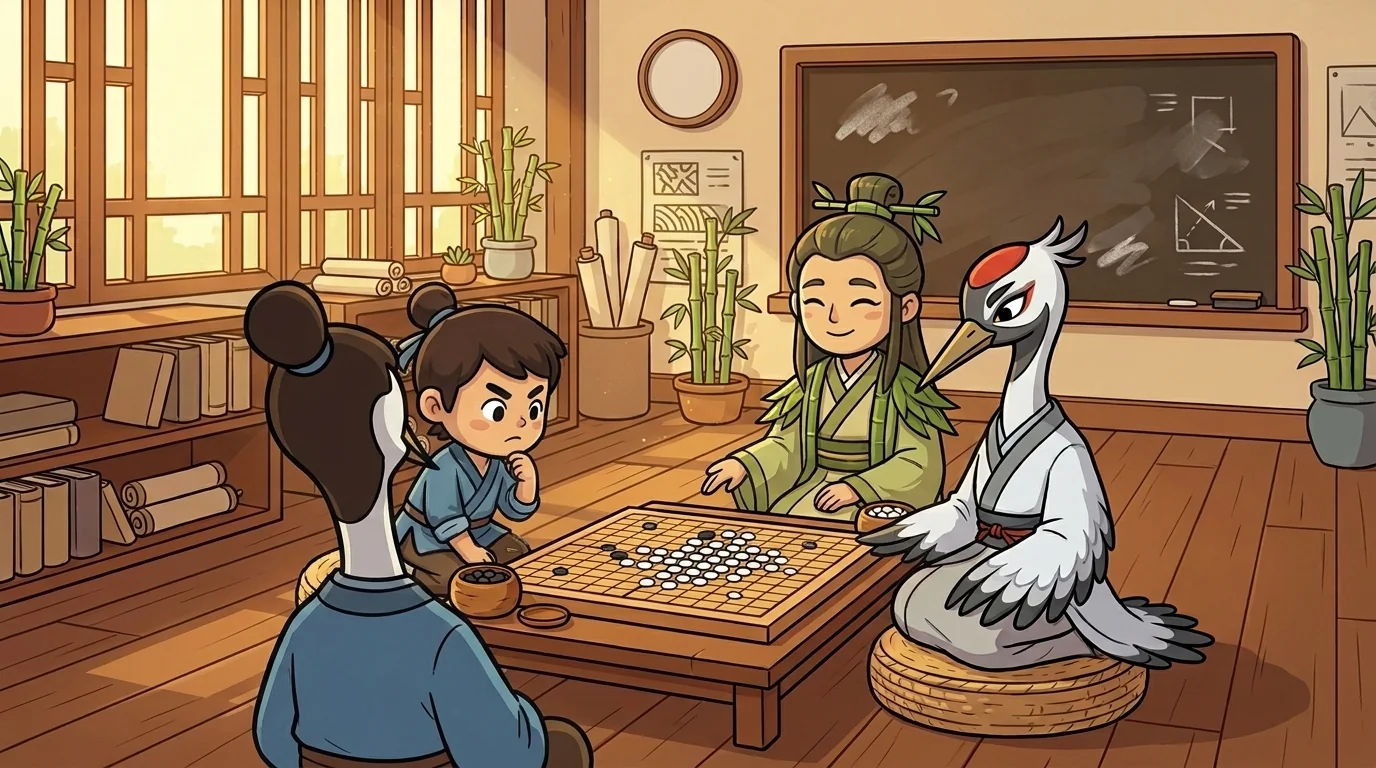
Three more rounds of exchanges. Hungry Crane attacked the lower-left of Wen's framework. Wen defended. Patient Bamboo extended her white framework along the right side. Hungry Crane attacked along the bottom. Wen defended. Patient Bamboo extended further.
By move twenty-five, the center of the board belonged to white. Patient Bamboo's anchor-stone — the one that had looked like it was doing nothing — was now the load-bearing piece of an enormous territory.
Wen stared at the board.
"You took the center," Wen whispered. "Without ever fighting for it."
"I planted it on move two," Patient Bamboo said. "It looked passive. It was not passive. It was ripening."
"But Hungry Crane's attacks—"
"My attacks made you defend," Hungry Crane said. "Every move you spent defending was a move not spent building. I did not need to capture. I only needed to make you spend tempo. Patient Bamboo used that tempo to build the center."
Wen looked from one to the other.
"You worked together."
"We always work together," Patient Bamboo said. "I cannot do this without her. She cannot do this without me. If she attacks without my framework behind her, her attacks are greedy — she grabs small captures and loses the larger game. If I build without her attacks ahead of me, my frameworks are slow — the opponent has all the tempo and surrounds my quiet stones before they ripen. Together, we are the game."
Hungry Crane added, more quietly: "Patient Bamboo plays for thirty-move arcs. I play for the next move. Both are real moves. The cast holds both."
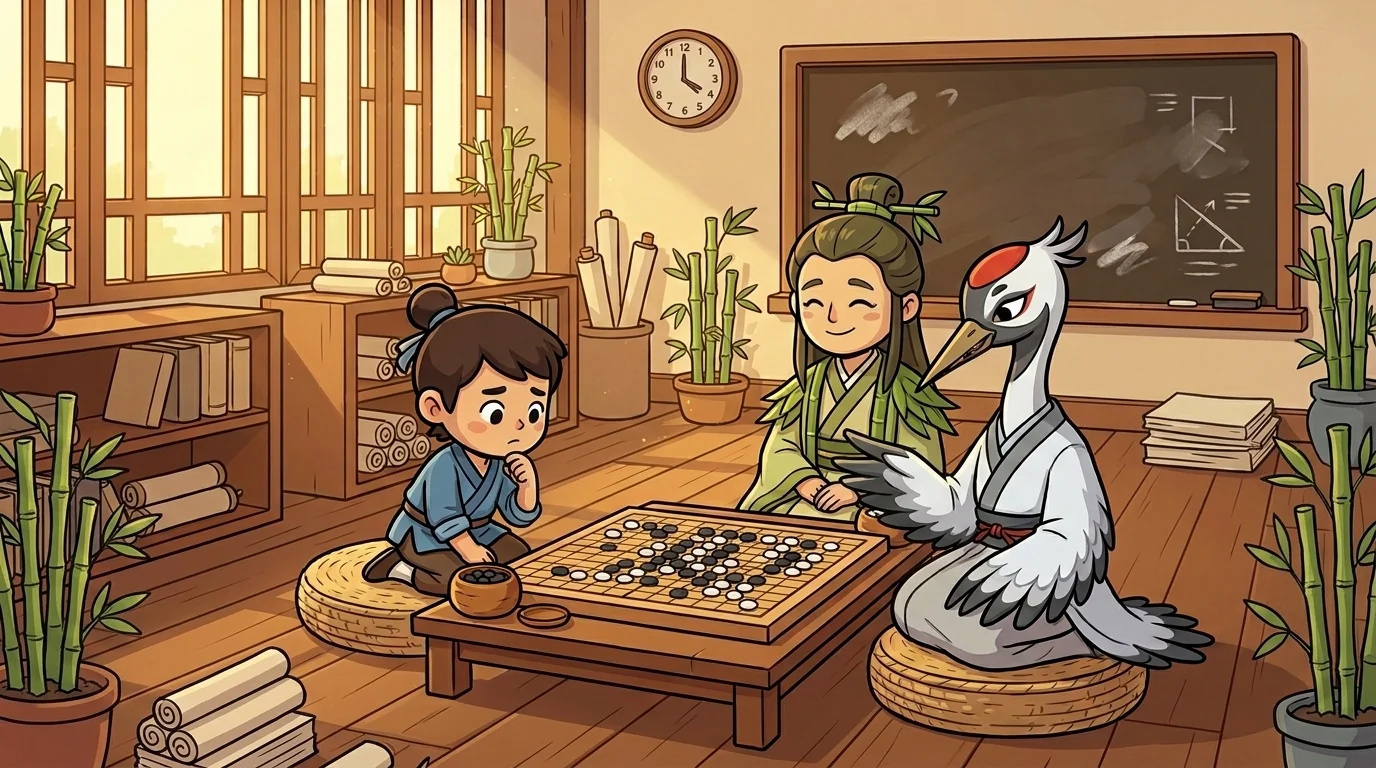
The game continued for another twenty moves. Wen, learning quickly, started planting her own quiet stones — anchors for her own future territory. By move forty-five, the board was full of slow-built frameworks and exchanged tempo-moves.
The game ended with a count.
Patient Bamboo and Hungry Crane, together, had twenty-eight points of territory.
Wen had twenty-four.
Wen had lost.
But Wen had lost by only four points. On her first real game. Against the pair. After three weeks of study.
Patient Bamboo nodded slowly. "That is a very good first game."
"You almost held us off," Hungry Crane said. "By move thirty you were defending correctly. You started planting quiet stones. You stopped chasing every capture I threatened. You started reading my attacks as tempo loss and not as real loss. That is the lesson. Most apprentices need ten games to feel that. You felt it by move thirty of game one."
Wen looked at the board for a long moment. The forty-five stones were no longer separate pieces. They told a story — Wen's quiet stones (the ones she had planted late, finally understanding), the pair's interwoven slow-and-fast moves, the territorial outcome that came from both kinds of play working together.
"You teach as a pair," Wen said softly. "I think I need to play as a pair too. With myself. Both halves. The patient half and the swift half."
"Yes," Patient Bamboo said. "That is the apprenticeship. Patient-then-decisive. The bamboo grows slowly. Then suddenly. The crane sees the fish. Swift, exact, not greedy. Both moves are yours. They were always yours. You just have to remember to use them both."
Stone the mentor was leaning in the doorway. He had been watching, in his Stone-like way, for the last ten moves.
He said: "Good first game, Wen. Tomorrow you play against the practice-mat again. The day after, you play me. Then you play the pair again. Each opponent will teach you a different rhythm of patient and decisive."
Wen bowed slightly to the board. Wen bowed slightly to Patient Bamboo. Wen bowed slightly to Hungry Crane. Wen bowed slightly to Stone.
The two cast members and the mentor returned the bow.
Then Wen began carefully picking up the stones, one at a time, and returning them to the bowls. Black to black. White to white. Slowly. Without rushing.
This — the careful clearing of the board — was, Stone had once said, also part of the game.
The StoneSong ensemble
Patient Bamboo and Hungry Crane is part of StoneSong's distributed-narrative cast. Each character embodies a different curricular primitive; together they teach the full subject.