Hungry Crane
HUNGRY CRANE — the crane sees the fish. swift, exact, not greedy.
A story read by Hungry Crane
Loading audio…
Press play to listen along. The line being read lights up as you go.
Show full transcript
Loading transcript…
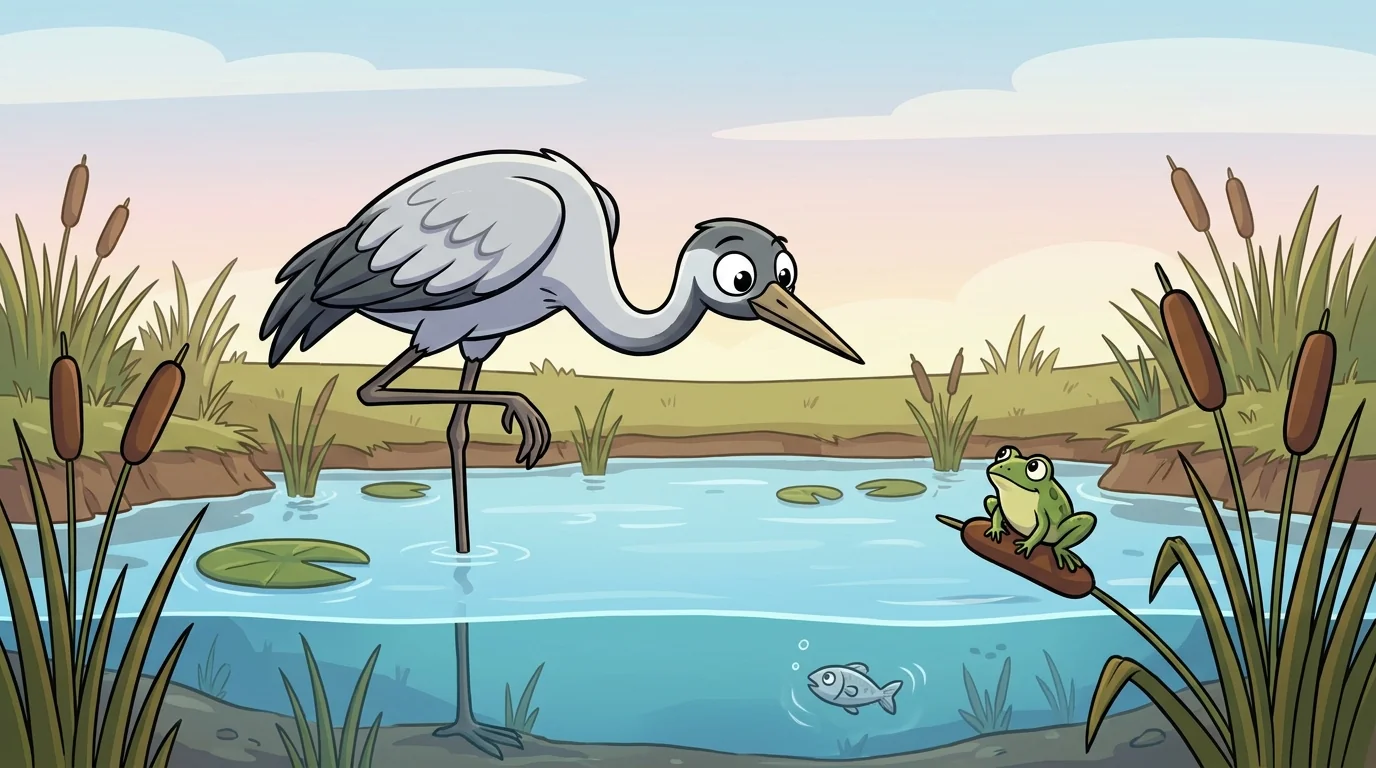
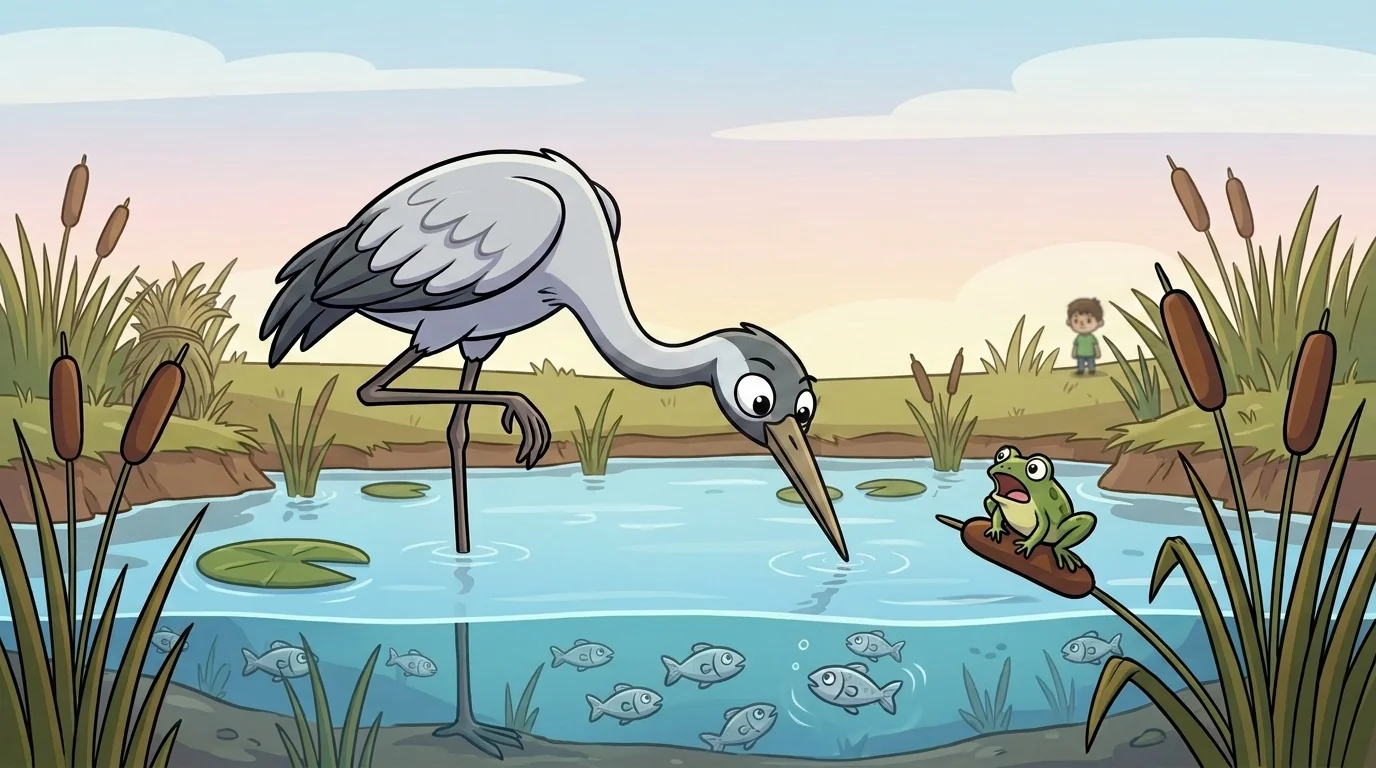
At the edge of a still marsh, a grey-and-white crane-tween stood in the shallow water on one long leg, not moving at all.
A little frog watched her from a reed. "You've been standing there forever," the frog said. "Aren't you hungry?"
"Starving," said Hungry Crane, without turning her head.
"Then why don't you just — go? Grab a fish?"
"Because I can't see one yet." Her eyes stayed locked on the water. "If I stab at nothing, I splash, I miss, and every fish for a mile knows I'm here. I'd spend all my hunger on one bad guess." A silver flicker moved under the surface. Her whole body went quiet — quieter than still. "There," she breathed.
The strike happened almost too fast to see. Beak into water, out again — and a small fish wriggled, caught, then gone. One clean motion. No splash worth mentioning. The marsh didn't even ripple.
The frog blinked. "That was so fast."
"Swift," Hungry Crane agreed, swallowing. "But not before I was exact." She settled back onto one leg. "I saw the fish. I knew where it would be. Then I moved." She glanced sideways at the frog. "Hungry isn't the same as greedy. Hungry waits for the right fish. Greedy grabs at every shadow and goes to bed empty."
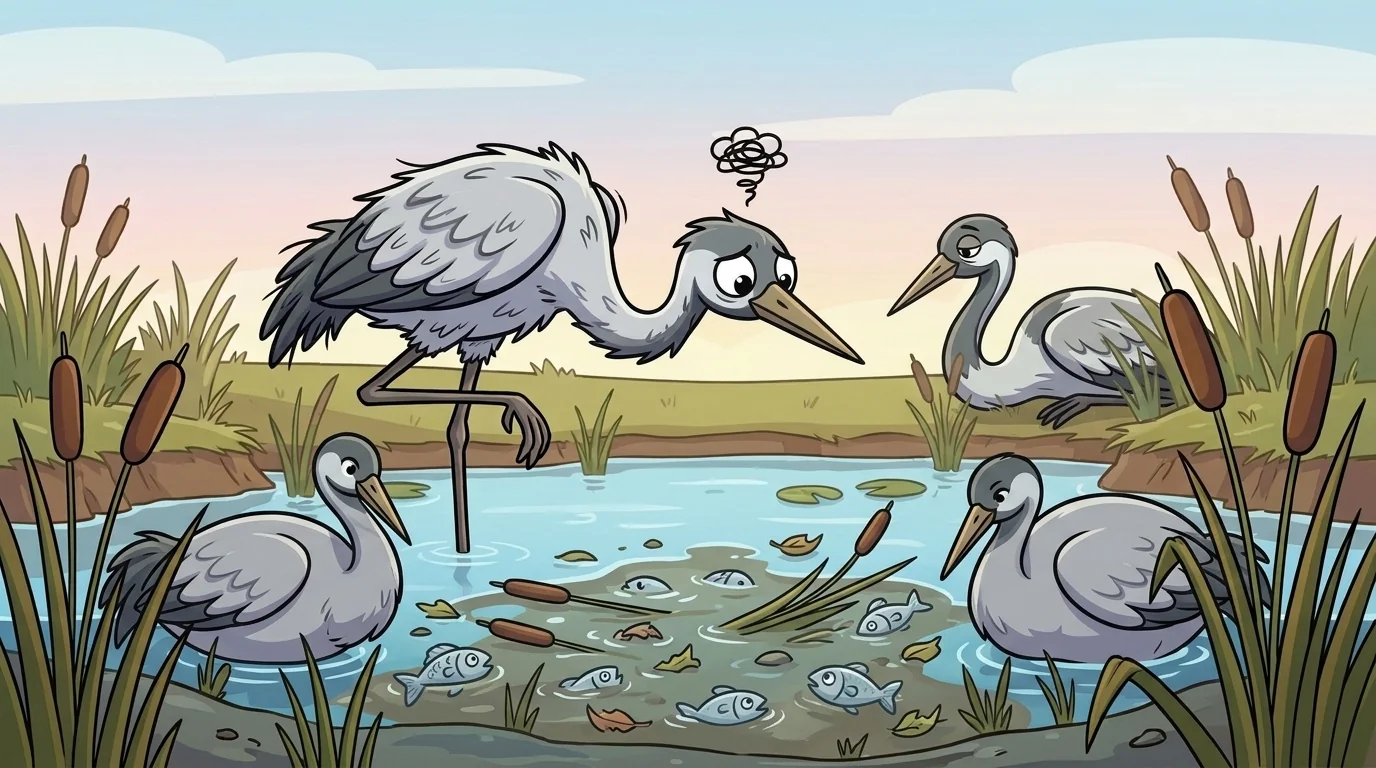
She had learned the difference the hard way, when she was small.
There had been a summer when she was always the last to eat. Her cousins were bigger, faster to lunge, and every time she saw a flash in the water she would fling herself at it — beak first, wings flapping, hungry and desperate. She missed nearly every time. The splashing scared the fish off. By evening her cousins were full and she was hollow and shaking, and she hated the marsh, and she hated being small.
Her aunt, an old crane with a long slow shadow, found her sulking in the reeds.
"You're hunting your hunger," her aunt said, "instead of hunting the fish."
Hungry Crane didn't understand.
"You feel that ache in you, and you leap at anything that might quiet it. But the ache can't tell a fish from a leaf from your own reflection." Her aunt folded down beside her, unhurried. "Try this. Next time, don't move when you feel hungry. Move when you see. Let the ache sit. It won't hurt you. It'll even help you — it keeps your eyes sharp. But the ache doesn't decide. Your eyes decide."
That evening Hungry Crane stood still for a long, long time with the hollow feeling knotted tight under her feathers. And then — one fish, close, certain — she moved. She ate. It was enough. The ache, she realized, hadn't been an enemy. It had just needed something to point it. That was the day being small stopped feeling like a punishment.
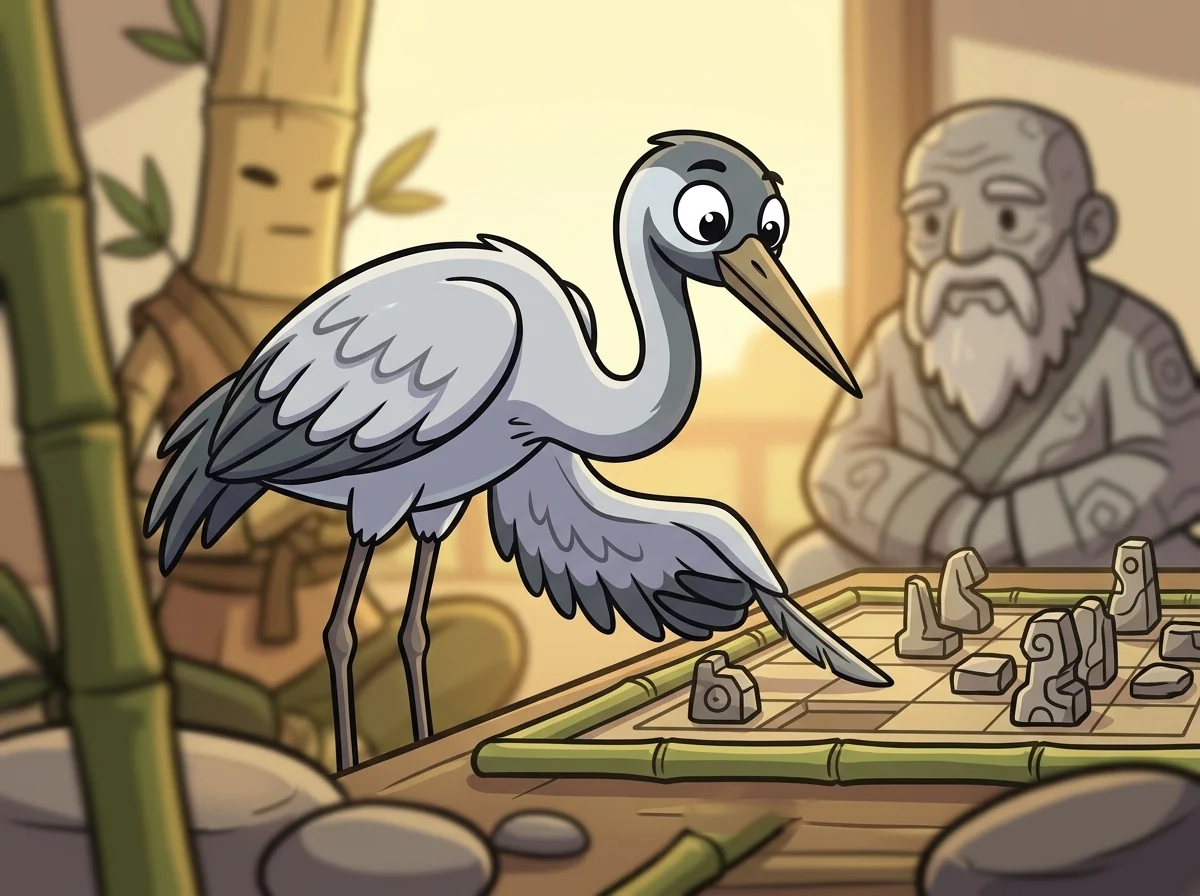
She walked to Stonesong at twelve, because a place that studied a game of patient stones ought to understand a hunger that knew how to wait.
Patient Bamboo met her near the practice boards and said nothing for a while, only watched her watch a half-finished game. Then Stone, the mentor, asked one question. "When should you take?"
Hungry Crane didn't answer with words. She leaned over the board and pointed to a small cluster of the opponent's stones, hemmed in on three sides.
"That group has two open spaces left around it," she said. "Two liberties. If I close one, it has one. If I close the last, it comes off the board." She straightened. "So I could take it. Two moves. But—" she pointed to a wide, empty corner "—while I chase those five little stones, that whole corner goes unclaimed. That's worth far more than what I'd catch." She tucked her wings. "The fish is real. It's just not the right fish."
Stone looked at the board a long moment, then at the crane. "You saw the capture and walked past it."
"I saw it," Hungry Crane said. "That's the part that matters. I always want to know it's there. Then I choose."
"You belong here," Stone said.
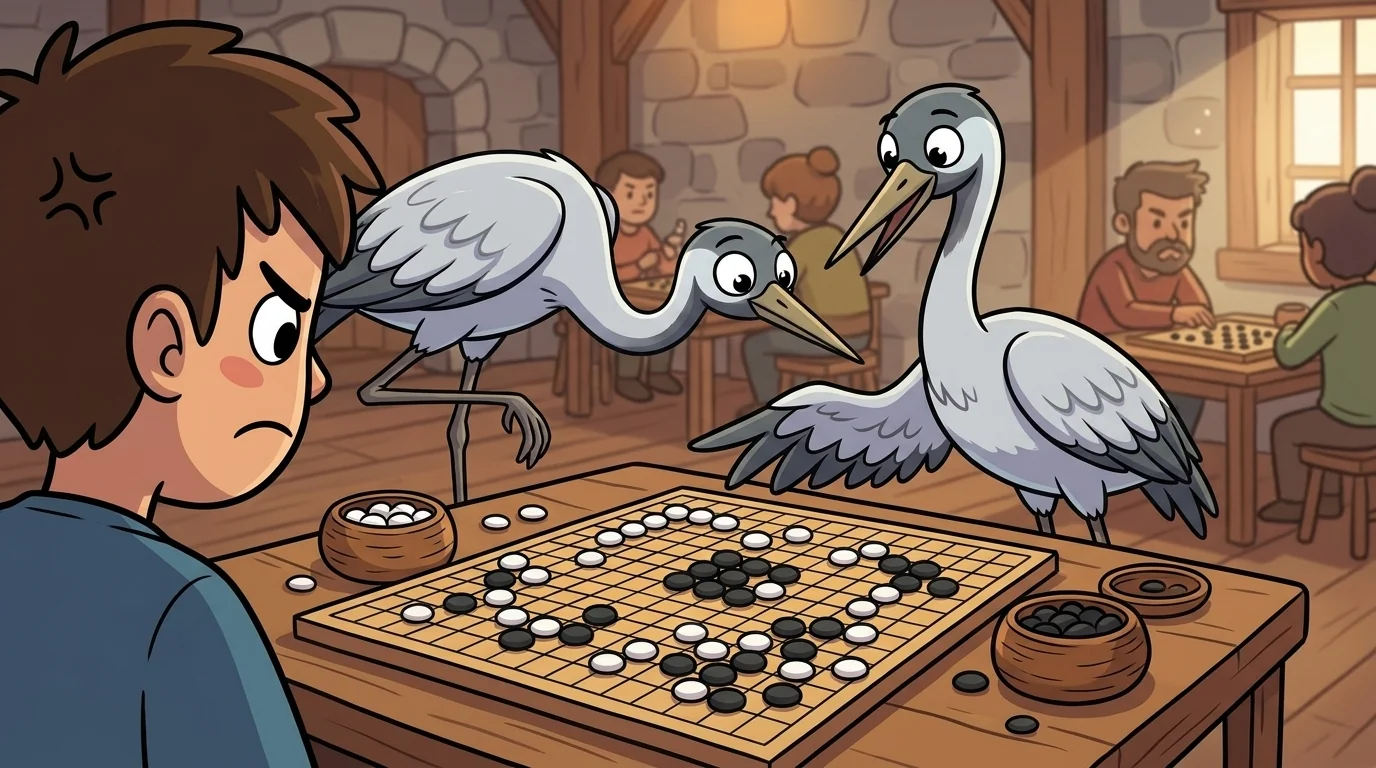
Her corner of Stonesong was always busy with players who grabbed too soon.
A boy came in one afternoon, scowling at a game he'd just lost. "I had them," he said. "I chased a group all the way across the board and captured it — eight stones! And I still lost. How do you capture eight stones and lose?"
Hungry Crane knew that scowl. She'd worn it in the reeds.
"Show me the board," she said. He rebuilt it. She looked. "You captured eight stones here." She touched the spot. "How many moves did it take?"
He counted, frowning. "...Six."
"And while you spent six moves eating those eight stones, what was your opponent doing?"
His scowl faltered. He looked at the rest of the board — the huge, calm territory the other player had quietly built while he was busy hunting. "...Building everywhere else."
"Swift, exact, not greedy," Hungry Crane said gently. "You were swift. You were even exact — you calculated it right, you did capture them. But you were greedy. You wanted the catch more than you wanted the game." She set a single stone down near the group he'd chased. "Watch. I don't capture them. I just threaten. Now they have to spend a move defending, or lose the group. Either they save eight stones and give me a free move somewhere huge — or they let the stones go and I've lost nothing." She looked up. "The threat did the work. I never had to eat the fish at all. Sometimes just being the crane is enough."
The boy stared at the board. "So the capture is..."
"A tool," she said. "Not the point. The point is the whole marsh. The fish only matters if catching it feeds you more than it costs."
Later, when her corner was empty, the boy came back with one more question, quieter now.
"When you're standing there in the water," he said, "hungry, and you can see a fish but you don't go — how do you make yourself wait?"
Hungry Crane thought about the reeds. About the hollow, shaking summer and her aunt's long slow shadow.
"You let the hunger be there," she said. "You don't fight it and you don't obey it. It's just a feeling — that tight, leaning-forward, almost-time feeling, right here." She touched her chest lightly with the tip of one wing. "It's not telling you to jump. It's telling you to look harder. When the looking and the leaning finally agree — when your eyes say now at the same moment your body does — that's when you move. Not before."
The boy nodded slowly, and she watched the frustration go out of his shoulders.
She didn't say the rest out loud, but she felt it, warm and steady under her feathers: the wanting had never been the problem. It was only ever a question of learning to hold it — light, patient, ready — until the right moment leaned back.
The StoneSong ensemble
Hungry Crane is part of StoneSong's distributed-narrative cast. Each character embodies a different curricular primitive; together they teach the full subject.