Master Snail
MASTER SNAIL — the snail leaves a trail. every step considered. nothing wasted.
A story read by Master Snail
Loading audio…
Press play to listen along. The line being read lights up as you go.
Show full transcript
Loading transcript…
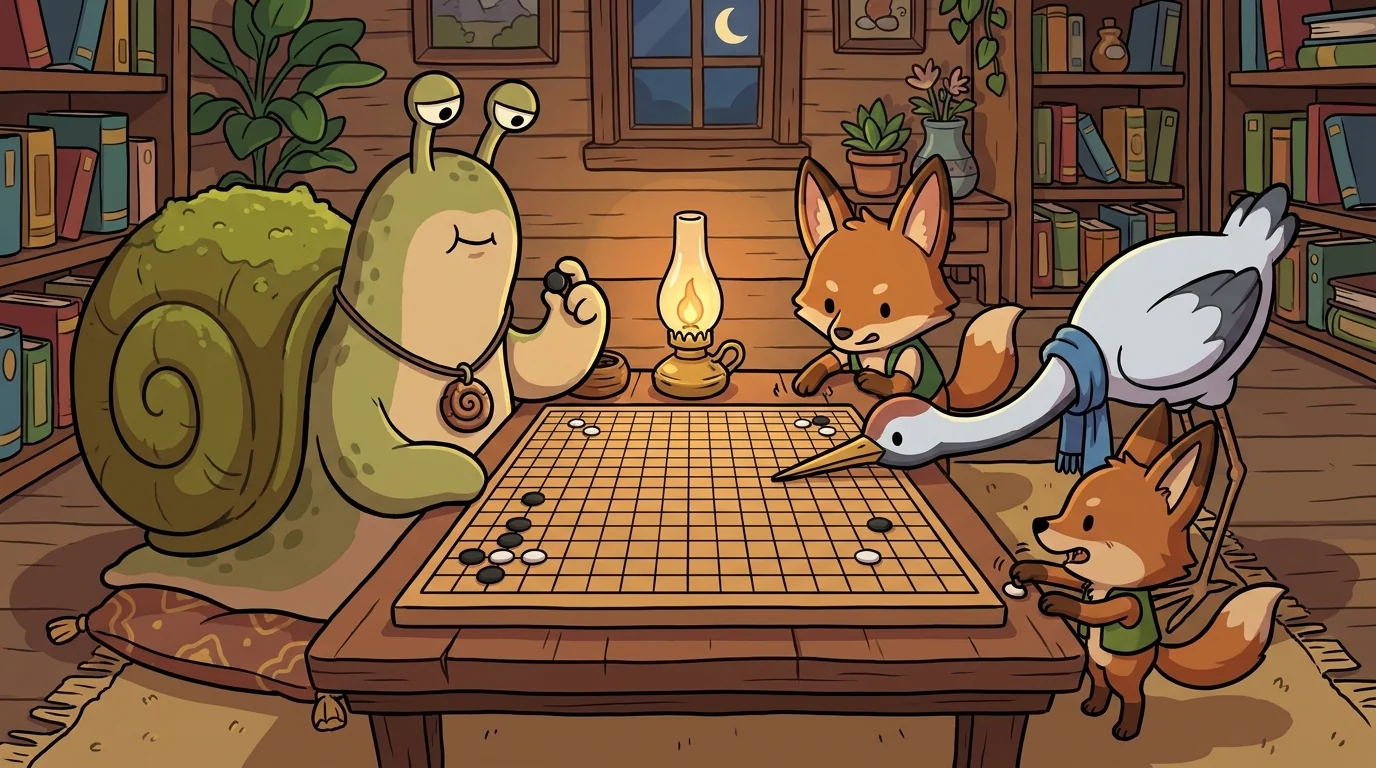
The board was nineteen lines by nineteen lines, and Master Snail had been looking at one empty spot on it for almost a minute.
Around the low wooden table, the others were fidgeting. A young fox kept tapping the edge. A crane leaned so far forward her beak nearly touched the stones. But Master Snail sat still on his cushion, his cool mossy-green shell catching the lamplight, a small spiral charm swaying against his chest. He held a single black stone between two fingers and did not put it down.
"Any day now," the fox muttered.
Master Snail didn't rise to it. He turned the stone slowly, the way you'd turn a key you weren't sure fit yet. "Four questions," he said, not to the fox, to himself. "What am I actually trying to do here? Does this stone help that? If I were sitting where you're sitting — what would you do back? And after all of it, am I better off, or only busier?"
He let the questions settle. The lamp hissed. Then, gently, he set the stone on the line where the left edge of the board opened wide.
"There," he said. "That corner's mine to grow into now. Not loudly. Just — mine."
He gestured at the thin line of dark stones curving up the board's side, each one placed on a different quiet evening. "See the trail? Every one of those I sat with the way I sat with this. None of them were guesses. None of them were just to fill the silence." He smiled, small and slow. "A snail can't take a step back. So a snail learns to be very sure about the step forward."
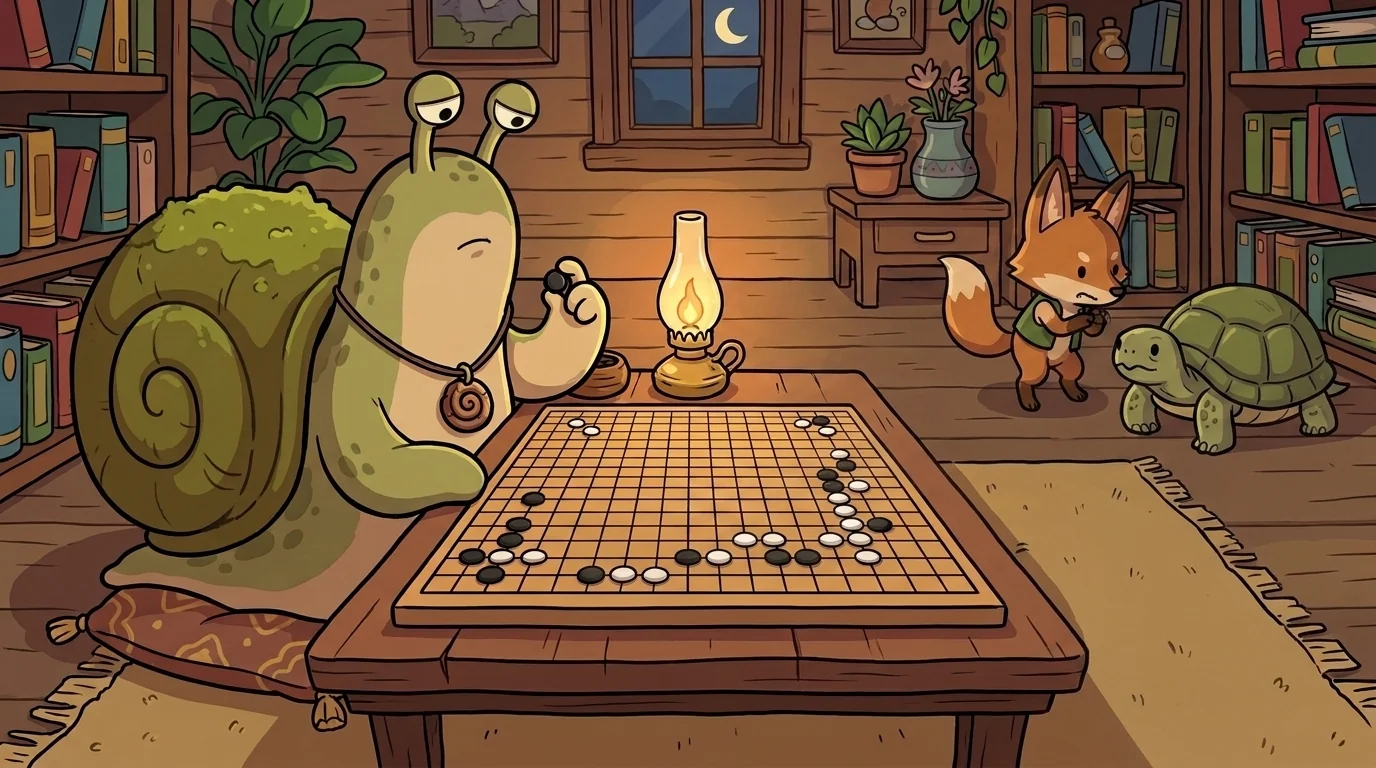
Master Snail had not always been slow on purpose.
When he was small, he'd been the fastest slow thing anyone had seen — which was still slow, but he made up for it by never stopping to think. He'd slide onto a game board and slap stones down as fast as his soft foot allowed, chasing whatever looked exciting: a capture here, a bold reach there. He lost. A lot. And every loss left the same sour taste, like he'd run a whole race in the wrong direction.
One evening after a bad game, he curled into his shell, tight and ashamed, certain the problem was that he simply wasn't clever enough.
An old tortoise who'd been watching lowered herself beside him. She didn't tell him he was clever. She said, "You move like you're being chased. Are you?"
He peeked out. "No."
"Then why hurry?" She tapped the board. "You put a stone here, and before it's even warm you're already three moves away in your head. You never stay with the move you just made. So you never find out what it wanted."
He didn't understand, not right away. But he tried it — one stone, and then a full breath before the next. In that breath, for the first time, he saw the whole board instead of just the shiny corner. He saw what his stone had started, and where it needed to go next to matter.
He didn't win that night. But the sour taste was gone. In its place was something steadier, almost warm: the feeling of having actually been there for his own decisions.
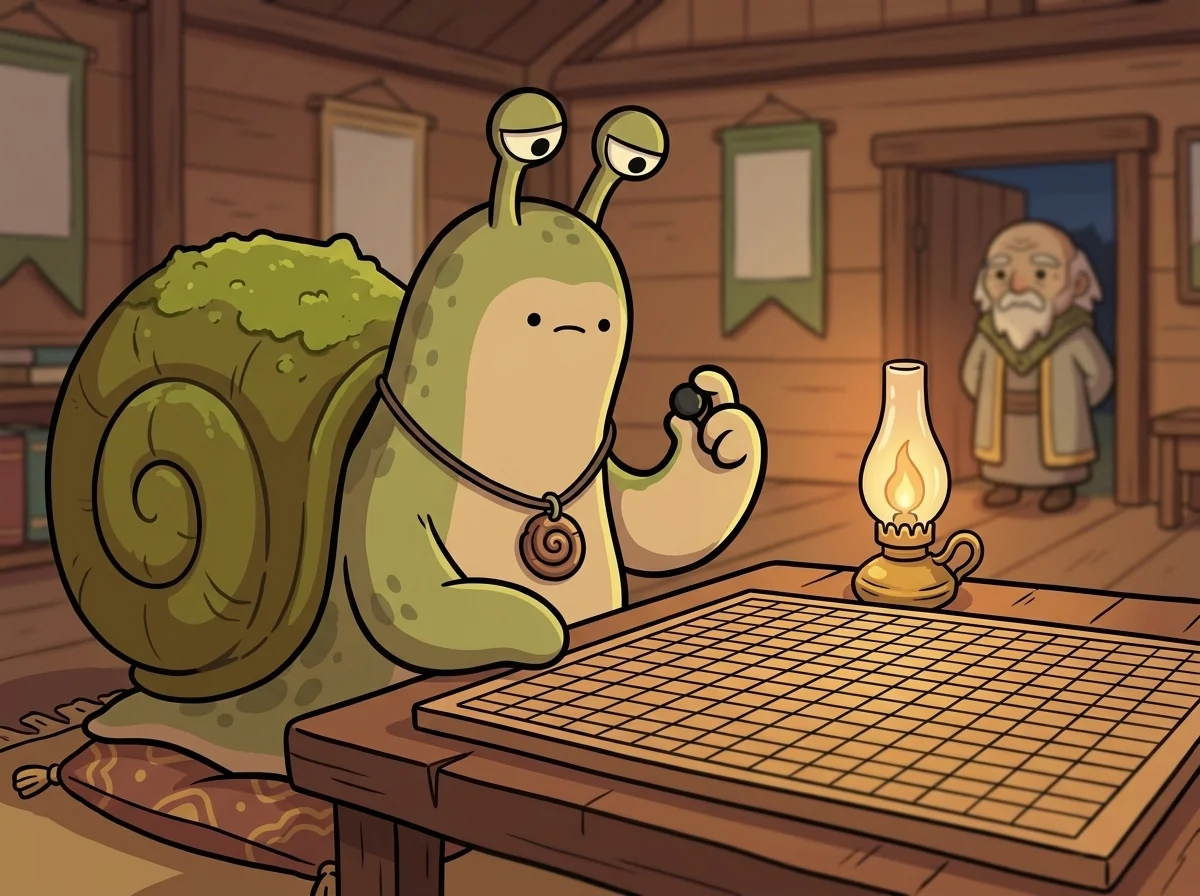
He came to Stonesong when he was older, because a place built around a board of quiet stones ought to understand the kind of player who moves like still water.
The mentor who kept the great hall met him at the door and asked only one thing. "Show me how you play."
Master Snail didn't answer with words. He crossed to the nearest board, chose one stone, and simply held it, looking. He looked so long the mentor thought he'd forgotten the question. Then he placed it — dead in the center of an empty corner — and looked up.
"You took forever over one stone," the mentor said.
"I took as long as the stone needed," Master Snail said. "It's the first move of the whole game. Everything grows from it. Why would I rush the root of the tree?"
The mentor was quiet a moment. Then he nodded. "Slow," he said. "But you were here for it. You'll do." He stepped aside from the door. "Come in."
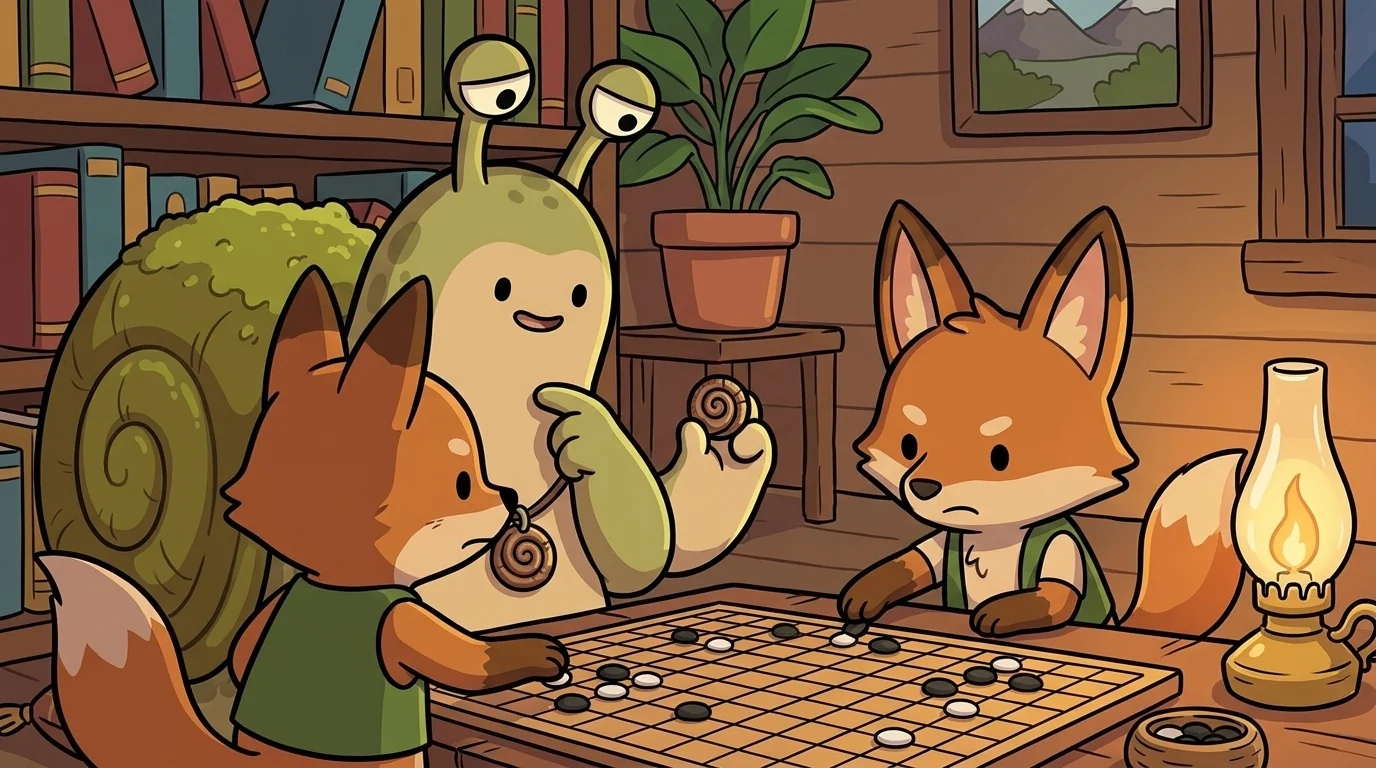
Master Snail's corner of the hall filled up with players who moved too fast — and one afternoon, one of them nearly threw his stones down in frustration.
"I keep losing," the fox-kit said, the same fox, older now, no longer teasing. "I play fast so I don't look scared. But then I look up and my stones are everywhere and none of them are helping each other."
Master Snail knew that scattered feeling. He'd worn it his whole young life.
"Play me a move," he said. "But before you touch a stone, tell me the plan."
The fox hovered a paw over the board, then stopped. "...I don't have one. I just saw a stone I could take."
"That's the whole thing," Master Snail said kindly. "You're answering a question nobody asked. Let's find the real one." He held up his consideration charm like a small coin. "Before the stone touches the board: What are you building? Does this move build it? If it were your turn, what would you do to stop you? And after that — are you stronger, or just tangled in a fight you started?"
The fox breathed out and looked — really looked — for the first time. His paw drifted away from the tempting capture and settled instead on a lonely edge. "If I play here," he said slowly, "my two weak stones become one strong wall. And you'd probably answer over there, but that's fine, because... my left side's already safe."
"Yes," said Master Snail softly. "That's a move that knows what it's for."
The fox placed it. And his shoulders, which had been up near his ears all afternoon, came down.
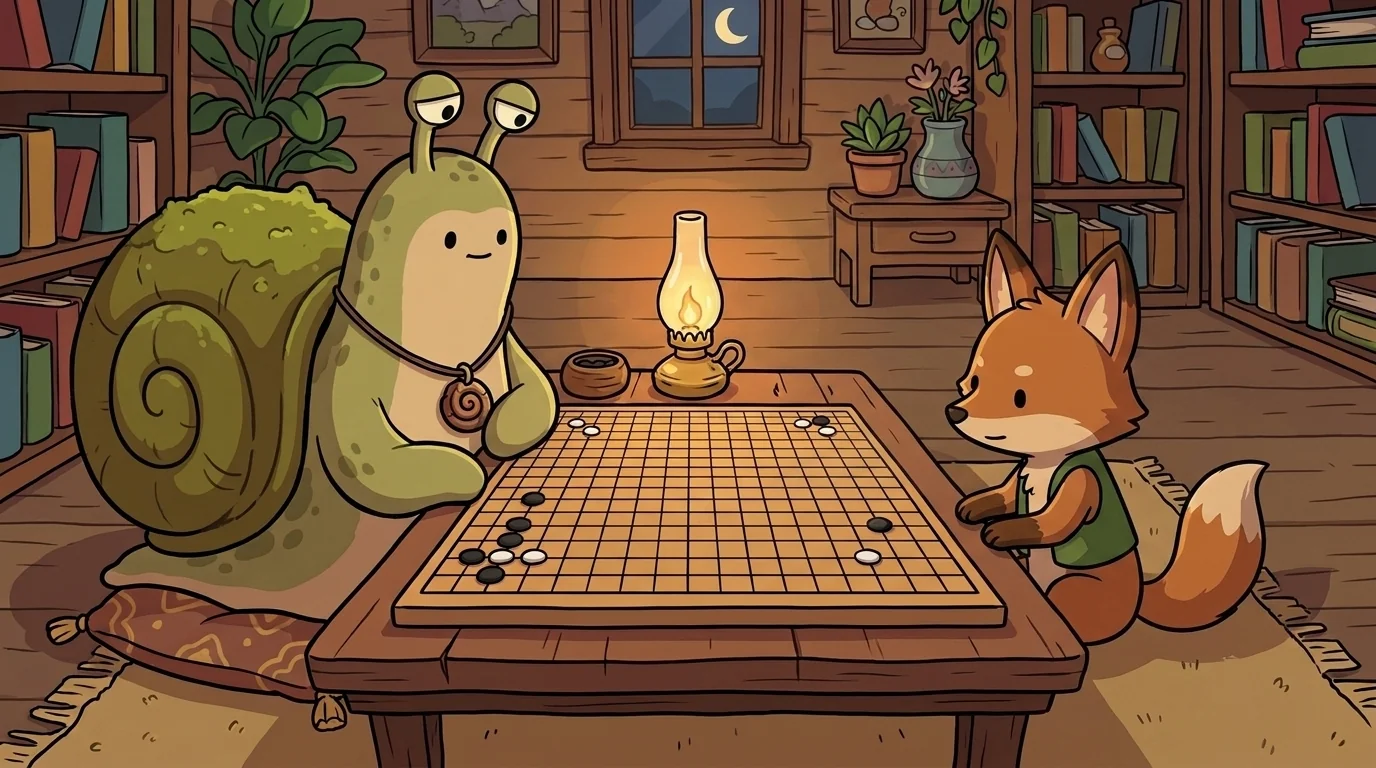
Later, when the hall had emptied and the lamps burned low, the fox came back with a quieter question.
"When you sit there thinking so long," he said, "and everyone's staring — doesn't it feel awful?"
Master Snail considered it, the way he considered everything.
"It used to," he admitted. "It felt like everyone could see me being slow, and slow felt like a thing to be sorry for." He watched the last stone he'd placed, sitting patient in its corner. "But somewhere along the way the staring stopped mattering. Because inside the pause, it isn't rushed and it isn't scared. It's just... clear. Like the surface of a pond when nothing's dropped into it yet. I get to see the whole board, and I get to choose on purpose, and afterward there's nothing to take back." He tucked the charm away. "That clear, unhurried feeling — settled, sure, entirely my own — that's the part worth waiting for."
The fox nodded, and Master Snail watched the last of the boy's hurry drain out of him, leaving something calmer behind — the same quiet that had once, on a bad evening long ago, unclenched his own tight shell.
The StoneSong ensemble
Master Snail is part of StoneSong's distributed-narrative cast. Each character embodies a different curricular primitive; together they teach the full subject.