
Hunch and Anchor
evidence-based inference — a good reader guesses what the text implies (the leap) AND points to the specific words that support the guess (the anchor). An inference you can't tie to evidence is just a guess; evidence you never reason from is just a quote. The reading move is the two done together.
Press play to listen along. The line being read lights up as you go.
Show full transcript
Loading transcript…
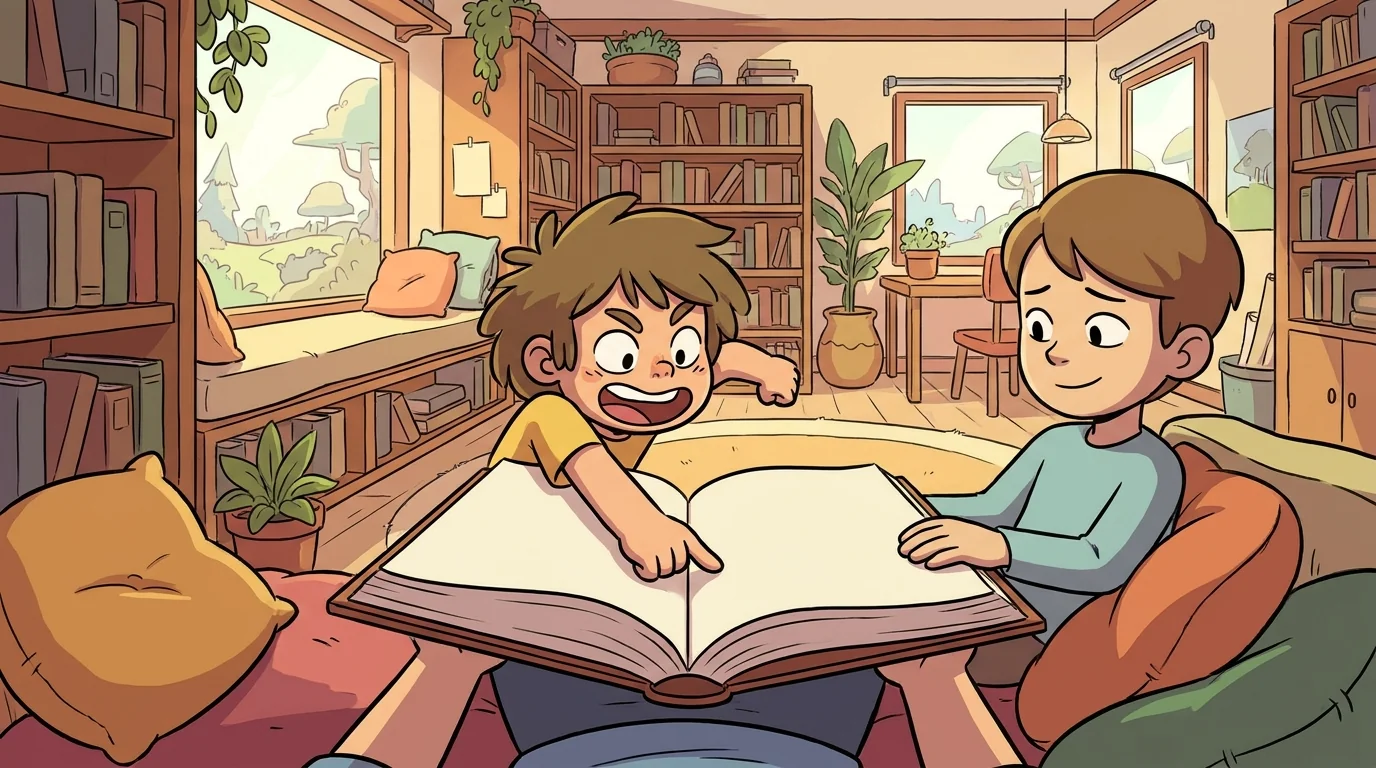
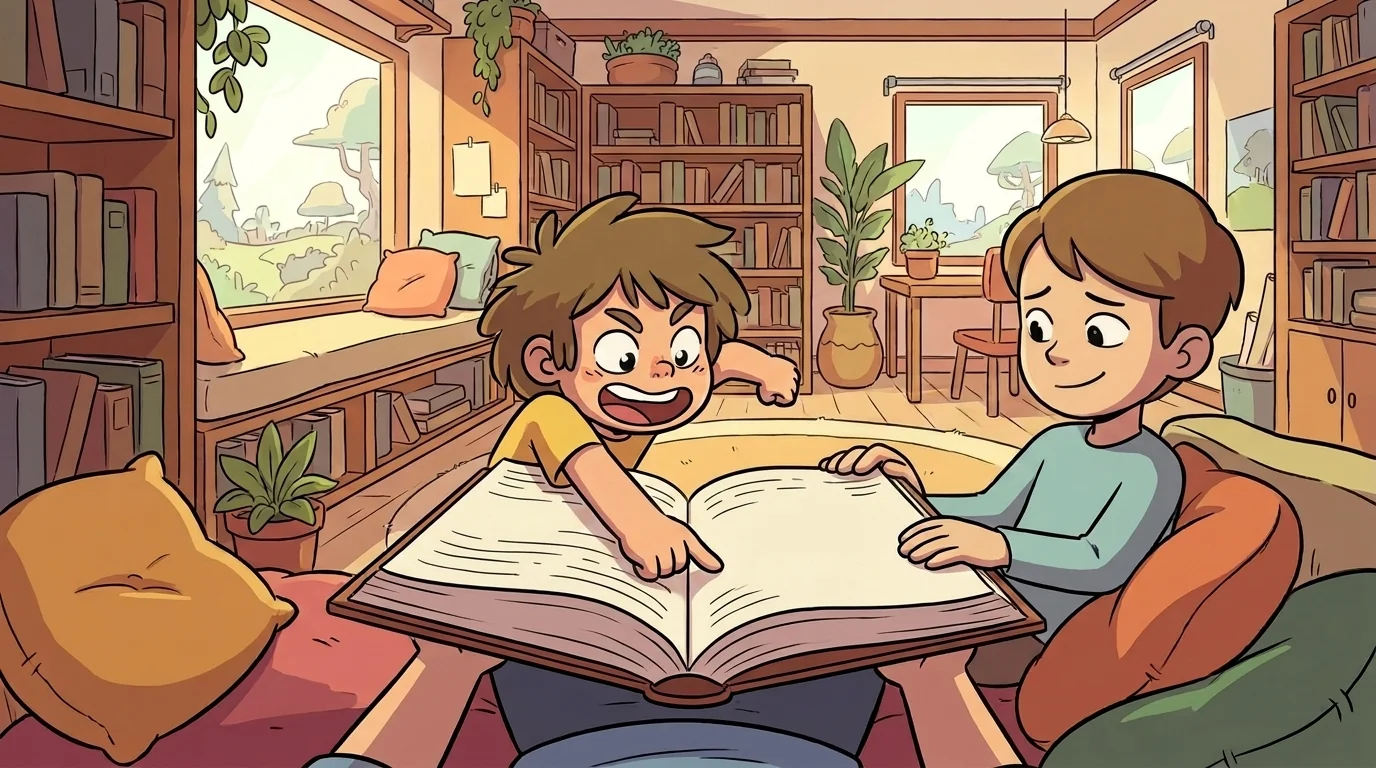
The rain tapped a steady, rhythmic beat against the high arched windows of the grand reading-room, filling the space with the scent of old paper and beeswax. Inside, Hunch and Anchor sat together on a long wooden bench, sharing the weight of a book so massive it required both of their laps to keep it steady.
Hunch was practically vibrating with energy, tapping a rapid tattoo against the leg of the bench while their eyes darted eagerly across the yellowed page. Anchor sat perfectly still, resting one blunt, ink-stained finger on the wide margin to keep the heavy parchment from fluttering in the draft.
"Oh!" Hunch cried suddenly, sitting up so fast the heavy volume nearly slid to the floor. "She is absolutely terrified, Anchor. She is shaking in her boots, and I can practically feel her heart hammering."
Anchor did not look up immediately, but instead let their finger slide down to the next paragraph with practiced ease. When they finally spoke, their voice was quiet and steady, like the low hum of a well-tuned cello.
"Where does it say that?" Anchor asked.
It was the same question Anchor always asked, not to challenge their friend, but simply to find a solid starting place.
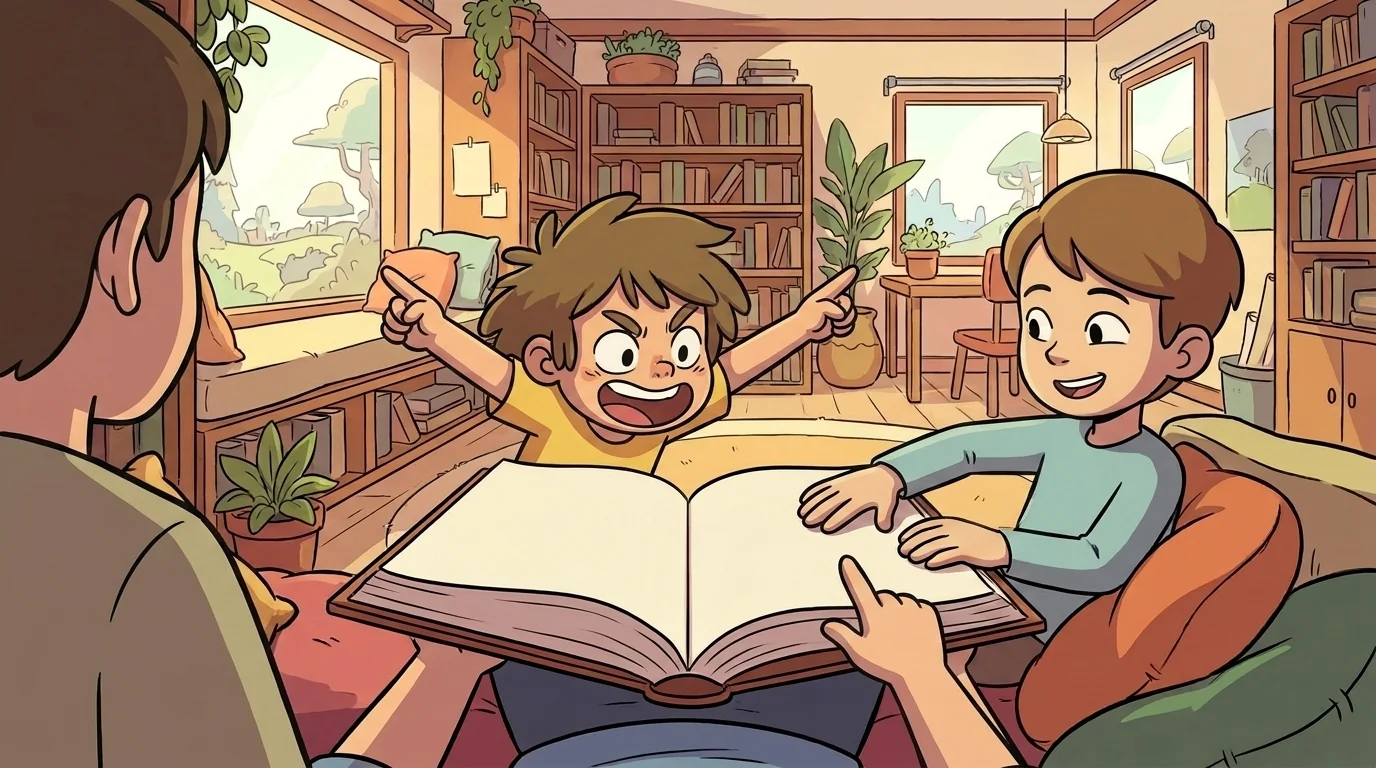
Hunch let out a dramatic sigh, throwing their hands toward the high timber ceiling. "It doesn't say it in plain letters," Hunch insisted. "That is the entire beauty of an *inference*, because you have to read between the lines to find the truth."
"Then show me the lines you are reading between," Anchor said, gently nudging the heavy book a fraction of an inch closer to their partner. "I do not ask to catch you out, but to make your idea strong, because a hunch without *evidence* is just a wish."
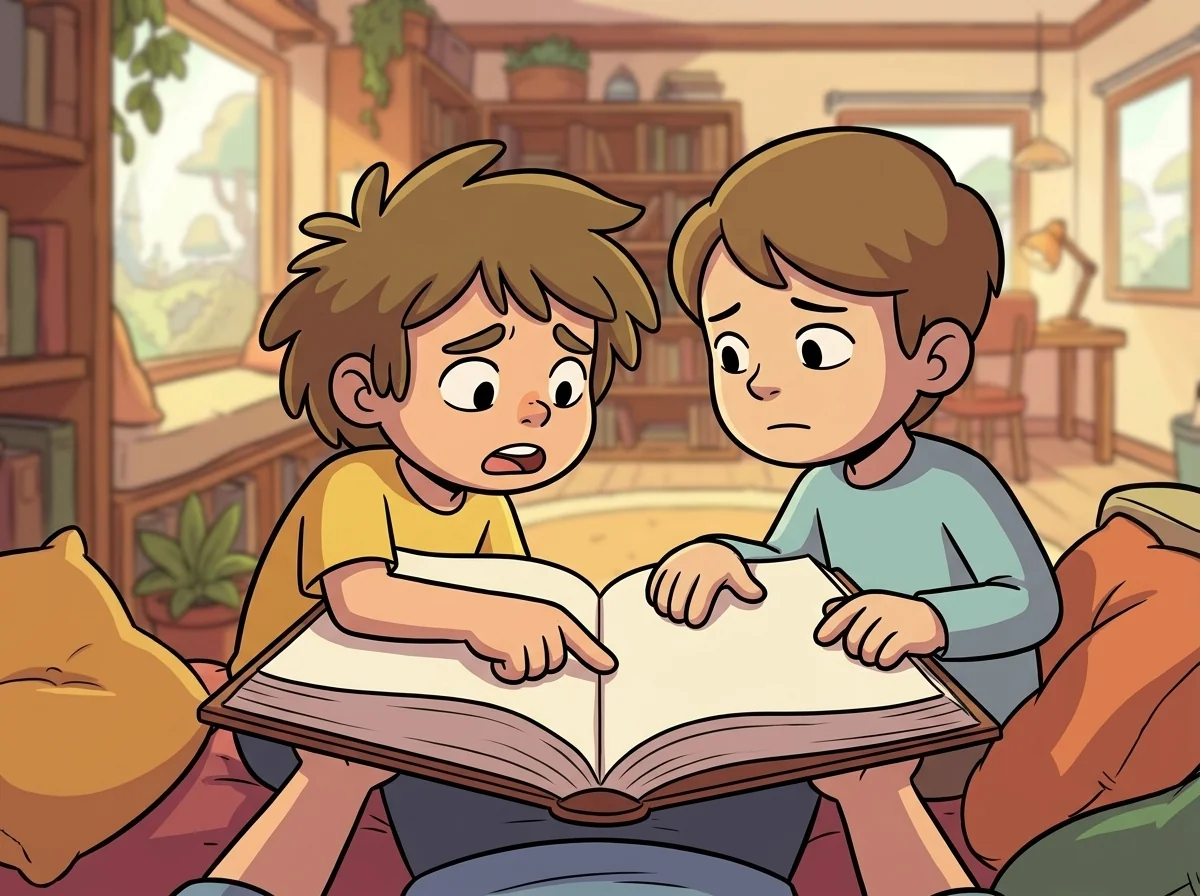
Hunch grumbled under their breath, but they leaned back over the page anyway, their messy hair falling forward to cast a shadow over the text. They ran a finger down the column of print, searching the black marks until they found the key.
"Look at the third line from the bottom," Hunch said, tapping the paper triumphantly. "Her knuckles turned white on the iron latch."
"The author never uses the word 'scared,' but people do not squeeze latches until their knuckles turn white unless they are frightened."
Anchor looked closely at the words and nodded, a warm smile spreading across their face. "Now that is a proper reading, because it is no longer a wild guess."
"That is a guess with a strong rope tied to it," Anchor said.
Anchor loved to explain the importance of the rope, especially when Hunch was quiet enough to listen. Later that morning, as they shared a plate of dry biscuits, Anchor brought up the subject again.
"When I was first learning this work," Anchor said, brushing a crumb from their sleeve, "I watched a reader study a passage about a boy named Toby."
"The book said Toby left his lunch untouched on the desk and stared out the window all through recess."
Hunch paused, a biscuit halfway to their mouth, waiting for the rest of the story.
"She stood up and announced that Toby was grounded," Anchor said, shaking their head slowly. "She claimed his parents had taken away his toys for the weekend."
Hunch winced, imagining the poor boy's empty weekend. "That is a very specific guess for such a short passage," Hunch remarked.
"It was a creative hunch," Anchor agreed, always fair. "But when I asked her for proof, she could not find a single word to support it."
"She had built an entirely new story on top of the real one, and the rope simply did not reach that far."
"So the rope snapped," Hunch said.
"Exactly," Anchor said. "The words on the page could only hold up the idea that Toby was sad or worried, but they could not carry the weight of angry parents."
"The evidence tells you exactly how far your hunch is allowed to go, and you cannot take even one step further."
Hunch chewed thoughtfully, staring at the crumbs on the table. "So a hunch can easily be too big for its rope," Hunch murmured.
"And it can also be too small," Anchor replied. "Some readers are too afraid to leap at all, so they only ever point at the words and repeat them."
"They see 'her knuckles turned white' and they stop there, never trying to understand what the white knuckles actually mean."
"That is why I need you," Anchor added, bumping Hunch's shoulder.
By afternoon, the rain had stopped, leaving the sky a pale, watery gray that made the reading-room feel cozy. A young apprentice named Jory sat on a stool nearby, struggling with a short paragraph on his slate. He had been chewing on his wooden pencil so hard that the yellow paint was chipping off in tiny flakes.
"I do not understand," Jory muttered, looking up at them with a frustrated frown. "How do you know how far to jump?"
"Hunch just leaps, and Anchor just checks, but how do I do both without falling?"
Hunch slid off the bench and knelt beside the boy’s desk, their eyes bright with encouragement. "Let me see what you are reading, Jory," Hunch said, tapping the slate.
Jory pointed a shaky finger at three short sentences on his slate.
"The dog stood by the gate, refusing to bark at the passing carts as he kept his nose pressed against the cold iron bars, waiting."
"Alright," Hunch said. "Leap first, and do not be afraid of making a mistake."
"What do you think is happening in this scene?" Hunch asked.
"The dog is lonely?" Jory suggested quietly. "He wants his owner to come home?"
"That is a wonderful start," Hunch said. "Now, let us look for the anchor."
Anchor leaned over the desk, their presence calm and reassuring as they pointed to the slate. "Let us look at the words, Jory, and find why you think he is lonely."
"He is standing by the gate," Jory said, thinking aloud. "And he is waiting, completely ignoring the carts that pass by."
"Perfect," Anchor said. "The words 'waiting' and 'did not bark' support your idea because they show the dog is focused on one thing."
"But what if you said the dog was angry?" Anchor asked.
Jory shook his head, pointing out that angry dogs usually bark or growl at things.
"Exactly," Anchor said. "Your angry hunch would not have a rope, but your lonely hunch is perfectly tied to the page."
"You kept the part of the leap the words could carry, and you let go of the rest."
Jory looked at his slate, a small smile of relief appearing on his face as he understood. "So I just have to ask the words if they can hold me up?" Jory asked.
"Every single time," Hunch said, tapping the boy's shoulder with a grin.
Later that day, they faced their most difficult challenge of the week. They found a passage near the back of the Great Book that contained no named emotions at all.
"Arthur placed two bowls on the wooden table. He stared at the empty stool by the stove for a long minute, then carried one bowl back."
"Well," Anchor said, tracing the letters. "The words are plain enough, with no difficult vocabulary to puzzle over."
"We have two bowls, an empty stool, and one bowl returned to the pot."
But Hunch had gone very still, the constant tapping of their heel stopping completely.
"No," Hunch said, their voice dropping to a whisper. "This is a heavy story, because someone is missing from that empty stool."
Anchor did not argue, but instead looked at the lines and then back at Hunch’s quiet face. "That is a massive leap, Hunch," Anchor said softly. "Can we anchor it?"
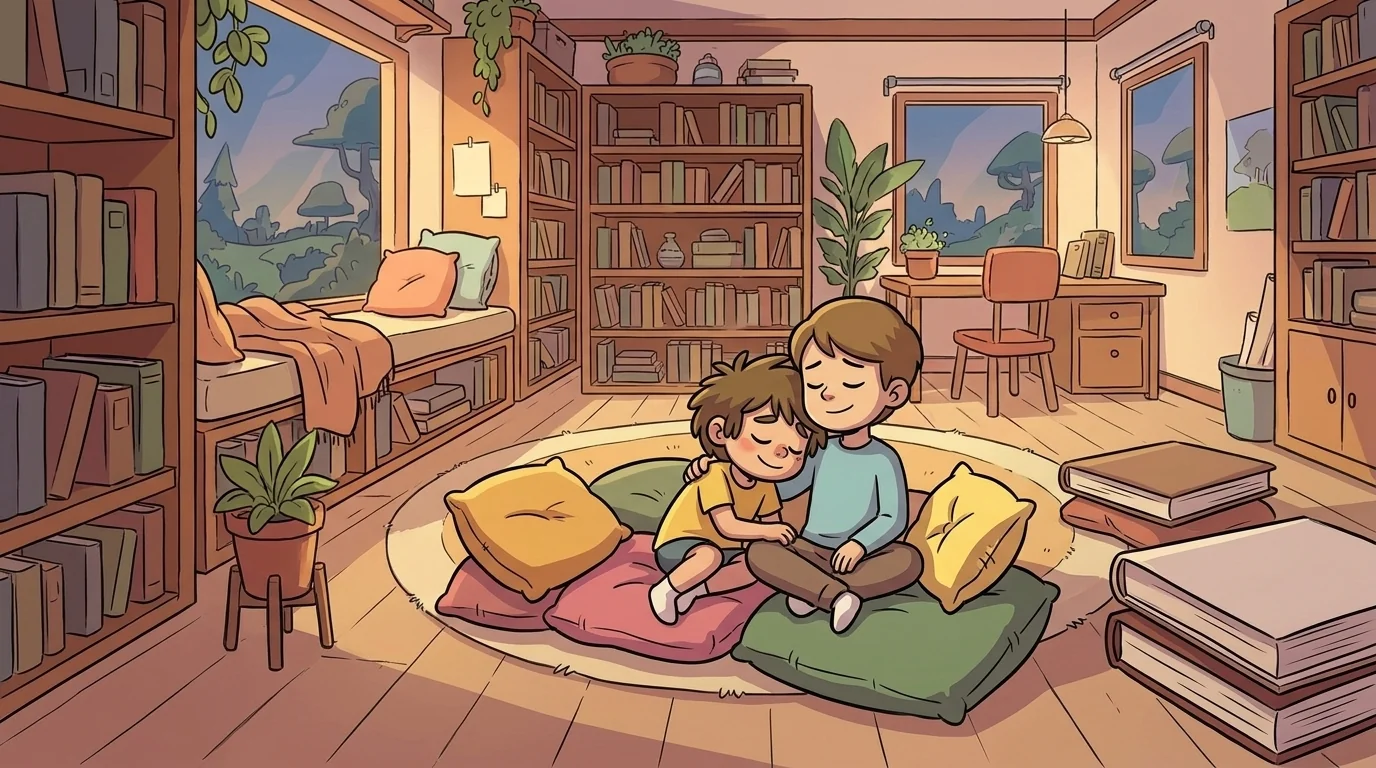
Together, they bent over the simple sentences, dissecting them piece by piece to find the truth.
"He set two bowls out of habit," Hunch explained, pointing to the first sentence. "Because for a long time, he always made dinner for two."
"And the empty stool?" Anchor asked, leaning closer.
"He stared at it," Hunch said. "Not just a quick glance, but a long minute of remembering the person who should have been there."
"And then he carried the bowl back because he could not bear to look at the extra food."
Anchor stared at the page, counting the connections with a look of deep respect. "Every single part of your leap has a word holding it down," Anchor whispered.
"You leaped all the way to loss, and the rope held the entire distance."
As the evening shadows lengthened, they finally closed the Great Book and prepared to leave. The apprentice had gone home, and the reading-room was quiet once more.
"Do you ever wish you could just leap?" Hunch asked, swinging their legs over the edge of the table. "Without me always holding the rope?" Hunch added with a playful grin.
Anchor thought about it for a long moment, watching the dust motes dance in the lamplight. "Do you ever wish you could just stay on the ground, without me nudging you to jump?" Anchor asked back.
Hunch laughed, the sound echoing softly off the high walls. "Never," Hunch said. "I would be stuck on the page forever, and that would be terribly boring."
"And I would be floating off into stories that do not exist," Anchor said, placing a heavy brass bookend on the shelf. "I would be lost, and a little bit afraid of being wrong without ever knowing it."
"We need both parts to find the truth, because the brave part and the honest part belong together."
They walked to the heavy oak door, their shadows stretching long and dark across the floorboards, perfectly joined.
The ReadQuest ensemble
Hunch and Anchor is part of ReadQuest's distributed-narrative cast. Each character embodies a different curricular primitive; together they teach the full subject.
-
Crest
Main idea / central message (the *peak* of the passage)
-
Hunch
Inference (reading between the lines)
-
Anchor
Evidence / textual citation
-
Plume
Author's purpose / voice / tone
-
Frame
Text structure (compare-contrast, sequence, cause-effect, problem-solution, description)
-
Pith
Vocabulary in context (deriving word meaning from surrounding text)
-
Yonder
Predicting — alert young-hare creature who reads the trail's clues to guess what's around the bend; a wrong guess just means the story surprised you
-
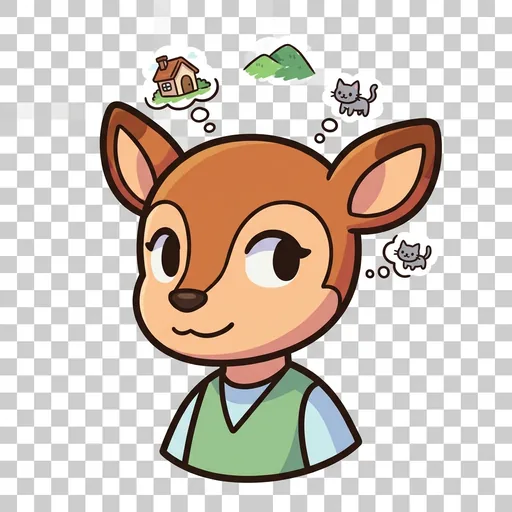
Vista
Visualizing — dreamy young-deer creature who turns words into a movie in the mind; the writer gives the words, the reader gives the pictures
-
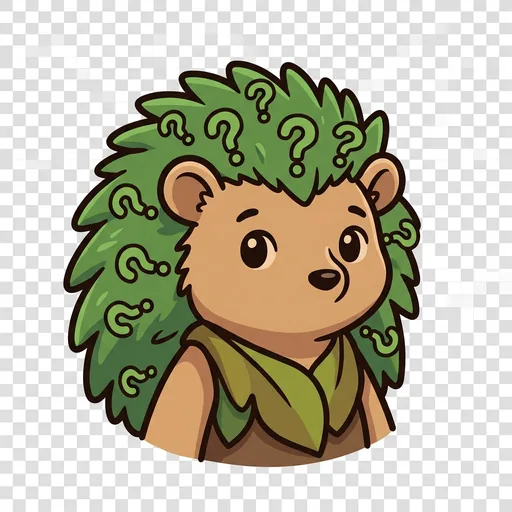
Nettle
Questioning the text — question-quilled hedgehog who pokes a passage with why/how/what-if; asking questions means you're awake, not that you don't understand
-
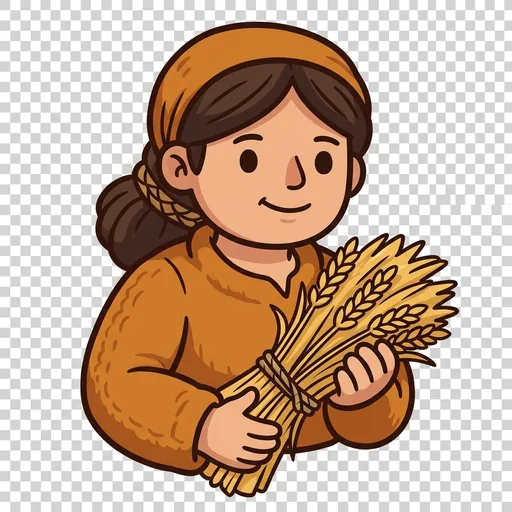
Sheaf
Summarizing — warm-handed harvester who gathers a whole passage into one tidy armful, keeping the important middle and letting loose details fall