Fork
FORK — two paths, both real, both lead somewhere.
Loading audio…
Press play to listen along. The line being read lights up as you go.
Show full transcript
Loading transcript…
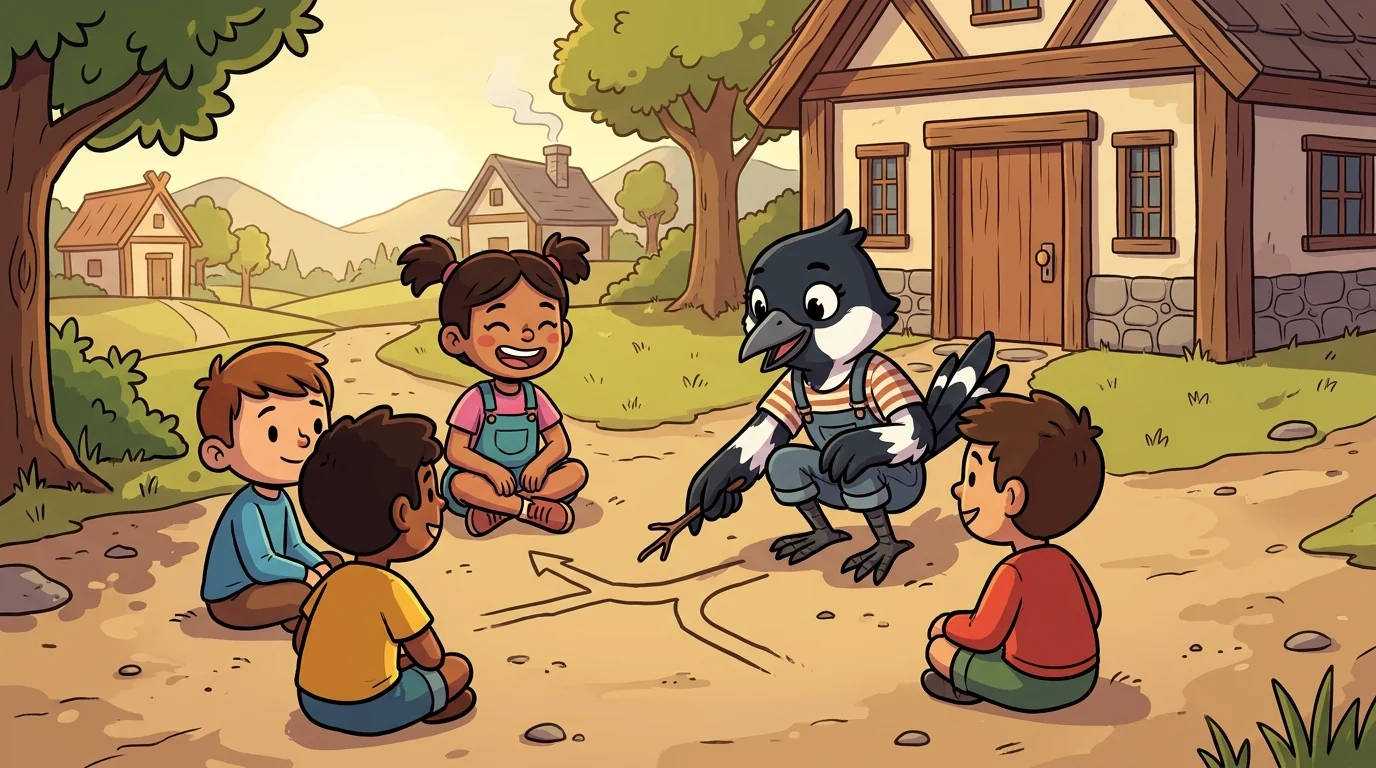
At the crossroads outside QuestForge, a magpie-tween named Fork crouched in the dust and drew a line with a twig — then, at the end of it, she drew two more lines branching apart.
Around her, four kids sat cross-legged, waiting to hear what happened next in the story she was telling. She'd stopped at the good part on purpose. A locked door. A guard asleep beside it. A window three stories up.
"So," Fork said, tapping the split in her drawing. "Sneak past the guard, or climb to the window. Which one?"
"The window," said the tallest kid.
"Okay." Fork brushed away the guard-line entirely and leaned into the window-line, following it with her twig. "You climb. Halfway up, your foot knocks a flowerpot. It falls. Now you're clinging to a ledge, and somewhere below, the guard is waking up — but you're already too high for him to reach. You made a different problem than the guard-path would've made. A better one, maybe. That's yours now."
The tall kid grinned like she'd won something.
"See," Fork said, "if I'd told you both paths just led to the guard wakes up either way — you'd have felt it. Kids always feel it. A fake choice is a hallway wearing a costume."
Fork had learned to hate fake choices young.
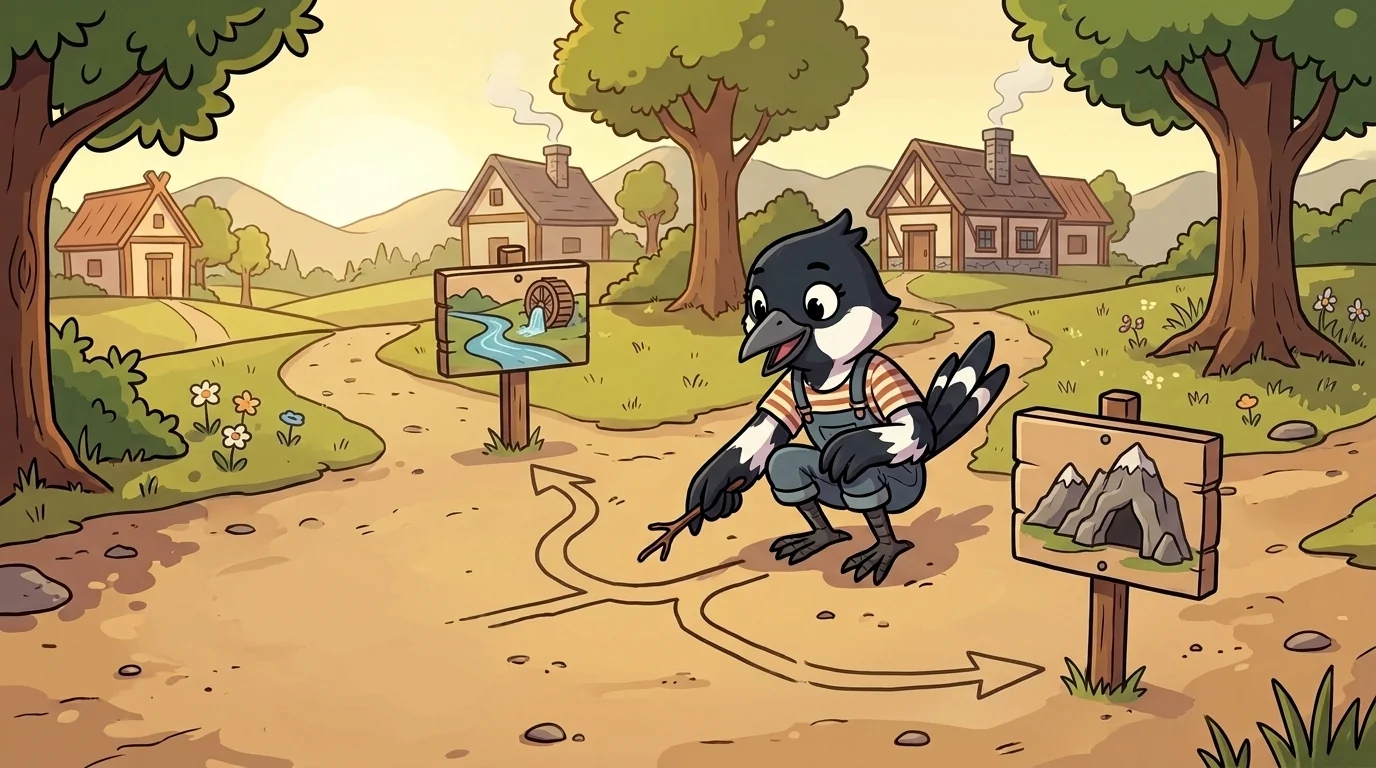
Her family were path-mappers — magpies who spent generations watching which roads out of the village actually went somewhere and which just looped back. When Fork was small, an older cousin used to run a "pick-a-path" game at the crossroads, letting the littler birds choose left or right. Fork chose left three days running. Left, left, left. And every single day, the game ended in the exact same clearing with the exact same berries.
The fourth day she sat down in the road and refused to choose at all.
Her grandmother found her there, scowling at the dust. She didn't tell Fork to cheer up. She just asked, quietly, "It stopped feeling like choosing, didn't it? Like your picking never touched anything."
Fork nodded, hot behind the eyes. It was worse than being told no. Being told yes, choose — and then having the choice mean nothing — made her feel small and tricked and a little bit invisible.
"That," her grandmother said, tracing two real branches in the dirt, one curving toward the river, one toward the ridge, "is why a crossroads only counts if the two roads go somewhere different. Otherwise it isn't a crossroads. It's just one road pretending." She looked at Fork. "When you make a fork for someone, you make them a promise. Both ways real. Both ways yours."
Fork carried that promise the rest of her life.
She walked to QuestForge at twelve, because a place that built whole worlds out of stories ought to care whether the choices in them were real.
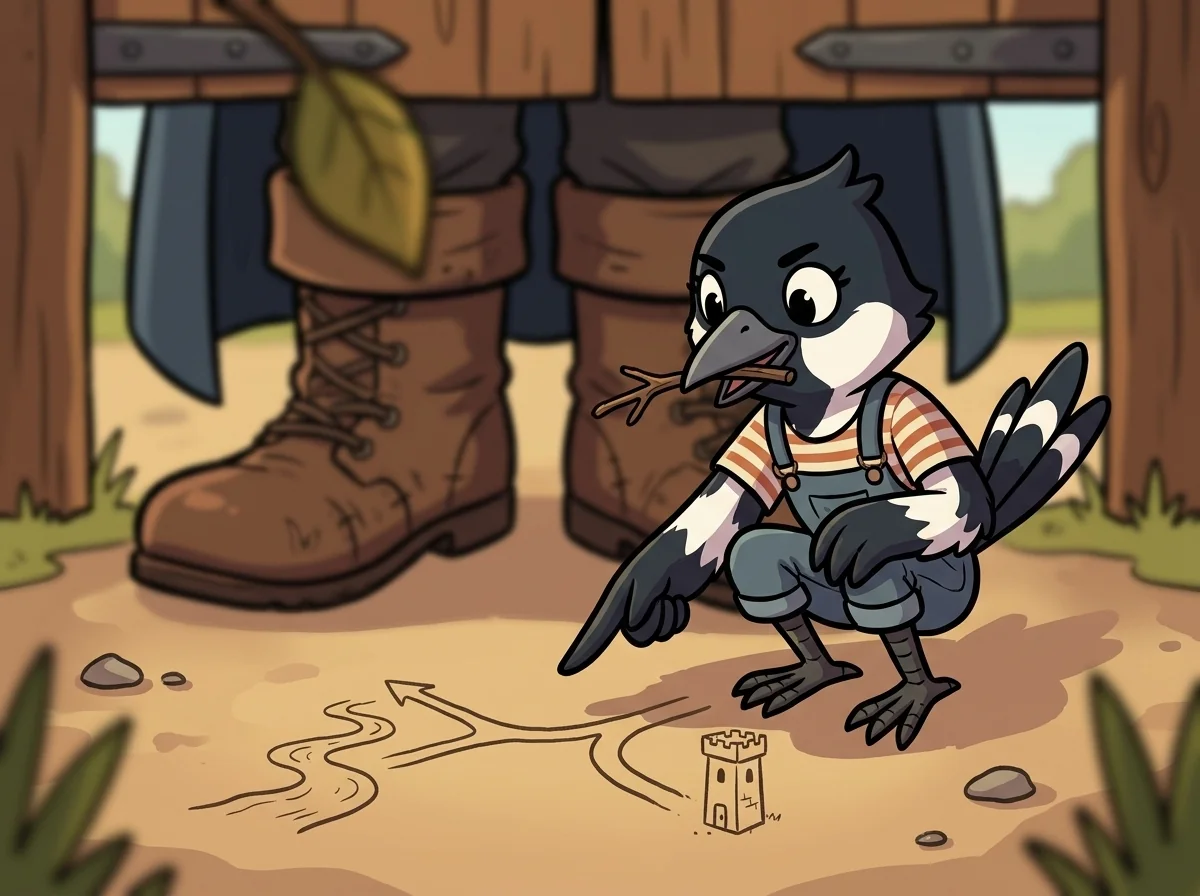
Lorekeeper, the old mentor who ran the story-workshops, met her at the gate. He didn't ask her to prove she was clever. He asked one question. "What is branching narrative?"
Fork didn't answer with a speech. She knelt and drew a split in the ground — one line forking into two — and then she drew a small different picture at the end of each: a river on the left, a locked tower on the right.
"Two paths," she said. "Both real. Both leading somewhere the other one doesn't." She pointed between them. "If I put the same thing at the end of both, I lied to whoever's walking. So I don't do that."
Lorekeeper looked at the two little pictures in the dirt for a long moment. "You belong here," he said.
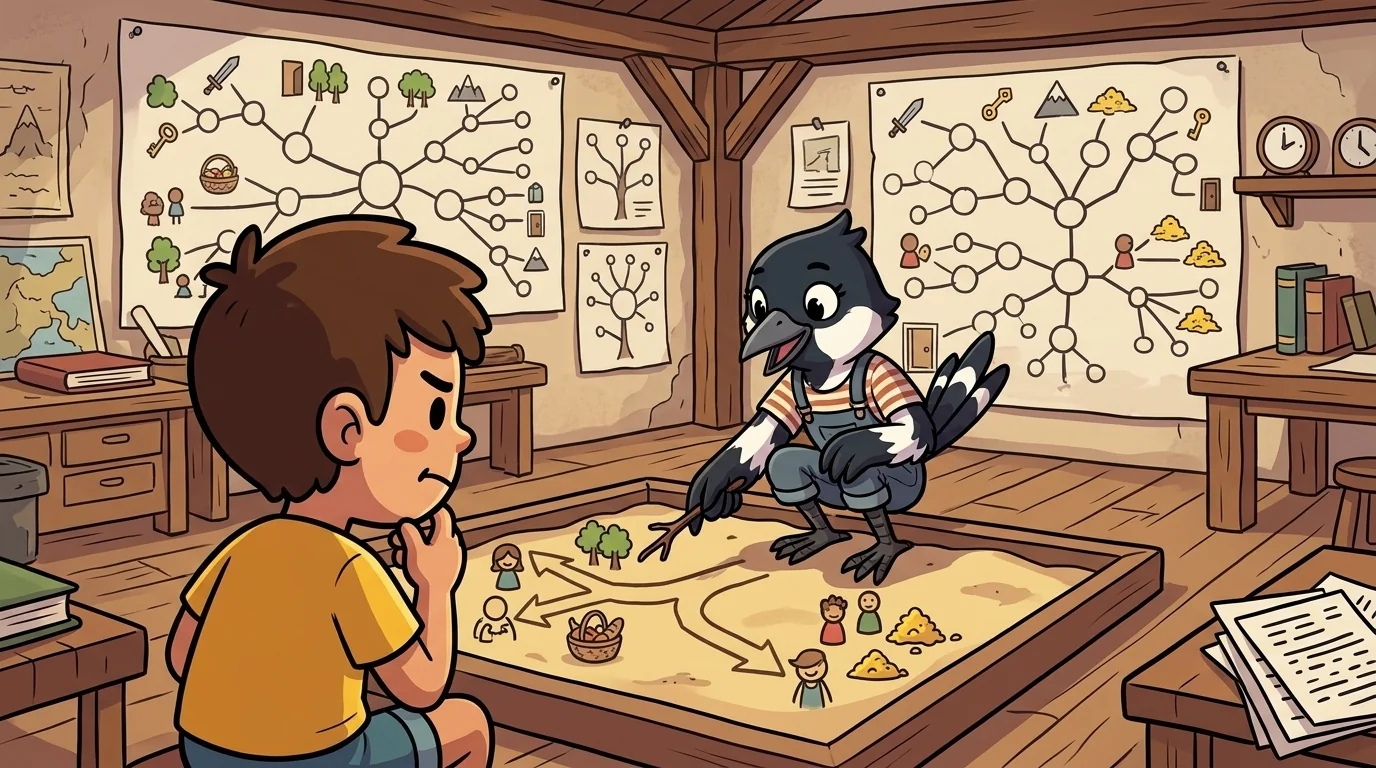
Fork's workshop was full of half-drawn story-trees, branches pinned to the walls like maps of decisions nobody had made yet.
A boy came in one afternoon, chewing his lip. He'd written an adventure for his friends and it had gone flat. "I gave them a choice," he said, frustrated. "Fight the dragon or talk to the dragon. And it still felt boring. What did I do wrong?"
"Show me where the two paths go," Fork said.
He shuffled his notes. "Fight the dragon — the dragon attacks. Talk to the dragon — the dragon attacks."
Fork raised an eyebrow. "So both roads walk into the same room."
"...Oh."
"Try it like this." She took two blank branches and started drawing. "Talk to the dragon: the villagers tell you it's hungry. So maybe your players go find food and skip the fight entirely — and now the whole session is about a hunt instead of a battle." She tapped the other branch. "Fight the dragon: the villagers tell you it stole their gold. Now even winning isn't the end — there's treasure to return, a village to face, a choice about keeping some. Different setup. Different scenes. Different next choices." She sat back. "Same dragon. Completely different stories. That's the fork."
The boy stared at his two little branches, then laughed. "Mine wasn't a fork. It was a hallway with a fake door."
"Now you can feel it too," Fork said, pleased. "And here's the honest part — if there's really only one good road, don't dress up a fake choice. Just tell the story straight. A road that admits it's a road beats a maze that's secretly a road."
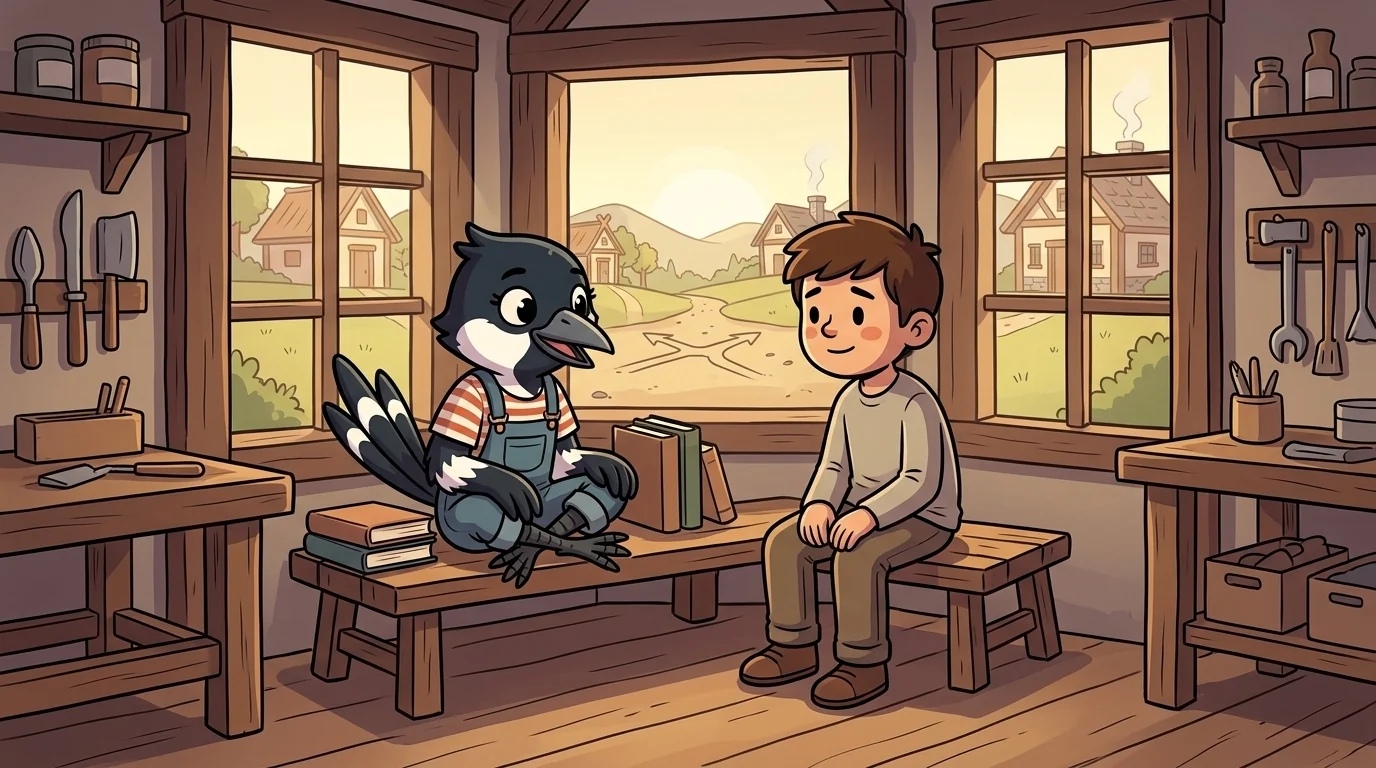
Later, when the workshop had emptied, the boy came back with one more question. Quieter now.
"When I give them a real choice," he said, "I don't know where it'll go. It kind of scares me. What if they pick the path I didn't plan?"
Fork thought about the crossroads. About sitting in the dust, refusing to choose, and how her grandmother had made her a promise in two lines of dirt.
"Then you get to be surprised too," she said. "That's not the scary part — that's the whole gift. When a choice is real, it stops being yours the second you offer it. It becomes theirs. And there's a feeling that comes with handing it over honestly — a nervous, wide-open, anything-could-happen feeling — that you only ever get when the choice actually matters." She looked out the window toward the crossroads. "A fake choice keeps you safe and keeps them small. A real one lets the story belong to everyone at the table. It's a little terrifying. It's also the best feeling there is."
The boy nodded slowly, and Fork watched something loosen in him — the same tricked, invisible feeling she'd once carried, finally letting go.
She didn't say the rest out loud, but she thought it, warm and certain: the choices worth offering are the ones you can't fully steer. That open, uncertain feeling isn't a mistake. It's what it feels like when a choice is real.
The QuestForge ensemble
Fork is part of QuestForge's distributed-narrative cast. Each character embodies a different curricular primitive; together they teach the full subject.
-
Sheet
Point-buy character creation + stat optimization — every build is a legitimate story
-
Roll
Dice probability + distribution — dice don't remember; every roll is its own universe
-
Hex
Encounter map grid + range/AOE geometry — math you can SEE
-
Hoard
Resource economics + budget — tools-not-trophies; counter-tropic friendly dragon