Hoard
HOARD — tools, not trophies. counter-tropic friendly dragon.
Loading audio…
Press play to listen along. The line being read lights up as you go.
Show full transcript
Loading transcript…
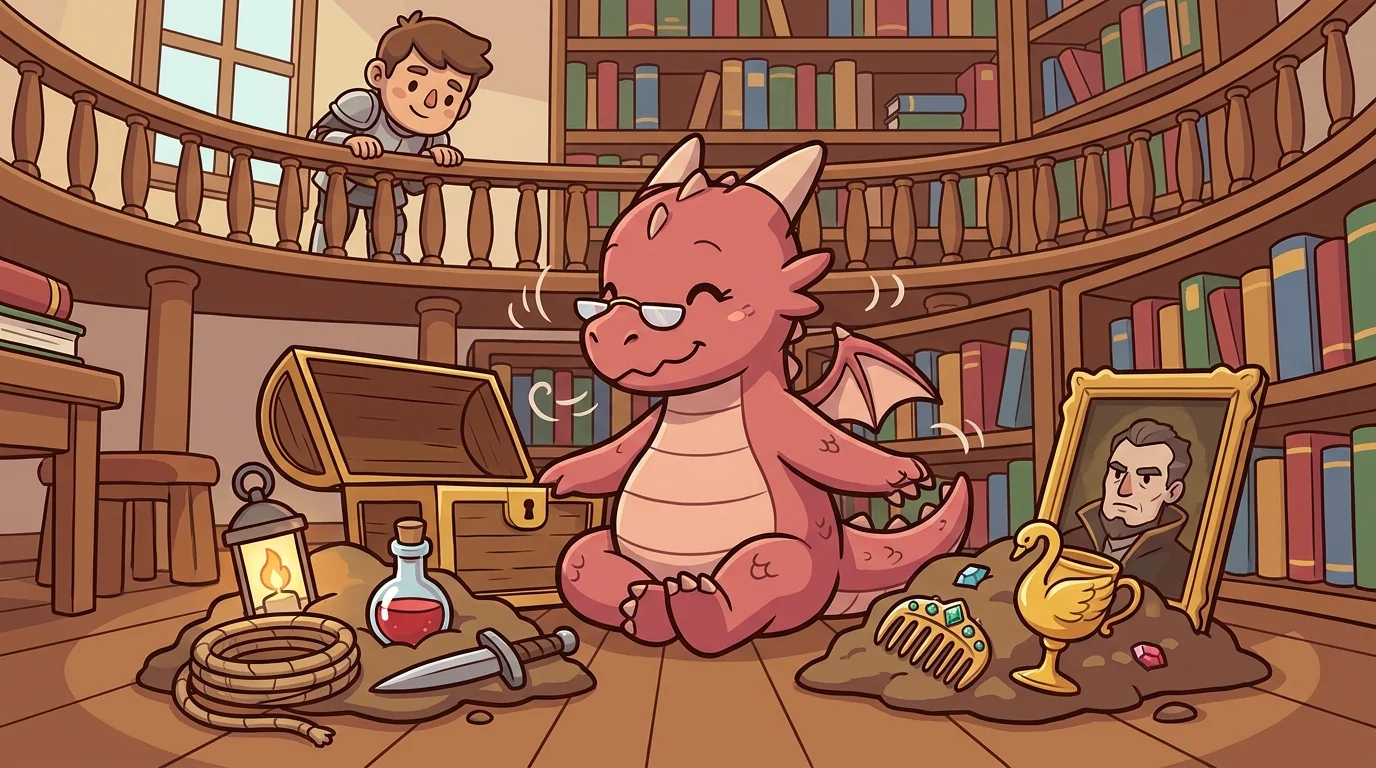
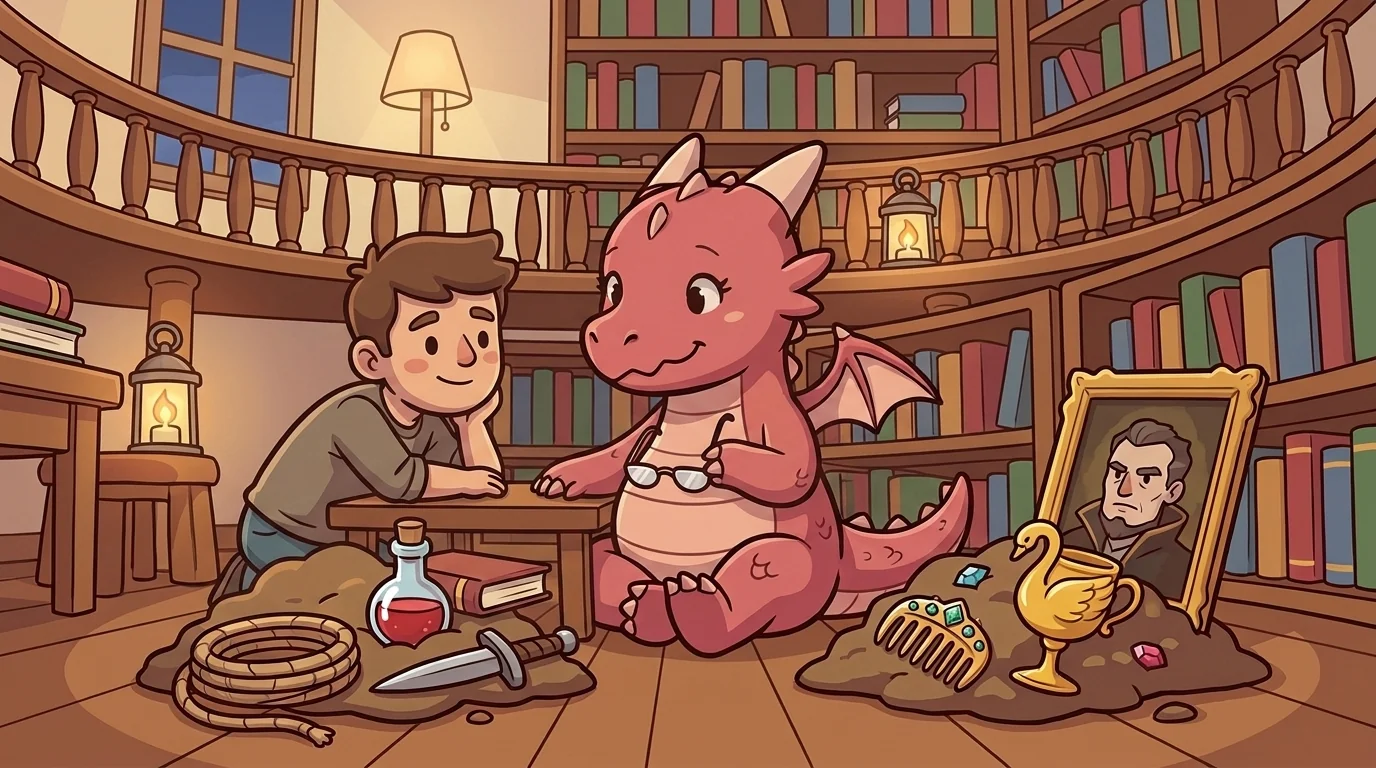
At the back of the QuestForge library, a small rose-scaled dragon sat cross-legged on the floor, surrounded by a spilled treasure chest, sorting it into two piles.
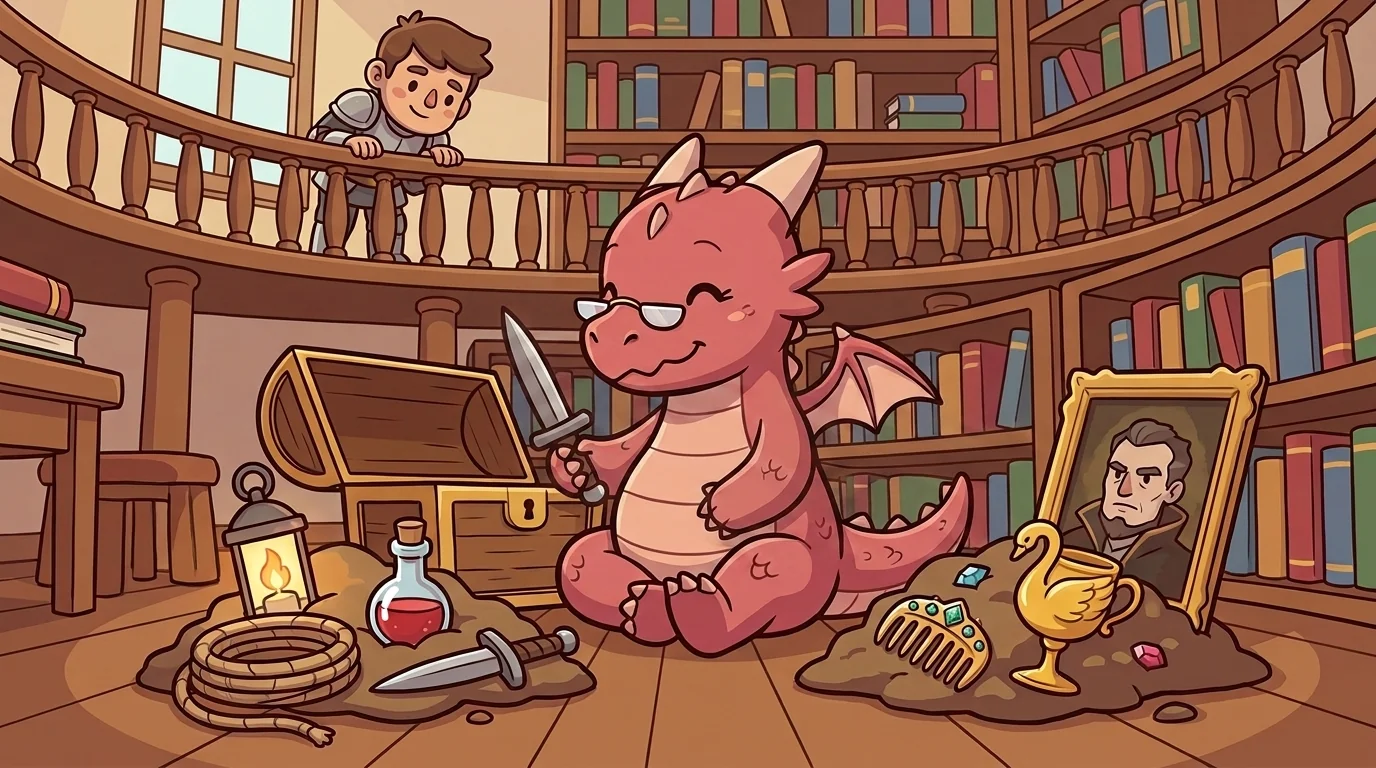
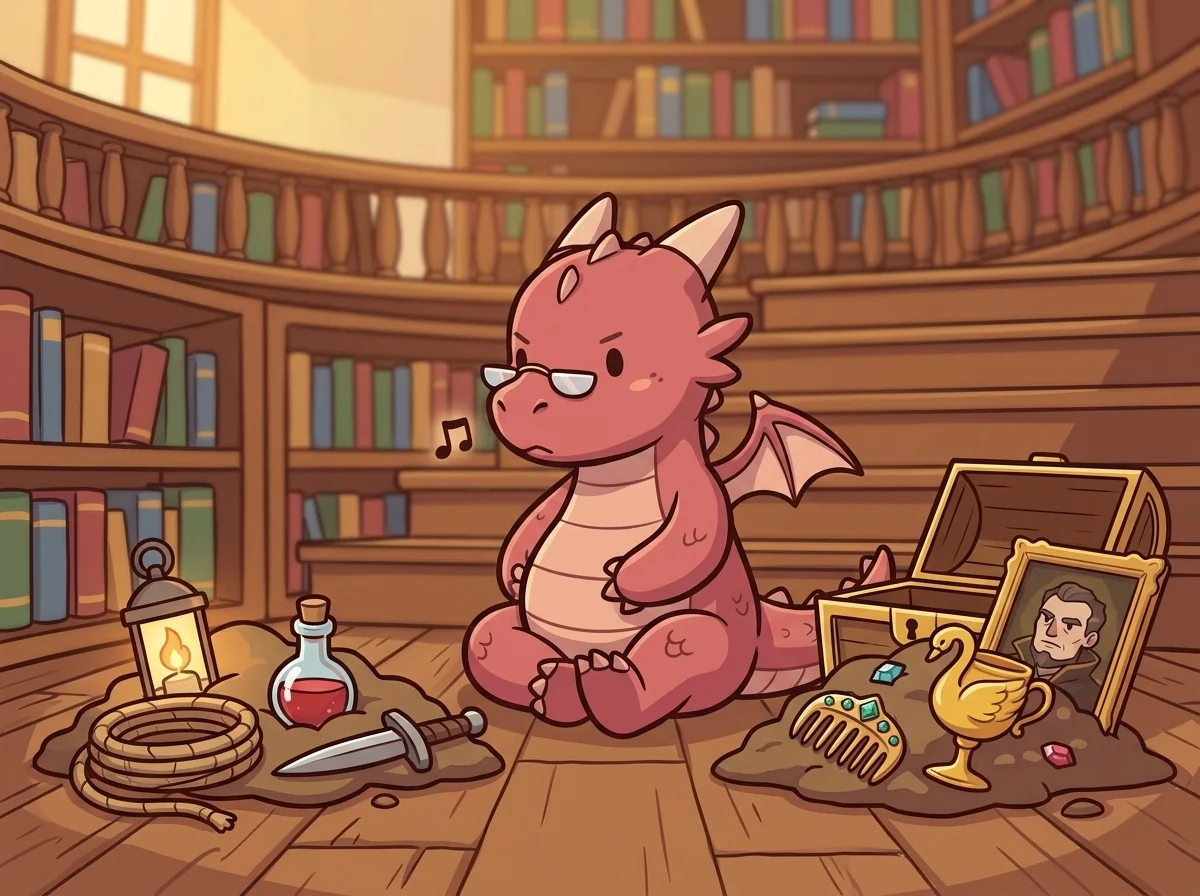
Hoard was not a fierce dragon. She was round-bellied and bookish, with soft little spectacles that kept sliding down her snout, and she was humming while she worked. Into the left pile went a coil of rope, a lantern, a healing potion, a plain iron dagger. Into the right pile went a gem-crusted comb, a goblet shaped like a swan, and a painting of a stern man nobody in the room recognized.
An adventurer leaned over the railing above her. "That's the dragon's hoard? You're just... sorting it?"
"I'm budgeting it," Hoard said, not looking up. She held up the rope. "This gets used. Bridges, cliffs, tying up bandits — it earns its place every week." She held up the swan goblet. "This has never touched a lip. It's beautiful. It's also dead weight in someone's backpack." She set the goblet gently in the right pile. "Tools go here. Trophies go there."
"Aren't dragons supposed to love trophies?"
Hoard smiled, and it was a genuinely kind smile, which was somehow the most surprising thing about her. "Dragons are supposed to do a lot of things," she said. "I read the rules. I decided not to."
Hoard had grown up in the library-village, where her family had been archive-keepers for longer than anyone could count.
Dragons live a very long time, and that had taught her family something slow and quiet: they had watched hundreds of adventuring parties pass through, load up on treasure, and stagger out the gates bent double under the weight of it. Half of what they carried, they never used. It just clanked around in their packs, souvenirs of quests they'd survived, until it got left behind at the next inn.
Little Hoard used to feel a strange ache watching that. She kept a shelf of her own once — a shelf of pretty things she'd been given, none of which did anything. She'd look at it and feel proud and also, underneath, faintly heavy, the way you feel when a room is too full.
Her grandmother, an enormous dragon with a voice like a warm avalanche, found her staring at the shelf one evening. "You don't play with any of it," her grandmother observed.
"I'm keeping it," Hoard said. "It's a hoard. Dragons keep hoards."
"Mm." Her grandmother nudged the swan goblet's ancestor — a jeweled thimble — with one careful claw. "A hoard is more useful when it's shared, little one. And a thing is more useful when it's used. Keeping isn't the same as treasuring. Sometimes keeping is just... holding on."
Hoard didn't clear the shelf that night. But the ache had a shape now, and the shape had words: tools earn their place; trophies just take up room.
She walked to QuestForge at fifteen, which is barely more than a hatchling for a dragon, because a place that built whole games out of treasure surely needed someone who understood what treasure was for.
Lorekeeper, the old mentor, met her at the gate and did not seem alarmed to be greeted by a dragon, which Hoard appreciated. He asked her one question. "What is resource economics?"
Hoard didn't lecture. She unslung her pack, tipped it out on the flagstones, and sorted the contents into two quick piles — rope and flint and a waterskin on one side, a tarnished medal and a chipped figurine on the other.
"This pile does jobs," she said, tapping the tools. "This pile does nothing but come along for the ride." She looked up at him over her spectacles. "A game gives players gold and gear as rewards. If you give too much, the gold means nothing and the packs overflow. If every item is a tool that solves a real problem, the players actually reach for their treasure. That's the whole trick. Reward them — but let the reward do work."
Lorekeeper crouched, picked up the chipped figurine from the trophy pile, and turned it over. "And this dragon at my gate," he said mildly, "who is friendly and bookish and sorting her own hoard onto my nice clean stones?"
"That's part of it too," Hoard said. "Nobody expects the dragon to be kind. Which is exactly why it's worth doing."
Lorekeeper set the figurine down. "You belong here," he said.
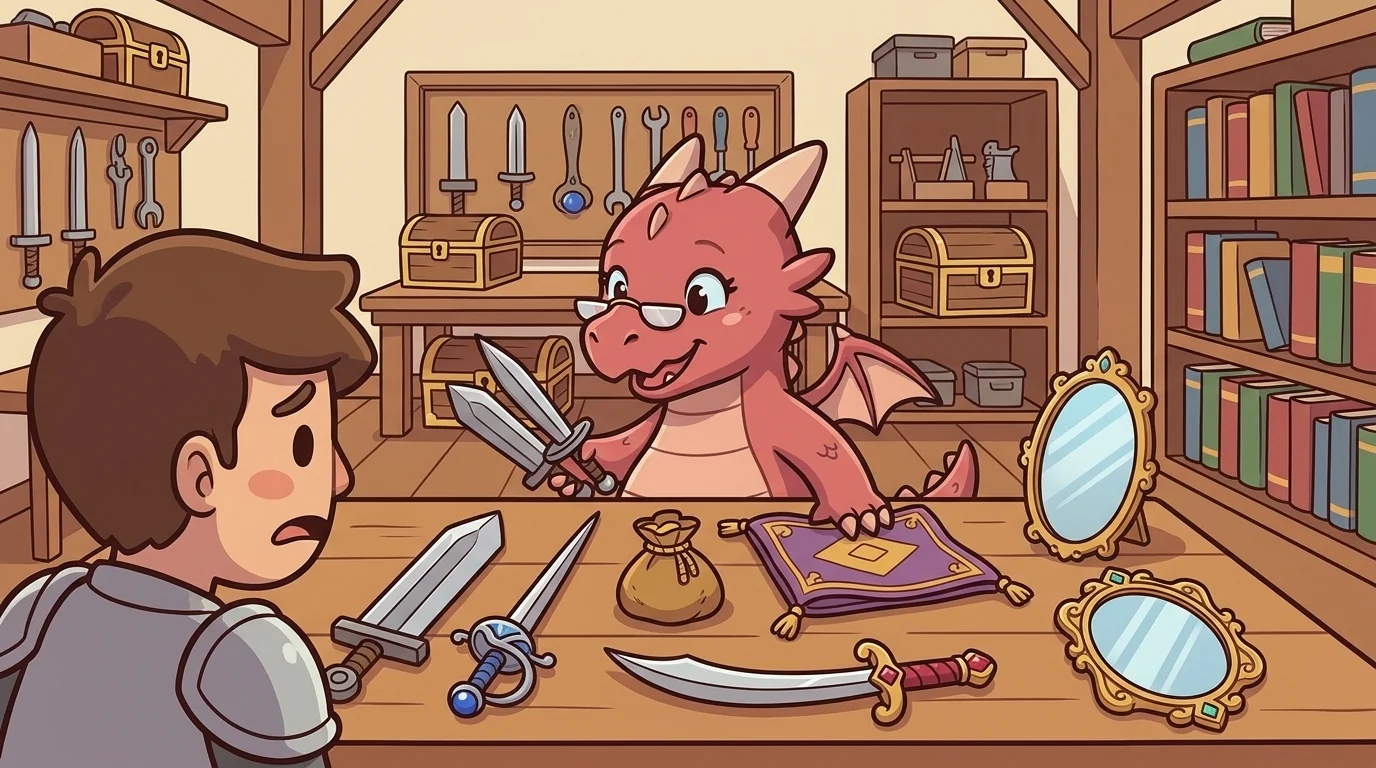
Hoard's workshop was the tidiest room in QuestForge, and one afternoon a young game-maker came in looking genuinely distressed.
"I gave my players so much good stuff," he said. "Three magic swords, a bag of gold, a flying carpet, a talking mirror. And now they're bored and the game's too easy and I don't understand what I did wrong."
Hoard nodded slowly. She'd expected this exact slump; she saw it often. "Lay it all out for me," she said, and he did, on her big oak table.
She picked up the first magic sword. "What problem does this solve?"
"Fighting monsters."
She picked up the second. "And this one?"
He hesitated. "...Also fighting monsters."
"And the third?"
"...Okay, yeah."
"Three tools for one job," Hoard said gently. "The moment they had one good sword, the other two became trophies. Cool trophies! But the players stopped feeling clever, because there was nothing left to choose." She slid the flying carpet forward. "Now — this. What does this let them do that nothing else does?"
His face changed. "Cross the canyon in chapter four. And spy on the tower. And escape the flood."
"That's a tool," she said, and she was almost delighted. "One item, three problems, real decisions. Keep that. And here's the kind part —" she gathered the two extra swords "— you don't have to throw the trophies away. Let them hang on a wall. Let them be a story the players tell. Just stop counting them as rewards, because a reward that solves no problem isn't a reward. It's clutter with a shine on it."
The game-maker laughed, surprised, and started sorting his own table into two piles without being asked.
That evening, when the workshop was quiet, the young game-maker came back with a smaller question.
"The dragon thing," he said. "You could've made yourself scary. Everyone would've expected it. Why didn't you?"
Hoard took off her spectacles and thought about the shelf of pretty useless things she'd kept as a hatchling, and how light the room had felt the day she'd finally let it be shared.
"Because scary would've been a trophy too," she said. "It's the expected thing. It looks impressive and it does no work." She tapped the table where the tool pile sat, quiet and ready. "Friendly does work. Friendly gets you a table full of someone's whole game and a question at the end of the day. I'd rather be useful than fearsome." She smiled at him, warm and a little tired. "Turns out you get to choose what you are. Same as the treasure. Same as the story. You just have to be brave enough to pick the one that's actually good for something — instead of the one that only glitters."
The game-maker nodded, and Hoard watched the worried tightness go out of his shoulders, the way a too-full room feels when you finally open a window.
The QuestForge ensemble
Hoard is part of QuestForge's distributed-narrative cast. Each character embodies a different curricular primitive; together they teach the full subject.
-
Sheet
Point-buy character creation + stat optimization — every build is a legitimate story
-
Roll
Dice probability + distribution — dice don't remember; every roll is its own universe
-

Fork
Branching narrative + decision design — two paths, both real, both lead somewhere
-
Hex
Encounter map grid + range/AOE geometry — math you can SEE